
Sonic Artificial Intelligence: How Sound-Based AI Works and Where It Wins
Sonic artificial intelligence turns sound into decisions. Here is how audio models actually process signals, the use cases delivering value now, and how to pick tools.
Sonic Artificial Intelligence: How Sound-Based AI Works and Where It Wins
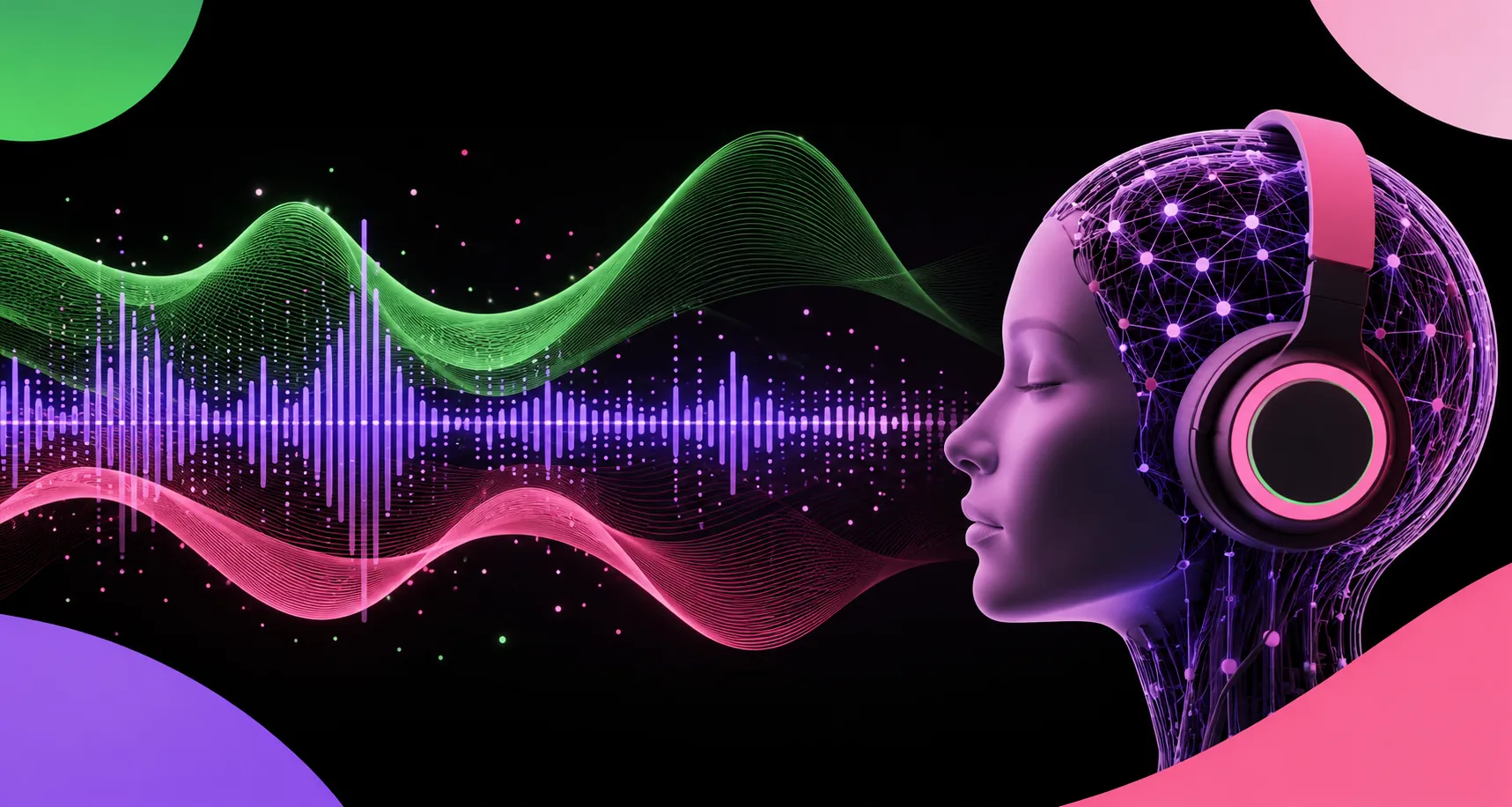
Sonic artificial intelligence is the branch of machine learning that takes sound as its primary input or output — speech, music, machine noise, environmental audio — and produces transcriptions, classifications, detections, or newly generated audio. It is distinct from text and vision AI in one technically important way: audio is a continuous one-dimensional waveform sampled tens of thousands of times per second, so almost every sonic AI system first converts sound into a time-frequency image called a spectrogram before a model ever touches it. That single design choice explains why audio models borrowed so much architecture from computer vision, and why sonic AI improved dramatically once transformer models learned to handle long sequences. The field now spans four practical clusters: speech recognition and understanding, sound event detection, generative audio, and acoustic condition monitoring. Each has different accuracy expectations, different latency budgets, and very different regulatory exposure — and treating them as one market is the most common planning mistake teams make.
Quick Answer: Sonic artificial intelligence is machine learning applied to sound. Models convert waveforms into spectrograms, then learn patterns to transcribe speech, detect events, monitor equipment, or generate audio. Core categories are speech recognition, sound event detection, acoustic monitoring, and generative audio — each with distinct latency, accuracy, and privacy requirements.
How WebPeak Approaches Audio AI Features Inside Real Products
Sonic AI rarely ships as a standalone model; it ships as a feature inside an application that must capture audio in a browser, stream it reliably, hold state, and present results a user trusts. That integration work is where most audio projects stall, and it is the specific gap WebPeak's artificial intelligence services tend to fill — model selection and evaluation paired with the streaming pipelines built through their MERN stack development practice, so transcription latency and reconnect behavior are engineered rather than hoped for. Their back-end development team handles the parts audio teams underestimate: chunked upload, queueing, retry semantics, and storage policies for recordings that may contain personal data. Working worldwide across AI, development and design, the agency can be reached at webpeak.org, and the reason to involve a full-stack team early is simple — a model with a five percent word error rate embedded in a fragile pipeline performs worse in production than a slightly weaker model wired correctly.
How Sonic AI Models Actually Turn Sound Into Decisions
Every audio pipeline follows the same four stages, and understanding them tells you where quality is won or lost. First, capture and sampling: microphones convert pressure waves into digital samples, typically at 16 kHz for speech and 44.1 kHz or higher for music. Sampling rate caps what the model can ever hear, so a 16 kHz recording permanently discards high-frequency detail — which is fine for transcription and disqualifying for music analysis. Second, feature extraction: a Short-Time Fourier Transform slices the signal into overlapping windows and computes frequency content per window, producing a spectrogram, often scaled to mel frequencies that approximate human hearing sensitivity. This is the step that converts an audio problem into an image-like problem.
Third, modeling: convolutional networks read spectrograms as images and remain excellent for short sound-event classification, while transformer-based encoder-decoder models dominate speech recognition because they capture long-range context — the reason modern systems get homophones right from surrounding words. OpenAI's Whisper, released as open weights in 2022, is the clearest public example of this architecture shift, and its availability is why multilingual transcription became a commodity capability rather than a specialist one. Fourth, post-processing: diarization separates speakers, language models correct domain vocabulary, and confidence scores route uncertain segments to human review. Generative audio inverts the pipeline, predicting audio tokens or spectrograms and reconstructing a waveform with a neural vocoder. The critical practical point across all four stages is that audio quality upstream constrains everything downstream: a cheap omnidirectional microphone in a reverberant room will defeat a state-of-the-art model, and no amount of fine-tuning recovers information the recording never captured.
Where Sonic AI Delivers Measurable Value Today
These are the deployments that consistently justify their cost, ordered roughly by how reliably they succeed.
- Speech-to-text for documentation. Meetings, clinical notes, legal intake, support calls. Value comes from time recovered, and accuracy requirements are moderate because a human reviews the draft.
- Voice interfaces and hands-free control. Warehouses, kitchens, field service, vehicles. Latency matters more than perfect accuracy; a constrained vocabulary raises reliability sharply.
- Acoustic condition monitoring. Bearings, pumps, motors and HVAC systems change their sound signature before they fail. Models trained on normal operating sound flag anomalies, making this one of the strongest industrial cases.
- Sound event detection for safety and security. Glass breaking, aggression detection, gunshot recognition, alarm verification. High false-positive costs mean threshold tuning matters more than raw accuracy.
- Call analytics and quality assurance. Transcribe, then apply language models for sentiment, compliance-phrase checking, and objection tracking across full call volume rather than sampled audits.
- Generative voice and localisation. Synthetic narration, dubbing, and accessibility audio. Consent and disclosure are the binding constraints, not model quality.
- Music and sonic branding analysis. Tagging, similarity search, stem separation, and testing audio identities — the three-note Netflix cue or Intel's chime are sonic branding assets that models can now analyse for recall and distinctiveness.
Comparing the Main Categories of Sonic Artificial Intelligence
| Category | Input | Typical Output | Latency Need | Main Risk |
|---|---|---|---|---|
| Speech recognition | Speech, 16 kHz | Text with timestamps | Real-time to batch | Domain vocabulary errors |
| Sound event detection | Environmental audio | Event label plus confidence | Near real-time | False positives at scale |
| Acoustic monitoring | Machine vibration and noise | Anomaly score | Minutes acceptable | Sparse failure examples |
| Generative speech | Text plus voice reference | Synthetic waveform | Sub-second for interactive | Consent and impersonation |
| Music analysis | Full-band audio, 44.1 kHz | Tags, stems, embeddings | Batch | Licensing of training data |
What Practitioners Consistently Find About Audio AI Performance
Publicly verifiable benchmarks in audio are narrower than in text, so the honest framing here is expert observation rather than invented percentages. In practice, four patterns repeat across deployments. First, microphone and room acoustics account for more variance in transcription quality than model choice does — teams that spend on directional microphones and basic acoustic treatment routinely outperform teams that spend the same budget on a premium model with poor capture. Second, domain vocabulary is the dominant error source: drug names, part numbers, surnames and internal product codes fail far more often than ordinary speech, and a custom vocabulary or biasing list usually fixes more errors than a model upgrade. Third, anomaly-based acoustic monitoring succeeds where classification fails, because most factories have thousands of hours of normal sound and almost no labelled examples of the specific failure they fear; training on normality and flagging deviation sidesteps that data shortage entirely. Fourth, overlapping speech remains the hardest common condition — accuracy degrades sharply when two people talk simultaneously, which is why diarization quality, not word error rate, determines whether meeting transcripts are actually usable.
Two verifiable structural facts anchor the field. Whisper's open release in 2022 made multilingual speech recognition broadly accessible without per-minute API dependency, shifting many projects from vendor selection to self-hosting decisions. And Google's AudioSet, a large public ontology and dataset of labelled sound events, remains the reference resource that made general-purpose sound classification research possible at all. Beyond models, the production reality is that audio work is media work: pipelines share concerns with professional video and audio production — capture quality, noise floor, format handling, and storage cost — and treating sonic AI purely as a data-science exercise while ignoring those fundamentals is the most reliable way to ship a disappointing feature.
Key Takeaways
- Sonic artificial intelligence converts waveforms into spectrograms before modeling, which is why audio systems borrowed architectures from computer vision.
- Sampling rate sets a hard ceiling on capability: 16 kHz suits speech, while music and acoustic analysis need full-band audio.
- Capture quality and domain vocabulary cause more real-world errors than model selection, so fix microphones and word lists first.
- Acoustic condition monitoring works best as anomaly detection trained on normal sound, because labelled failure audio is almost always scarce.
- Whisper's 2022 open release and Google's AudioSet dataset are the two public foundations that made general-purpose audio AI widely accessible.
Frequently Asked Questions
What exactly is sonic artificial intelligence?
Sonic artificial intelligence is machine learning that takes sound as input or produces sound as output. It covers speech recognition, sound event detection, acoustic anomaly monitoring, and generative audio. Models typically convert the waveform into a spectrogram, then learn frequency and timing patterns that map to labels, text, or new audio.
Is sonic AI the same as voice recognition?
No. Voice recognition is one application within sonic AI, and it splits further into speech-to-text and speaker identification. Sonic AI also includes non-speech work such as detecting failing machinery, identifying breaking glass, separating musical stems, and synthesising narration, all using different models and evaluation criteria.
How much audio data do I need to train a sound model?
Far less than most teams assume, if you fine-tune. Adapting an existing speech model to your vocabulary often needs only a few hours of labelled domain audio. Acoustic anomaly detection can work with tens of hours of purely normal operating sound and zero labelled failures.
Can sonic AI run without sending audio to the cloud?
Yes. Compact speech and sound-event models run on edge devices and modern phones, and open-weight models can be self-hosted entirely inside your own network. On-device processing is often the right choice for privacy-sensitive audio, since it avoids transmitting recordings that may contain identifiable voices.
What causes most transcription errors in production?
Three things dominate: poor capture from cheap or badly placed microphones, reverberant rooms that smear speech, and specialist vocabulary the model never learned. Overlapping speakers cause the remainder. Improving microphones and supplying a domain word list usually fixes more errors than switching to a larger model.
Conclusion
The decision that determines whether a sonic AI project succeeds is made before any model is chosen: decide which of the four categories you are actually in, then budget for the constraint that category imposes. Speech documentation lives or dies on capture quality and vocabulary. Acoustic monitoring lives or dies on framing the task as anomaly detection rather than classification. Generative voice lives or dies on consent and disclosure. Your immediate next step is to record thirty minutes of genuinely representative audio from your real environment — not a quiet office — and run it through two candidate models before committing anything. That one test reveals more about your eventual accuracy than any vendor benchmark, because it measures the only signal that matters: the sound you will actually be working with.
Related articles
 Artificial Intelligence
Is Artificial Intelligence Evil? Separating Real Risks From Science Fiction Fear
Is artificial intelligence evil? A clear-eyed look at what AI can and cannot intend, the documented harms that are real, and the governance frameworks that address them.
 Artificial Intelligence
Artificial Intelligence Engineer Jobs: Skills, Salaries, and How to Get Hired
A practical breakdown of artificial intelligence engineer jobs: what the role really involves, the skills employers screen for, and the portfolio that gets interviews.
 Artificial Intelligence
Supply Chain Artificial Intelligence Jobs: Roles, Skills, and How to Get Hired
Supply chain artificial intelligence jobs blend logistics knowledge with data skills. Here are the real roles, the skills employers screen for, and a hiring roadmap.