
Coactive Artificial Intelligence: Designing Systems Where People and Models Work as One Team
Coactive artificial intelligence keeps humans inside the decision loop instead of replacing them. Learn the design patterns, interfaces, and metrics that make it work.
Coactive Artificial Intelligence: Designing Systems Where People and Models Work as One Team
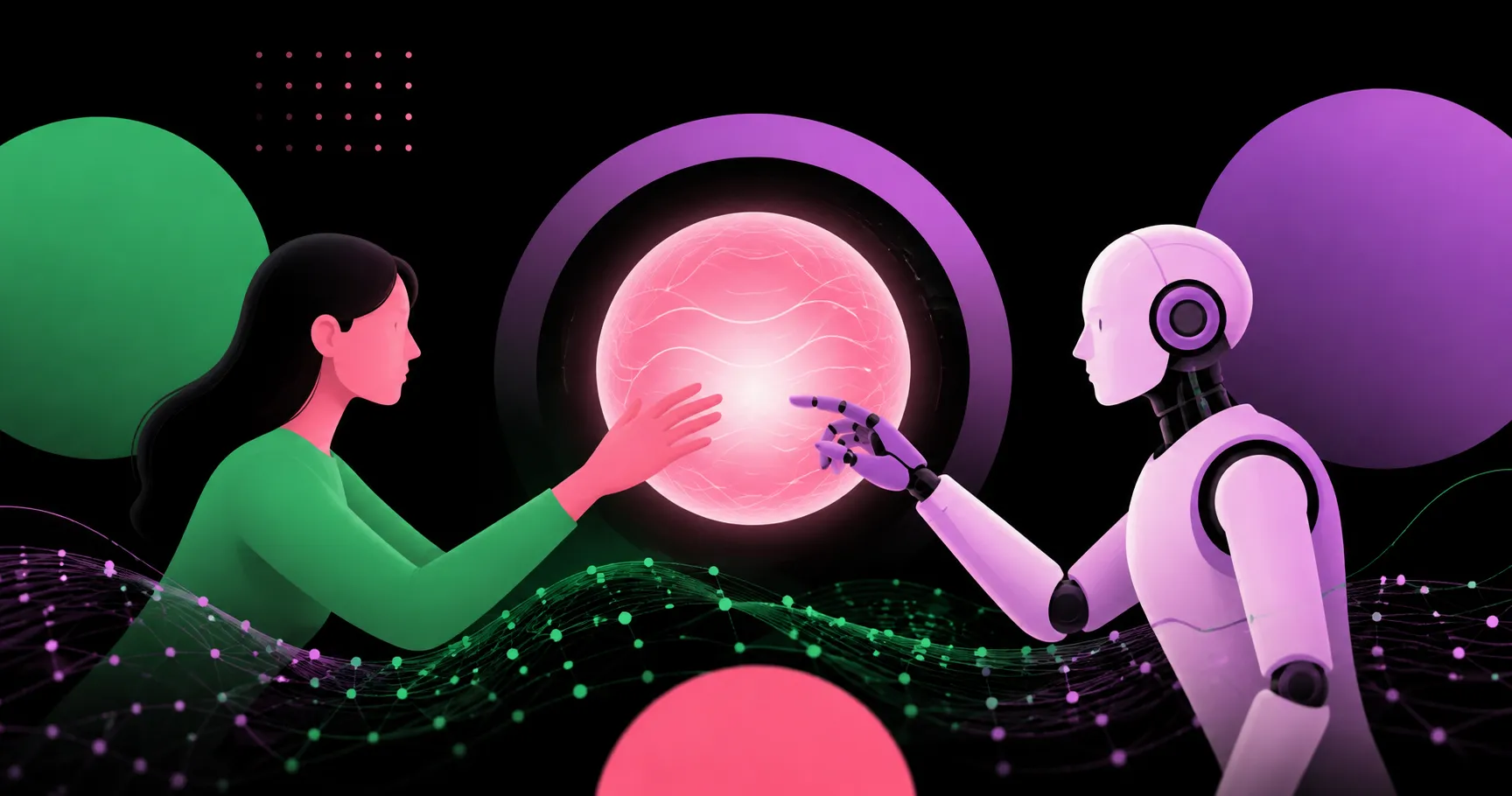
Coactive artificial intelligence describes systems designed for continuous joint work between a person and a model, where both parties contribute, correct each other, and share responsibility for the outcome. The term comes from coactive design research in human-robot interaction, which studied how autonomous systems and human operators maintain shared awareness during a task. Applied to modern AI, it names a specific architectural choice: instead of building a model that produces a finished answer and hoping the user accepts it, you build a loop where the model proposes, the human steers, and the system captures that steering as signal. The distinction is not philosophical. Coactive systems and fully automated systems have different interfaces, different evaluation metrics, and different failure modes, and choosing the wrong one for your task is expensive.
Quick Answer: Coactive artificial intelligence is an approach where humans and AI work together continuously within a single task, each observing and adjusting the other's contributions. It suits high-stakes, ambiguous, or context-heavy work where full automation is unsafe, and it depends on interfaces that make model reasoning visible and correction cheap.
How WebPeak Builds the Interfaces Coactive AI Depends On
Coactive systems succeed or fail at the interface, because the loop between human judgement and model output is only as fast as the UI that carries it. Teams frequently underestimate this: they invest heavily in model quality and then ship a plain text box that gives the user no way to inspect, constrain, or partially accept a suggestion. This is where WebPeak tends to add practical value for clients building AI-assisted products, combining AI engineering with interface design and front-end development so that streaming output, inline editing, confidence signalling, and correction capture are treated as core product features rather than afterthoughts. Working with organisations worldwide, their teams design these review surfaces around the specific decision the user is making, which is what separates a usable coactive tool from a demo.
What Makes a System Coactive Rather Than Just Automated?
Three properties distinguish coactive design, and a system needs all three to qualify.
Observability. The human can see what the model is doing and why, at a level of detail that supports judgement. This does not require full mechanistic interpretability; it requires showing sources, confidence, the specific inputs that drove an output, and what the model considered and rejected. Without observability the human cannot meaningfully supervise, and supervision collapses into rubber-stamping.
Directability. The human can change the model's behaviour mid-task without restarting. Practically this means the ability to lock parts of an output, adjust constraints, reject a single element rather than the whole result, and redirect at any point. A system where the only control is regenerating from scratch is not directable, it is a slot machine.
Mutual predictability. Each party can anticipate the other's behaviour. The user learns how the model responds to certain instructions; the system learns the user's preferences and applies them consistently. This is why coactive systems benefit enormously from persistent user-level memory of accepted and rejected suggestions.
A useful test: if removing the human from the loop would produce roughly the same output, the system is automated with a review step, not coactive. In a genuinely coactive system, the human's contributions materially change the trajectory of the work.
Design Patterns That Make Coactive AI Work in Production
These patterns come from what consistently holds up when AI-assisted tools reach real users rather than pilot groups.
- Propose, do not commit. The model's output should enter the workspace as a suggestion the user accepts, edits, or dismisses, never as a completed action. Reserve autonomous commitment for reversible, low-consequence operations.
- Make rejection cheap and informative. One click to dismiss, with an optional reason. Rejection data is the highest-quality training signal most products collect and the one most often discarded.
- Show the working, not just the answer. Cite the source document, highlight the input rows used, or list the assumptions applied. Users calibrate trust from evidence, not from confidence percentages.
- Support partial acceptance. Let users take three paragraphs of a five-paragraph draft. All-or-nothing acceptance forces users into full rewrites and destroys the time saving.
- Preserve user edits as preferences. If a user consistently rewrites a certain phrasing or formatting, the system should adapt. Repeating a correction the user has already made is the fastest way to lose them.
- Degrade honestly. When confidence is low, say so and narrow the scope of the suggestion rather than producing a confident-sounding guess.
- Keep latency inside the thinking window. If a suggestion arrives after the user has moved on mentally, it interrupts rather than assists. Streaming partial output preserves the loop.
Coactive AI Versus Full Automation: Choosing Per Task
The choice is not organisational, it is per workflow. The table maps common task characteristics to the model of collaboration that fits.
| Task Characteristic | Better Fit | Reason | Primary Risk If Reversed |
|---|---|---|---|
| High volume, low consequence, stable rules | Full automation | Human review adds cost without reducing error | Review bottleneck and wasted analyst hours |
| Ambiguous inputs requiring context | Coactive | Human supplies context the model lacks | Confident, plausible, wrong output at scale |
| Regulated or legally binding decisions | Coactive with recorded sign-off | Accountability must rest with a person | Unattributable decisions and compliance exposure |
| Creative or brand-sensitive output | Coactive | Taste and positioning are not learnable from prompt alone | Generic output that erodes brand distinctiveness |
| Irreversible or destructive actions | Coactive with explicit confirmation | Cost of a single error exceeds cumulative review cost | Unrecoverable damage from one bad inference |
Expert Analysis: Why Coactive Systems Outlast Fully Automated Ones
Rather than cite adoption statistics that would be difficult to verify, it is more useful to describe the pattern observed repeatedly when AI features are rolled out and then measured six months later.
Fully automated features tend to lose trust in one incident, while coactive features lose it gradually or not at all. A single high-profile automated error, visible to a customer, typically results in the feature being disabled entirely. Coactive features fail more gracefully because the human catch prevents the error from reaching the outside world, and the near-miss becomes tuning data instead of an incident report.
The compounding advantage is data, not accuracy. Coactive systems generate a continuous stream of paired examples: what the model proposed and what the human actually shipped. That is a preference dataset produced as a byproduct of normal work, and it is far more valuable than generic training data because it encodes your organisation's specific standards. Products that capture and use this signal improve steadily; products that discard it plateau at whatever the base model provides.
Perceived control drives adoption more than measured accuracy. Professionals adopt tools that make them faster without making them accountable for output they could not inspect. Give an expert an editable draft with visible sources and adoption is straightforward. Give the same expert a black-box final answer and adoption stalls even when the output quality is identical, because they cannot defend a decision they did not participate in.
Teams building these products often pair thoughtful interface and experience design with responsive front-end work in frameworks suited to streaming, stateful review surfaces, which is why React-based development is a common foundation for this class of tool. The same principles carry over into wider web application development where human oversight of automated processes is required.
Key Takeaways
- Coactive artificial intelligence requires three properties together: observability, directability, and mutual predictability between human and model.
- If removing the human would not change the output, the system is automated with a review step rather than genuinely coactive.
- Partial acceptance and cheap, informative rejection are the two interface features that most affect real-world usefulness.
- The accept-and-edit stream from coactive use is a preference dataset that encodes organisational standards no generic model has.
- Automation and coaction should be chosen per task, based on reversibility and consequence, not adopted as a company-wide philosophy.
Frequently Asked Questions
What does coactive artificial intelligence mean in simple terms?
It means the person and the AI work on the same task together rather than one handing off to the other. The model proposes, the person adjusts, and the system responds to those adjustments in real time. Both contribute continuously instead of taking separate turns.
How is coactive AI different from human-in-the-loop?
Human-in-the-loop usually means a person reviews or approves output at a checkpoint. Coactive AI is more continuous: the human can intervene at any moment, redirect the work mid-task, and the system adapts to those interventions. Checkpoint review is a subset of coactive design, not the whole of it.
Does coactive AI make work slower than full automation?
Per task, yes, it is slower than automation that works correctly. Across a realistic workload including errors, corrections, and rework, it is frequently faster, because catching a flawed output before it ships costs far less than discovering it downstream.
What kinds of businesses benefit most from coactive AI?
Any business where output carries professional, legal, or brand accountability: legal review, clinical documentation, financial analysis, editorial work, and technical support. In these fields the cost of a confident wrong answer is high enough that human participation is not overhead, it is the product.
How do I measure whether a coactive system is working?
Track the acceptance rate of suggestions, the amount of editing applied to accepted output, and time to completed task versus the manual baseline. A rising acceptance rate with falling edit volume indicates the system is genuinely learning your standards rather than simply being tolerated.
Conclusion
The most consequential insight here is that coaction is an interface decision before it is a model decision. Two products using an identical model will produce completely different outcomes depending on whether the user can inspect, constrain, and partially accept what it produces. If your AI feature has stalled at low adoption despite acceptable output quality, the problem is almost certainly that users cannot participate in the work, only approve it. Start by adding partial acceptance and visible sourcing to your existing feature, then measure how the edit-and-accept pattern changes before touching the model at all.
Related articles
 Artificial Intelligence
Night Shift Artificial Intelligence Intern Jobs: How to Find, Evaluate and Land One
Night shift artificial intelligence intern jobs exist in data labeling, model monitoring, and AI operations. Learn where they are posted, what they pay attention to, and how to apply.
 Artificial Intelligence
Convergence Artificial Intelligence: How AI, Data, Cloud and Automation Are Merging Into One Stack
Convergence artificial intelligence is collapsing separate data, cloud and automation tools into a single stack. Here is what changes and how to plan the transition.
 Artificial Intelligence
Non Artificial Intelligence Examples: 12 Everyday Systems People Mistake for AI
Most tools marketed as intelligent are not. This guide breaks down real non artificial intelligence examples and shows exactly how to spot the difference.