
Convergence Artificial Intelligence: How AI, Data, Cloud and Automation Are Merging Into One Stack
Convergence artificial intelligence is collapsing separate data, cloud and automation tools into a single stack. Here is what changes and how to plan the transition.
Convergence Artificial Intelligence: How AI, Data, Cloud and Automation Are Merging Into One Stack
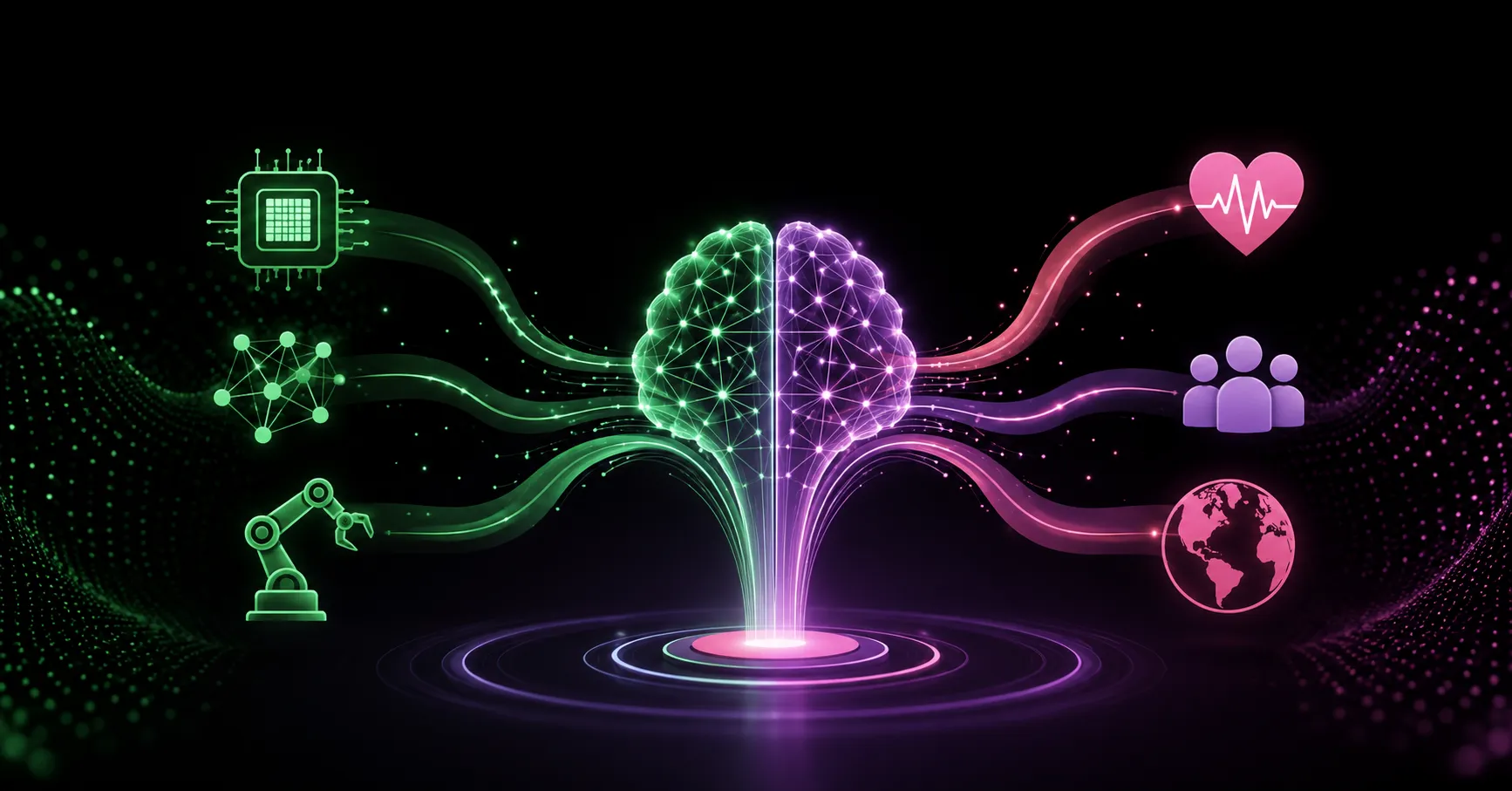
Convergence artificial intelligence refers to the collapsing of previously separate technology domains, including data platforms, cloud infrastructure, business automation, analytics, and application development, into a single integrated stack organised around AI models. For most of the last decade these were distinct purchases with distinct teams: a data warehouse team, a cloud platform team, a business process automation team, and an analytics team, each with their own tools and vocabulary. Convergence describes what happens when a model becomes the common interface across all of them, capable of reading from the warehouse, triggering the automation, and generating the interface. The practical consequence for a business is not that it needs more tools, but that it likely needs fewer, and that the boundaries between its internal teams are about to look arbitrary.
Quick Answer: Convergence artificial intelligence is the merging of data platforms, cloud infrastructure, automation, and application layers into one AI-centred stack. It reduces tool sprawl and integration overhead, but it raises the cost of poor data quality, because a single weak data foundation now degrades every capability built on top of it.
Consolidating a Converged Stack With WebPeak
Most organisations arrive at convergence with a decade of accumulated systems rather than a clean slate, which makes the transition an integration problem rather than a purchasing one. Teams typically need someone who can work across the whole surface at once: connecting existing databases to model endpoints, replacing brittle scripted automations with governed workflows, and rebuilding the front-end so users interact with one system instead of five. WebPeak operates across exactly that range, delivering AI, back-end, front-end, and content capability from a single team for clients worldwide, and their full-service digital agency model means the data plumbing and the user-facing product are designed against the same architecture rather than negotiated between two vendors. For convergence projects, that single point of accountability is often the difference between consolidation and simply adding another layer.
What Is Actually Converging, and Why Now?
Convergence is not a marketing abstraction; four specific merges are visible in how systems are being built today.
Data and AI are merging. Warehouses and lakehouses now include vector search, embedding generation, and model inference as native functions. This matters because it removes the copy step. Previously, using data for AI meant exporting it to a separate system, which introduced staleness, cost, and a governance gap. When inference runs where the data lives, permissions and lineage carry across automatically.
Automation and reasoning are merging. Traditional business process automation executed deterministic rules and failed on anything unstructured. Model-driven automation handles the ambiguous middle: reading an unusual invoice format, classifying an atypical support ticket, deciding when a case needs escalation. The rules engine still runs the deterministic steps; the model handles the exceptions that previously required a human queue.
Application and interface layers are merging with the model. Interfaces are increasingly generated or adapted at runtime rather than fully designed in advance, with the model deciding which controls and data a specific user needs at a specific moment.
Infrastructure and orchestration are merging. Compute, model serving, and workflow scheduling are consolidating into single control planes, which is why platform decisions now have wider blast radius than they used to.
The timing driver is straightforward: the cost of moving data between systems has become the dominant cost in most AI projects, and convergence is the market's answer to that inefficiency.
A Sequenced Plan for Moving Toward a Converged Stack
Consolidation done in the wrong order produces an expensive migration with no capability gain. This sequence front-loads the work that everything else depends on.
- Inventory your data surfaces first. List every system holding business-critical data, its owner, and its freshness. Convergence amplifies whatever quality exists at this layer, in both directions.
- Establish one identity and permission model. If access rules differ between your warehouse, application, and automation tools, a converged system will either over-expose data or block legitimate use. Resolve this before integration, not after.
- Pick one canonical store per data domain. Multiple competing sources of truth for customer records make every downstream AI output unreliable and untraceable.
- Replace the highest-friction integration first. Target the pipeline that breaks most often or requires the most manual reconciliation. Early visible relief buys organisational patience for the rest.
- Keep the model layer swappable. Convergence should reduce integration count, not increase dependency on one provider. Abstract model calls behind an internal interface.
- Instrument lineage end to end. Every AI-generated output should be traceable to the records that produced it. Without lineage, you cannot debug a wrong answer or defend a decision.
- Retire what you replaced. Convergence only delivers savings if legacy systems are actually decommissioned. Running both indefinitely is the most common way these programmes fail to pay back.
Traditional Siloed Stack Versus Converged AI Stack
The table below contrasts how the same operational concerns are handled in each model, which is the clearest way to see what you gain and what you take on.
| Concern | Traditional Siloed Stack | Converged AI Stack | What Changes for the Team |
|---|---|---|---|
| Data movement | Scheduled exports between systems | Processing where data already resides | Less pipeline maintenance, more schema discipline |
| Governance | Permissions duplicated per tool | Single policy applied across layers | Access reviews become centralised and auditable |
| Automation logic | Deterministic rules only | Rules plus model handling of exceptions | Exception queues shrink, evaluation work grows |
| Failure impact | Contained within one silo | Propagates across dependent layers | Testing and rollback discipline become critical |
| Vendor exposure | Spread across many contracts | Concentrated in fewer platforms | Negotiating leverage falls, portability planning matters more |
Expert Analysis: The Trade-Off Nobody Puts in the Business Case
Convergence is usually justified on cost and speed, and those benefits are real. What is rarely written down is the correlated-failure risk that comes with them, so rather than quote unverifiable adoption figures, here is the honest structural analysis.
Consolidation converts many small independent failures into fewer large correlated ones. In a siloed architecture, an outage in the automation platform leaves analytics working. In a converged stack sharing a control plane, a single degradation can affect reporting, automation, and the customer-facing product simultaneously. This is not an argument against convergence; it is an argument for treating disaster recovery as a first-class requirement rather than a later phase.
Data quality debt becomes visible and expensive at exactly the wrong moment. Siloed systems hide inconsistency because each team works around their own known issues informally. Convergence surfaces every one of those inconsistencies at once, usually during a high-visibility rollout. Teams that audit and reconcile their core entities before consolidating avoid a painful and public discovery phase.
The organisational change is larger than the technical change. When one platform spans data, automation, and application delivery, the traditional boundaries between those teams create queueing delays that eliminate the speed benefit. The businesses that get real value reorganise around outcomes rather than layers, which is a leadership decision, not an engineering one.
Content and interface work do not disappear, they move earlier. Converged systems generate more output, which raises the importance of consistent structure and messaging at the source. In practice this pushes work toward well-defined content models and shared component libraries, and full-stack approaches such as MERN stack development or a headless setup built with Strapi CMS give teams a structured foundation that both humans and models can work against reliably. Broader guidance on artificial intelligence adoption is worth reviewing alongside the architecture work.
Key Takeaways
- Convergence artificial intelligence merges data, cloud, automation, and application layers into one AI-centred stack, driven mainly by the cost of moving data between systems.
- Running inference where data already lives removes staleness and preserves permissions and lineage automatically.
- Consolidation amplifies existing data quality, so auditing core entities before migrating prevents a public discovery of long-standing inconsistencies.
- Fewer platforms means fewer independent failure domains, making disaster recovery planning more important, not less.
- The benefits are only realised when replaced legacy systems are actually decommissioned and teams reorganise around outcomes rather than technology layers.
Frequently Asked Questions
What does convergence mean in artificial intelligence?
It means previously separate technology areas, such as data warehousing, cloud infrastructure, business automation, and application development, are merging into one integrated stack with AI models as the common layer across them. The result is fewer systems, fewer integrations, and fewer handoffs between specialist teams.
Is convergence the same as AI consolidation of vendors?
Related but not identical. Vendor consolidation is a procurement outcome; convergence is an architectural shift in which capabilities that once required separate products become features of one platform. You can converge architecturally while still using several vendors, provided they share data and identity cleanly.
What is the biggest risk of a converged AI stack?
Correlated failure. When analytics, automation, and customer-facing features share infrastructure, one degradation can affect all of them at once. The mitigation is deliberate isolation of critical paths and rehearsed recovery procedures, planned at the start rather than added after the first incident.
Do small businesses benefit from convergence artificial intelligence?
Often more than large ones, because small teams cannot afford to maintain separate specialists for data, automation, and application work. A converged stack lets a small team operate capabilities that previously required several. The prerequisite is still clean, consistent data.
Where should a company start with convergence?
Start with identity and permissions, then a single canonical source per data domain. These two foundations determine whether every later integration is straightforward or endlessly contested. Beginning with model selection before this groundwork is the most common sequencing mistake.
Conclusion
The decision that determines whether convergence pays back is whether you treat it as a data governance programme with an AI outcome, or an AI programme with data problems to solve later. The first framing produces a stack that keeps improving; the second produces an impressive prototype that cannot be trusted with real decisions. Before evaluating a single converged platform, spend two weeks documenting which system is authoritative for each of your core business entities, because that document will shape every architectural choice that follows and will expose whether you are ready to consolidate at all.
Related articles
 Artificial Intelligence
Night Shift Artificial Intelligence Intern Jobs: How to Find, Evaluate and Land One
Night shift artificial intelligence intern jobs exist in data labeling, model monitoring, and AI operations. Learn where they are posted, what they pay attention to, and how to apply.
 Artificial Intelligence
Non Artificial Intelligence Examples: 12 Everyday Systems People Mistake for AI
Most tools marketed as intelligent are not. This guide breaks down real non artificial intelligence examples and shows exactly how to spot the difference.
 Artificial Intelligence
Coactive Artificial Intelligence: Designing Systems Where People and Models Work as One Team
Coactive artificial intelligence keeps humans inside the decision loop instead of replacing them. Learn the design patterns, interfaces, and metrics that make it work.