
Supply Chain Artificial Intelligence Jobs: Roles, Skills, and How to Get Hired
Supply chain artificial intelligence jobs blend logistics knowledge with data skills. Here are the real roles, the skills employers screen for, and a hiring roadmap.
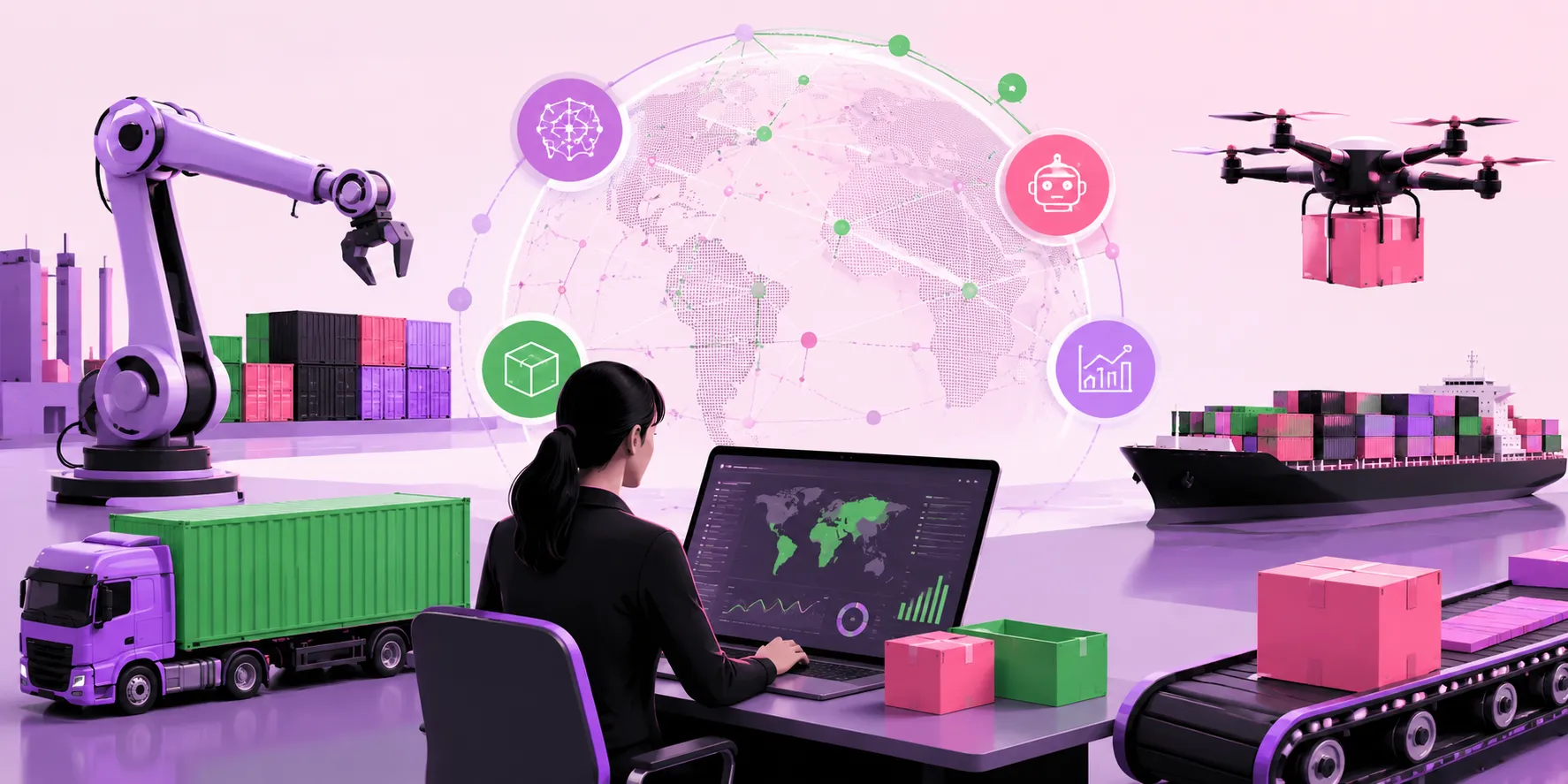
Supply Chain Artificial Intelligence Jobs: Roles, Skills, and How to Get Hired
Supply chain artificial intelligence jobs are roles where machine learning, optimization, and data engineering are applied to the movement of goods — forecasting demand, positioning inventory, routing freight, scoring supplier risk, and planning capacity. They exist at the intersection of two historically separate talent pools: supply chain planners who understand service levels, lead times and safety stock, and data scientists who understand model training and validation. What makes this job market distinctive is that pure technical skill is rarely enough. A forecasting model that ignores promotional calendars, minimum order quantities, or the difference between a stockout and an overstock will be technically sound and operationally useless. That is why the most in-demand candidates are the ones who can read an ERP schema and explain why forecast bias matters more than raw accuracy. This guide maps the actual roles, the screening criteria hiring managers use, and a concrete path to a first offer.
Quick Answer: Supply chain artificial intelligence jobs apply machine learning and optimization to demand forecasting, inventory, logistics routing, and supplier risk. Common titles include demand planning data scientist, supply chain ML engineer, operations research scientist, and analytics manager. Employers screen for Python, SQL, time-series forecasting, optimization tools, and genuine supply chain domain knowledge.
Why Portfolio Presentation Decides Many Supply Chain AI Interviews
Candidates in this field lose offers not because their models are weak but because their work is unreadable to the operations leaders who approve hires. A forecast improvement means nothing until it is shown as an inventory or service-level outcome in an interface a planner recognises. That presentation layer is ordinary product work, and it is where React JS development and clear website design turn a notebook into a portfolio piece a director will actually finish reading. Teams that also need the model layer built or reviewed use AI and machine learning services from the same partner, which keeps the analysis and the interface consistent. Whether you are a candidate building a portfolio or a company building an internal planning tool, this worldwide digital agency covers the full span from model to dashboard — and the reason that matters here is blunt: in supply chain AI, the deliverable is a decision someone trusts, not a metric on a slide.
The Real Roles Behind the Job Title
Job postings use inconsistent language, so learn to read the underlying function rather than the title. A demand planning data scientist builds and maintains statistical and machine-learning forecasts at SKU, location and time-bucket level, and owns forecast accuracy and bias metrics such as MAPE, WMAPE and forecast value added. The work is heavily time-series oriented and deeply intertwined with the sales and operations planning (S&OP) cycle. A supply chain machine learning engineer productionises those models — building feature pipelines from ERP and warehouse management data, deploying inference, monitoring drift, and handling retraining. This role is closer to software engineering than analysis, and it is currently the hardest to fill because it requires both MLOps competence and tolerance for messy enterprise data.
An operations research scientist or optimization engineer works on constrained decision problems rather than prediction: vehicle routing, network design, production scheduling, inventory allocation. The toolkit here is mathematical programming — linear and mixed-integer programming with solvers like Gurobi, CPLEX or the open-source OR-Tools — and the distinction from machine learning is fundamental. Forecasting predicts what will happen; optimization decides what to do given constraints. Most mature supply chain AI systems need both, and candidates who understand the handoff between them are unusually valuable. Rounding out the field, a supply chain analytics manager translates between operations and data teams and owns the decision framework rather than the code, while a digital twin or simulation engineer builds models of network behaviour to stress-test scenarios before committing capital. Emerging roles increasingly involve applying language models to procurement documents, supplier communications, and contract analysis — a genuinely new lane created by the last few years of AI progress.
Skills Employers Actually Screen For
These are ordered by how often they appear as hard filters in real hiring processes.
- SQL, at a genuinely strong level. Window functions, joins across transactional tables, and comfort with imperfect data. Nearly every technical screen tests this.
- Python with pandas and a forecasting or ML library. statsmodels, scikit-learn, and a gradient-boosting library; increasingly libraries built for hierarchical time-series forecasting.
- Time-series specifics. Seasonality, intermittent demand, hierarchical reconciliation, backtesting with rolling origins, and why standard cross-validation leaks information in temporal data.
- Supply chain fundamentals. Safety stock logic, service levels, lead time variability, bullwhip effect, MOQs, and the asymmetry between holding cost and stockout cost.
- Optimization literacy. Formulating a problem with decision variables, objective and constraints, and knowing when a heuristic beats an exact solver in practice.
- Enterprise data reality. Familiarity with ERP structures such as SAP, plus WMS and TMS data, and the discipline to reconcile figures with finance.
- Communication with operations. Explaining a model to a planner who will override it if they do not trust it. This is a decisive differentiator at interview stage.
- Optional but effective credentials. ASCM/APICS CPIM or CSCP for domain credibility, or a cloud data certification for the engineering track.
Comparing the Main Supply Chain AI Career Tracks
| Role | Core focus | Primary tools | Best background | Success measured by |
|---|---|---|---|---|
| Demand planning data scientist | Forecast accuracy and bias | Python, SQL, statsmodels | Planning or statistics | WMAPE and forecast value added |
| Supply chain ML engineer | Production pipelines and monitoring | Python, cloud, orchestration | Software engineering | Model uptime and retraining reliability |
| Operations research scientist | Constrained decision optimization | Gurobi, CPLEX, OR-Tools | Industrial engineering, OR | Cost and service improvement |
| Analytics manager | Decision framing and adoption | SQL, BI tools, S&OP process | Operations leadership | Decisions changed by analytics |
| Simulation and digital twin engineer | Scenario stress testing | Simulation software, Python | Engineering, modeling | Quality of network decisions |
What the Labour Market Data and Hiring Patterns Show
On verifiable ground: the U.S. Bureau of Labor Statistics, through its Occupational Outlook Handbook, projects employment of operations research analysts to grow much faster than the average for all occupations over the current decade, and it identifies logistician roles as growing as well — with the explicit reasoning that organisations increasingly use analytical methods to improve efficiency and control costs. Those are the two occupational categories most supply chain AI roles are classified under, so this is the closest thing to reliable public demand data in this field. I am deliberately not attaching invented salary percentages or growth figures beyond that, because compensation in this niche varies more by industry and location than by title, and precise-sounding numbers without a source do candidates real harm.
Beyond official statistics, hiring patterns are consistent enough to state as practitioner observation. First, domain knowledge is the scarcer half of the pairing. There are far more competent data scientists than data scientists who can explain why a 5 percent accuracy gain on slow-moving SKUs may be worth less than eliminating bias on fast movers. Candidates who bridge that gap tend to move faster than pure specialists. Second, portfolio projects using real, messy public data — freight, retail sales, or public logistics datasets — outperform certificate collections in interviews, because they demonstrate judgment under ambiguity rather than course completion. Third, internal transitions succeed disproportionately often: planners and buyers who learn SQL and Python while already inside the business frequently beat external data candidates for the same role, because they already know which numbers the organisation trusts. Fourth, the enduring constraint on these teams is data infrastructure, not modeling talent, which is why engineering-leaning candidates who can build reliable pipelines and internal web applications for planners are increasingly the ones getting hired first.
Key Takeaways
- Supply chain AI roles split into four main tracks: forecasting, ML engineering, optimization and operations research, and analytics leadership.
- Forecasting predicts outcomes while optimization chooses actions under constraints; strong candidates understand the handoff between them.
- The U.S. Bureau of Labor Statistics projects much-faster-than-average growth for operations research analysts, the category covering many of these roles.
- Domain knowledge is scarcer than modeling ability, so planners who learn SQL and Python often outcompete external data scientists.
- Portfolio projects on messy real logistics data, presented as decisions rather than metrics, move interviews further than certificate lists.
Frequently Asked Questions
Do I need a supply chain degree to get an AI job in this field?
No, but you need demonstrable domain fluency. Employers accept engineering, statistics, economics or computer science backgrounds provided you understand safety stock, lead times, service levels and the S&OP cycle. A credential such as ASCM's CPIM or CSCP is a fast way to signal that knowledge credibly.
Which programming skills matter most for supply chain AI roles?
SQL first, then Python. Strong SQL including window functions is tested in almost every screen because the data lives in transactional systems. Python with pandas plus a forecasting or gradient-boosting library covers most modeling work. Optimization roles additionally expect solver experience with OR-Tools, Gurobi or CPLEX.
Can a supply chain planner move into an AI role internally?
Yes, and this is one of the most reliable paths. Planners already know which data the business trusts and where processes break. Learning SQL, Python and forecasting validation while automating part of your current planning workload creates a portfolio your own employer can immediately verify.
Which industries hire most for supply chain AI?
Retail and consumer goods lead because of SKU volume and promotional complexity, followed by third-party logistics and freight, manufacturing, pharmaceuticals and distribution. Large e-commerce operations and grocery chains hire heavily for forecasting and routing specifically, since small accuracy gains translate into significant cost movement.
What kind of portfolio project impresses hiring managers?
One that ends in a decision, not a chart. Take a public retail or freight dataset, build a backtested forecast, translate the improvement into inventory or service-level impact, and present it in a simple interface a planner could use. Document your assumptions and failures honestly.
Conclusion
The most important decision in pursuing supply chain artificial intelligence jobs is choosing which half of the pairing you will make your strength — deep supply chain judgment supported by solid data skills, or strong engineering supported by credible domain literacy — because candidates who try to be average at both are the ones who stall in screening. Pick your side, then build one end-to-end project on genuinely messy real logistics data and present it as an operational decision with a measurable service or cost consequence. That single artifact answers the question every hiring manager in this field is actually asking: can this person turn a model into something a planner will trust on a Monday morning?
Related articles
 Artificial Intelligence
Is Artificial Intelligence Evil? Separating Real Risks From Science Fiction Fear
Is artificial intelligence evil? A clear-eyed look at what AI can and cannot intend, the documented harms that are real, and the governance frameworks that address them.
 Artificial Intelligence
Artificial Intelligence Engineer Jobs: Skills, Salaries, and How to Get Hired
A practical breakdown of artificial intelligence engineer jobs: what the role really involves, the skills employers screen for, and the portfolio that gets interviews.
 Artificial Intelligence
Artificial Intelligence at Brown: Programs, Research Strengths, and Career Paths
A practical guide to artificial intelligence at Brown University: how the Open Curriculum shapes AI study, key research centres, admissions realities, and careers.