
Artificial Intelligence Literacy for Young Children: Main Talking Points Every Parent and Teacher Should Cover
A practical guide to the main talking points of artificial intelligence literacy for young children, with age-based scripts, hands-on activities and clear safety rules.
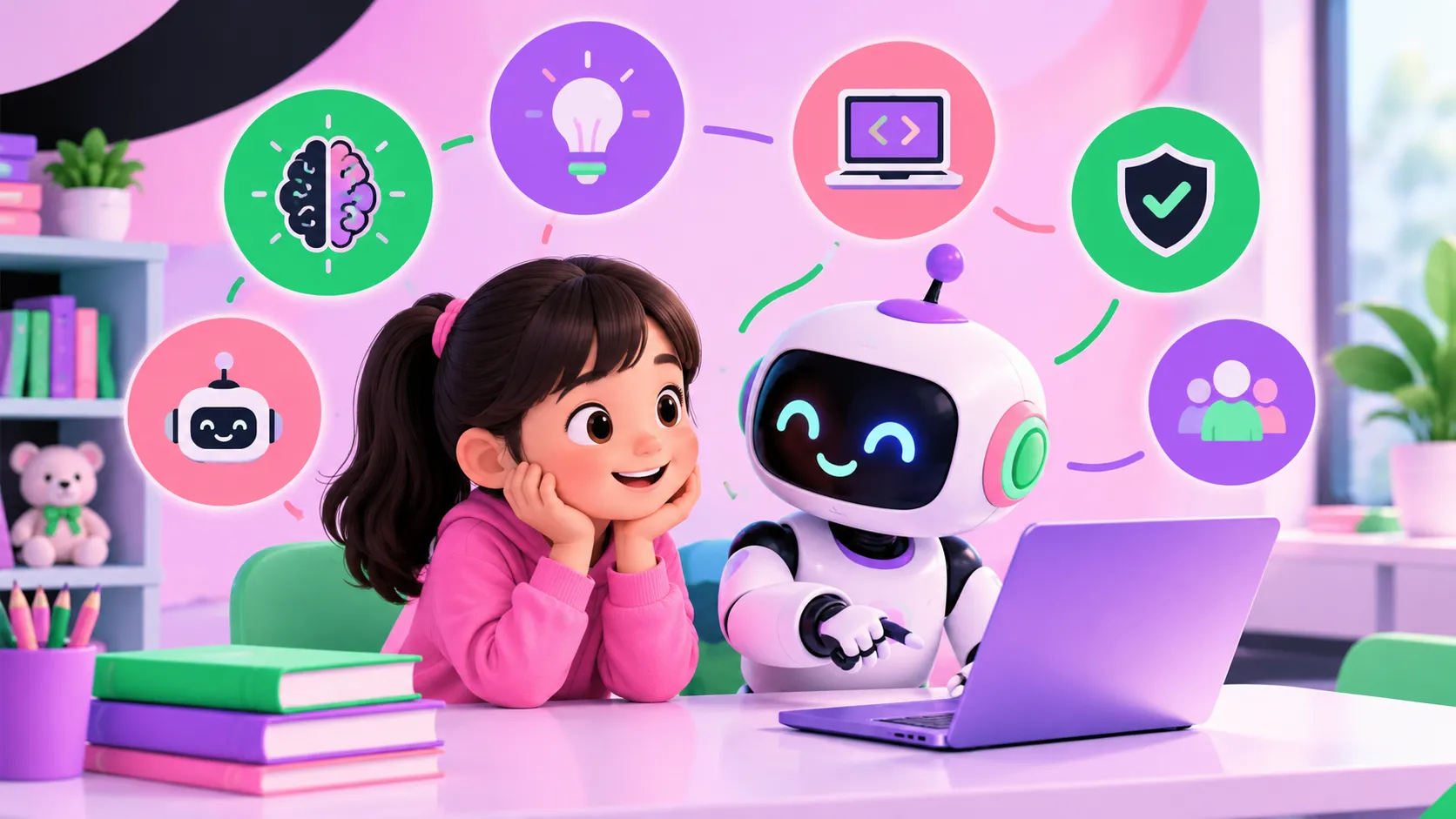
Artificial Intelligence Literacy for Young Children: Main Talking Points Every Parent and Teacher Should Cover
Artificial intelligence literacy for young children means giving kids aged roughly 4 to 11 the vocabulary, mental models and habits they need to recognize when a machine is making a prediction, question what it says, and understand who built it and why. It is not coding class. A six-year-old does not need to know what a neural network weight is, but she absolutely needs to know that the voice in the smart speaker is not a person, that it can be wrong, and that it remembers what she says. This distinction matters because children today meet AI before they meet long division: recommendation feeds on kids' video apps, autocorrect, voice assistants, photo filters, and homework helpers are all AI systems. UNESCO's 2024 AI competency framework for students makes the same point at policy level, organizing AI education around human-centered mindset, ethics, techniques and system design rather than programming alone. The talking points below are the ones that survive contact with real classrooms and real kitchen-table conversations.
Quick Answer: The main talking points of AI literacy for young children are: AI is a machine that makes guesses from patterns, not a living thing; it learns from data people give it; it can be confidently wrong; it can be unfair if its data is unfair; it collects information about you; and a human is always responsible for what it does.
How WebPeak Helps Schools and EdTech Brands Explain AI to Young Learners
Translating these talking points into something a seven-year-old will actually absorb is a design and content problem as much as a teaching one, and that is where an agency layer earns its place. Teams building parent guides, classroom posters, school microsites or AI-literacy courseware need illustrated explainers with correct terminology, reading-age-appropriate copy, and interfaces a child can navigate without adult help. WebPeak works with education clients worldwide on exactly this kind of output, pairing their artificial intelligence services with infographic design so that abstract ideas like "training data" become a single visual a child can point at and re-explain in her own words. Their approach is worth noting for one specific reason: they treat the vocabulary list as the design brief, so the illustration and the lesson never drift apart.
What Should a Child Actually Understand About AI at Each Age?
AI literacy has to follow cognitive development, not curriculum convenience. Children under about seven are in what Piaget described as the preoperational stage, where animism is normal: they genuinely believe things that talk are alive. Fighting that belief with technical explanation fails; naming it works.
Ages 4 to 6 — machine or living thing? The single goal is category sorting. A dog eats, sleeps and feels. A speaker plugs in, needs no food, and was built in a factory. Ask a child to sort household objects into "alive" and "built" and put the smart speaker in the built pile out loud, every time.
Ages 7 to 8 — AI makes guesses from examples. Now you can introduce prediction. Explain that the app that recognizes cats was shown thousands of cat pictures by people, and that showing it only orange cats would make it bad at recognizing black ones. This is the age where "training data" can be named directly, because children of this age already understand practice and learning from examples in their own lives.
Ages 9 to 11 — AI can be wrong, biased and persuasive. Older primary children can hold two ideas at once: the tool is useful, and the tool has a motive behind it. This is the right stage to discuss recommendation feeds designed to keep you watching, and chatbots that produce fluent text that is factually false. MIT RAISE's Day of AI curriculum pitches its dataset-and-bias activities at roughly this band for the same developmental reason.
The Seven Core Talking Points, in Teaching Order
Use these as a sequence rather than a menu. Each one depends on the one before it, and each has a one-sentence version a child can repeat back to you.
- "It is a machine, not a friend." Establish the category first. Point out the power cable or the battery. Children who skip this step tend to over-trust assistants for years.
- "It learns from examples people give it." Introduce data as a pile of examples chosen by humans. Use a physical pile of picture cards so "data" is a thing on the table, not a word.
- "It guesses — and guesses can be wrong." Have the child deliberately catch an AI making a mistake: a mispronounced name, a wrong autocorrect, a chatbot inventing a fact about their school. One caught error teaches more than ten warnings.
- "Unfair examples make unfair guesses." Show what happens when a training pile only contains one kind of thing. Ask: who got left out of this pile, and how would that feel?
- "It remembers, and someone can see it." Cover data collection concretely — voice recordings, search history, uploaded photos. The rule children retain best is behavioral: never type your full name, school, address or a photo of yourself into a chatbot.
- "Someone made it, and someone profits from it." Ask who built this and what they want you to do next. This is the earliest form of media-literacy skepticism and it transfers directly to advertising.
- "A person is always responsible." If an AI grading tool marks a child unfairly, a human chose to use it. Machines cannot be blamed; this is the ethical anchor for everything else.
Age-by-Age AI Literacy Planner
| Age Band | Core Concept | Hands-On Activity | Child's Own Words |
|---|---|---|---|
| 4–6 | Alive vs. built | Sort toys, pets and gadgets into two hoops on the floor | "It talks, but it is not alive." |
| 7–8 | Learning from examples | Train a paper "robot" by sorting animal cards into yes and no piles | "It only knows what we showed it." |
| 9–10 | Errors and bias | Hunt for three wrong answers from a voice assistant or chatbot | "It sounds sure even when it is wrong." |
| 10–11 | Data, privacy and persuasion | Audit which apps on a tablet ask for a microphone or camera | "It saves what I say, so I keep my details private." |
What Practitioners Consistently See — and Where Adults Get It Wrong
Two patterns show up repeatedly in real teaching practice, and neither requires a statistic to be convincing. The first is that children resolve uncertainty about machines through social framing: if an adult says "ask her" about a voice assistant, the child files the device as a person, and no later lesson fully undoes it. Changing adult language to "let's ask the device" is the cheapest, highest-impact intervention available, and it costs nothing.
The second is that abstract warnings do not stick, but caught errors do. A child who has personally watched a chatbot invent a fake fact about her own town becomes durably skeptical, while a child lectured about "AI hallucinations" remembers the phrase and none of the caution. Organizations working in this space reflect the same emphasis: Common Sense Media's guidance for families centers on co-use and conversation rather than technical instruction, and UNESCO's student framework leads with human-centered mindset before technique. Practitioners building supporting resources for this work — everything from parent handouts to school platforms — often lean on specialist partners for the technical build, in the same way schools commission professional content writing support for reading-age-accurate learning materials. The underlying point is consistent: AI literacy for young children is delivered through language and experience, and the tooling exists only to support those two things.
Key Takeaways
- AI literacy for young children is about mental models and habits, not programming; the first goal is separating "machine" from "living thing."
- Concepts must follow development: category sorting at 4–6, learning-from-examples at 7–8, error and bias at 9–11.
- UNESCO's 2024 AI competency framework for students places human-centered mindset and ethics ahead of technical skill, mirroring good early-years practice.
- Adult language shapes child belief — saying "the device" instead of "she" prevents years of over-trust.
- One personally discovered AI mistake builds more lasting skepticism than repeated abstract warnings about accuracy.
Frequently Asked Questions
At what age should I start talking to my child about artificial intelligence?
Start as soon as your child uses or watches a device that talks, recommends or autocorrects — often around age four. At that age the conversation is only about whether something is alive or built. Technical ideas like training data and bias can wait until roughly seven and nine respectively.
How do I explain artificial intelligence to a five-year-old in simple words?
Say it is a machine that copies patterns people showed it, like a very fast guessing game. Emphasize that it needs electricity, was made in a factory, and does not have feelings. Avoid words like brain, thinking or knowing, because those words push young children toward believing the device is alive.
Should young children use AI chatbots for homework?
Only with an adult sitting alongside and with a fact-checking step built in. Treat the chatbot as a draft-maker whose claims must be verified in a book or trusted site. Never let a child enter their full name, school, address or photographs, and review the platform's age requirements first.
What is the biggest mistake parents make when teaching AI literacy?
Using human pronouns and human verbs for devices. Calling an assistant "she" or saying it "knows" the answer teaches a child that the machine is a trustworthy person. Switching to neutral phrasing such as "the device predicted" costs nothing and prevents durable over-trust in machine answers.
How do I teach algorithmic bias without frightening my child?
Frame it as fairness, not danger. Build a pile of picture cards that only includes one kind of animal, then ask which animals were left out and how that changes the machine's guesses. Children already understand exclusion from playground experience, so bias becomes a fairness problem they can reason about calmly.
Conclusion
If you take one decision away from this guide, make it this: teach the category before you teach the technology. A child who firmly knows an AI system is a built machine that guesses from human-supplied examples can absorb every later lesson — accuracy, bias, privacy, persuasion — because each one attaches to a mental model that already fits. Adults who skip that step end up correcting misplaced trust for years. Your next step is small and immediate: choose one device in your home or classroom this week, name it out loud as a machine, and invite the child to catch it making a single mistake. That one exercise starts genuine AI literacy faster than any curriculum download, and it gives the child something far more valuable than information — a reliable habit of asking who built this, what it was shown, and whether it might be wrong.
Related articles
 Artificial Intelligence
Artificial Intelligence Hiring: How AI Recruiting Works and How to Use It Fairly
AI now touches most stages of recruiting. This guide explains how the tools screen candidates, where bias creeps in, and how to audit a hiring stack safely.
 Artificial Intelligence
Artificial Intelligence Headphones: How AI Audio Actually Changes What You Hear
AI headphones promise smarter listening, but the marketing hides what matters. Here is how the machine learning inside them works and which features count.
 Artificial Intelligence
Artificial Intelligence Forex: What AI Can and Cannot Do in Currency Trading
Artificial intelligence forex trading explained honestly: what AI models can and cannot predict, realistic use cases, risk controls, and testing methods.