
Artificial Intelligence Fun: 12 Genuinely Entertaining Ways to Play With AI
AI is no longer only a work tool. This guide shows the most entertaining ways to use it, from image games to music, and how to keep the fun safe and private.
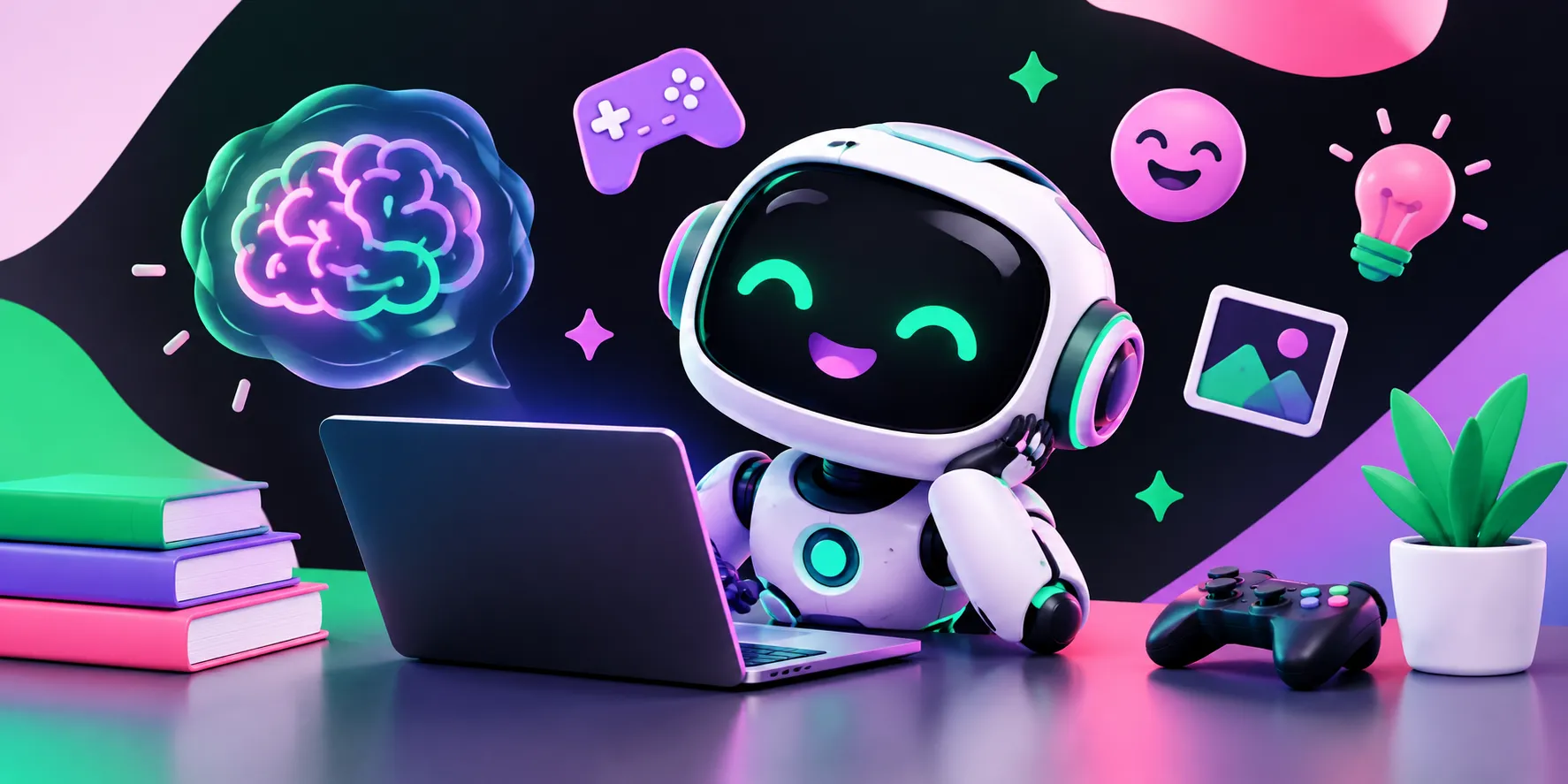
Artificial Intelligence Fun: 12 Genuinely Entertaining Ways to Play With AI
Artificial intelligence fun refers to the recreational use of AI systems — chatbots, image generators, music models, voice tools and game engines — for play, creativity and curiosity rather than productivity. It is the fastest-growing reason ordinary people open an AI app: not to write a report, but to see what happens. And that instinct is well founded, because AI models are unusually good at the things play requires. They improvise, they accept absurd instructions without complaint, they generate infinite variations, and they never get bored of your fourth attempt at the same joke. The catch is that most people never get past the first novelty prompt. They ask a chatbot to tell a joke, get something mildly amusing, and conclude AI is a toy with a short battery life. The genuinely entertaining uses sit one layer deeper, in the space where you stop treating the model as an oracle and start treating it as an improv partner with a very large memory and no ego.
Quick Answer: The most fun uses of artificial intelligence involve creative collaboration rather than simple questions — AI-run text adventures, image-generation games, voice and music remixing, personalised trivia, and interactive storytelling. Fun improves dramatically when you give the model a role, constraints and a scoring system instead of asking open-ended prompts.
How WebPeak Turns Playful AI Experiments Into Publishable Creative Work
There is a real gap between messing around with an AI image generator and producing something you would happily put on a website or a client's social feed. That gap is craft: consistent art direction, correct file formats, readable typography, and assets that survive compression on mobile. This is the practical work handled by teams such as the digital specialists at WebPeak, who combine artificial intelligence services with human design review so generated concepts become finished assets. Their social media post and banner design work is a good example of the pattern: AI accelerates the idea stage, then designers fix the hierarchy, spacing and brand consistency that models still get wrong. The same logic applies to data-heavy play — a fun AI-generated chart becomes genuinely useful once it is rebuilt properly as an infographic design.
What Actually Makes AI Fun Instead of Merely Impressive
The difference between a novelty and an activity you return to is interaction loops. A loop is a repeatable cycle of input, response and consequence — the core of every game ever made. A single AI prompt has no loop, which is why it entertains for eleven seconds. Fun appears when you build a loop on top of the model.
Three ingredients reliably create that loop. The first is a role: tell the model exactly who it is, because "you are a sarcastic Victorian butler judging my music taste" produces vastly more entertaining output than "be funny". Vague instructions produce averaged, generic answers, since the model has no reason to commit to a specific voice. The second is constraints. Ask for a story in exactly fifty words, a rhyme that never uses the letter E, or an explanation of quantum tunnelling using only kitchen equipment. Constraints force novelty, and novelty is what makes you laugh. The third is state — something that persists and changes. Score, health points, an inventory, a running tally of your terrible decisions. State turns a conversation into a game.
It also helps to understand what AI is genuinely bad at, because the failures are half the fun. Language models are weak at counting, at strict spatial reasoning and at knowing what they do not know. Games that lean on those weaknesses — "guess which of these three facts I hallucinated" — are entertaining precisely because the machine is a flawed player rather than an all-knowing referee.
12 Ways to Have Real Fun With Artificial Intelligence
Each of these has been chosen because it creates a loop, not a one-off output. Start with two or three rather than trying everything at once.
- Run a text adventure. Ask a chatbot to be a dungeon master, set a genre, and insist it ends every reply with three numbered choices plus your current health and inventory. The persistent state is what keeps it gripping.
- Play twenty questions in reverse. You think of an object; the AI interrogates you. Its questioning strategy is often smarter than a human's, and its confident wrong guesses are the entertainment.
- Hold an image-generation guessing game. One person writes a secret prompt, generates the image, and everyone else races to reconstruct the prompt. Score points for matching keywords.
- Build a fictional band. Use an AI music tool for a track, an image model for cover art, and a chatbot to write an unbearably pretentious review of your own album.
- Translate through five languages and back. Feed a famous song lyric through a chain of translations and read the wreckage aloud. It is a genuinely funny way to see how meaning degrades.
- Stage a debate between historical figures. Two personas, one absurd motion, strict two-sentence turns. The constraint keeps it punchy instead of waffling.
- Make a personalised trivia night. Give the model a topic, a difficulty level and a rule that every wrong answer must be plausible. It generates rounds faster than any quizmaster.
- Roast your own creative work. Ask for the harshest fair critique of your writing, playlist or portfolio. Uncomfortable, useful, and oddly hilarious.
- Invent a language. Have the AI build grammar rules, then hold a short conversation in it. Consistency errors become an in-joke.
- Turn photos into styles. Restyle holiday snapshots as woodblock prints, blueprints or 1970s sci-fi paperbacks, then have people guess the original.
- Play the hallucination hunt. Request ten facts about a niche topic, then verify each one. It is a game that quietly teaches critical thinking.
- Co-write a choose-your-own-ending story with friends. Each person adds one instruction the AI must obey. The result is chaos with a plot.
Comparing AI Tool Types for Entertainment
Not every AI tool is fun in the same way. The table below maps the main categories against what they are actually good for recreationally, and where they disappoint.
| Tool type | Best fun use | Group friendly? | Main limitation |
|---|---|---|---|
| Text chatbots | Role-play, games, improv, trivia | Yes, with one person typing | Loses track of long-running rules |
| Image generators | Prompt-guessing games, restyling photos | Very high | Struggles with text, hands and exact counts |
| Music and audio models | Fake bands, parody tracks, jingles | Moderate | Short clips, limited fine control |
| Voice cloning and TTS | Narrated stories, silly audiobooks | Moderate | Serious consent and impersonation risks |
| Video generators | Short surreal clips, memes | Low, slow to iterate | Expensive, inconsistent between frames |
| AI in games | Dynamic NPCs and endless side quests | Yes | Still rare in mainstream titles |
What Experience Actually Shows About AI Play
Rather than quote invented figures, here is what holds up consistently in practice across hundreds of hours of recreational AI use — and it contradicts a lot of the hype.
Specificity beats sophistication. A basic, freely available chatbot given a sharp role and firm constraints is far more entertaining than a frontier model given a lazy prompt. In practice, the quality of the instruction matters more than the quality of the model for almost all playful use.
Fun collapses when the model forgets. The single most common reason an AI game stops being enjoyable is context drift: after twenty or thirty exchanges the model quietly abandons the rules. The reliable fix is to restate the state in every message — current score, inventory, rules — so the model re-reads it rather than recalls it.
Group play outperforms solo play. AI entertainment is far more durable when at least two humans are present, because humans supply the competition and the model supplies the raw material. Solo AI play tends to fade within a session; group AI play tends to become a recurring thing.
The failures are the content. Long-term users almost universally report that the funniest moments come from wrong answers, misread instructions and bizarre images rather than successful outputs. Treating errors as features rather than defects is the mindset shift that makes AI genuinely entertaining.
One practical caution worth stating plainly: recreational AI use still involves sending data to a service. Do not feed real photographs of other people into generators without their agreement, avoid cloning anyone's voice for jokes, and assume anything you type may be retained unless the provider explicitly says otherwise. If your playful experiments start turning into published creative output, it is worth understanding how professional graphic design workflows handle rights, source assets and brand safety before anything goes public.
Key Takeaways
- AI becomes fun when you add an interaction loop — a role, constraints and persistent state such as score or inventory.
- Precise, committed prompts produce far funnier results than open-ended requests like "be funny".
- Image generators are the most group-friendly AI category; video generators are the least, because iteration is slow and costly.
- Context drift, not model quality, is the usual reason an AI game stops being enjoyable — restate the rules in every turn.
- Never use real voices, faces or private data in playful AI experiments without explicit permission from the people involved.
Frequently Asked Questions
What is the most fun thing you can do with AI right now?
Running an interactive text adventure is the strongest option, because it combines storytelling, decision-making and persistent state. Give the model a genre, insist on numbered choices each turn, and require it to track your health and inventory. That single instruction turns a chatbot into a game.
Do I need to pay for AI tools to have fun with them?
No. Free tiers of mainstream chatbots and image generators are more than adequate for games, role-play and prompt challenges. Paid plans mainly buy speed, longer memory and higher image resolution. Prompt quality affects entertainment value far more than subscription level does.
Why does the AI stop following my game rules after a while?
Because models work from a limited context window and gradually deprioritise older instructions. The practical fix is repetition: restate the rules, score and inventory in each message, or ask the AI to output a short status block every turn so the rules stay visible in recent context.
Is it safe to upload photos of my friends to AI image tools?
Not without asking them first. Uploaded images may be stored, reviewed or used for service improvement depending on the provider's terms. Treat other people's faces as their data, not yours, and keep playful edits to your own photos or clearly synthetic images.
Can AI actually be funny, or is it just random?
AI can be reliably funny when given structure, because humour depends on constraint and surprise. Models are poor at spontaneous wit but excellent at executing comedic formats — parody reviews, absurd personas, forced constraints. The human supplies the framing; the machine supplies the volume.
Conclusion
If you take one decision away from this guide, make it this: stop prompting and start designing. The difference between AI as a five-minute novelty and AI as a genuinely entertaining activity is entirely down to whether you build a loop around it — a role for the model, rules it must obey, and a piece of state that changes as you play. Pick a single idea from the list above, write the role and rules out properly before you begin, and restate them each turn. You will know within one session whether AI play is for you, and you will be judging it on a fair test rather than a lazy one. Keep other people's data out of it, treat the mistakes as the punchline, and the fun tends to look after itself.
Related articles
 Artificial Intelligence
Artificial Intelligence Hiring: How AI Recruiting Works and How to Use It Fairly
AI now touches most stages of recruiting. This guide explains how the tools screen candidates, where bias creeps in, and how to audit a hiring stack safely.
 Artificial Intelligence
Artificial Intelligence Headphones: How AI Audio Actually Changes What You Hear
AI headphones promise smarter listening, but the marketing hides what matters. Here is how the machine learning inside them works and which features count.
 Artificial Intelligence
Artificial Intelligence Forex: What AI Can and Cannot Do in Currency Trading
Artificial intelligence forex trading explained honestly: what AI models can and cannot predict, realistic use cases, risk controls, and testing methods.