
Artificial Intelligence Headphones: How AI Audio Actually Changes What You Hear
AI headphones promise smarter listening, but the marketing hides what matters. Here is how the machine learning inside them works and which features count.
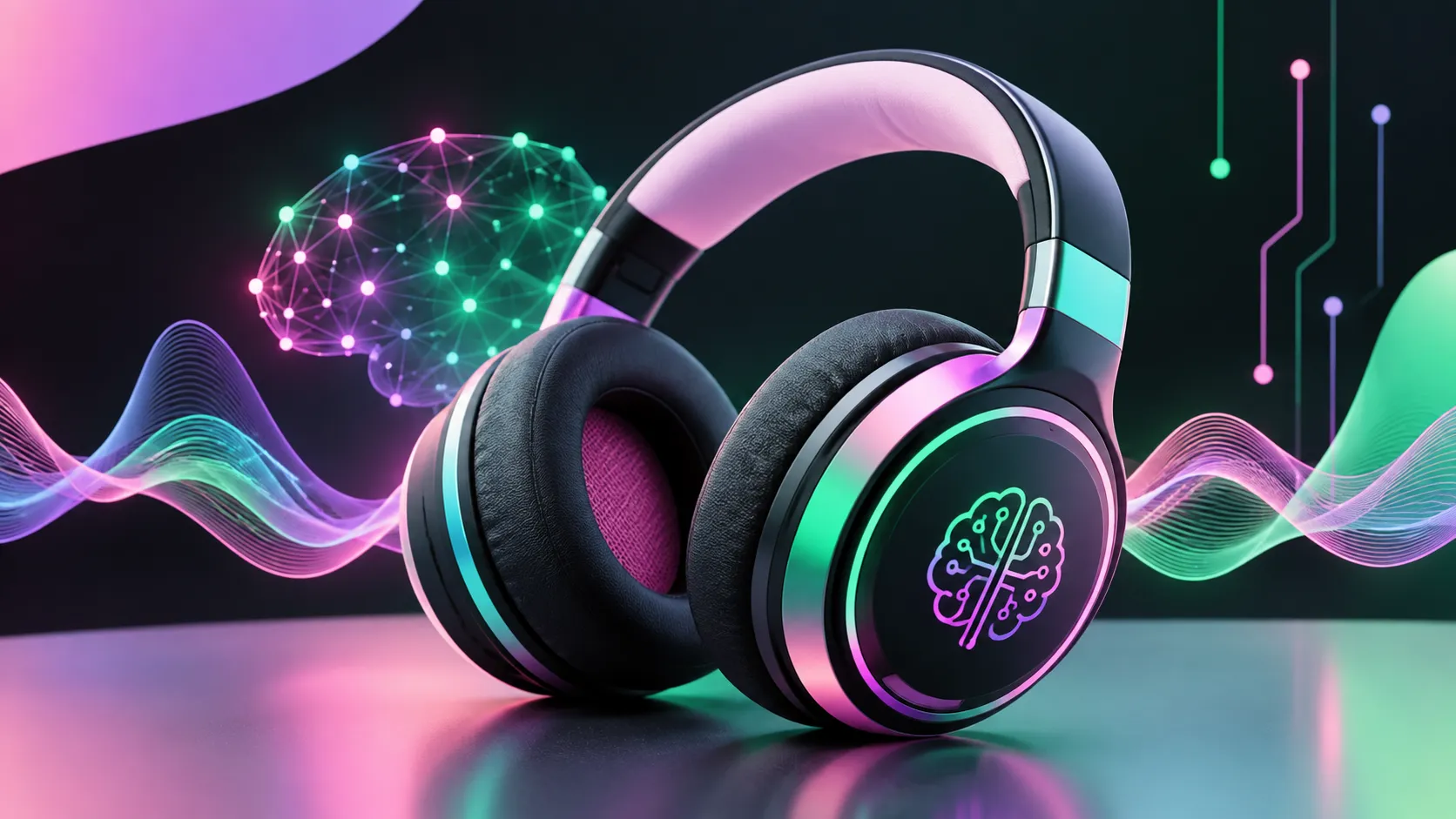
Artificial Intelligence Headphones: How AI Audio Actually Changes What You Hear
Artificial intelligence headphones are headphones and earbuds that run machine learning models — usually on a dedicated chip inside the earpiece — to analyse and modify sound in real time. That includes adaptive noise cancellation that responds to your specific environment, neural voice isolation that separates speech from background noise on calls, spatial audio that tracks head movement, and hearing personalisation that shapes output to your individual ear and hearing profile. The important distinction is between headphones that merely have a cloud-connected app and headphones that perform genuine inference locally within a few milliseconds. Only the second category can meaningfully change what you hear, because audio processing has a latency budget measured in single-digit milliseconds. Anything routed to a server arrives far too late to help. Understanding that constraint is the fastest way to separate real AI audio from the marketing version.
Quick Answer: Artificial intelligence headphones use on-device neural networks to cancel noise adaptively, isolate voices on calls, personalise frequency response to your hearing, and render head-tracked spatial audio. The genuine benefits are call clarity and adaptive noise cancellation; the weakest claims are AI-enhanced sound quality and automatic genre detection.
Section 2 Precedes the Brand Note: What the AI in Your Earbuds Is Actually Doing
How WebPeak Supports Audio and Consumer Tech Brands Online
Explaining on-device machine learning to a shopper in under thirty seconds is a genuinely difficult content and engineering task, and it is where most audio brands lose the sale. Technical specification tables need to stay readable on a phone, interactive noise-cancellation demos need to load without blocking the page, and firmware documentation needs somewhere sensible to live. Teams that combine artificial intelligence services with production web engineering handle this better than either discipline alone, and this worldwide digital agency works across exactly that overlap. Fast, search-visible product pages for audio hardware typically call for Next JS web development because server rendering keeps heavy comparison pages quick, while the long tail of firmware notes, compatibility updates and support content depends on ongoing website maintenance and support rather than a one-off build.
Which AI Audio Features Are Real and Which Are Marketing
Four features in this category do real work. Adaptive active noise cancellation is the strongest. Traditional ANC generates an inverted waveform to cancel incoming sound using a fixed filter. The AI version continuously classifies your environment — aircraft cabin, café, train, street — and adjusts the cancellation curve and its aggressiveness accordingly, while also compensating for how well the tip seals in your particular ear. That leak compensation is quietly the most valuable part, because a poor seal destroys bass response and cancellation performance more than any specification difference.
Neural voice isolation is the second genuine advance. Older headsets used beamforming, which favours sound arriving from the direction of your mouth. Modern systems run a trained speech-separation model that recognises the statistical signature of human speech and strips everything else, which is why current earbuds remain intelligible in wind and crowd noise where older ones simply failed.
Hearing personalisation works, with a caveat. A short in-app test builds a rough profile of your hearing sensitivity across frequencies and applies compensating gain. This is a simplified version of the principle behind hearing aids, and users with mild high-frequency loss often notice a real improvement in clarity. It is not a medical assessment and should not be treated as one.
Head-tracked spatial audio uses motion sensors plus a head-related transfer function to keep a virtual soundstage anchored as you move. It is genuinely convincing for film and some live recordings, and largely pointless for most stereo music.
Now the weak claims. "AI-enhanced sound quality" usually means an aggressive preset equaliser with no learning involved. "AI genre detection" changes the equaliser based on what it thinks you are playing, which most listeners disable within a week because the transitions are audible. And "AI battery optimisation" is typically ordinary power management. None of these are reasons to choose one model over another.
How to Choose AI Headphones Without Being Sold To
Work through these checks in order. The first three eliminate most poor purchases.
- Confirm processing happens on-device. Look for a named audio or neural processing chip in the specifications. If the AI features stop working in airplane mode without a phone connection, be sceptical of the latency claims.
- Test the seal before judging the sound. Try every supplied tip size. A one-size change alters perceived bass and cancellation more than moving between price tiers, and every AI feature depends on a good seal.
- Evaluate calls, not music, in a noisy place. Record a voice memo through the headset in a café. This single test separates good neural voice isolation from adequate beamforming instantly.
- Check what survives without the app. Some models lose personalisation or spatial audio if you never install the companion software. Decide whether that trade is acceptable.
- Read the privacy terms for the hearing test. Hearing profiles are health-adjacent data. Find out whether the profile stays on the device or is uploaded to an account.
- Verify firmware support duration. AI features improve through firmware updates, so a brand with a poor update record is buying you less over time regardless of launch specification.
- Ignore the transparency mode demo in a shop. Retail environments are acoustically atypical. Judge transparency mode on a street and in conversation instead.
AI Audio Features Compared
The table below separates what each feature does from where it falls short, so you can weigh them against how you actually listen.
| Feature | What it does | Where it clearly helps | Main limitation |
|---|---|---|---|
| Adaptive noise cancellation | Classifies environment and adjusts cancellation live | Flights, trains, open offices | Depends heavily on ear tip seal |
| Neural voice isolation | Separates speech from background noise on calls | Street and café calls, wind | Can clip quiet or accented speech |
| Hearing personalisation | Adjusts frequency response to your hearing profile | Mild high-frequency hearing loss | Not a medical test or hearing aid |
| Head-tracked spatial audio | Anchors a virtual soundstage as you move | Films, games, live recordings | Little benefit for stereo music; uses battery |
| Automatic genre equalising | Switches presets based on detected content | Casual mixed playlists | Audible switching; often disabled by users |
What Long-Term Use Reveals About AI Headphones
Rather than quoting figures that cannot be verified, here are the patterns that consistently emerge from extended real-world use of AI-equipped earbuds.
Fit dominates everything. The most reliable observation in personal audio is that a correct ear tip size improves both bass response and noise cancellation more than upgrading to a more expensive model with the wrong tips. Any AI processing sits downstream of a physical seal it cannot fix.
Call quality is where AI has changed the experience most. Adaptive noise cancellation is an incremental improvement on a mature technology, but neural speech separation is a step change. In practice, calls that would have been abandoned on a windy street five years ago are now routinely completed without either party commenting on the noise.
Transparency mode is the underrated feature. Well-implemented transparency processing — passing external sound through with minimal delay and colouration — is what makes earbuds wearable for hours in shops, offices and conversations. It receives a fraction of the marketing attention that spatial audio does, and delivers considerably more daily value.
Firmware changes the product you own. Because the models run on the device, manufacturers can and do meaningfully improve cancellation and voice isolation after purchase. This makes update history a legitimate buying criterion rather than a footnote — a point that applies across the whole category of app-connected hardware, where mobile app development quality determines how much of the device's capability the owner ever reaches.
Battery and processing trade off honestly. Running more inference costs power. Enabling every AI feature simultaneously reduces runtime noticeably, so the sensible approach is to keep adaptive cancellation and voice isolation on, and switch spatial audio on only when watching video.
Key Takeaways
- Genuine AI headphone features run on-device, because audio processing has a latency budget of only a few milliseconds.
- Neural voice isolation for calls is the most significant real improvement AI has brought to headphones.
- Ear tip seal affects bass and noise cancellation more than moving up a price tier does.
- "AI sound enhancement" and automatic genre detection are largely preset equalisers, not learning systems.
- Firmware update history is a legitimate buying criterion, since on-device models improve after purchase.
Frequently Asked Questions
Do artificial intelligence headphones actually sound better?
They sound clearer in difficult conditions rather than inherently better. AI improves noise cancellation, call intelligibility and hearing personalisation, all of which affect what reaches your ear. Raw fidelity still depends on driver quality, tuning and fit, none of which machine learning replaces.
Does the AI in headphones need an internet connection?
Not for the features that matter. Adaptive noise cancellation and voice isolation run on a chip inside the earbud and work fully offline. Connectivity is only needed for firmware updates, app settings and any cloud-based assistant features layered on top.
Is the hearing test in headphone apps reliable?
It gives a useful approximation for tuning audio, not a clinical result. The test measures your response through consumer hardware in an uncontrolled environment. Many people with mild high-frequency loss notice a genuine clarity improvement, but anyone with hearing concerns should see an audiologist.
Why do my AI earbuds have worse battery life than advertised?
Because quoted figures usually assume moderate volume with some features disabled. Running adaptive cancellation, voice isolation and head-tracked spatial audio at once increases processing load and power draw. Turning spatial audio off when you are only listening to music recovers most of the difference.
Are AI headphones worth upgrading to from older noise-cancelling models?
If you take calls in noisy places, yes — neural voice isolation is a clear generational improvement. If you mainly listen to music in quiet settings, the gain is modest and your money is better spent on fit, tuning and comfort than on additional processing features.
Conclusion
The decision that matters when buying artificial intelligence headphones is which single AI feature you are actually paying for. If you spend your day on calls from streets, cafés and trains, neural voice isolation justifies the premium on its own and should drive your shortlist. If you mostly listen to music in reasonably quiet places, the honest answer is that fit, comfort and tuning will do more for your experience than any amount of on-device inference. Whichever way you go, test the seal with every supplied tip, record a call in a genuinely noisy environment before committing, and check how long the manufacturer keeps shipping firmware. Those three checks tell you more than any specification sheet will.
Related articles
 Artificial Intelligence
Artificial Intelligence Hiring: How AI Recruiting Works and How to Use It Fairly
AI now touches most stages of recruiting. This guide explains how the tools screen candidates, where bias creeps in, and how to audit a hiring stack safely.
 Artificial Intelligence
Artificial Intelligence Forex: What AI Can and Cannot Do in Currency Trading
Artificial intelligence forex trading explained honestly: what AI models can and cannot predict, realistic use cases, risk controls, and testing methods.
 Artificial Intelligence
Artificial Intelligence Literacy for Young Children: Main Talking Points Every Parent and Teacher Should Cover
A practical guide to the main talking points of artificial intelligence literacy for young children, with age-based scripts, hands-on activities and clear safety rules.