
Artificial Intelligence Hiring: How AI Recruiting Works and How to Use It Fairly
AI now touches most stages of recruiting. This guide explains how the tools screen candidates, where bias creeps in, and how to audit a hiring stack safely.
Artificial Intelligence Hiring: How AI Recruiting Works and How to Use It Fairly
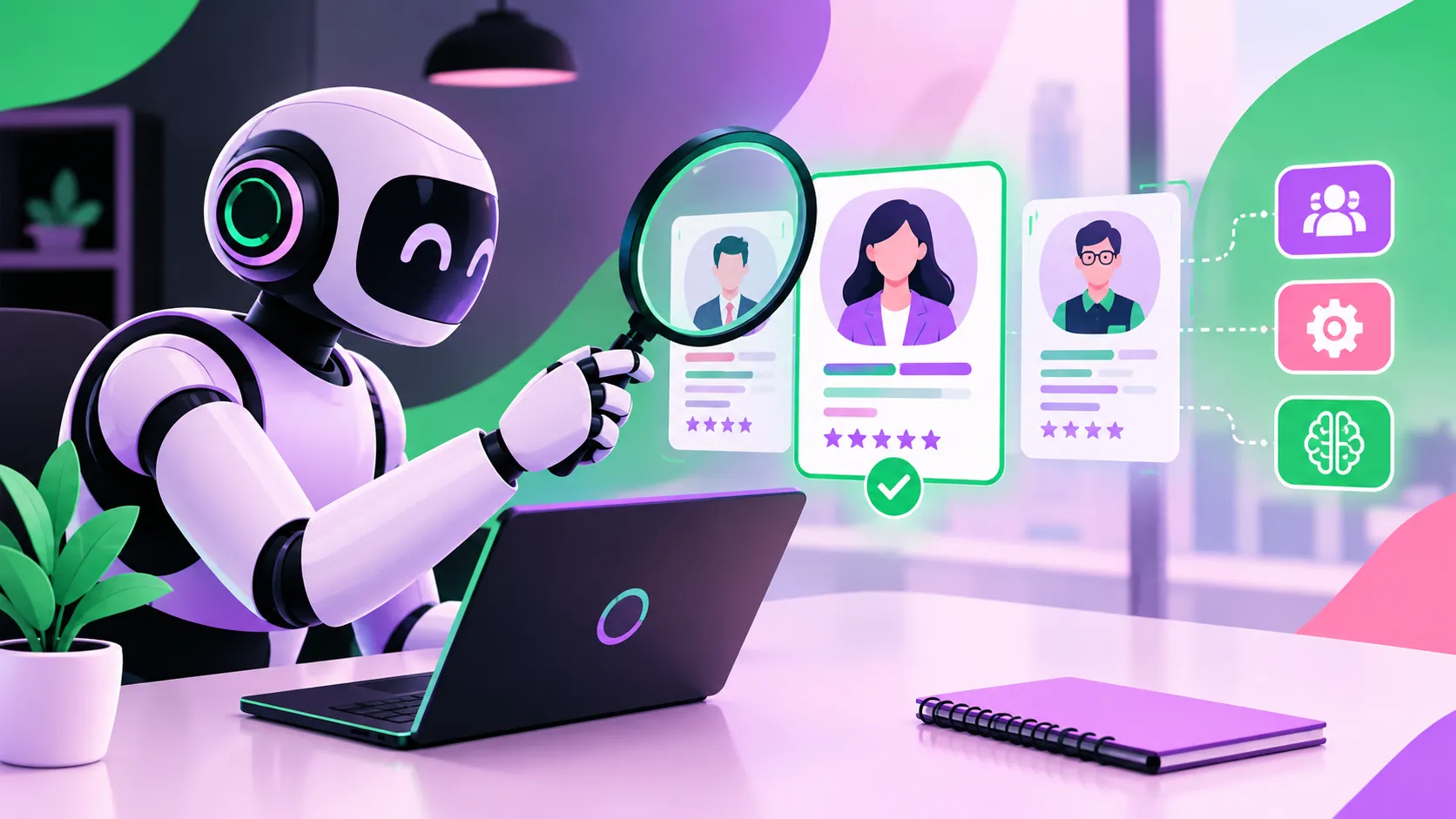
Artificial intelligence hiring is the use of machine learning systems across the recruitment process — parsing and ranking CVs, sourcing passive candidates, generating job descriptions, scheduling interviews, scoring assessments and summarising interview transcripts. It is already the default rather than the exception in mid-sized and large organisations, largely because application volumes rose sharply once applying became a one-click action. The important thing to understand is that "AI hiring" is not one technology but a stack of loosely connected tools, each with different accuracy, different failure modes and different legal exposure. A keyword-matching parser and a video interview scoring model are both marketed as AI recruiting, yet they carry entirely different risks. Treating them as one category is how organisations end up with an unfair process they cannot explain, and how candidates end up rejected by a system nobody in the company fully understands.
Quick Answer: Artificial intelligence hiring uses machine learning to parse CVs, rank applicants, source candidates and summarise interviews. It works well for administrative speed and structured matching, and poorly for predicting job performance or judging personality. Human decision-makers must review every rejection, and every tool needs documented bias testing.
Where AI Genuinely Helps in Recruiting and Where It Should Not Decide
The reliable rule is that AI performs well on tasks with verifiable ground truth and badly on tasks where nobody can agree what the correct answer is. Parsing a CV into structured fields has ground truth — either the extracted job title matches the document or it does not. Predicting whether someone will excel in a role three years from now has no such anchor, because the training data reflects historical hiring decisions and past manager ratings rather than objective performance.
That is why the strongest use cases sit in administration. CV parsing converts unstructured documents into searchable data and removes hours of manual entry. Semantic search across a candidate database lets recruiters find people whose experience matches an intent rather than an exact keyword, which surfaces qualified applicants that keyword filters would discard. Interview scheduling across multiple calendars is a solved logistics problem worth automating. Job description drafting speeds up a repetitive writing task, though someone must still check the requirements are real rather than aspirational. Interview transcript summarisation improves the quality of the evidence panels use, provided candidates consent to recording.
The weak uses cluster around inference about people. Automated video interview scoring based on facial expression or vocal tone rests on contested scientific ground and faces increasing regulatory hostility. Personality inference from social media is both unreliable and reputationally hazardous. Fully automated rejection without human review is, in several jurisdictions, either restricted or requires disclosure and an appeal route. And any model trained to imitate previous hiring decisions will faithfully reproduce whatever pattern those decisions contained, including the parts nobody intended.
Why the Careers Page Matters More Than the Screening Tool — and How WebPeak Helps
Most organisations invest in AI screening while leaving the candidate-facing side of the process untouched, which is precisely backwards. A slow, confusing application flow filters out strong candidates before any model sees them, and structured, machine-readable job data is what allows AI matching to work correctly in the first place. Practical fixes are build problems: applicant tracking integrations and secure data handling belong in back-end web development, structured job schema and accessible forms belong in website design, and hiring teams that need to publish roles without developer help are usually best served by Strapi CMS website development. Agencies operating across those layers, WebPeak among them, tend to start by fixing the application funnel before touching the automation on top of it.
Seven Steps to Deploy AI Hiring Responsibly
This sequence reflects what regulators increasingly expect and what defensible processes look like in practice.
- Write down the decision the tool makes. Distinguish clearly between tools that rank, tools that recommend and tools that reject. Only the first two should ever operate without a human in the loop.
- Demand the vendor's bias audit. Ask for disparate impact testing across protected characteristics, the date it was conducted, and the population it was tested on. A vendor unwilling to share this is telling you something important.
- Keep a human reviewer on every rejection. Human review is both an accuracy control and, in a growing number of jurisdictions, a legal requirement. Log who reviewed what.
- Disclose AI use to candidates. State plainly which stages involve automated assessment and provide a route to request human reconsideration. Transparency reduces complaints and improves employer reputation.
- Structure your job data first. Consistent skills taxonomies and clean job descriptions improve matching accuracy far more than switching to a more advanced model.
- Monitor outcomes, not just efficiency. Track pass-through rates by demographic group and stage. Efficiency metrics alone will hide a fairness problem indefinitely.
- Retain records and explanations. Keep the inputs, the score and the reasoning available for the retention period your jurisdiction requires. If you cannot explain a decision later, you cannot defend it.
AI Hiring Tools Compared by Risk and Value
The table below separates the categories by how much value they deliver against how much risk they carry.
| Tool category | Primary benefit | Risk level | Required control |
|---|---|---|---|
| CV parsing and data extraction | Removes manual data entry | Low | Spot-check extraction accuracy |
| Semantic candidate search | Surfaces qualified people keywords miss | Low to moderate | Review query bias and filters |
| Applicant ranking and scoring | Prioritises reviewer attention | Moderate to high | Documented bias audit plus human review |
| Automated video assessment | Scales early-stage screening | High | Legal review; often best avoided |
| Interview summarisation | Better evidence for panel decisions | Low to moderate | Candidate consent and transcript access |
| Chat-based screening assistants | Answers questions and collects basics | Moderate | Clear disclosure and escalation path |
What Practitioner Experience Shows About AI in Recruiting
No fabricated percentages here — these are the patterns that recur across organisations deploying AI hiring at scale.
AI shifts the bottleneck rather than removing it. Automating screening typically produces more shortlisted candidates reaching interview, which moves the constraint to interviewer availability. Teams that do not plan for that end up with faster screening and slower overall time-to-hire, which is the opposite of the intended outcome.
Bias enters through the training target, not the algorithm. The most common failure is not a badly built model but a badly chosen objective. When a system is trained to predict "candidates similar to those we hired before", it inherits every historical preference in that data — including proxies for background, education and demographics that were never explicitly included as features.
Candidates now use AI too, and screening must adapt. Applications are increasingly AI-assisted, which makes keyword-based CV matching close to meaningless as a signal. Practical hiring stacks are therefore moving toward structured work samples and verifiable evidence rather than document analysis, because polished prose no longer differentiates candidates.
Explainability is the real procurement criterion. Organisations that can articulate why a candidate was ranked where they were handle complaints, audits and regulatory questions comfortably. Those that cannot are exposed regardless of how accurate the model may be. This is one reason careful, human-reviewed content writing for job descriptions and rejection communications remains a genuine competitive advantage in a heavily automated funnel.
The regulatory direction is one-way. Rules governing automated employment decision tools are tightening across multiple jurisdictions, generally converging on three requirements: disclosure to candidates, independent bias auditing, and a human review route. Building to those three principles now avoids rebuilding later, whichever specific law eventually applies to you.
Key Takeaways
- AI hiring performs well on administrative tasks with verifiable answers and poorly on predicting future job performance.
- Bias usually enters through the training objective — imitating past hiring decisions — rather than through the algorithm itself.
- Every automated rejection should have a documented human reviewer and an appeal route for the candidate.
- Automating screening moves the bottleneck to interviewer capacity, so plan interview availability before deploying.
- Explainability, disclosure and independent bias audits are the three requirements regulators are converging on globally.
Frequently Asked Questions
Can AI legally reject a job applicant on its own?
In many jurisdictions this is restricted, and where permitted it usually requires disclosure and a route to human review. The defensible approach everywhere is to let AI rank and recommend while a named human makes and records every rejection decision. Check your local employment law.
How do I know if an AI hiring tool is biased?
Ask the vendor for disparate impact testing showing pass-through rates by protected characteristic, then run your own monitoring on live data. Bias is measured in outcomes, not intentions, so track how different groups progress through each stage rather than trusting a compliance statement.
Should candidates be told that AI is used in the hiring process?
Yes. Disclosure is increasingly a legal requirement and is always good practice. State which stages involve automated assessment, what the system evaluates and how to request human reconsideration. Transparency reduces complaints and measurably improves how candidates perceive the employer.
Does using AI to write my CV hurt my chances?
Not inherently, but generic AI-written applications perform poorly because they lack specific evidence. Use AI to structure and tighten your wording, then add concrete, verifiable achievements with real numbers and outcomes. Specificity is what survives both automated matching and human review.
What is the biggest mistake companies make with AI recruiting?
Automating screening without expanding interview capacity or fixing the application experience. The result is a faster funnel feeding an unchanged bottleneck, plus a rejection process nobody can explain. Fix the job data and candidate journey before adding automation on top of it.
Conclusion
The one decision that determines whether artificial intelligence hiring helps or harms your organisation is where you draw the line between assistance and authority. Let AI handle parsing, sourcing, scheduling and summarising, and keep every rejection in human hands with a written record of who decided and why. That single boundary delivers most of the efficiency benefit while keeping you explainable to candidates, auditors and regulators alike. Your practical next step is straightforward: list every tool currently touching your hiring process, mark which ones can eliminate a candidate, and demand a bias audit and a human review step for each one. If a vendor cannot supply either, that is your answer.
Related articles
 Artificial Intelligence
Artificial Intelligence Headphones: How AI Audio Actually Changes What You Hear
AI headphones promise smarter listening, but the marketing hides what matters. Here is how the machine learning inside them works and which features count.
 Artificial Intelligence
Artificial Intelligence Forex: What AI Can and Cannot Do in Currency Trading
Artificial intelligence forex trading explained honestly: what AI models can and cannot predict, realistic use cases, risk controls, and testing methods.
 Artificial Intelligence
Artificial Intelligence Literacy for Young Children: Main Talking Points Every Parent and Teacher Should Cover
A practical guide to the main talking points of artificial intelligence literacy for young children, with age-based scripts, hands-on activities and clear safety rules.