
Artificial Intelligence Gift Ideas: What to Buy, What to Skip, and Why
Choosing an AI gift is easy to get wrong. This guide breaks down the best AI gadgets and subscriptions by budget, skill level and real everyday usefulness.
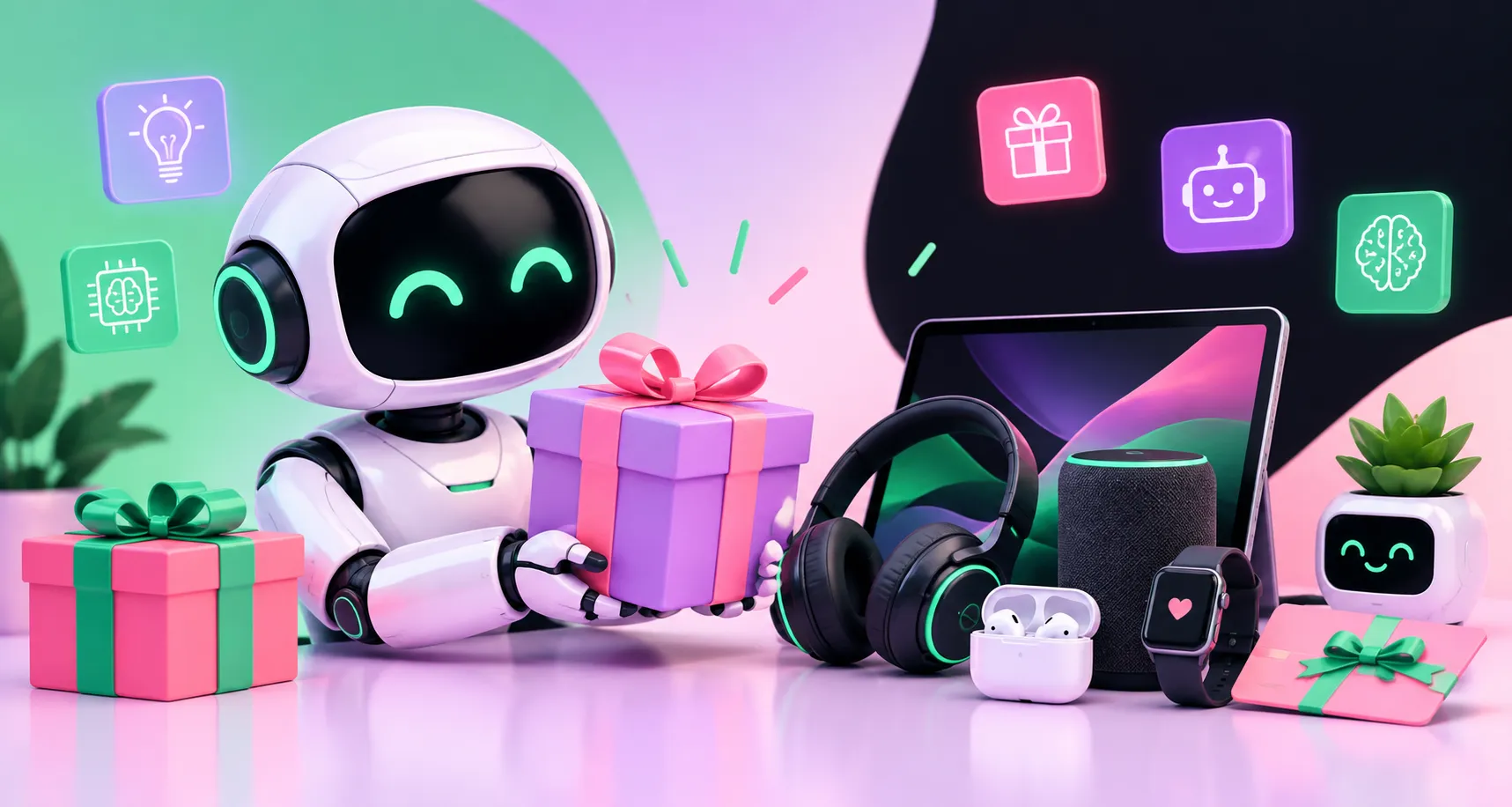
Artificial Intelligence Gift Ideas: What to Buy, What to Skip, and Why
Artificial intelligence gift ideas are presents whose core value comes from machine learning — devices that adapt to the user, software that generates or organises content, or subscriptions that unlock AI capabilities. They have become one of the most popular gift categories and also one of the most returned, because AI gifts fail differently from ordinary ones. A jumper in the wrong size is obvious. An AI gadget in the wrong hands looks impressive for a week, then sits in a drawer because it needed an account, a subscription, a phone permission and a use case the recipient never had. The useful way to shop this category is to stop asking "what is the most advanced AI thing I can buy?" and start asking "what repetitive annoyance in this person's week could a machine plausibly absorb?" Every genuinely successful AI gift answers that second question.
Quick Answer: The best artificial intelligence gift ideas solve a recurring annoyance rather than showcasing technology. Strong choices include AI noise-cancelling earbuds, smart pet or security cameras with object recognition, AI note-taking recorders, robot vacuums with obstacle avoidance, and paid AI assistant subscriptions. Avoid anything requiring heavy setup or an ongoing fee the recipient must pay themselves.
Where WebPeak Fits If You Are Selling AI Gifts Rather Than Buying Them
Gift guides have a commercial mirror image: the brands and retailers trying to sell AI products need pages that explain complicated technology quickly, load fast on mobile and convert without overpromising. That is a build-and-content problem more than a marketing one. Product pages for AI hardware need comparison tables, clear specification blocks and honest capability language, which is why considered website design matters more here than in most retail categories. On the engineering side, filtering, variant selection and fast interactive comparison tools sit squarely in React JS web development territory, with server-side rendering for search visibility handled through Next JS web development. Agencies working across those disciplines worldwide, including WebPeak, tend to treat AI product pages as an education problem first and a conversion problem second — which is the correct order.
Why AI Gifts Fail More Often Than Ordinary Gifts
Understanding the failure modes is the fastest route to a good choice, because almost every disappointing AI gift falls into one of four traps.
The subscription trap. Many AI devices are hardware wrappers around a paid cloud service. The camera works, but the useful features — person detection, event history, smart summaries — sit behind a monthly fee. Gifting a device that quietly generates a bill for the recipient is worse than gifting nothing. Always check whether the core feature survives without a subscription, and if it does not, pay for the first year yourself.
The setup cliff. AI hardware frequently demands an account, firmware update, home network access and a permissions walkthrough. For a technically confident recipient that is a ten-minute job. For someone who dislikes fiddling with apps, it is the reason the box never gets opened twice. Match setup complexity to the person, not to the specification sheet.
The privacy mismatch. Cameras, microphones and always-listening assistants are wonderful gifts for some people and genuinely unwelcome for others. This is not a technical judgement but a personal one, and it is not something you can guess. If you are unsure whether someone wants a microphone in their kitchen, they probably do not.
The capability gap. Marketing language for AI features runs far ahead of reality. "AI-powered" is applied to everything from sophisticated on-device neural networks to a simple threshold rule. The distinguishing question is whether the feature adapts to the individual user over time or merely reacts to a fixed trigger. Only the former is meaningfully AI.
Ten AI Gift Ideas That Hold Up in Daily Use
These are grouped roughly by rising commitment — the earlier items need almost no setup, the later ones assume an interested recipient.
- AI noise-cancelling earbuds. The most reliably appreciated AI gift, because adaptive noise cancellation and voice isolation improve something the person already does daily. No configuration required beyond pairing.
- A paid AI assistant subscription. Gifting a year of a mainstream AI chatbot plan is unglamorous and unusually useful, particularly for students, writers and small business owners. Pay upfront so no card details are needed.
- Smart pet camera with object recognition. Detects and clips the moments that matter instead of recording eight hours of an empty room. Confirm which features work without a plan.
- AI voice recorder or note device. Records meetings and lectures, then transcribes and summarises them. Excellent for anyone who takes notes badly under pressure. Check the language support before buying.
- Robot vacuum with obstacle avoidance. Modern models use on-device vision to identify and avoid cables and pet accidents. This is a genuine AI upgrade over older random-bounce models.
- Smart photo frame with automatic curation. Selects and rotates the best shots from a shared album. Especially good for grandparents, because the effort sits with the giver, not the recipient.
- AI-assisted drawing tablet or creative software licence. For an artistic recipient, tools with generative fill and smart selection remove drudgery rather than replacing skill.
- Sleep or fitness tracker with adaptive coaching. Useful when the coaching actually changes based on personal trends rather than issuing the same generic advice weekly.
- AI language-learning subscription with conversational practice. Speaking practice with an infinitely patient partner is the single strongest AI use case in education.
- A single-board computer AI starter kit. Perfect for a curious teenager or hobbyist who wants to build rather than consume. Wrong for almost everyone else.
Matching AI Gifts to Budget and Recipient
The table below maps price bands to the strongest options and the specific risk to check before you buy.
| Budget band | Strongest option | Best suited to | Key thing to verify first |
|---|---|---|---|
| Under 50 | AI assistant subscription, gifted prepaid | Students, writers, freelancers | Whether they already pay for one |
| 50 to 150 | AI earbuds or smart photo frame | Commuters, parents, grandparents | Device and phone compatibility |
| 150 to 300 | AI voice recorder or pet camera | Professionals, pet owners | Which features need a monthly plan |
| 300 to 600 | Robot vacuum with vision avoidance | Busy households, pet owners | Floor plan and home layout suitability |
| 600 plus | Creative hardware plus software licence | Designers, illustrators, editors | Whether their workflow supports it |
What Buying Patterns Really Tell Us About AI Gifts
No invented statistics here — instead, the patterns that hold up repeatedly among people who buy and receive AI products.
Boring beats novel. The AI gifts that stay in use are almost always ones attached to an existing daily habit: listening, cleaning, sleeping, note-taking. Standalone "AI companion" gadgets with no established habit to attach to are the most commonly abandoned category, because the recipient has to invent a reason to pick them up.
Ongoing cost is the biggest single predictor of abandonment. In practice, devices that quietly require a subscription after a trial period are the ones that end up unused, regardless of how good the hardware is. A cheaper device with full offline functionality is usually the better gift.
On-device processing is worth paying for. Products that run their models locally rather than in the cloud tend to respond faster, keep working during internet outages and raise fewer privacy concerns. Look for phrases like "on-device" or "local processing" in the specifications — it is one of the few marketing claims that reliably signals real engineering.
The best AI gift is often software plus something physical. Pairing a prepaid subscription with a small tangible item solves the problem that digital gifts feel insubstantial while remaining genuinely useful. It is an unglamorous strategy that works.
If you are on the selling side of this category rather than the buying side, the same insight applies to how products are presented: shoppers need honest capability descriptions and transparent subscription terms far more than they need superlatives, which is why well-structured ecommerce solutions for AI hardware focus on comparison clarity rather than persuasion.
Key Takeaways
- The best AI gifts attach to an existing daily habit; standalone AI novelties are the most frequently abandoned.
- Always check whether core features require a subscription, and prepay it yourself if they do.
- Match setup complexity to the recipient's patience, not to the product's specification sheet.
- "On-device" or "local processing" is one of the few AI marketing claims that reliably indicates genuine capability.
- Never gift a camera or always-listening assistant to someone whose privacy preferences you are unsure about.
Frequently Asked Questions
What is the safest AI gift to buy for someone who is not technical?
AI noise-cancelling earbuds are the safest choice, because the intelligence works invisibly and setup ends at pairing. There is no account to configure, no dashboard to learn and no subscription to manage, so the recipient gets the benefit without any of the usual AI friction.
Are AI subscriptions actually a good present?
Yes, provided you prepay them so the recipient never enters payment details. A gifted year of an AI assistant is genuinely useful for students, freelancers and small business owners. Check first whether they already subscribe, since duplicate plans are the most common waste in this category.
How can I tell if a product's AI claims are real?
Ask whether the feature adapts to the individual user over time or simply reacts to a fixed trigger. Genuine AI personalises and improves; marketing-led AI applies a threshold rule. Specifications mentioning on-device models, neural processing or local inference are a reasonable signal of real capability.
Is it rude to give someone a smart camera or voice assistant?
It can be, because microphones and cameras touch personal privacy boundaries you cannot reliably guess. If you have never heard the person express interest in smart home devices, choose something else. When in doubt, gift capability that does not listen or watch continuously.
What AI gift works best for children or teenagers?
An AI starter kit built around a single-board computer suits a curious teenager who wants to build things, while an AI language-learning subscription suits a younger learner. Avoid open-ended chatbots for children without supervision, and check age requirements in the provider's terms.
Conclusion
The single decision that determines whether an AI gift succeeds has nothing to do with the technology: it is whether the present slots into something the recipient already does every week. Pick the habit first — commuting, cleaning, note-taking, learning, sleeping — and then choose the AI product that quietly improves it. Before you check out, confirm two things: that the feature you are buying for still works without a monthly fee, and that the setup is something the recipient will genuinely tolerate. Get those right and you will have given a present that is still in use months later, which is a far better outcome than giving the most advanced thing on the shelf.
Related articles
 Artificial Intelligence
Artificial Intelligence Hiring: How AI Recruiting Works and How to Use It Fairly
AI now touches most stages of recruiting. This guide explains how the tools screen candidates, where bias creeps in, and how to audit a hiring stack safely.
 Artificial Intelligence
Artificial Intelligence Headphones: How AI Audio Actually Changes What You Hear
AI headphones promise smarter listening, but the marketing hides what matters. Here is how the machine learning inside them works and which features count.
 Artificial Intelligence
Artificial Intelligence Forex: What AI Can and Cannot Do in Currency Trading
Artificial intelligence forex trading explained honestly: what AI models can and cannot predict, realistic use cases, risk controls, and testing methods.