
AGI Artificial General Intelligence Bitcoin Mining Switch
Why AGI artificial general intelligence ambitions are pulling bitcoin mining hash rate toward AI compute, and what that switch means for infrastructure teams.
AGI Artificial General Intelligence Bitcoin Mining Switch
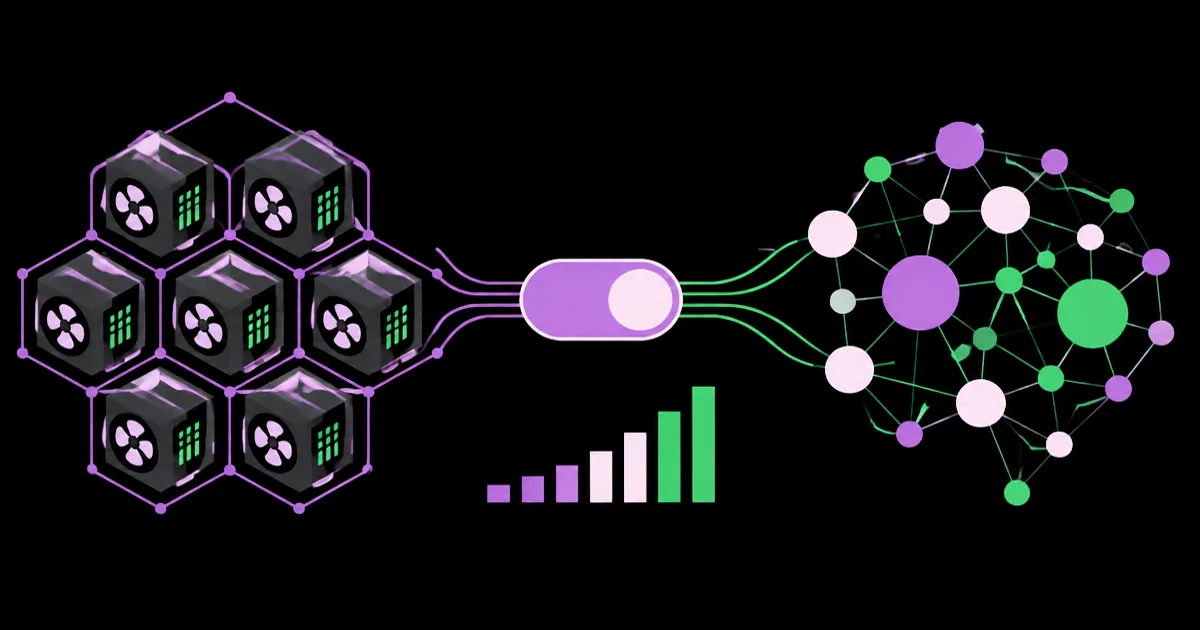
Two industries are now bidding for the same three things: power, land and cooling. Artificial general intelligence, or AGI, refers to a hypothetical system able to perform any intellectual task a human can, and the race toward it has made large-scale AI training the most aggressive new buyer of data centre capacity. Bitcoin mining companies, which spent a decade assembling exactly that kind of capacity, are the ones holding the inventory. That is the real story behind the hash rate switch.
Quick Answer: The AGI-driven bitcoin mining hash rate switch describes miners reallocating power capacity and sites from proof-of-work hashing to AI and high-performance computing workloads. It happens because AI training pays for energy differently, but it requires new hardware, denser cooling and enterprise-grade reliability that mining sites were never built to deliver.
How a Technical Agency Helps Infrastructure Firms Explain the Switch
A capacity pivot is a communication problem as much as an engineering one, because investors, regulators and enterprise customers each need a different version of the same explanation. WebPeak works with infrastructure and deep-tech clients on exactly that translation layer, and their machine learning advisory team is usually the one drawing the boundary between what a site can genuinely host and what a pitch deck claims it can. From there their backend engineering group builds the telemetry dashboards that show utilisation per rack and per contract, which is the artifact enterprise buyers actually ask for. You can see the full breadth of what the agency covers at webpeak.org, including the data visualisation work their technical diagram designers produce for capacity reports.
Why Mining Capacity and AI Compute Are Not Interchangeable
Mining sites and AI data centres share utilities but not architecture. Proof-of-work mining uses ASICs, single-purpose chips that do one hashing operation extremely efficiently and tolerate heat, dust, intermittent power and modest network links. AI training uses GPUs or accelerators that need high-bandwidth interconnect between nodes, tight thermal control, redundant power and low-latency storage.
That means a miner cannot simply repoint hardware at AI work. What transfers is the hard-to-get part: the energy contract, the substation, the land, the permits and the operations team. What does not transfer is the building interior. Converting a mining shed into an AI hall typically means new racks, liquid or rear-door cooling, redundant power distribution and a serious network build. Anyone evaluating these claims should also be sceptical of the vocabulary used to sell them, in the same way you would read past marketing labels when you assess what an AI badge on a product really means.
Hash rate is the second half of the equation. When a miner moves megawatts to AI, its share of network hashing falls, but total network hash rate is set by every participant, so one company's switch is absorbed by difficulty adjustment rather than causing a visible collapse.
How Operators Evaluate a Capacity Switch
Teams that make this decision well tend to work through a fixed checklist:
- Contract quality. AI customers want multi-year commitments with uptime guarantees; mining revenue is variable but obligation-free. Switching trades optionality for predictability.
- Power profile. Mining can throttle instantly and is often paid to do so. AI training clusters dislike interruption, which can disqualify sites whose economics depend on curtailment.
- Cooling ceiling. Rack density for AI is far above typical mining density, so the honest question is how many megawatts the building can cool, not how many it can draw.
- Network path. Remote sites chosen for cheap power frequently lack the fibre routes AI customers require.
- Capital and timeline. Retrofits are construction projects with construction risk, not configuration changes.
- Team skills. Running an enterprise SLA is a different operating discipline from running a mining fleet.
Mining Workloads Versus AI Training Workloads
| Dimension | Proof-of-work mining | AI training cluster |
|---|---|---|
| Primary hardware | Single-purpose ASICs | GPUs and AI accelerators |
| Interconnect need | Minimal | High-bandwidth, low-latency |
| Tolerance for downtime | High | Low |
| Cooling approach | Air, often ambient | Dense air, liquid or rear-door |
| Revenue shape | Variable, market-priced | Contracted, customer-priced |
| Hardware refresh pressure | Efficiency-driven | Generation-driven |
A Practitioner Read on Where This Goes
In practice, the operators who succeed at this switch are the ones who stop describing themselves as miners and start describing themselves as power developers. The durable asset was never the ASIC fleet; it was the ability to secure interconnection and energise a site faster than a traditional data centre developer. Framed that way, mining was an excellent way to monetise stranded power while waiting for a higher-value tenant, and AI is that tenant.
The corresponding risk is concentration. A miner selling hashes has thousands of implicit counterparties and a liquid market; an operator hosting one AI customer has a single counterparty and a multi-year exposure to that customer's funding. Hybrid strategies, where part of a site remains flexible mining load and part becomes contracted compute, are a reasonable hedge for exactly this reason. It also helps to keep the underlying goal in view rather than the hype around it, which is easier if you have read how scientific reasoning differs from statistical pattern learning before assuming AGI timelines justify any capital plan.
Key Takeaways
- The AGI-era compute switch moves energy capacity, not mining hardware, from hashing to AI workloads.
- ASICs cannot run AI training; the transferable assets are power contracts, land, permits and operations capability.
- AI tenancy demands redundancy, dense cooling and fibre that most mining sites were never designed around.
- Switching trades variable but flexible mining revenue for contracted revenue with counterparty concentration risk.
- Hybrid sites that keep some flexible load preserve optionality while capturing contracted AI demand.
Frequently Asked Questions
Can bitcoin mining rigs be used for AI training?
No. Mining ASICs are fixed-function chips built for one hashing algorithm and cannot execute the general matrix operations AI training requires. Only GPU-based mining hardware has any crossover, and even then memory capacity and interconnect usually fall short of modern training requirements.
Does a miner switching to AI reduce bitcoin network hash rate?
It reduces that company's contribution, but network-wide hash rate reflects all participants. Bitcoin's difficulty adjustment absorbs changes in participation, so an individual operator's pivot affects its own revenue mix far more than it affects overall network security.
What does AGI actually mean in this context?
AGI describes a hypothetical system capable of performing any intellectual task a human can. Its practical relevance here is demand-side: the pursuit of ever larger models drives sustained purchases of training capacity, which is what makes energised sites so valuable right now.
Is converting a mining site to AI hosting expensive?
Yes, and it is a construction project rather than a retrofit of equipment. Expect new racks, upgraded cooling, redundant power distribution, structural work and fibre installation, with timelines measured in quarters and capital requirements that often exceed the original mining build.
Should smaller operators attempt this switch?
Only with a signed anchor customer or a partner funding the retrofit. Smaller operators without contracted demand risk spending heavily to build capacity that sits idle, which is a worse position than continuing to mine with flexible, curtailable load.
Conclusion
The decision that matters is not whether AI compute pays better than hashing today; it is whether your site can honestly meet enterprise reliability requirements without a rebuild you cannot fund. Answer that with an engineering assessment before an investor deck. Your next step is a site-by-site audit covering cooling ceiling, fibre availability and interconnect headroom. If you are on the software side of this shift instead, continue with our look at how AI assistants are packaged and deployed on top of that compute.
Related articles
 Artificial Intelligence
Artificial Intelligence 5: Five Shifts Teams Must Plan
Artificial intelligence 5 shifts that decide whether an AI project ships: data readiness, evaluation, cost control, human oversight and clear ownership.
 Artificial Intelligence
Alex Artificial Intelligence: Naming AI Agents That Work
Why Alex artificial intelligence style human names keep appearing on AI assistants, when a personal name helps adoption, and when it quietly damages trust.
 Artificial Intelligence
Albert Einstein Artificial Intelligence: Lessons for AI
What Albert Einstein artificial intelligence comparisons get right and wrong, and how his method of reasoning still challenges how modern models are built.