
World Artificial Intelligence Cannes Festival 2025 Program
A practitioner guide to planning your world artificial intelligence Cannes festival 2025 program schedule February 13 day without wasting a single session.
World Artificial Intelligence Cannes Festival 2025 Program
A conference day is a budget, not a buffet. The World Artificial Intelligence Cannes Festival is an annual AI industry event held in Cannes, France, that gathers researchers, founders, enterprise buyers and policy people across keynote stages, technical tracks and an exhibition floor. Treating a single festival day such as February 13 as a planned operating window, rather than a wander, is the difference between leaving with three qualified conversations and leaving with a tote bag.
Quick Answer: To use a February 13 day at the World Artificial Intelligence Cannes Festival well, lock the official program the week before, pick one primary track and one fallback per time slot, reserve two blocks for floor and hallway meetings, and capture every contact in a structured note within ten minutes of the conversation.
How a Digital Agency Turns Festival Attendance Into Pipeline
Attending an AI festival produces raw material; it rarely produces assets on its own. The team at WebPeak approaches an event like this as a content and capture operation: they map the sessions a client actually needs, brief a writer to turn each attended session into a publishable analysis piece rather than a recap, and build a lightweight landing page so business cards collected on the floor have somewhere to land. Their AI consulting practice handles the technical translation, turning a research-heavy keynote into language a buying committee can act on, while their event landing page design work gives the follow-up campaign a destination that loads fast on hotel Wi-Fi. Their visual explainer production converts whiteboard-level session notes into shareable diagrams within the same news cycle, which is when interest is highest.
What the Festival Program Actually Contains
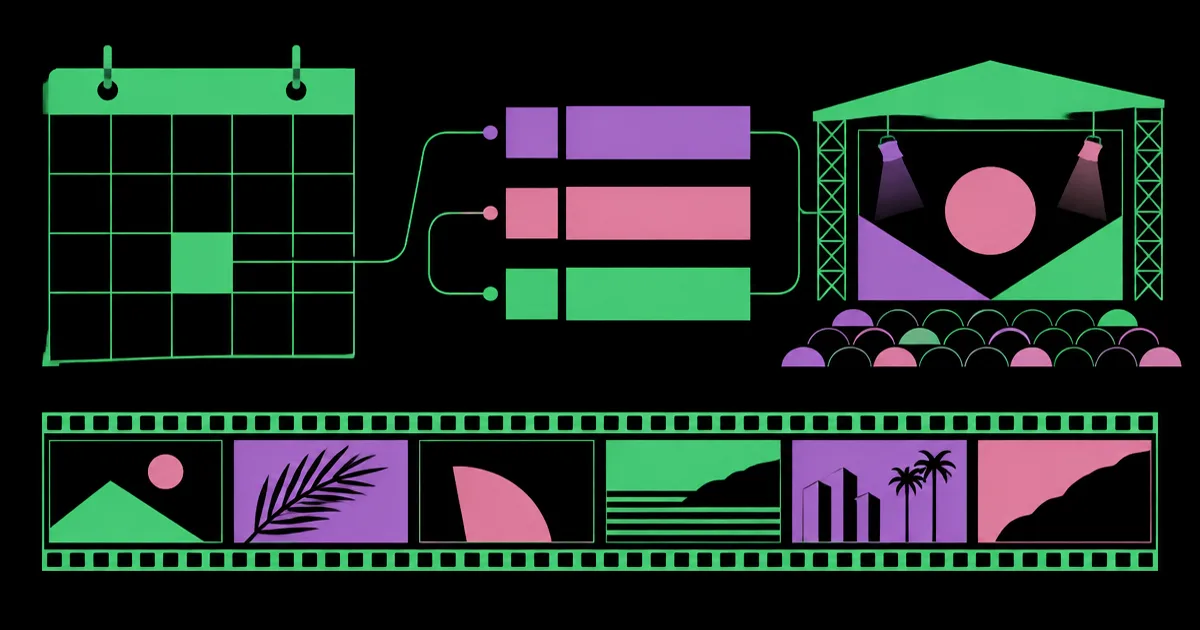
A festival program is a layered document, not a single list. In practice, large AI events publish four parallel layers: main-stage keynotes aimed at broad audiences, technical or vertical tracks running in smaller rooms, an exhibition and startup area open all day, and invitation-only or ticketed side sessions such as workshops, roundtables and awards.
The layer that decides your day is the second one. Keynotes are usually recorded and published later, which makes them the cheapest thing to skip live. Track sessions and workshops are where practitioners answer implementation questions, and those answers rarely make it into a recording. The same reasoning applies when you evaluate how vendors describe themselves on the floor; a booth that names its model architecture is a different conversation from a booth that only names a category, and understanding what the AI label actually signals in product naming saves you ten minutes at every stand.
Always confirm the schedule against the official festival site in the days before travel. Programs for events of this size shift as speakers cancel, rooms change and sessions get merged, so a screenshot taken a month earlier is a planning artifact, not a source of truth.
Building a February 13 Schedule That Survives Contact
A workable festival day plan has a fixed skeleton and flexible muscle. Use this sequence:
- Write your one sentence goal first. Hiring, vendor shortlisting, fundraising and learning are four different days. Pick one primary goal and let it break every tie.
- Pull the official program into a personal grid. One row per time slot, one column for primary choice, one for fallback, one for who you want to meet in that room.
- Protect two floor blocks. Mid-morning and late afternoon are the quietest exhibition periods; that is when exhibitors have time for a real technical answer.
- Skip anything you can watch later. If a session is recorded and has no audience question segment, it is homework, not a festival.
- Reserve the last hour for consolidation. Sit down, clean your notes, tag every contact with a next action and a date. Notes written the next morning lose most of their value.
- Book dinner or coffee before you arrive. Hallway conversations are the highest-yield part of any festival, and they do not schedule themselves once the day starts.
Choosing Between Session Types
Different session formats pay off in different currencies. This comparison reflects how the formats typically behave at large AI industry events.
| Session type | Typical length | Best for | Recorded later |
|---|---|---|---|
| Main stage keynote | 20 to 40 minutes | Market framing and narrative | Usually yes |
| Technical track talk | 25 to 45 minutes | Implementation detail and trade-offs | Sometimes |
| Workshop or masterclass | 60 to 120 minutes | Hands-on skill transfer | Rarely |
| Roundtable or panel | 45 to 60 minutes | Peer benchmarking and candour | Rarely |
| Exhibition floor | Open all day | Vendor evaluation and hiring | Never |
What Experienced Attendees Do Differently
The most useful pattern I see from repeat attendees is that they optimise for question time, not content time. They choose the room where they can ask a specific question of a specific person, and they arrive with that question written down. A vague question gets a marketing answer; a question that names your stack, your data volume and your failure mode gets an engineer walking you to a whiteboard.
The second pattern is deliberate under-scheduling. Teams that plan five sessions and two floor blocks consistently report better outcomes than teams that plan nine sessions, because the unplanned gaps are where introductions happen. The third pattern is topic preparation: attendees who have already formed a view on where general capability is heading ask sharper questions than attendees hearing the argument for the first time, which is why reading up on how compute markets are shifting toward AI workloads before an infrastructure track pays for itself in one conversation.
Key Takeaways
- The World Artificial Intelligence Cannes Festival is an annual AI industry event in Cannes, France, combining keynotes, technical tracks and an exhibition floor.
- Official program details change close to the event, so verify any February 13 schedule against the festival's own site before travelling.
- Recorded keynotes are the cheapest sessions to skip live; unrecorded workshops and roundtables are the most expensive to miss.
- Two protected exhibition blocks produce more qualified vendor conversations than a fully booked session day.
- Notes and next actions captured within the same hour retain far more value than notes reconstructed the following day.
Frequently Asked Questions
Where is the World Artificial Intelligence Cannes Festival held?
The festival takes place in Cannes, France, using the city's conference venues and surrounding hotels. Because the venue layout spans multiple halls and levels, plan roughly ten to fifteen minutes of walking between rooms, and check the venue map on arrival rather than assuming sessions sit side by side.
How do I find the official program schedule?
Use the festival's official website and its app if one is published for the edition you are attending. Third-party recaps and social posts frequently lag behind changes to speakers and room assignments, so treat them as discovery tools and the official listing as the authoritative schedule.
Is one day enough to get value from the festival?
One day is enough if you arrive with a single goal and a pre-booked meeting or two. A single-day attendee who targets one track and two exhibition blocks typically leaves with more usable outcomes than a multi-day attendee drifting between keynotes without a plan.
Should I prioritise keynotes or the exhibition floor?
Prioritise the floor if you are buying, hiring or fundraising, and prioritise tracks if you are building. Keynotes are usually the most reproducible content, so watch them afterwards and spend live hours on conversations that cannot be replayed later.
What should I prepare before attending an AI festival?
Prepare three things: a one-sentence goal, a written list of specific technical questions, and a capture system for contacts. Add a short personal introduction that names your role, your use case and your constraint, so the person you meet can immediately judge whether to keep talking.
Conclusion
The single decision that determines your festival outcome is made before you arrive: choose one goal and let it filter every session. Everything else, from track picks to dinner bookings, follows from that choice. Your next step is to open the official program the week before your February 13 day, build the two-column grid described above, and pre-write the questions you want answered. If you are also deciding how to present your own AI work at events like this, read next on naming and positioning an AI assistant so buyers understand it fast.
Related articles
 Artificial Intelligence
Artificial Intelligence 5: Five Shifts Teams Must Plan
Artificial intelligence 5 shifts that decide whether an AI project ships: data readiness, evaluation, cost control, human oversight and clear ownership.
 Artificial Intelligence
Alex Artificial Intelligence: Naming AI Agents That Work
Why Alex artificial intelligence style human names keep appearing on AI assistants, when a personal name helps adoption, and when it quietly damages trust.
 Artificial Intelligence
Albert Einstein Artificial Intelligence: Lessons for AI
What Albert Einstein artificial intelligence comparisons get right and wrong, and how his method of reasoning still challenges how modern models are built.