
Artificial Intelligence Cake Ideas: Designs That Impress
A practitioner guide to artificial intelligence cake ideas, covering circuit piping, colour control, structural planning and clean edible tech motifs.
Artificial Intelligence Cake Ideas: Designs That Impress
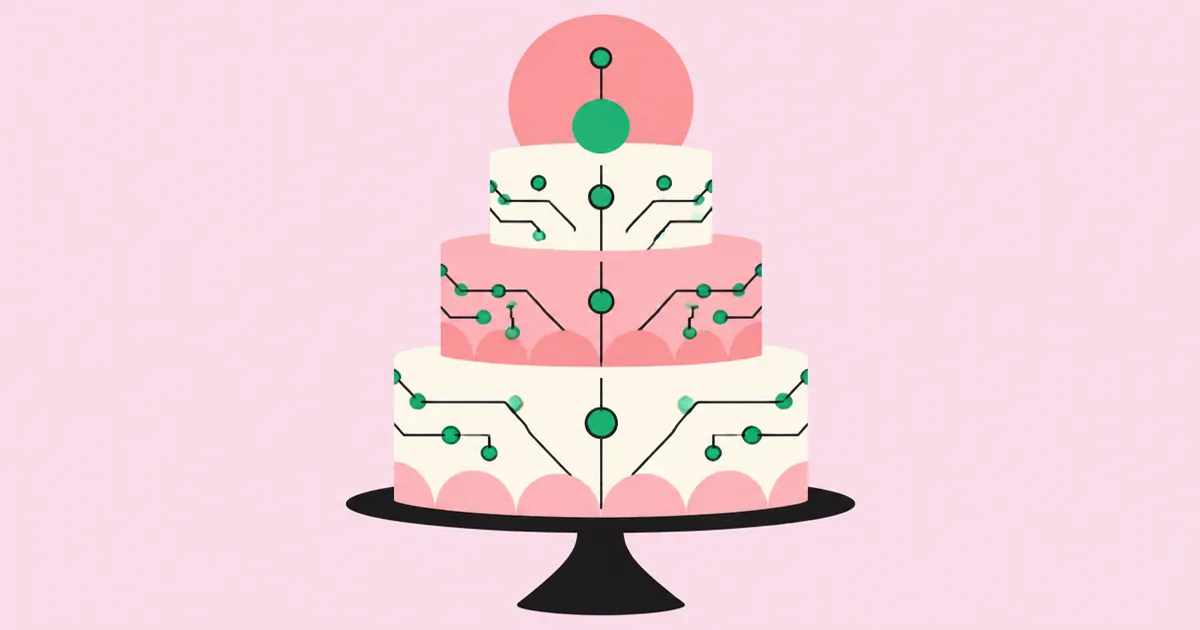
An artificial intelligence cake is a themed cake whose decoration translates machine-learning imagery — circuit traces, node graphs, layered networks, robotic geometry — into edible form. The design problem is not the flavour; it is legibility. Tech motifs are made of thin lines and repeated nodes, and thin lines are exactly what buttercream, humidity and a two-hour car journey destroy first. Successful builds start by choosing one motif and one surface finish that can hold that motif for the whole event.
Quick Answer: An artificial intelligence cake works best with one clear motif, such as circuit traces, a neural node graph or a robot silhouette, piped or printed on a smooth chilled surface. Use three colours maximum, keep line weight above two millimetres, and add fragile toppers only at the venue.
How WebPeak Turns An AI Cake Concept Into A Usable Design File
Most AI cake failures start at the artwork stage: a decorator receives a screenshot of a glowing neural network and tries to pipe detail that was never physically possible. WebPeak works the other way around, building simplified vector versions of AI motifs sized to the actual tier diameters, with line weights, node counts and colour separations set for edible printing or stencil cutting. Their design team also produces the flattened stencil layers, a print-ready wafer-paper file and the matching dessert-table graphics, so the theme reads consistently. Teams planning a launch party or a hackathon celebration usually brief this digital agency once and receive both the cake artwork and the surrounding event assets from the same palette.
What Makes An Artificial Intelligence Cake Read As AI?
Recognition comes from pattern, not from detail. Four motifs communicate artificial intelligence instantly: circuit traces with terminal nodes, a node-and-edge network, a stylised brain split into geometric segments, and a blocky robot form. Anything more literal — a rendered chatbot window, a screen full of code — fails because edible surfaces cannot hold small type. When a theme needs supporting visuals for invitations, table cards or a photo backdrop, the same simplified motif can be reused across print, and a service such as structured visual design work keeps the cake and the printed pieces on one grid.
Colour does the second half of the work. A dark base with one bright accent reads as technology; a pastel base with a single graphic accent reads as playful and modern. Mixing four or five saturated colours flattens the motif and the circuit lines stop being visible in photographs, which is where most cakes actually live afterwards.
Seven AI Cake Designs That Hold Up In Practice
- Circuit-trace tier: smooth dark ganache with gold or mint traces piped in royal icing, terminating in round nodes. The most forgiving design because lines can be piped freehand.
- Node graph dome: a single round cake with sugar spheres connected by piped edges, giving depth without fragile overhangs.
- Geometric brain: a carved dome divided into flat facets, each facet a slightly different shade of one colour family.
- Layered network cake: three stacked rectangles representing input, hidden and output layers, with vertical piped connections between them.
- Robot block cake: square tiers with fondant panels, rivets made from piped dots and a chocolate-panel face plate with no printed features.
- Data-flow drip: a mirror-glaze or drip finish where the drip lines are deliberately spaced to look like signal paths.
- Wafer-paper motif: the printed route — an edible-ink motif applied to a chilled buttercream panel, ideal when the design has fine repeating nodes.
Choosing A Decoration Method For Your Motif
| Method | Best motif | Skill needed | Transport risk |
|---|---|---|---|
| Piped royal icing | Circuit traces, node edges | Moderate hand control | Low once fully set |
| Fondant panels | Robot forms, layered blocks | Rolling and cutting practice | Medium in humidity |
| Edible ink on wafer paper | Dense node graphs, fine grids | Low, needs a printer | Low if kept dry |
| Isomalt or sugar shards | Screen-like accents, spikes | High, heat sensitive | High, apply on site |
| Airbrush with stencils | Gradient circuit backgrounds | Moderate setup | Low |
Practitioner Notes On Building, Moving And Photographing The Cake
In practice, the sequence that fails least is: chill the crumb coat hard, apply the final smooth surface, chill again, then trace the motif with a food-safe marker or a pin-pricked template before any piping begins. Freehand circuit work drifts within the first few centimetres, and a drifted trace cannot be lifted off buttercream without leaving a scar. A common implementation pattern for multi-tier builds is to decorate each tier separately on its own board and stack at the venue, which removes the two riskiest moments — travel vibration and last-minute stacking pressure — from the same hour.
Teams usually underestimate the photography stage. The motif that looked crisp on the bench disappears under warm venue lighting because the accent colour is too close in value to the base. Testing the palette as a flat digital mock-up first costs minutes and prevents that; the same mock-up doubles as a source file for announcement graphics, and studios that also handle event and social visual production can prepare both from one artwork set.
The main operational advantage of treating an AI cake as a design deliverable is repeatability. Once motif geometry, line weight and colour values are documented, the same theme scales from a single eight-inch cake to a dessert table without redesign. Organisations running recurring AI events often keep that documentation alongside their other brand material, and where the theme extends into product demos or interactive displays, teams supporting applied AI implementation work can align the visual story with what the technology actually does.
Key Takeaways
- An artificial intelligence cake reads clearly only when it commits to a single motif such as circuit traces or a node graph.
- Piped line weight below roughly two millimetres becomes invisible in photographs and breaks during transport.
- Three colours — one dominant base, one accent, one neutral — produce stronger contrast than a full multicolour palette.
- Edible-ink wafer paper is the most reliable method for dense repeating patterns that hand piping cannot hold.
- Decorating tiers separately and stacking on site removes the two highest-risk moments from cake delivery.
Frequently Asked Questions
What is an artificial intelligence cake?
It is a themed cake decorated with visual references to machine intelligence, such as circuit traces, neural node graphs, layered network shapes or robot forms. The theme lives entirely in the decoration and colour choices, so any sponge, filling or dietary variation can be used underneath without affecting the concept.
How do you pipe circuit lines on a cake?
Chill the finished surface, mark the route with a pin-pricked paper template, then pipe with stiff royal icing through a small round tip in short connected strokes. Finish each line with a slightly larger dot to form a node. Let the icing set fully before moving or boxing the cake.
Which colours work best for an AI cake?
A dark base with one bright accent gives the strongest technology feel, while a soft pastel base with a single graphic accent suits playful celebrations. Keep to three colours, and check that the accent differs from the base in brightness, not only in hue, so the motif survives dim venue lighting.
Can you print an AI design directly onto a cake?
Yes. Edible-ink printers apply artwork to wafer paper or frosting sheets, which are then laid onto a chilled buttercream or ganache surface. This is the most accurate option for dense node grids and fine repeated patterns, and it needs vector artwork sized precisely to the tier diameter.
How far in advance should the cake be decorated?
Bake and fill one to two days ahead, apply the final surface the day before, and complete piped or printed motifs the evening prior so everything sets. Attach sugar shards, spheres or any fragile toppers at the venue, since those elements soften with humidity and break during transport.
Conclusion
The decision that determines whether an artificial intelligence cake looks intentional or improvised is motif discipline: one pattern, three colours, line weight thick enough to survive both the drive and the venue lights. Sketch the motif flat at true tier size before touching any icing, and let that single drawing govern every decoration choice that follows.
Related articles
 Miscellaneous
How to Say Artificial Intelligence in Spanish Correctly
Wondering how to say artificial intelligence in Spanish? The standard term is inteligencia artificial, and word order matters more than most learners expect.
 Miscellaneous
Artificial Intelligence Stocks Under $1: How to Evaluate Penny AI Plays Without Getting Burned
Artificial intelligence stocks under $1 carry specific structural risks most guides ignore. Here is the delisting, dilution, and disclosure framework to check first.
 Miscellaneous
Artificial Intelligence Costume Ideas: How to Build a Winning AI Look
Planning an artificial intelligence costume? This guide covers concept design, materials, safe electronics, and build ideas that read clearly as AI in a crowd.