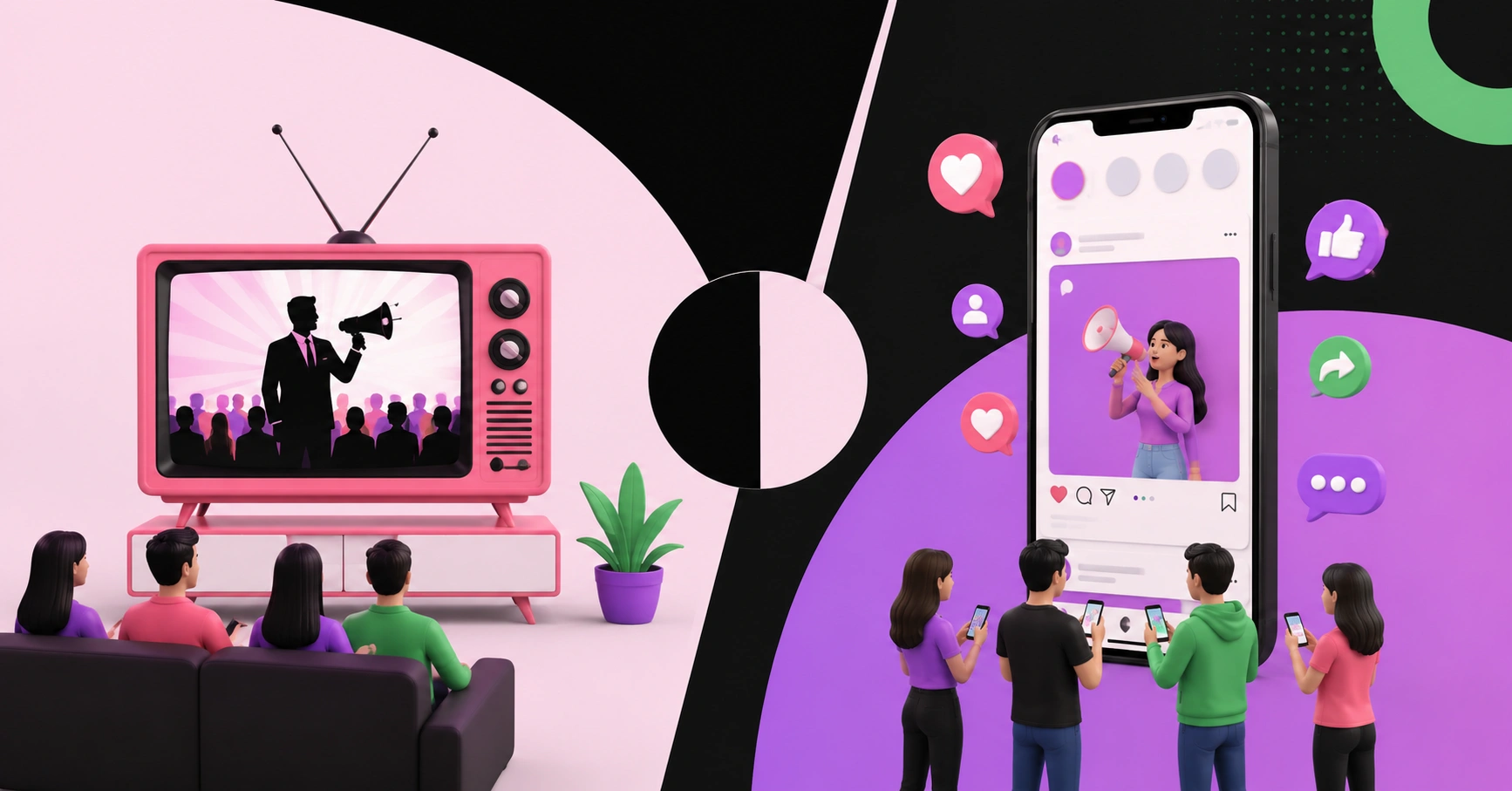
Which Channel Drives Better Awareness: TV or Social Media?
Brand awareness is the degree to which target audiences recognize and recall your brand, and choosing between TV and social media to build it is one of the most consequential media decisions marketers make. Television delivers mass reach and high emotional impact through sight, sound, and motion on a trusted screen, while social media delivers precise targeting, two-way engagement, and measurable interaction at a fraction of the entry cost. The honest answer is that neither channel is universally "better" — the right choice depends on your audience, budget, product complexity, and the specific type of awareness you need. Global ad spending data shows this clearly: digital now commands the majority of ad budgets, yet TV still captures a significant share precisely because it does something social struggles to replicate at scale.
Quick Answer: Social media drives better awareness for targeted, budget-conscious, and younger audiences with measurable engagement, while TV drives better broad, mass-market awareness and emotional trust. For most brands, a combined approach — TV for scale and social for precision — outperforms relying on either channel alone.
How WebPeak Helps You Build a Data-Driven Awareness Strategy
Deciding between channels is only valuable if you can execute and measure the campaign effectively. WebPeak helps brands plan, launch, and optimize awareness campaigns across digital channels, combining creative and analytics under one roof. Their digital marketing services cover audience research, paid social, and performance tracking so you invest where returns are provable, while their social media management team builds the consistent content presence that turns one-time impressions into lasting recall. Because their strategists work from real engagement data rather than assumptions, they can tell you whether your budget is better spent scaling reach or deepening targeted engagement — the exact question at the heart of the TV-versus-social debate.
What Is the Real Difference Between TV and Social Media Awareness?
The core difference is passive reach versus active engagement. TV builds awareness through repeated, high-quality exposure to broad audiences who watch without interacting — it is excellent at making a brand feel established and trustworthy. Social media builds awareness through targeted exposure combined with interaction: likes, shares, comments, and saves that extend organic reach and signal genuine interest.
Reach is the total number of unique people exposed to your message, while engagement measures how actively they respond. TV historically wins on raw reach for mass-market products, especially during live events. Social media wins on engagement and precision, letting you target by age, interest, behavior, and location — and then measure exactly who responded. Crucially, social awareness compounds: a single shared post can reach new audiences organically, whereas TV awareness stops the moment the ad budget does.
Which Channel Should You Choose for Your Business Goals?
The right channel depends on matching medium strengths to your objectives. Use these guidelines to decide where your awareness budget belongs:
- Choose TV when you sell a broad-appeal product, need to reach older or less digitally active demographics, are launching at national scale, or want the credibility signal that a TV presence still carries.
- Choose social media when you have a defined niche audience, a limited budget, a younger target demographic, or a product that benefits from demonstration, community, and shareable content.
- Choose both when you have the budget for an integrated campaign — TV drives the initial mass awareness spike, and social media captures, retargets, and deepens that attention with measurable follow-up.
- Prioritize social first when you need to prove ROI quickly, since its lower entry cost and precise measurement let you test messaging before committing to expensive TV production.
A practical rule: if you cannot clearly describe your target customer's demographics and interests, TV's broad net may serve you better; if you can, social media's targeting will stretch your budget far further.
How Do TV and Social Media Compare Side by Side?
To make the trade-offs concrete, the table below compares both channels across the factors that most influence awareness outcomes. Use it to weigh which strengths align with your current goals and constraints.
| Factor | Television | Social Media |
|---|---|---|
| Reach | Very broad, mass-market, strong for live events | Highly targeted, can scale but audience-segmented |
| Entry cost | High production and airtime costs | Low, accessible even for small budgets |
| Targeting precision | Limited to program and time-slot demographics | Precise by age, interest, behavior, and location |
| Measurement | Estimated ratings, harder to attribute directly | Real-time, granular, fully trackable metrics |
| Engagement | Passive one-way viewing | Interactive, shareable, community-driven |
| Best for | Broad trust and large-scale launches | Niche targeting, testing, and measurable growth |
What Do the Data and Trends Say?
The numbers reveal a clear shift with important nuance. According to industry estimates from sources like Statista and eMarketer, digital advertising now accounts for well over 70% of total global ad spend, and social media alone represents a large and growing share of that figure. At the same time, Nielsen research has repeatedly found that TV still delivers some of the highest reach per exposure for mass audiences, and studies on media trust consistently rank TV advertising among the more credible formats compared to online ads.
In my experience running awareness campaigns, the most common mistake is treating this as a binary choice. The brands that win rarely pick one channel — they sequence them. A short TV or connected-TV burst creates a recognition baseline, and social media then does the heavy lifting of retargeting, storytelling, and conversion at a measurable cost per result. The original insight most guides miss is this: social media does not just build awareness, it validates it. Because you can measure engagement in real time, social lets you confirm which messages resonate before you pour money into non-measurable TV placements. For most businesses today, especially those without national budgets, leading with social media and layering in targeted video or connected-TV as growth allows is the smarter, more accountable path.
Key Takeaways
- Social media wins on targeting, cost-efficiency, and measurability; TV wins on broad reach and perceived trust.
- Digital now commands over 70% of global ad spend, yet TV retains high reach-per-exposure for mass audiences.
- Social awareness compounds through shares and organic reach, while TV awareness stops when the budget stops.
- An integrated approach — TV for scale, social for precision — consistently outperforms relying on a single channel.
- Lead with social media to test and prove messaging before committing to higher-cost TV placements.
Frequently Asked Questions
Is social media better than TV for brand awareness?
Social media is better for targeted, budget-conscious, and measurable awareness, especially with younger audiences. TV is better for broad, mass-market reach and building trust. Neither is universally superior; the right choice depends on your audience, budget, and awareness goals, and combining both often works best.
Which channel is cheaper for advertising?
Social media is significantly cheaper to start with, requiring no expensive airtime or high production costs. Small businesses can launch effective campaigns on modest budgets. TV involves substantial production and placement expenses, making it better suited to brands with larger budgets and mass-market objectives.
Can small businesses benefit from TV advertising?
Small businesses can benefit from local TV or connected-TV placements, which are more affordable than national spots and offer some targeting. However, most small businesses see faster, more measurable results by leading with social media first and adding TV once they have proven messaging and budget.
How do I measure awareness on each channel?
On social media, track reach, impressions, engagement rate, shares, and follower growth in real time through built-in analytics. TV awareness relies on estimated ratings, reach studies, and brand-lift surveys, which are less precise. Social media offers far more direct, granular measurement of campaign performance.
Should I use TV and social media together?
Yes, for most brands with adequate budget an integrated approach works best. TV or connected-TV creates a broad recognition baseline, and social media retargets, deepens engagement, and measures response. Sequencing the two channels typically produces stronger, more accountable awareness results than using either alone.
Conclusion
The single most important insight is that the TV-versus-social-media question is rarely an either-or decision — it is a matter of sequencing strengths to match your audience and goals. If you must choose one, most modern businesses should lead with social media because it lets you target precisely, measure honestly, and prove what works before committing larger sums, then layer in TV or connected-TV as your ambitions and budget grow. Start by clearly defining who your customer is and what type of awareness you actually need, then build a channel plan around measurable outcomes rather than assumptions. Awareness that you can measure is awareness you can improve, and that discipline — not the channel itself — is what ultimately drives lasting brand recognition.