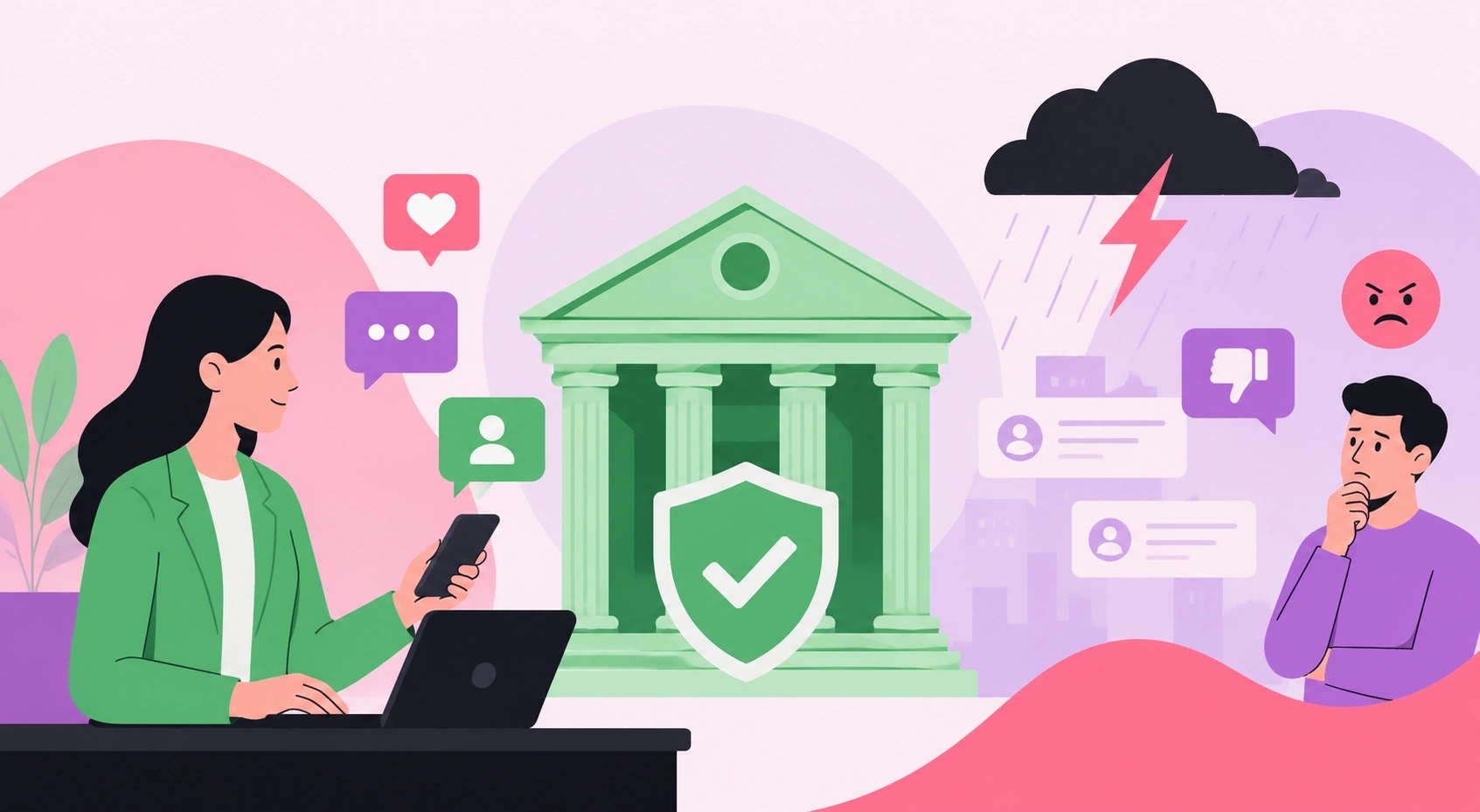
How Should Banks Handle Social Media During a Crisis?
Crisis communication for banks is the coordinated practice of managing public messaging during high-stakes events like outages, fraud incidents, data breaches, or liquidity rumors, when fear can spread instantly. On social media, banks should handle a crisis by responding fast, communicating with transparency, centralizing their message, and actively monitoring sentiment to stop misinformation before it triggers panic or a bank run. In an environment where a single viral rumor can move billions in deposits within hours, a slow or defensive social media response is itself a financial risk. This article lays out a practical, expert framework banks can use.
Quick Answer: Banks should handle social media during a crisis by responding within minutes, communicating transparently from a single verified account, correcting misinformation quickly, and reassuring customers with facts about their security. A pre-built crisis plan, monitoring tools, and a trained response team are essential.
How WebPeak Helps Financial Brands Prepare for Crisis Communication
Effective crisis response depends on systems built long before trouble strikes. WebPeak is a worldwide digital agency that helps financial and corporate brands build resilient communication infrastructures. Their digital marketing services include social listening setup, response playbooks, and rapid content workflows, so banks can detect emerging issues early, deploy approved messaging in minutes, and maintain customer trust even under intense public pressure during a high-stakes event.
Why Is Social Media So High-Risk for Banks During a Crisis?
Banks run on trust, and trust is fragile online. A bank run, the rapid mass withdrawal of deposits driven by fear, can now begin on social media rather than at physical branches. Misinformation spreads faster than verified facts, and screenshots, even fake ones, can appear authoritative. Customers expect near-instant answers, so silence reads as guilt or incompetence. Regulators and journalists also monitor these channels in real time, meaning every post carries legal and reputational weight. The combination of speed, scale, and high financial stakes makes social media uniquely dangerous and uniquely important for banks during any disruption.
What Steps Should a Bank Take Immediately in a Social Media Crisis?
A disciplined sequence prevents improvised mistakes. Banks should follow a clear, rehearsed order of operations the moment a crisis emerges.
- Activate the crisis team: Bring legal, communications, and executives together within minutes.
- Acknowledge quickly: Post a brief holding statement confirming you are aware and acting.
- Centralize messaging: Direct all updates through one verified official account to prevent confusion.
- Correct misinformation: Address false claims directly with verifiable facts, not vague denials.
- Reassure with specifics: Confirm deposit insurance, security measures, and what customers should do.
- Update continuously: Provide regular progress updates until the issue is fully resolved.
What Should and Should Not Banks Do on Social Media in a Crisis?
Clear do's and don'ts keep teams aligned under pressure. The wrong tone or a deleted post can deepen a crisis as much as the original event. The table below contrasts effective and harmful approaches across the most critical decision points banks face during a live incident.
| Situation | Effective Action | Harmful Action |
|---|---|---|
| Initial response | Acknowledge within minutes with facts | Stay silent or wait hours for perfection |
| Misinformation | Correct calmly with verifiable evidence | Ignore it or argue defensively |
| Customer fear | Reassure with specifics and clear next steps | Use vague corporate jargon |
| Negative comments | Respond professionally and consistently | Delete comments or block critics |
What Does Recent Experience Teach Banks About Crisis Speed?
Recent events prove that speed and transparency are decisive. During the 2023 collapse of Silicon Valley Bank, analysts widely noted that fear amplified on social media and messaging apps contributed to roughly 42 billion dollars in withdrawal requests in a single day, one of the fastest bank runs in history. Separately, research from Edelman's Trust Barometer consistently shows that financial services rank among the lower-trust sectors, meaning banks start from a trust deficit that crisis missteps can quickly worsen. In my assessment, the insight most banks underestimate is that pre-approval is everything: the institutions that survive social media crises are not necessarily the ones with the best writers, but the ones with legally cleared message templates and decision authority ready to deploy in minutes, not days. Preparation, not eloquence, wins.
What Should Be in a Bank's Social Media Crisis Plan?
A crisis plan is the difference between a coordinated response and a chaotic scramble, and every bank should have one documented and rehearsed before it is ever needed. The plan should clearly define roles, specifying exactly who monitors channels, who drafts messages, who approves them, and who has final sign-off authority during off-hours. It should include a tiered severity framework so the team knows when a complaint is routine versus when it constitutes a full crisis requiring executive involvement. Pre-approved message templates for the most likely scenarios, outages, breaches, fraud, and liquidity rumors, save critical minutes because they only need minor customization rather than full legal review under pressure. The plan must also specify monitoring tools and thresholds that trigger escalation, a contact tree reachable 24/7, and a post-crisis review process. Critically, the plan should be tested through simulations at least annually, because a plan that exists only on paper and has never been practiced almost always fails when adrenaline and ambiguity are high during a real event.
How Should Banks Rebuild Trust After a Crisis?
The work does not end when the immediate crisis subsides; how a bank behaves afterward determines whether trust is restored or permanently damaged. The first step is a transparent post-incident summary that explains what happened, what the bank did, and what it is changing to prevent recurrence, communicated in plain language rather than legalese. Banks should then follow through visibly on those commitments, because customers remember broken promises far longer than the original incident. Proactively reaching out to affected customers, offering concrete remedies, and maintaining a steady cadence of normal, helpful content all signal stability returning. In my assessment, the institutions that emerge stronger from a crisis treat it as a trust-building opportunity rather than something to bury and forget. Acknowledging mistakes honestly, demonstrating accountability, and showing measurable improvement can actually deepen customer loyalty, turning a moment of vulnerability into proof that the bank can be relied upon precisely when things go wrong.
Key Takeaways
- Banks should acknowledge a crisis on social media within minutes, as silence reads as guilt.
- Social-media-driven fear contributed to roughly 42 billion dollars in single-day withdrawals during the 2023 SVB collapse.
- All crisis messaging should flow through one verified official account to prevent confusion.
- Deleting critical comments or blocking customers almost always escalates a crisis.
- Pre-approved message templates and a trained response team matter more than perfect wording.
Frequently Asked Questions
How fast should a bank respond on social media during a crisis?
A bank should post an initial acknowledgment within minutes, ideally under 30, even if full details aren't ready. A quick holding statement confirming awareness prevents misinformation from filling the vacuum and signals to customers and regulators that the situation is being actively managed.
Should banks delete negative comments during a crisis?
No. Deleting critical comments almost always backfires, appearing as censorship and fueling distrust. Instead, respond professionally with facts, address legitimate concerns directly, and only remove content that is abusive, illegal, or clearly spam, following a documented and consistent moderation policy.
What should a bank's first crisis post include?
The first post should acknowledge the issue, confirm the bank is aware and investigating, reassure customers their funds and data are protected where true, and promise timely updates. Keep it brief, factual, and free of jargon to calm fear without overpromising specifics.
How can banks prevent a social media crisis from causing a bank run?
Banks prevent runs by responding instantly, correcting false rumors with evidence, emphasizing deposit insurance and liquidity, and maintaining consistent reassurance. Active social listening to detect rumors early, combined with transparent and frequent updates, stops panic from compounding before it spreads beyond control.
Who should manage a bank's social media during a crisis?
A pre-designated crisis team should manage it, including communications, legal, compliance, and senior leadership with clear decision authority. Frontline social media staff execute approved messaging, while executives sign off quickly. Defined roles and pre-cleared templates ensure fast, accurate, and legally sound responses.
Conclusion
The most important decision a bank can make is to build its social media crisis plan before a crisis ever happens, because in a real event there is no time to improvise. Speed, transparency, and pre-approved messaging are the difference between containing fear and triggering a run. Your next step is to audit your current readiness: do you have monitoring in place, cleared templates, and a team empowered to act in minutes? In banking, trust is the product, and on social media, that trust is defended one fast, honest update at a time. The banks that thrive through turbulence are not those that avoid every crisis, that is impossible, but those that prepare relentlessly, respond transparently, and treat each incident as a chance to prove their reliability. Build that capability before you need it, and a moment that could break customer confidence becomes one that ultimately reinforces it.