How Do Search Engine Advertising Compare to Social Media Advertising?
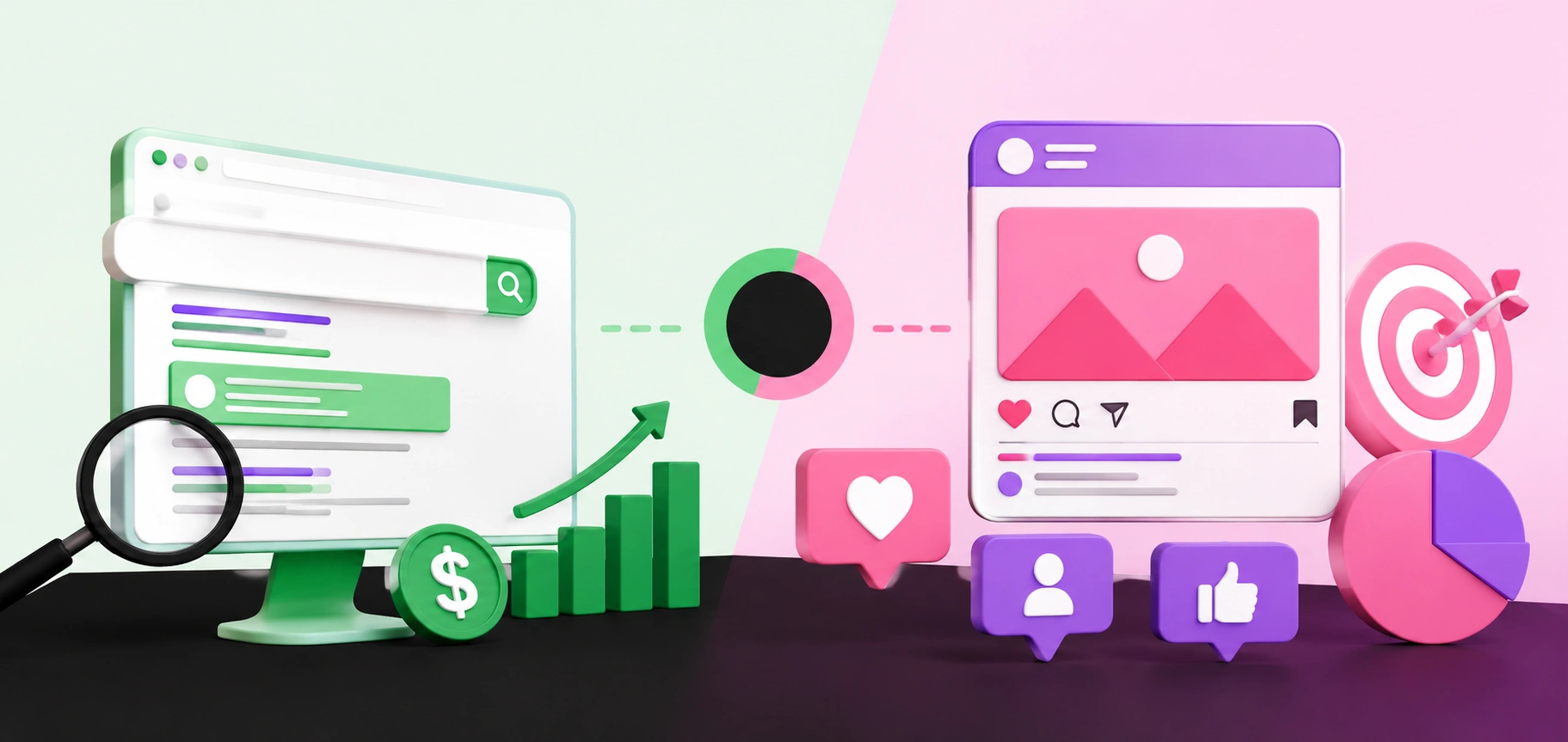
Search engine advertising and social media advertising are the two dominant forms of paid digital marketing, but they work on fundamentally different principles. Search engine advertising (like Google Ads) shows ads to people who are actively searching for a product or solution — capturing existing demand. Social media advertising (like Meta, TikTok, or LinkedIn ads) shows ads to people based on their interests, behaviors, and demographics — creating demand by interrupting the feed. Understanding this distinction between capturing intent and creating interest is the key to allocating your budget wisely and avoiding wasted spend on the wrong channel for your goals.
Quick Answer: Search engine advertising targets active buyers searching for solutions, delivering high intent and faster conversions. Social media advertising targets users by interest and behavior, excelling at brand awareness and demand creation. Use search for bottom-funnel capture and social for top-funnel discovery — most businesses need both.
How WebPeak Helps You Master Both Advertising Channels
Choosing between search and social is rarely either/or — the winning approach blends both with the right budget split. WebPeak builds integrated paid media strategies that run Google Ads for high-intent search capture alongside social media marketing campaigns for discovery and retargeting. Their team handles keyword research, audience targeting, ad creative, and conversion tracking so your spend is measured against real revenue, not vanity metrics. This lets businesses test both channels intelligently and shift budget toward whatever delivers the best return.
What Is the Core Difference in User Intent?
Intent is the defining difference between these two channels. Search intent means the user has a specific need and is actively looking for it — someone typing "emergency plumber near me" is ready to buy now. Interest-based targeting means the platform predicts who might care based on their behavior, even though they were not looking for you.
This changes everything about how each channel performs. Search ads convert faster because they meet demand at the exact moment of need, but demand is capped by how many people are searching. Social ads reach far larger audiences and build awareness, but conversion rates are typically lower because you are interrupting, not answering. A business selling a brand-new product with no search volume must use social to create demand first; a business selling a known service benefits most from capturing search demand.
Which Channel Should You Choose for Your Goal?
The right channel depends entirely on your objective, product type, and sales cycle. Use this framework to decide where to invest:
- Choose search advertising when: people already search for your product, you sell high-intent services (legal, medical, repair, B2B software), or you need fast, measurable conversions.
- Choose social advertising when: you are launching a new or visual product, building brand awareness, targeting a specific demographic, or retargeting previous website visitors.
- Use both when: you want a full-funnel strategy — social to introduce your brand and search to capture the demand that social created.
A practical rule: if a customer would type your solution into Google, prioritize search. If they would discover it while scrolling, prioritize social. Most mature businesses run both, using social to fill the top of the funnel and search to close the bottom.
How Do the Two Channels Compare on Key Metrics?
Comparing search and social side by side clarifies where each shines. The table below breaks down the practical differences that affect your budget and results.
| Factor | Search Engine Advertising | Social Media Advertising |
|---|---|---|
| User Intent | High — active searchers | Low to medium — passive discovery |
| Best For | Conversions & lead capture | Awareness & demand creation |
| Targeting Basis | Keywords & search queries | Interests, behavior, demographics |
| Typical Conversion Speed | Fast | Slower, nurture-driven |
| Creative Emphasis | Text & ad copy | Visual & video content |
The comparison reveals a complementary relationship rather than a rivalry. Search captures the demand that social helps create, which is why the strongest campaigns coordinate messaging across both channels rather than treating them as competing line items.
What Do the Data and ROI Trends Show?
The numbers reinforce that both channels earn their place in a marketing budget. According to WordStream's benchmark data, the average click-through rate for Google Search ads across industries is roughly 3–6%, reflecting the high intent of searchers. Meanwhile, Meta reports that its advertising reaches billions of monthly active users, giving social ads unmatched scale for awareness and precise interest-based targeting.
In my experience analyzing campaigns, the most common mistake is judging both channels by the same metric. Expecting social ads to convert as directly as search ads leads marketers to cut social budgets that were actually building the pipeline search later closed. The smarter approach is measuring search on cost-per-conversion and social on cost-per-qualified-reach and assisted conversions. Businesses that align each channel with the right KPI — and support it with strong SEO for long-term organic capture — consistently get more from every dollar than those chasing a single channel.
Key Takeaways
- Search advertising captures existing demand from high-intent buyers; social advertising creates demand through interest-based targeting.
- Search converts faster but is capped by search volume; social offers massive reach but lower direct conversion rates.
- Use search for bottom-funnel capture and social for top-funnel discovery — most businesses need both.
- Judge each channel by the right KPI: cost-per-conversion for search, assisted conversions and reach for social.
- Coordinating messaging across both channels outperforms treating them as competing budgets.
Frequently Asked Questions
Is search advertising better than social media advertising?
Neither is universally better — they serve different goals. Search advertising is better for capturing ready-to-buy customers, while social advertising is better for building awareness and reaching new audiences. The best choice depends on your product, sales cycle, and objective. Most businesses achieve the strongest results using both together.
Which is cheaper, Google Ads or social media ads?
Social media ads often have a lower cost-per-click, but Google Ads frequently deliver a lower cost-per-conversion because searchers have higher intent. Cheaper clicks do not always mean cheaper customers. Evaluate cost based on actual conversions and revenue, not click price alone, to judge true value.
Can I run search and social ads at the same time?
Yes, and doing so is often the most effective strategy. Social ads build awareness and create demand, while search ads capture that demand when users later search for your product. Running both creates a full-funnel system where each channel reinforces and improves the performance of the other.
Which channel works best for a brand-new product?
Social media advertising usually works best for brand-new products because there is little to no existing search demand to capture. Social lets you create awareness and interest through visual and video content. Once people begin searching for your product, adding search ads captures that newly generated demand.
How do I measure success on each channel?
Measure search advertising by cost-per-conversion, conversion rate, and return on ad spend. Measure social advertising by reach, engagement, assisted conversions, and cost-per-qualified-lead. Using the wrong metric — like expecting social to convert like search — leads to cutting campaigns that are actually driving pipeline value.
Conclusion
The most important insight is that search and social advertising are not competitors but partners at different stages of the customer journey — social creates the demand that search then captures. Rather than asking which is better, ask which stage of your funnel needs the most help right now and fund that first. Start by defining your primary goal, matching it to the right channel, and measuring each with the metric that fits its purpose. With disciplined tracking and coordinated messaging, paid advertising becomes a predictable growth engine rather than a guessing game.