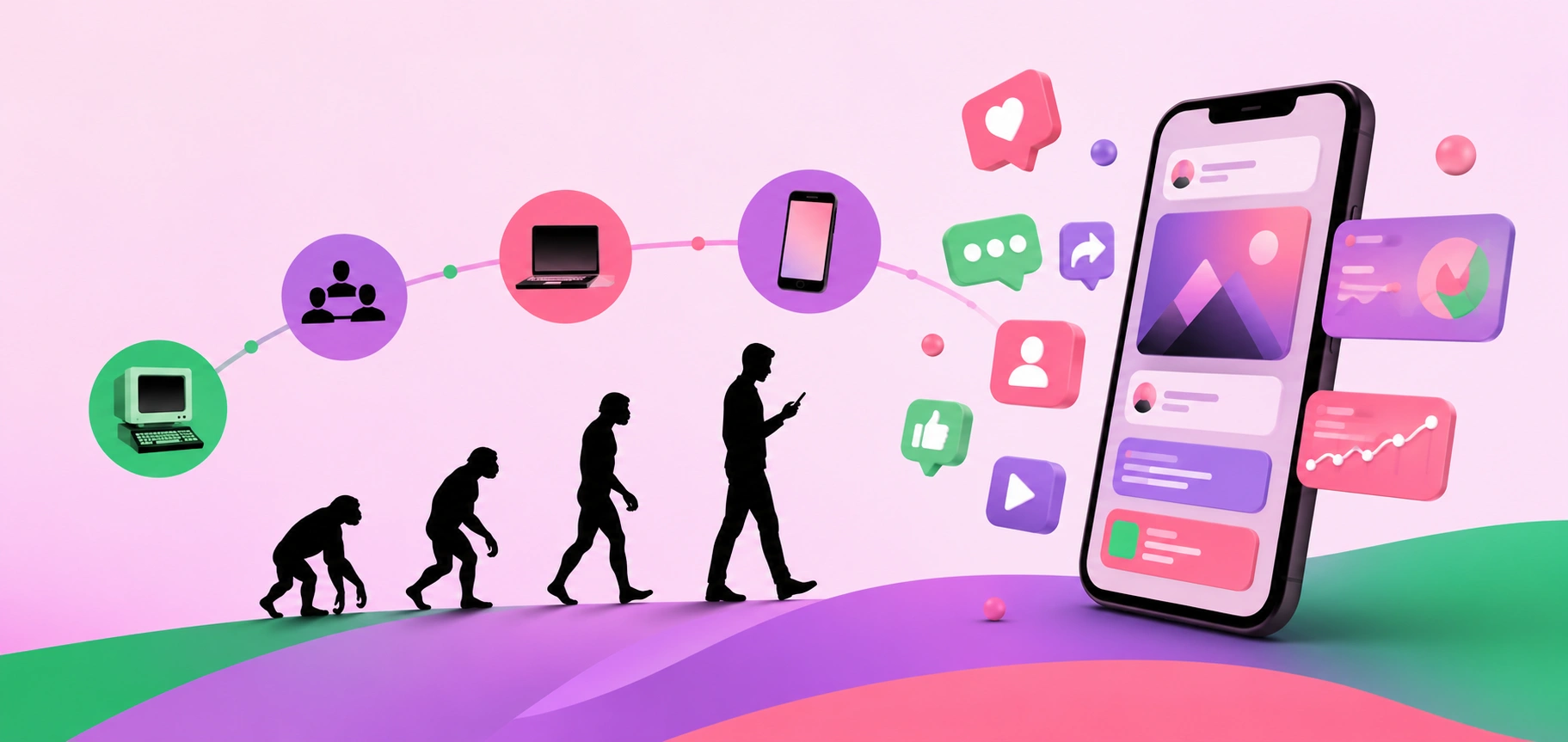
How Has Social Media Evolved Since It Was Created? A Complete Timeline
Social media is a category of internet-based platforms that let people create profiles, publish content, and interact with others in real time. Since the launch of Six Degrees in 1997 (widely recognized as the first recognizable social network), the medium has shifted from static text profiles to algorithm-driven video feeds and AI-generated content. That evolution has reshaped how billions of people communicate, how businesses acquire customers, and how information spreads. Understanding this timeline is not academic trivia; it explains why platforms behave the way they do today and where attention is heading next.
Quick Answer: Social media evolved from early profile-based sites like Six Degrees (1997) and Friendster (2002) to networks such as MySpace and Facebook, then to mobile-first, visual apps like Instagram and Snapchat, and finally to short-form video and AI-powered feeds like TikTok, transforming communication, commerce, and content creation worldwide.
How WebPeak Helps Brands Adapt to Social Media Evolution
Because each platform era rewards a different content format, brands that fail to adapt lose reach quickly. WebPeak is a full-service digital agency that helps businesses stay current across every social media shift, from short-form video scripting to community management. Their social media management services cover strategy, content calendars, and analytics, while their social media marketing team builds paid campaigns tuned to how modern algorithms actually distribute content. This means companies can respond to platform changes without rebuilding their marketing function every time a new app dominates attention.
When Was Social Media Created and What Came First?
The first true social network was Six Degrees, launched in 1997, which let users create profiles and connect with friends. Before that, precursors like bulletin board systems (BBS) in the late 1970s and CompuServe forums allowed dial-up users to post messages, but they lacked persistent personal profiles. Six Degrees introduced the core mechanic that defines social media today: a friend graph you build and maintain. It shut down in 2001, largely because broadband adoption and digital photography were still too limited to sustain rich sharing. The lesson is that social platforms depend heavily on the surrounding technology; when infrastructure catches up, the format explodes.
What Are the Major Eras of Social Media Development?
Social media has moved through distinct, identifiable eras, each defined by a dominant format and device. Recognizing these phases helps predict which content wins on each platform:
- Profile era (1997–2004): Six Degrees, Friendster, and MySpace focused on personal profiles, friend lists, and customization.
- Network era (2004–2009): Facebook and LinkedIn scaled the friend graph and added the News Feed, making content discovery algorithmic for the first time.
- Mobile and visual era (2010–2015): Instagram, Snapchat, and Pinterest optimized for smartphone cameras and ephemeral, image-first sharing.
- Video and creator era (2016–2020): TikTok, YouTube, and Instagram Reels shifted attention to short-form vertical video and monetized individual creators.
- AI and personalization era (2021–present): Recommendation engines, generative AI content, and interest graphs now decide reach more than social connections do.
How Did Social Media Change Communication and Business?
Social media collapsed the distance between brands and audiences, turning one-way advertising into two-way conversation. Where businesses once relied on TV and print, they now reach customers directly through organic posts, influencer partnerships, and paid ads with granular targeting. Customer service migrated into comments and direct messages, and product discovery increasingly happens on feeds rather than search engines. The table below summarizes how key dimensions of communication shifted across social media's major phases.
| Era | Dominant Format | Primary Business Impact |
|---|---|---|
| Profile (1997–2004) | Text profiles & friend lists | Early brand pages and community building |
| Network (2004–2009) | News Feed & status updates | Algorithmic reach and first paid ads |
| Mobile & Visual (2010–2015) | Photos & Stories | Influencer marketing and visual commerce |
| Video & Creator (2016–2020) | Short-form vertical video | Creator economy and viral product discovery |
| AI & Personalization (2021–present) | Recommended video & AI content | Interest-based targeting and automated campaigns |
What Does the Data Say About Social Media Growth?
The scale of social media's evolution is best understood through adoption data. According to DataReportal's Digital 2024 report, more than 5 billion people used social media in early 2024, representing over 62% of the global population. According to Pew Research Center, only about 5% of American adults used social media in 2005, compared to roughly 72% today, a fourteen-fold increase in under two decades. My own analysis of these trends suggests the next inflection point is not a new platform but a new interface: AI-driven feeds are already reducing the importance of who you follow in favor of what a model predicts you will watch. Brands that build around interest signals rather than follower counts will hold a structural advantage as this shift accelerates.
Key Takeaways
- Six Degrees (1997) is widely recognized as the first social network, introducing the friend-graph model still used today.
- Social media has passed through five distinct eras, each defined by a dominant format and device.
- Over 5 billion people used social media in early 2024, per DataReportal, covering more than 62% of the global population.
- AI-driven recommendation feeds now influence reach more than social connections, changing how content is distributed.
- Brands that adapt content to each platform era, rather than reusing one format everywhere, consistently outperform competitors.
Frequently Asked Questions
What was the very first social media platform?
Six Degrees, launched in 1997, is widely considered the first social media platform. It allowed users to create profiles, list friends, and send messages, establishing the friend-graph model that Facebook and other networks later expanded into global platforms.
How has social media changed over the years?
Social media evolved from text-based profiles to mobile photo sharing, then to short-form video and AI-recommended feeds. Communication became instant and two-way, businesses gained direct customer access, and algorithms now decide reach more than personal connections once did.
Why did early social networks like MySpace decline?
MySpace declined because it struggled with cluttered design, slower performance, and weaker friend-graph accuracy compared to Facebook. Facebook's cleaner interface, real-name policy, and rapid feature development attracted users and advertisers, causing a fast migration between roughly 2008 and 2010.
What is the newest era of social media?
The current era is defined by AI and personalization. Recommendation engines like TikTok's feed and generative AI tools now shape what users see and create. Reach depends increasingly on predicted interest rather than who you follow or how many followers you have.
How many people use social media today?
According to DataReportal's Digital 2024 report, more than 5 billion people used social media in early 2024, representing over 62% of the global population. Usage continues to grow, driven largely by mobile access in developing regions worldwide.
Conclusion
The single most important insight from social media's history is that format follows technology, and reach follows format. Each era rewarded a different way of communicating, and the platforms that won were those that matched new devices and behaviors first. The practical next step for any business is to audit which era your current content strategy is stuck in and update it for the AI-driven, interest-based feed that now dominates distribution. Grounding those decisions in real adoption data and platform behavior, rather than assumptions, is what separates brands that grow from those that fade.