
Fleet Artificial Intelligence: How AI Is Rebuilding Modern Fleet Management
Fleet artificial intelligence explained: how AI telematics, predictive maintenance and route optimisation cut costs, and how to deploy it without losing drivers.
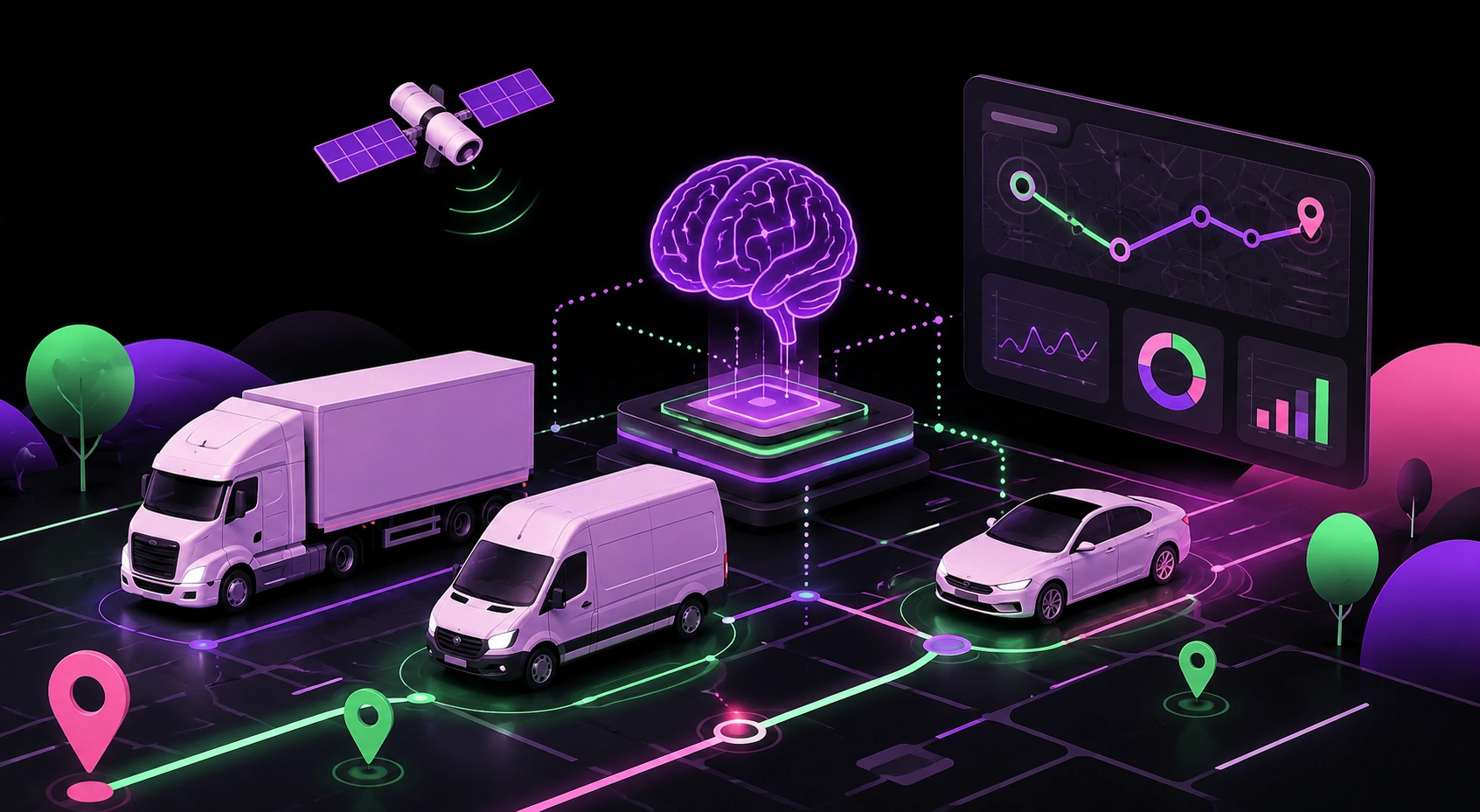
Fleet Artificial Intelligence: How AI Is Rebuilding Modern Fleet Management
Fleet artificial intelligence is the application of machine learning to vehicle fleet operations — using telematics, camera, engine, and routing data to predict failures, optimise dispatch, score driving behaviour, and automate compliance work that used to be manual. A fleet, in this context, is any managed group of vehicles: trucking fleets, delivery vans, service vehicles, buses, refuse collection, rental cars, or increasingly mixed electric and combustion fleets. What separates fleet AI from ordinary fleet software is direction. Traditional telematics tells you what happened — a vehicle sped, a part failed, a route ran late. AI systems predict what will happen and prescribe an action before the cost lands. That shift from reporting to prediction is where the operational value sits, and it is also where most implementations go wrong.
Quick Answer: Fleet artificial intelligence uses machine learning on telematics, engine, and video data to predict maintenance failures, optimise routes dynamically, coach driver behaviour, and automate compliance. Its main value is shifting fleets from reactive reporting to preventive action, reducing unplanned downtime and fuel waste.
Section 2: What Fleet AI Actually Does, System by System
Fleet AI is not one product but five distinct capability areas, each with different data requirements and different failure modes. Confusing them is the most common procurement mistake.
Predictive maintenance ingests engine and diagnostic data — via OBD-II on light vehicles and the SAE J1939 CAN bus on heavy commercial vehicles — and learns which fault-code sequences, temperature curves, and voltage patterns precede specific failures. The output is a work order scheduled before a breakdown, not an alert after one. Its accuracy depends entirely on having historical repair records to label against; without them, the model has nothing to learn from.
Dynamic route optimisation solves a constrained vehicle routing problem that changes continuously as traffic, orders, time windows, vehicle capacity, and driver hours shift. Unlike static route planning, AI systems re-solve mid-shift and re-dispatch.
AI dash cameras and driver behaviour analysis use on-device computer vision to detect following distance, lane departure, phone use, and drowsiness, then trigger in-cab alerts. Providers in this category include Samsara, Motive, Lytx, and Netradyne. The critical design choice is whether coaching is immediate and private to the driver or reported upward as surveillance — that single decision determines adoption.
Fuel and energy management models idling, acceleration profiles, load, and terrain. On electric fleets it extends to charge scheduling and range prediction under real load and temperature, which is materially different from manufacturer range figures.
Compliance automation handles hours-of-service, inspection reports, and audit trails. In the United States, the FMCSA electronic logging device (ELD) mandate already requires digital hours-of-service records for most commercial drivers, so the data foundation for this layer typically exists before any AI is added.
How WebPeak Supports Fleet Technology Builds
Fleet AI projects fail more often on plumbing than on modelling. Telematics feeds arrive in inconsistent formats, dashboards get built for executives rather than dispatchers, and driver-location data creates privacy exposure nobody scoped. Teams tackling this generally need three competencies together: web application development for the operational interfaces dispatchers actually live in, cloud solutions for ingesting continuous vehicle telemetry at scale, and cybersecurity work to protect location and video data. Fleet operators building custom platforms rather than buying off the shelf can review the full range of engineering services WebPeak offers to cover those gaps. Hiring for the modelling side is a separate challenge, and this overview of specialist AI talent recruiters is a useful starting point for fleets staffing an in-house data team.
A Practical Rollout Sequence for Fleet AI
Order matters enormously here. Fleets that start with the most advanced capability almost always stall. This sequence front-loads data quality and driver trust.
- Fix your data foundation first. Standardise vehicle IDs, odometer sources, fault codes, and repair records across all systems. Every downstream model inherits this quality ceiling.
- Digitise maintenance history before predicting it. Twelve to twenty-four months of labelled repair records is what makes predictive maintenance meaningful rather than decorative.
- Pick one measurable pain point for the pilot. Unplanned roadside breakdowns, fuel spend on a specific route group, or preventable collisions. One metric, one vehicle group, one quarter.
- Introduce cameras as coaching, not surveillance. Announce them in advance, explain retention periods, give drivers access to their own footage, and route alerts to the driver first. Skipping this step is the leading cause of camera programme failure.
- Keep humans in the dispatch loop initially. Let the optimiser recommend and let dispatchers approve. Trust is earned by visible correctness, and dispatchers catch context the model lacks.
- Measure against a real baseline. Record pre-deployment figures for downtime, fuel per mile, and incident rate. Without a baseline, any vendor's improvement claim is unfalsifiable.
- Scale by capability, not by fleet size. Prove one system fully across a subset, then add the next capability. Parallel rollouts obscure which change produced which result.
Comparing Fleet AI Capability Areas
The table below maps each capability to its data requirement, realistic time to value, and the risk most likely to derail it.
| Capability | Primary Data Source | Time to Measurable Value | Main Implementation Risk |
|---|---|---|---|
| Predictive maintenance | Engine and diagnostic bus data plus repair history | Medium to long | Missing or unlabelled maintenance records |
| Dynamic route optimisation | GPS, orders, traffic, time windows | Short | Dispatchers overriding recommendations |
| Driver behaviour and AI cameras | In-cab and road-facing video | Short to medium | Driver resistance and privacy exposure |
| Fuel and EV energy management | Fuel cards, telemetry, charge sessions | Short | Incomplete or reconciled fuel data |
| Compliance automation | ELD and inspection records | Short | Over-automating decisions needing human review |
Regulatory Facts and Field-Tested Observations
Several concrete constraints shape what fleet AI can legally do. In the United States, the FMCSA ELD rule requires most commercial motor vehicle drivers subject to hours-of-service rules to use electronic logging devices, which is why telematics penetration in US trucking is near-universal. In the European Union, driving time and rest periods are governed by Regulation (EC) No 561/2006, and smart tachographs are mandated for relevant vehicles — meaning European fleets have a comparable but differently structured data foundation. On privacy, driver location and in-cab video are personal data under the GDPR, which requires a lawful basis, defined retention, and transparency to the driver; several EU jurisdictions treat continuous in-cab recording as requiring particularly strong justification. These are real regulatory instruments, not vendor talking points, and they should be read before a camera contract is signed.
Beyond compliance, here is a clearly-labelled practitioner assessment rather than a statistic. In fleet AI deployments, the constraint is almost never model quality — it is workflow integration. A predictive maintenance alert that lands in an email inbox instead of the maintenance scheduling system produces no value at all, no matter how accurate it is. The fleets that get results connect predictions directly to work-order creation, parts availability, and bay scheduling, so the prediction has somewhere to go.
The second recurring pattern is driver churn as the hidden cost line. Camera programmes introduced without consultation reliably drive experienced drivers to competitors, and replacing a qualified commercial driver costs far more than the fuel savings the programme was justified on. Any honest fleet AI business case should model retention risk alongside efficiency gains. The third observation, specific to electrification: on mixed EV and diesel fleets, the highest-value early AI application is usually charge scheduling and real-world range prediction rather than maintenance, because energy cost variability and range anxiety are the binding constraints on utilisation.
Key Takeaways
- Fleet AI covers five distinct capability areas — predictive maintenance, route optimisation, driver behaviour, energy management, and compliance — each with different data needs.
- Predictive maintenance requires labelled historical repair records; without them, models have nothing to learn from.
- The FMCSA ELD mandate in the US and EU Regulation 561/2006 with smart tachographs mean most commercial fleets already have the data foundation in place.
- Driver location and in-cab video are personal data under the GDPR, requiring a lawful basis, defined retention, and driver transparency.
- Fleet AI value is limited by workflow integration, not model accuracy — predictions must feed directly into work orders and dispatch systems.
Frequently Asked Questions
What is fleet artificial intelligence in simple terms?
It is software that learns from your vehicles' data to predict problems and recommend actions. Instead of a report telling you a truck broke down last week, it flags the truck likely to break down next week and schedules the repair, using engine, GPS, and camera data together.
Do small fleets benefit from AI or is it only for large operators?
Small fleets benefit most from route optimisation, fuel analysis, and compliance automation, because these need little historical data and deliver value quickly. Predictive maintenance is harder below roughly twenty vehicles, since the fleet generates too few failure examples for reliable pattern learning.
How do AI dash cameras affect driver privacy?
In-cab video is personal data in most jurisdictions and is governed by the GDPR in Europe. Fleets should define retention periods, restrict access, disclose recording clearly, and give drivers visibility of their own footage. Event-triggered recording is generally easier to justify than continuous capture.
Can fleet AI reduce fuel and energy costs?
Yes, mainly by targeting idling, harsh acceleration, inefficient routing, and poor charge scheduling on electric vehicles. The gains are real but incremental and require driver behaviour change to persist. Establish a pre-deployment fuel-per-mile baseline so improvements can be verified rather than assumed.
What is the biggest mistake fleets make with AI adoption?
Buying advanced analytics before cleaning their data and workflows. Inconsistent vehicle identifiers, undigitised repair records, and alerts that land outside the maintenance system all produce accurate predictions nobody acts on. Fix the plumbing, then add the intelligence layer on top of it.
Conclusion
The decisive question in any fleet AI programme is not which vendor has the best model but whether your organisation can act on a prediction within its existing workflow. A system that forecasts a failure eight days out is worthless if parts procurement takes twelve days and nobody owns the alert. Before evaluating platforms, map one prediction end to end — from data source to alert to work order to completed repair — and identify where it would stall today. Fix that path first. Fleets that do this find their existing telematics data was already sufficient for meaningful gains, while fleets that skip it accumulate dashboards and wonder why costs never moved.
Related articles
 Artificial Intelligence
Jeff Dunham Artificial Intelligence: What That Search Really Tells Us About AI and Comedy
Why does Jeff Dunham artificial intelligence trend? This guide covers AI-generated comedy clips, likeness rights, and how ventriloquism differs from AI.
 Artificial Intelligence
How Attractive Am I? Artificial Intelligence Beauty Scores Explained Honestly
How attractive am I? Artificial intelligence scoring apps answer fast, but their maths is shakier than it looks. Here is what the scores really measure.
 Artificial Intelligence
Frontiers Artificial Intelligence: Where the Real Research Edge Sits Today
Frontiers artificial intelligence has two meanings: a peer-reviewed journal and the field's research edge. This guide explains both and why they matter now.