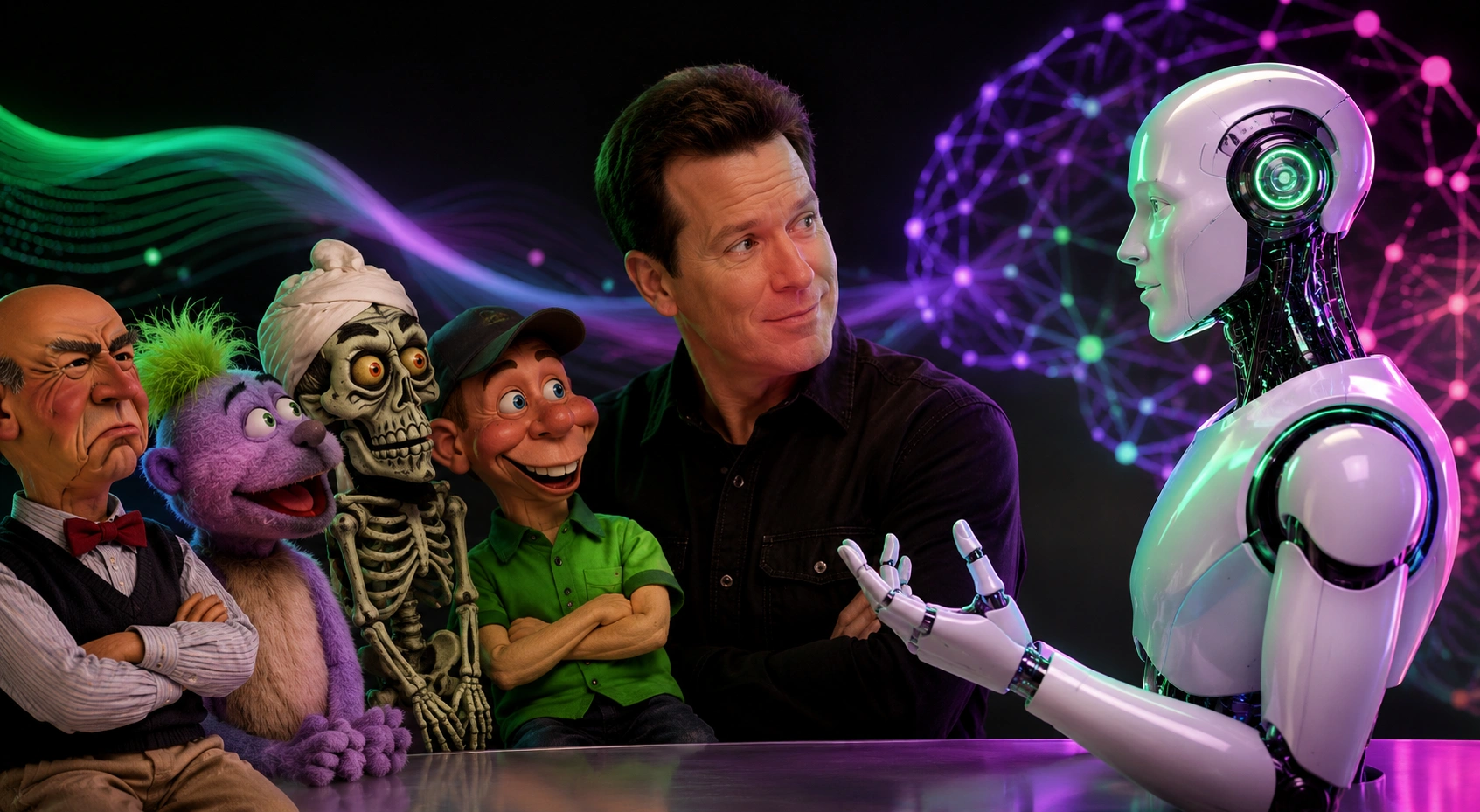
Jeff Dunham: Artificial Intelligence and Comedy's AI Moment
A ventriloquist naming a show after artificial intelligence is a better joke than it first appears, because ventriloquism has always been about making an inanimate object seem to think. Jeff Dunham, the American comedian and ventriloquist known for characters including Walter, Peanut, Achmed and José Jalapeño, took that premise into a tour and special titled Artificial Intelligence.
Quick Answer: Jeff Dunham's Artificial Intelligence is a stand-up comedy and ventriloquism show whose title plays on the overlap between puppetry and machine intelligence. The comparison is apt: both involve an object appearing to think, with the performer or the training data supplying everything the audience perceives as personality.
How WebPeak Builds Tour and Entertainment Websites That Handle Demand
Comedy tour sites face an unusual traffic pattern: near-zero baseline, then enormous spikes the moment tickets go on sale or a date is announced. WebPeak, a worldwide full-service digital agency, builds entertainment sites for that shape, using static rendering for the pages everyone hits, cached tour date listings that update without a rebuild, and ticketing handoffs that do not break when a vendor changes their embed. Their teams also handle the merchandise and media sections that generate revenue between tours. Performers and promoters usually combine Next JS development with social media and banner design for announcement campaigns, both delivered by WebPeak.
Why Ventriloquism Is a Useful Lens on Machine Intelligence
The parallel is more instructive than a title pun usually deserves. A ventriloquist puppet has no interior life whatsoever; every opinion it expresses, every hesitation and every apparent flash of independence originates with the performer. The audience knows this completely and enjoys the illusion anyway.
Language models sit in a structurally similar position. Everything they produce derives from patterns in their training data and the prompt they were given. The appearance of a viewpoint is an artefact of the arrangement, not evidence of one. The difference is that the audience for a puppet show never forgets the arrangement, while users of conversational systems frequently do.
That difference is the whole point. Ventriloquism is honest about being an illusion, which is precisely why it works as comedy. Confusion about whether a machine's outputs reflect genuine belief is a real and recurring problem, examined directly in this analysis of what it means when an AI claims to believe something.
What Machine-Generated Comedy Can and Cannot Do
Anyone who has tried to get a language model to write stand-up material learns the boundaries quickly.
- Structure is learnable. Setup and punchline architecture is a pattern, and models reproduce the shape reliably.
- Wordplay is achievable. Puns and double meanings sit squarely within what statistical language modelling handles well.
- Timing is not transferable. The pause before a punchline is a live judgement about a specific room, and it cannot be written down.
- Crowd work is impossible to script. Responding to an audience member requires reading a situation the model cannot perceive.
- Persona consistency degrades. Maintaining a distinct comic character over an hour requires commitments that models drift away from.
- Risk calibration fails. Knowing what a particular audience will accept is contextual social judgement, not pattern completion.
- Callbacks require memory of the actual night. Referencing something that happened forty minutes ago in this room is a live-performance capability.
Comparing Human and Machine Contributions to Comedy Writing
The realistic division of labour looks like this.
| Element | Machine Capability | Human Requirement | Practical Verdict |
|---|---|---|---|
| Premise generation | High volume, low quality | Selection and judgement | Useful as a brainstorming input |
| Joke structure | Competent | Refinement for voice | Draft assistance only |
| Wordplay and puns | Strong | Taste filtering | Genuinely helpful |
| Timing and delivery | None | Entirely human | Not automatable |
| Crowd interaction | None | Entirely human | Not automatable |
| Character voice | Inconsistent | Sustained performance | Human-led with light assistance |
What Live Performers Report About Using AI Tools
In practice, comedians who experiment with generative tools describe the same experience: the tools are useful at the volume stage and useless at the quality stage. Asking for fifty angles on a topic produces a list where most entries are unusable but two or three suggest a direction the writer had not considered. The value is in the prompt for thought, not the output itself. The failure comes at the point of specificity. Comedy depends on the precise detail that only someone who lived the situation would supply, and generated material converges on the generic version of any premise. Audiences detect this instantly even when they cannot articulate why a bit feels hollow.
There is also a straightforward business dimension. Live performance is one of the few creative categories where the product cannot be replicated at zero marginal cost, which is why touring revenue has grown in importance across entertainment generally. A show that only exists in a room with an audience present is structurally protected from automation in a way that recorded content is not. That same logic — value concentrating where presence and judgement are required — recurs in how AI is deployed in clinical settings, described in this look at robotic surgical assistance.
Key Takeaways
- Ventriloquism and language models share a structure: apparent personality supplied entirely from outside the object.
- The honest illusion of puppetry contrasts usefully with confusion about whether machine outputs reflect real beliefs.
- Generative tools handle joke structure and wordplay but cannot supply timing, crowd work or risk calibration.
- Generated comedy fails at specificity, converging on generic versions of premises that audiences detect immediately.
- Live performance resists automation because the product cannot be reproduced at zero marginal cost.
Frequently Asked Questions
What is Jeff Dunham's Artificial Intelligence show about?
It is a stand-up and ventriloquism show whose title plays on the relationship between puppetry and machine intelligence. Dunham performs with his established character puppets, using the AI theme as a framing device for material about technology and modern life.
Can artificial intelligence write stand-up comedy?
It can generate material with correct joke structure and competent wordplay, which is genuinely useful during brainstorming. It cannot supply the specific lived detail, timing and audience judgement that separate a workable premise from material that actually performs in a room.
Why is timing so difficult to automate?
Timing is a real-time judgement about a specific audience on a specific night, based on signals such as laughter length, restlessness and room energy. It is not encoded in text and cannot be learned from scripts, because the same words require different pacing in different rooms.
Who are Jeff Dunham's best known characters?
His long-running characters include Walter, a perpetually irritated older man, Peanut, a hyperactive purple creature, Achmed, José Jalapeño and Bubba J. Each has a distinct voice and comic register that Dunham sustains across full-length performances.
Is live comedy threatened by generative AI?
Less than most creative fields. The value of live comedy lies in presence, timing and audience interaction, none of which can be reproduced at scale. Recorded and written comedy faces more direct pressure, since those outputs can be generated cheaply.
Conclusion
The useful takeaway is that comedy exposes the boundary of machine capability more clearly than most benchmarks do: structure is learnable, judgement is not. Anyone using generative tools creatively should treat output as raw material requiring the specific detail only they can add. For a related look at how confidently machines can appear to hold positions they do not hold, read the discussion of AI and belief claims.