
Descartes Artificial Intelligence: What the Philosopher Got Right About Thinking Machines
Descartes artificial intelligence explained: his 1637 tests for machine minds, mind-body dualism, and why his questions still shape today's AI debates.
Descartes Artificial Intelligence: What the Philosopher Got Right About Thinking Machines
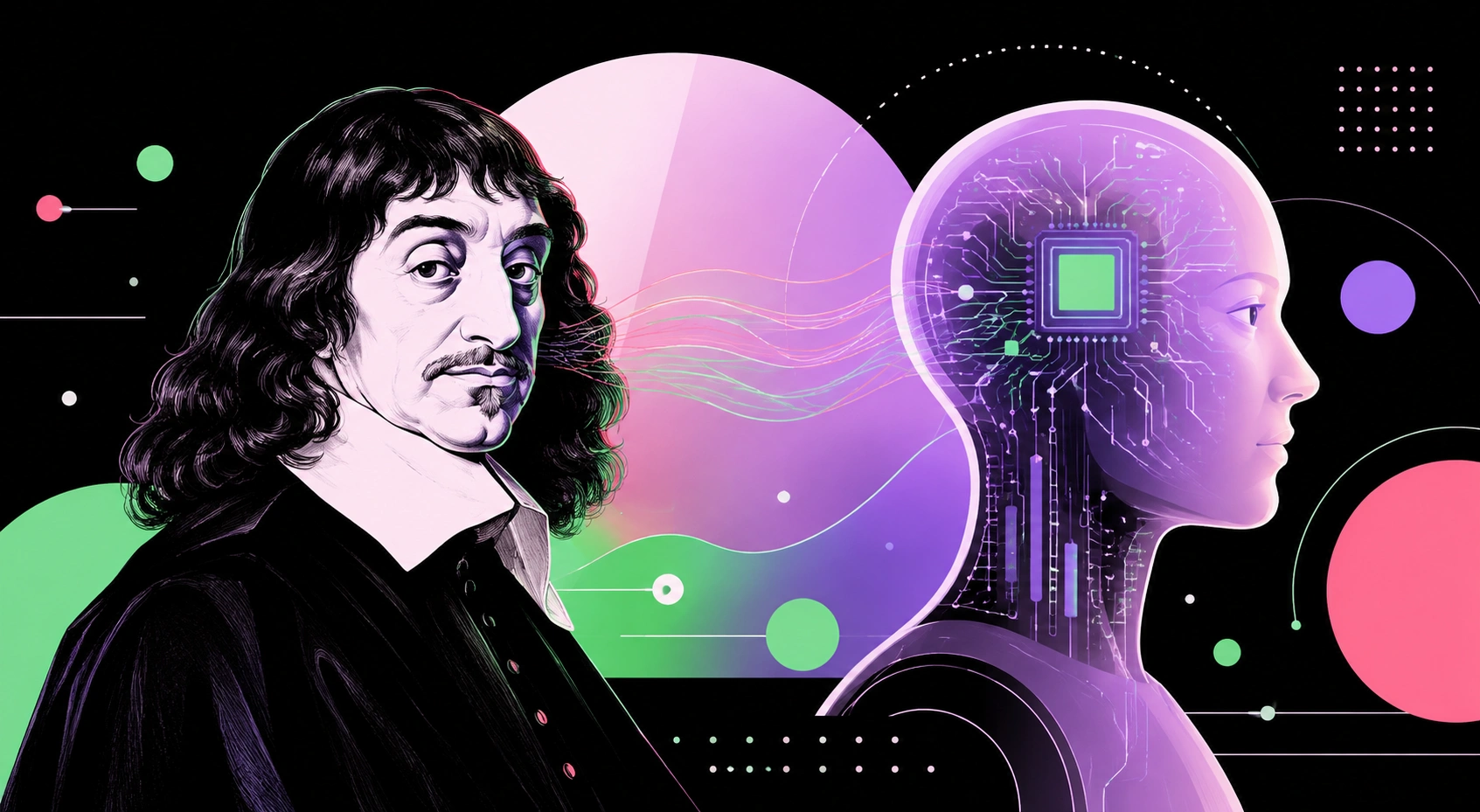
Descartes artificial intelligence is a phrase people search for two very different reasons, and both deserve a straight answer. The first is philosophical: René Descartes (1596–1650), the French philosopher and mathematician, wrote what is arguably the earliest systematic argument about whether a machine could think — three centuries before computers existed. The second is commercial: The Descartes Systems Group is a publicly traded logistics and supply chain software company whose products use AI for routing, tracking, and shipment visibility. This article focuses primarily on the first, because Descartes' 1637 argument is genuinely foundational to modern AI theory, and because his two proposed tests for distinguishing machines from minds anticipate the Turing test with startling precision. Understanding what he claimed — and where he was wrong — clarifies debates about large language models that are otherwise conducted entirely without historical memory.
Quick Answer: In his 1637 Discourse on the Method, Descartes argued machines could never truly think, proposing two tests: flexible use of language in any situation, and general reason across all subjects rather than one specialised function. His mind-body dualism framed thought as non-physical, a claim modern AI research rejects.
Section 2: How Descartes Framed the Machine Question in 1637
Descartes lived among automata. The royal gardens at Saint-Germain-en-Laye contained hydraulically powered moving figures, and mechanical clocks with animated components were the technological marvels of his age. He took them seriously as models. In Treatise on Man and in the Discourse, he argued that the human body is itself a machine — bones, muscles, nerves, and animal spirits operating by mechanical necessity. This was radical: he mechanised physiology deliberately and thoroughly.
He then extended the claim to animals. Descartes' bête machine doctrine held that non-human animals are pure automata without rational souls, their behaviour fully explicable by mechanism. Whatever one thinks of that conclusion morally, the methodological move is what matters here: Descartes established that complex, adaptive, apparently purposeful behaviour can be produced by mechanism alone. That is the founding premise of artificial intelligence as a discipline.
Where he drew the line was human reason. In Part Five of the Discourse on the Method, he proposed two criteria by which we could always tell a machine from a person. First, a machine might utter words, even words triggered by touch, but it could never arrange words in different ways to respond appropriately to whatever is said in its presence — as, he noted, even the dullest human can do. Second, even if a machine performed some tasks as well as or better than humans, it would fail at others, revealing that it acts from the disposition of its parts rather than from understanding. Reason, he wrote, is a universal instrument, whereas machine organs need a particular arrangement for each particular action.
How WebPeak Turns Complex Ideas Like This Into Content That Ranks
Topics that sit between philosophy, technology, and a similarly named company are notoriously hard to rank for, because search intent splits three ways and most published content serves only one. Resolving that requires editorial judgement rather than keyword volume — deciding which intent dominates, addressing the others explicitly, and structuring the page so both readers and AI search engines can extract the distinction. That is the kind of problem handled by WebPeak's SEO practice, working alongside their content writing and digital marketing teams. For publishers covering technical philosophy, AI research, or academic subject matter, the strategists at WebPeak focus on accuracy-first content, since citation-worthiness — not keyword density — is what earns visibility in AI-generated answers.
Descartes' Two Tests Versus the Modern AI Landscape
Descartes' criteria are testable, which is remarkable for a seventeenth-century argument. Here is how each holds up against current systems.
- The language test. Descartes claimed no machine could respond appropriately to arbitrary speech. Large language models now do exactly this, across open-ended conversation. On the behavioural reading, this test has been passed — a fact any honest assessment must concede.
- The generality test. He predicted machines would excel narrowly and fail elsewhere, exposing their mechanism. For decades this was AI's defining weakness, and it remains partially valid: modern models are broad but still fail in characteristic, non-human ways that reveal their architecture.
- The universal instrument claim. Descartes said reason works everywhere while mechanisms need bespoke arrangement per task. General-purpose foundation models directly challenge this — one system, many tasks, no re-engineering per task.
- The dualist premise. His conclusion depended on thought being non-physical, a claim mainstream cognitive science and AI research reject. This is the weakest link in his argument and the reason his conclusion does not follow even where his tests were shrewd.
- The interaction problem. Descartes could never explain how an immaterial mind causes physical action, a difficulty raised in his own lifetime. Any modern appeal to a non-computational essence of thought inherits the same unpaid debt.
Descartes and Turing: A Direct Comparison
Alan Turing's 1950 paper "Computing Machinery and Intelligence" reframed the question Descartes posed, replacing metaphysics with an operational test. The differences are instructive.
| Dimension | Descartes (1637) | Turing (1950) |
|---|---|---|
| Core question | Can a machine possess reason? | Can a machine imitate human responses indistinguishably? |
| Method | Philosophical argument from mechanism | Operational behavioural test |
| View of the body | A machine, fully mechanical | Irrelevant to the test |
| View of mind | Immaterial, non-mechanical substance | Question set aside as unanswerable |
| Conclusion | Machines can never truly think | Machines will plausibly pass as thinking |
| Lasting contribution | Defined the criteria for machine minds | Made those criteria empirically testable |
What the Historical Record Supports, and an Honest Assessment
Several claims here are verifiable and worth stating precisely. The Discourse on the Method was published anonymously in Leiden in 1637, with the machine passage in Part Five. "Cogito, ergo sum" — I think, therefore I am — appears in the Discourse and in Latin form in the Principles of Philosophy (1644), with the Meditations on First Philosophy (1641) presenting the argument in its most developed form. Descartes died in Stockholm in 1650. Turing's paper appeared in the journal Mind in October 1950. Separately and unrelated to the philosopher, The Descartes Systems Group is a Canadian-headquartered logistics software company listed on the Nasdaq and Toronto Stock Exchange, whose supply chain platform applies machine learning to route planning and shipment visibility — a naming coincidence, not a lineage.
Now an original assessment rather than a borrowed one. Descartes is usually cited in AI discussions as the man who was wrong, and that framing wastes him. What he actually did was identify the two properties that still separate impressive systems from convincing ones: contextual linguistic appropriateness and domain-general competence. Those remain the working benchmarks of the field, whatever vocabulary we now use for them. His failure was not the tests but the inference — he treated the absence of a mechanical explanation for reason as proof that none exists, which is an argument from ignorance dressed in geometry.
There is a practical lesson for anyone evaluating AI capability claims today. Descartes' second test is the more durable one. When assessing a system, do not ask whether it can converse; that bar has fallen. Ask whether its failures resemble human failures or reveal the shape of its architecture. Models that break in unhuman ways under distribution shift are still, in Descartes' language, acting from the disposition of their parts. That is a sharper diagnostic than most modern benchmarks provide, and it came from 1637.
Key Takeaways
- Descartes proposed two tests for machine minds in the 1637 Discourse on the Method: flexible language use and domain-general reason.
- He argued the human body is a machine and animals are automata, establishing mechanism as an explanation for complex behaviour — a founding premise of AI.
- His conclusion that machines cannot think rested on mind-body dualism, which contemporary cognitive science and AI research reject.
- Turing's 1950 paper in Mind answered Descartes' question by replacing metaphysical criteria with an operational behavioural test.
- The Descartes Systems Group is an unrelated logistics software company that applies AI to supply chain routing and visibility.
Frequently Asked Questions
Did Descartes actually write about artificial intelligence?
Not by that name, which was coined in 1955. But in Part Five of the Discourse on the Method he directly addressed whether a machine could think, proposed two criteria for telling machines from minds, and argued the human body itself functions mechanically. That is recognisably the same question.
What is mind-body dualism and why does it matter for AI?
Dualism is Descartes' claim that mind and body are two distinct substances — one immaterial and thinking, one physical and extended. It matters because if thought is non-physical, no physical computer could ever produce it. Modern AI research proceeds on the opposite assumption.
Has AI passed the tests Descartes proposed?
Partly. Large language models satisfy his language criterion by responding appropriately to open-ended conversation. His generality criterion is closer but not settled, since current systems still fail in characteristic patterns that expose their architecture rather than resembling ordinary human error.
Is Descartes Systems Group connected to the philosopher?
No. The Descartes Systems Group is a logistics and supply chain software company that uses AI for routing, compliance, and shipment tracking. The shared name is a coincidence, though it is why searches for Descartes and artificial intelligence return both philosophy and enterprise software results.
Why do AI researchers still read Descartes?
Because he framed the problem before any technology existed to bias the framing. His distinction between narrow mechanical competence and reason as a universal instrument maps almost exactly onto the modern contrast between narrow AI and general intelligence, which makes him unusually useful rather than merely historical.
Conclusion
The most valuable thing to take from Descartes is a diagnostic habit, not a verdict. He believed the giveaway would never be conversation quality but the pattern of a system's failures — whether it breaks like a mind or like a mechanism — and that instinct has aged far better than his metaphysics. If you want to apply it, stop evaluating AI systems on their best outputs and start cataloguing their worst ones, specifically at the edges of their training distribution. That catalogue tells you what you are actually dealing with. Descartes drew the wrong conclusion from the right question, which is a more useful legacy than being correct, because the question is still open and the test he designed for it still works.
Related articles
 Artificial Intelligence
Jeff Dunham Artificial Intelligence: What That Search Really Tells Us About AI and Comedy
Why does Jeff Dunham artificial intelligence trend? This guide covers AI-generated comedy clips, likeness rights, and how ventriloquism differs from AI.
 Artificial Intelligence
How Attractive Am I? Artificial Intelligence Beauty Scores Explained Honestly
How attractive am I? Artificial intelligence scoring apps answer fast, but their maths is shakier than it looks. Here is what the scores really measure.
 Artificial Intelligence
Fleet Artificial Intelligence: How AI Is Rebuilding Modern Fleet Management
Fleet artificial intelligence explained: how AI telematics, predictive maintenance and route optimisation cut costs, and how to deploy it without losing drivers.