
Artificial Intelligence Lottery Numbers: Can AI Really Predict a Winning Draw?
AI cannot beat true randomness, but it can change how you play. Here is what artificial intelligence lottery numbers really do, and how to use them wisely.
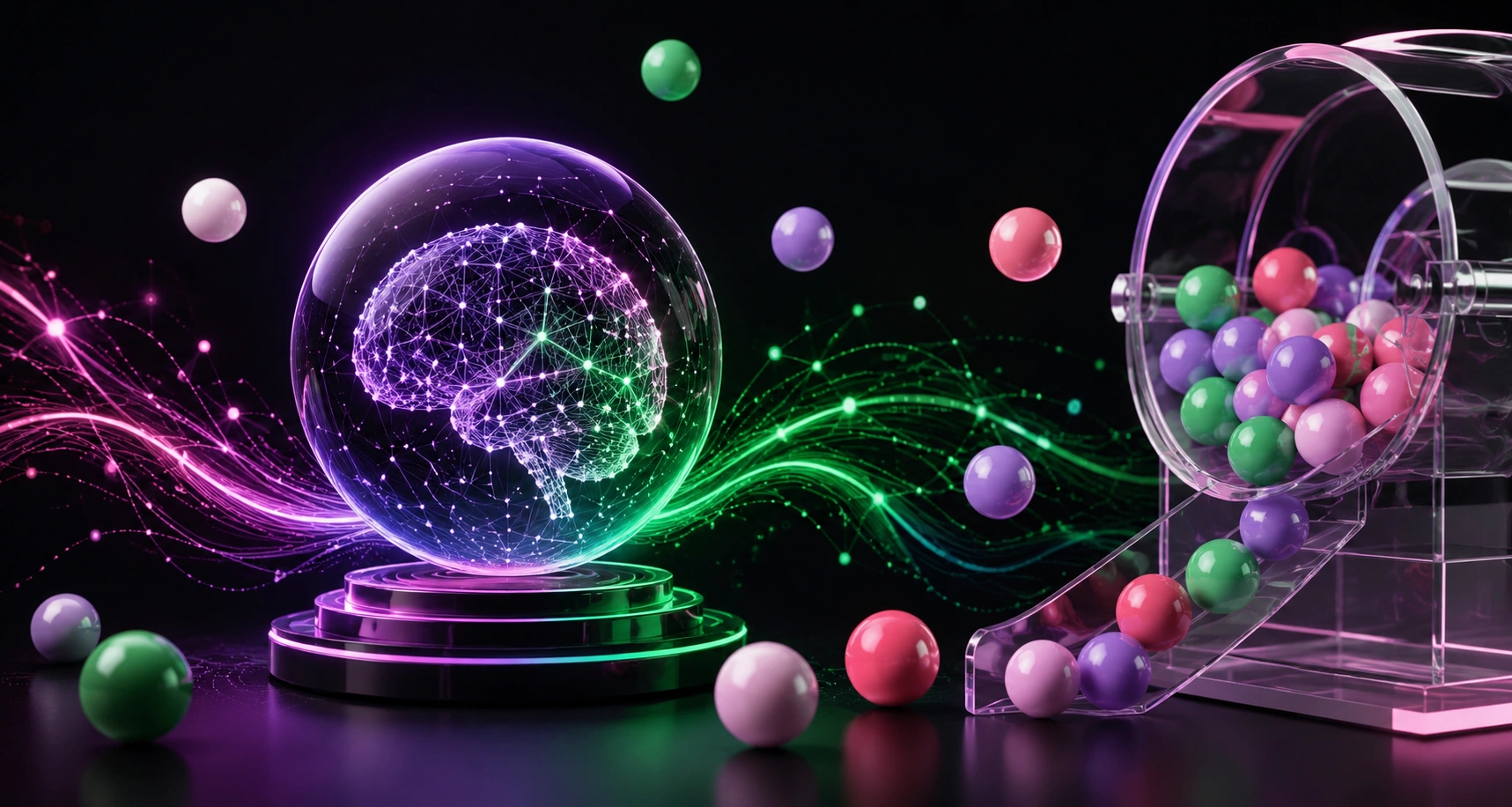
Artificial Intelligence Lottery Numbers: Can AI Really Predict a Winning Draw?
The phrase artificial intelligence lottery numbers describes number combinations produced by software that applies machine learning, statistical modelling, or pattern-matching to historical draw results in an attempt to forecast future winning numbers. Machine learning, in this context, means a system that learns relationships from past data in order to predict new outcomes. That definition already exposes the core problem: a correctly operated lottery draw contains no relationship to learn. Each draw is an independent event, meaning the outcome of Saturday's draw carries zero information about Wednesday's. An AI model trained on ten thousand past draws is not discovering a hidden signal; it is memorising noise and presenting it back with a confident-sounding interface. That does not make AI useless around lotteries — it simply means the useful applications are different from the ones being advertised, and understanding the difference protects both your money and your judgement.
Quick Answer: Artificial intelligence cannot predict lottery numbers. Lottery draws are independent random events with no learnable pattern, so no model can improve your odds of matching the balls. AI can only help with adjacent tasks: avoiding popular number combinations that split jackpots, tracking spending limits, managing syndicate records, and explaining probability honestly.
How WebPeak Helps Brands Publish Honest, Compliant Content About AI Predictions
Prediction-adjacent topics are a minefield for publishers: gambling advertising rules, YMYL (Your Money or Your Life) quality standards, and Google's helpful content systems all penalise pages that overpromise outcomes. Teams that need to rank in this space without making claims they cannot support often bring in a specialist partner, and the digital team at WebPeak is one example of an agency that works on exactly this problem worldwide. Their technical and editorial SEO work focuses on search intent and factual accuracy rather than volume, while their content writing services handle the harder part — turning a probability concept into plain language a reader trusts. For sites in regulated verticals, they also build disclaimer architecture, age-gating, and responsible-play messaging into the site build itself rather than bolting it on later.
Can AI Predict Lottery Numbers? What Probability Actually Allows
No. To predict something, a model needs signal — a stable statistical relationship between inputs and outputs. Lottery draws are engineered to eliminate signal. In a 6-from-49 style game, every combination is equally likely on every draw, and the balls have no memory of previous results. When a tool tells you 17 is "due" because it has not appeared in 40 draws, it is committing the gambler's fallacy: the mistaken belief that random processes self-correct. Equally, "hot number" logic mistakes short-run clustering for momentum. Randomness is lumpy by nature; clusters are expected, not predictive.
What AI models actually do on this data is overfit — a term meaning the model fits historical noise so tightly that it performs worse on new data than a random guess would. Test it yourself: train any model on draws up to a cut-off date and score its predictions on the draws that followed. It will land at chance level, every time. The only documented cases where lottery outcomes became genuinely predictable involved fraud or faulty equipment, not analytics. The 1980 Pennsylvania "Triple Six Fix" involved weighted balls loaded by insiders, and Eddie Tipton, a former information security director at the Multi-State Lottery Association, was convicted after tampering with random number generator software to make certain draws predictable on specific dates. Both were crimes committed from inside the system — the opposite of an edge available to a consumer app.
Seven Ways to Use AI Around a Lottery Ticket Without Fooling Yourself
AI cannot change your odds of matching numbers. It can change how much you win if you do match, and how much you lose while trying. These are the applications that survive scrutiny:
- Avoid crowded combinations. Prize tiers are usually split among all winners. Ask an AI tool to flag combinations humans over-pick — birthdays (1–31), consecutive runs like 1-2-3-4-5-6, diagonal patterns on a play slip, and multiples of 7. Choosing numbers above 31 does not raise your chance of winning; it raises your expected share if you win.
- Use a true random generator, not a "prediction" model. Quick-pick style randomness is mathematically equivalent to any AI output, and free.
- Set and enforce a hard budget. Have an assistant help you build a monthly cap tracked in a spreadsheet, with the amount treated as entertainment spending, not investment.
- Run the expected-value maths honestly. Ask a model to calculate expected value including taxes and prize-splitting. It is negative in essentially every public lottery.
- Manage syndicates properly. AI drafting is genuinely useful for written pool agreements listing members, contributions, ticket photos, and payout splits — the single most common source of lottery disputes.
- Check claim deadlines and rules. Unclaimed prizes expire. An AI assistant summarising your jurisdiction's rules is a real, low-risk use case.
- Stress-test any tool that charges you. If a product claims a proven prediction edge, ask for its out-of-sample test results. The absence of an answer is your answer.
What AI Lottery Tools Claim Versus What They Actually Do
| Tool Type | Typical Claim | What It Really Does | Genuinely Useful? |
|---|---|---|---|
| Hot/cold number analyser | Finds numbers that are "due" | Reports past frequency counts, which have no predictive power | No |
| Neural network predictor | Deep learning forecasts the next draw | Overfits random history; performs at chance out of sample | No |
| Pattern/wheeling system | Guarantees more wins | Covers combinations systematically at higher ticket cost | Partly — guarantees coverage, not profit |
| Unpopularity filter | Picks combinations others avoid | Reduces the chance of splitting a prize | Yes, for payout share only |
| Budget and syndicate assistant | Keeps play organised | Tracks spend, records, and agreements | Yes |
The Real Numbers, and What Experience Teaches About Prediction Claims
Start with published odds rather than model outputs. The jackpot odds for US Powerball are approximately 1 in 292.2 million, and EuroMillions sits near 1 in 139.8 million — figures published by the operators themselves. No software changes those denominators. A useful reality check on randomness came from Bulgaria in September 2009, when the national lottery drew the same six numbers in two consecutive draws; officials investigated and found no manipulation. Improbable-looking events occur inside fair systems, which is precisely why they cannot be used as evidence of a pattern.
Beyond published odds, the honest framing is expert observation rather than invented statistics. In practice, tools reviewed in this space share three tells: they showcase retrospective "hits" chosen after the fact, they never publish out-of-sample accuracy, and their marketing conflates prize-splitting strategy with odds improvement. A second consistent pattern is behavioural: people who receive an AI-generated combination tend to increase ticket spend because the recommendation feels earned, which raises losses while leaving odds untouched. That interaction between confident interfaces and human overconfidence is the actual risk of AI lottery products — not the numbers themselves. Teams building AI systems responsibly treat this as a design ethics question, the same discipline that governs hiring in the field, as covered in this overview of specialist AI talent recruitment.
Key Takeaways
- Lottery draws are independent random events, so no AI model can learn a pattern that improves your odds of matching numbers.
- Hot and cold number analysis relies on the gambler's fallacy; clustering in random data is expected, not predictive.
- Published jackpot odds — roughly 1 in 292.2 million for Powerball and 1 in 139.8 million for EuroMillions — are unaffected by any software.
- AI's only legitimate edge is payout-related: avoiding popular combinations reduces the chance of splitting a prize.
- Documented cases of predictable draws, including the Eddie Tipton RNG tampering conviction, involved insider fraud rather than analytics.
Frequently Asked Questions
Can artificial intelligence predict lottery numbers accurately?
No. Lottery draws are independent random events with no learnable structure, so machine learning models score at chance level when tested on draws they have not seen. Any tool claiming proven accuracy is showing retrospective examples, not verified out-of-sample results, and cannot improve your probability of winning.
Why do AI lottery apps sometimes seem to get numbers right?
Because partial matches are common by design. Matching two or three numbers happens frequently across millions of tickets, so any generator will produce apparent hits. Apps highlight those results and quietly discard the misses, a selection effect that makes random performance look like predictive skill.
Does picking numbers above 31 increase my chances of winning?
It does not change your odds of matching the balls at all. It only reduces the likelihood of sharing a prize, because many players choose birthday-based numbers between 1 and 31. Your expected payout per win improves slightly, while your probability of winning stays exactly the same.
Is it worth paying for an AI lottery prediction subscription?
No. You would be paying for random number generation that your lottery operator provides free through quick picks. Before buying any such product, request documented accuracy on draws after the model was built. Legitimate statistical tools publish that evidence; prediction subscriptions consistently do not.
What can AI genuinely help with if I play the lottery?
Practical administration. AI assistants are useful for enforcing a spending cap, calculating expected value including tax, drafting written syndicate agreements that prevent disputes, summarising local claim deadlines, and explaining probability in plain language so your expectations match reality rather than marketing.
Conclusion
The single most important decision here is a framing one: stop treating artificial intelligence lottery numbers as a forecasting problem and start treating the lottery as a fixed-odds entertainment purchase with a known, negative expected value. Once that shift happens, AI becomes genuinely useful — for budgeting discipline, syndicate paperwork, prize-splitting strategy, and honest probability explanations. Your next step is concrete: set a monthly entertainment cap you would not mind losing, use random selection with numbers spread beyond 31, and apply one simple test to any prediction product you encounter — ask for verified out-of-sample results. Tools that cannot answer that question are selling confidence, not capability, and knowing the difference is the only real advantage available.
Related articles
 Artificial Intelligence
Jeff Dunham Artificial Intelligence: What That Search Really Tells Us About AI and Comedy
Why does Jeff Dunham artificial intelligence trend? This guide covers AI-generated comedy clips, likeness rights, and how ventriloquism differs from AI.
 Artificial Intelligence
How Attractive Am I? Artificial Intelligence Beauty Scores Explained Honestly
How attractive am I? Artificial intelligence scoring apps answer fast, but their maths is shakier than it looks. Here is what the scores really measure.
 Artificial Intelligence
Fleet Artificial Intelligence: How AI Is Rebuilding Modern Fleet Management
Fleet artificial intelligence explained: how AI telematics, predictive maintenance and route optimisation cut costs, and how to deploy it without losing drivers.