
ASMR Artificial Intelligence: How AI Is Changing Whisper Content Creation
AI is reshaping how ASMR is made and discovered. Learn which tools genuinely help, where synthetic audio still fails, and how to build a workflow listeners trust.
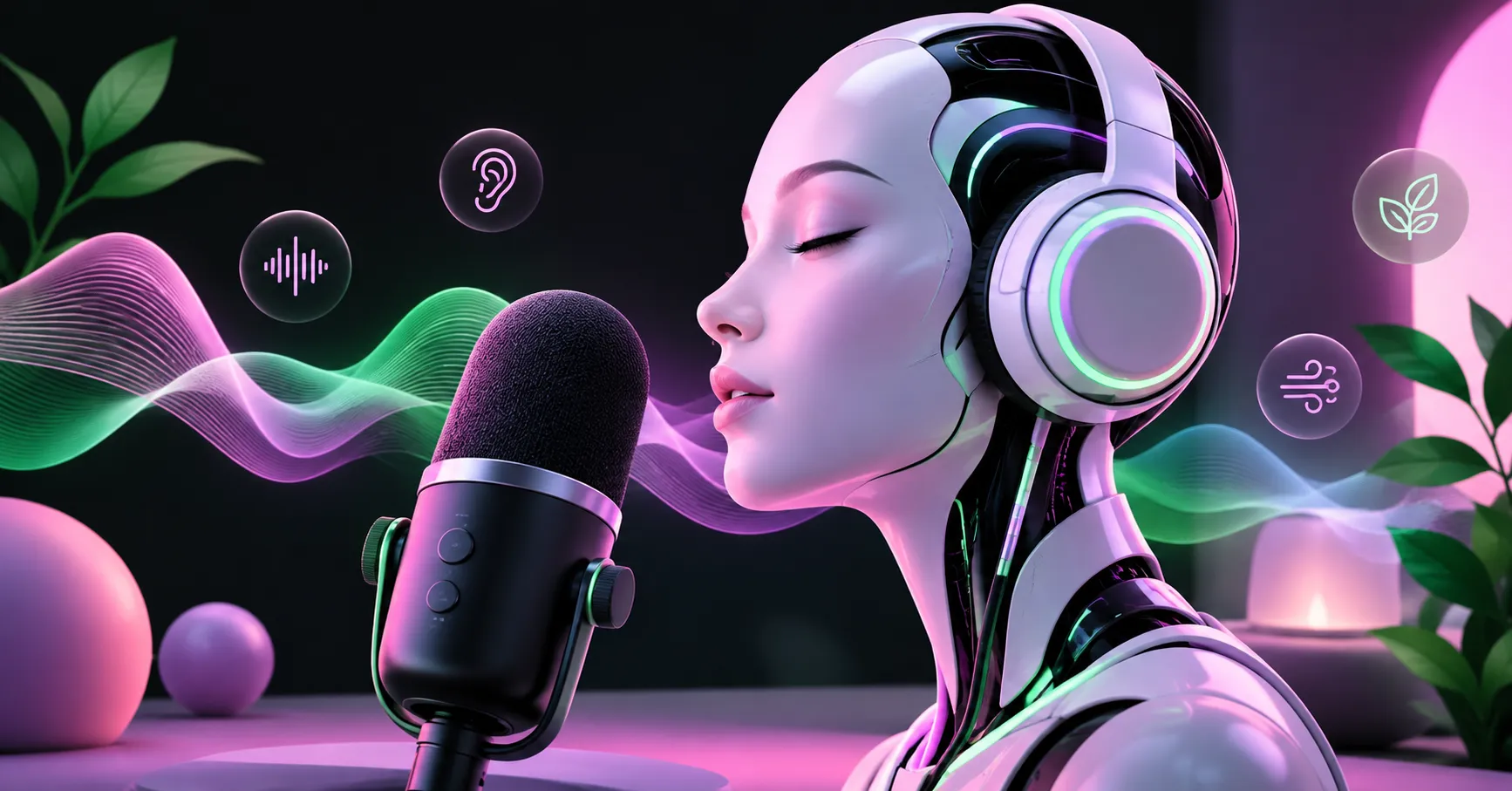
ASMR Artificial Intelligence: How AI Is Changing Whisper Content Creation
ASMR artificial intelligence refers to the use of machine learning systems — synthetic voice models, generative audio engines, noise-reduction networks, video upscalers, and recommendation algorithms — to create, clean, or distribute ASMR content. ASMR itself stands for Autonomous Sensory Meridian Response: the tingling, calming sensation some people experience in response to soft speech, gentle repetition, and close-range sounds like tapping or brushing. The intersection of the two is now one of the fastest-moving corners of creator tooling, and it is producing both genuinely useful workflows and a flood of low-effort synthetic audio that listeners are already learning to detect. Understanding the difference is the single most valuable skill for anyone publishing in this space today.
Quick Answer: ASMR artificial intelligence is the use of AI tools to generate, enhance, or recommend ASMR content. AI reliably improves noise removal, editing, mastering, translation, and thumbnails. It is still weak at producing authentic trigger textures and breath detail, so most successful creators record real audio and use AI in post-production.
Quick Answer: ASMR artificial intelligence describes AI systems used to create, clean, or distribute whisper and trigger-based relaxation content. In practice, AI performs best on post-production tasks — denoising, mastering, captioning, translation — while human-recorded microphone performance still delivers the physical detail that actually triggers tingles.
Where WebPeak Fits Into an AI-Assisted ASMR Content Strategy
An ASMR channel is a media business, and the parts that limit growth are rarely the audio. They are the discovery surfaces: the channel page, the website that hosts long-form sleep playlists, the schema markup that gets episodes into search results, and the visual identity that makes a thumbnail recognisable at 120 pixels wide. This is exactly the layer where WebPeak's digital agency team works with creators — they build the site, the content pipeline, and the marketing structure around media that already exists, rather than trying to replace the creative act itself. For an ASMR project specifically, their AI and design work maps cleanly onto three recurring problems: automating transcription and metadata at scale, producing thumbnail and banner sets that survive platform compression, and shipping a fast, ad-light site where long audio actually loads on mobile connections.
What ASMR Artificial Intelligence Can Do Today — And What It Still Cannot
The honest boundary line runs between processing and performing. AI processing of ASMR is mature; AI performance of ASMR is not.
On the processing side, spectral denoising models can strip air-conditioner hum and laptop fan noise from a take that would previously have been unusable — a meaningful change, because ASMR is recorded at high gain where every background source is amplified. Loudness normalisation models can hold a whisper track at a consistent perceived level across a 90-minute video, which matters enormously for listeners who fall asleep mid-episode and do not want a sudden 8 dB jump. Automatic transcription now handles whispered speech far better than it did even two years ago, which unlocks captions, chapter markers, and searchable text for every video in a back catalogue.
On the performance side, the limitation is physical. ASMR triggers depend on micro-detail: the exact transient of a fingernail on plastic, the wet consonant edges of close-range speech, the asymmetry between left and right channels when a creator moves around a binaural microphone. Text-to-speech models are trained overwhelmingly on clear, projected, broadcast-style speech, so they smooth away precisely the artefacts that cause tingles. Synthetic whisper output tends to sound thin, evenly spaced, and breath-free — and audiences describe it as "uncanny" or "not working" rather than simply bad. Generative sound-effect models have the same issue in reverse: they produce plausible categories of sound but lose the spatial consistency that makes a trigger feel like it is happening near your ear.
The practical conclusion is that AI belongs in your signal chain, not in your microphone.
How to Build an AI-Assisted ASMR Workflow That Still Sounds Human
The workflow below is ordered deliberately: every AI step happens after a real recording exists, so the source material carries the detail that models cannot invent.
- Record real audio at 24-bit, 48 kHz minimum. AI restoration works by reconstructing information, and it can only work with what the file contains. A 16-bit, heavily compressed source gives denoisers nothing to hold on to.
- Fix the room before you fix the file. Blankets, a closed door, and a switched-off HVAC unit remove more noise than any plugin, and they do it without the phasey artefacts that aggressive AI denoising introduces on quiet passages.
- Apply AI denoising conservatively — 20–40% strength, not 100%. Full-strength denoising strips the breath and mouth detail that carries the trigger. Listen specifically to whispered sibilants; if they sound like they are underwater, back it off.
- Use AI de-clicking selectively, bypassing your trigger sections. Mouth-click removers cannot tell an unwanted click from an intentional tapping trigger. Automate the plugin off during trigger segments.
- Normalise with a loudness target, not a peak target. Aim for roughly −18 to −16 LUFS integrated for sleep content, which sits quieter than the platform default and avoids waking listeners.
- Generate transcripts automatically, then correct proper nouns by hand. Whisper-model transcription will get 90% of a soft-spoken script right and mangle names — those names are often your search terms.
- Translate captions with AI, but have a native speaker review the first three episodes. ASMR travels internationally better than almost any format, because the audio needs no translation at all.
- Use AI image tools for thumbnail variants, not final art. Generate ten compositions, then have a designer finish the winner so type stays legible at small sizes.
Creators who outsource the visual half of that list often pair it with dedicated social media post and banner design support, since a single episode typically needs a thumbnail, a Shorts cover, a community-tab graphic, and a podcast tile in four different aspect ratios. If the long-form audio also lives on your own site, the loading behaviour of that page matters as much as the mix — which is where deliberate website design for media-heavy pages earns its keep. For creators expanding into filmed ASMR rather than audio-only, professional video production guidance is a reasonable next investment, because camera noise and lighting hum become audio problems very quickly.
AI Tools vs Human Recording: Where Each Approach Wins
The table below maps common ASMR production tasks against the approach that currently produces the better listener outcome.
| Production Task | Best Approach | Why | Risk If You Choose Wrong |
|---|---|---|---|
| Whispered voice performance | Human recording | Breath, pacing and consonant detail drive the tingle response | Synthetic voice reads as flat and "off", causing fast drop-off |
| Background noise removal | AI denoising | Spectral models separate steady hum from intended detail | Manual EQ removes trigger frequencies along with the noise |
| Tapping and brushing triggers | Human recording | Spatial consistency and transient shape cannot be faked convincingly | Generated textures feel randomised and non-binaural |
| Transcripts and captions | AI transcription | Fast, cheap, and now accurate on soft speech | Manual captioning consumes hours per long-form episode |
| Loudness consistency | AI-assisted mastering | Holds perceived level across 60–120 minute files | Volume jumps wake sleeping listeners and trigger unsubscribes |
| Thumbnail concepting | AI draft, human finish | Speeds ideation while keeping typography readable | Fully generated art often fails at small display sizes |
What the Research Actually Says About ASMR — and What That Means for AI Content
ASMR has a genuine, if young, research base, and it is worth knowing because it explains why synthetic content underperforms. The term was coined in 2010 by Jennifer Allen, who created it to describe a sensation that online communities had been discussing without a shared name. The first peer-reviewed study came in 2015, when Emma Barratt and Nick Davis published survey research in PeerJ documenting who experiences ASMR and which triggers were most commonly reported — whispering, personal attention, and crisp sounds ranked highly. In 2018, Giulia Poerio and colleagues published work in PLOS ONE showing that people who experience ASMR displayed measurable physiological changes while watching ASMR videos, including reduced heart rate.
Those findings point in one direction: ASMR is a response to specific perceptual cues, not to content categories. That is the core reason AI-generated whisper audio underdelivers. A model optimised for intelligibility produces speech that a listener can understand perfectly and feel nothing from, because intelligibility and trigger potency are different targets.
From practical observation across creator communities, three patterns repeat consistently. First, channels that switch to fully synthetic voices tend to see engagement fall faster than views, because comment sections turn into debates about authenticity rather than requests for more content. Second, the AI features creators keep paying for after the novelty passes are the boring ones — denoise, transcribe, translate, normalise. Third, disclosure helps: creators who explicitly label AI-assisted elements generally retain trust, while those who quietly swap in synthetic audio face a sharper backlash when audiences notice. Treat AI as infrastructure and audiences barely react; treat it as a replacement for performance and they react strongly.
Key Takeaways
- ASMR artificial intelligence means using AI to produce, clean, or distribute trigger-based relaxation content — most of its real value sits in post-production, not performance.
- Text-to-speech models remove the breath, transient detail, and spatial asymmetry that peer-reviewed ASMR research identifies as core triggers.
- Record at 24-bit/48 kHz and apply denoising at 20–40% strength so restoration models have real detail to preserve.
- Target roughly −18 to −16 LUFS integrated loudness for sleep content to avoid volume jumps that wake listeners mid-episode.
- AI transcription and translation are the highest-return tools for ASMR channels because the format already crosses language barriers with no dubbing required.
Frequently Asked Questions
Can AI actually make ASMR that gives you tingles?
Rarely, and inconsistently. Current voice models produce clear speech without the breath detail, uneven pacing, and binaural movement that trigger the response. Listeners frequently describe synthetic ASMR as pleasant but non-triggering. AI is far more effective at cleaning and mastering real recordings than at generating the trigger itself.
Is it against platform rules to publish AI-generated ASMR videos?
Major platforms allow AI-assisted content but increasingly require disclosure when synthetic media could mislead viewers, particularly synthetic voices imitating real people. Check each platform's current synthetic-media policy, label AI elements in your description, and never clone another creator's voice without written permission.
What is the best AI tool for cleaning up ASMR audio?
Choose based on artefacts rather than brand. Test two or three spectral denoisers on the same quiet whispered take, then listen specifically to sibilants and breaths at low volume. The right tool is the one that removes hum while leaving mouth detail intact at moderate strength settings.
Do I still need a good microphone if I use AI enhancement?
Yes, more than ever. AI restoration reconstructs from existing information, so a noisy, low-bit-depth source limits every downstream step. A capable binaural or large-diaphragm condenser microphone in a treated corner will outperform an expensive plugin chain applied to a weak recording.
How is AI changing how people discover ASMR content?
Recommendation systems now weight watch-through and repeat listening heavily, which favours long, consistently mixed sleep content over short novelty videos. Accurate captions and chapter markers also help both search and recommendation surfaces understand your episode, making AI transcription a discovery tool rather than an accessibility afterthought.
Conclusion
The most important decision in ASMR artificial intelligence is where you place the machine in your pipeline. Put it after the microphone and it removes friction — cleaner takes, consistent loudness, searchable transcripts, captions in five languages, and thumbnails produced in minutes instead of hours. Put it in front of the microphone and it strips out the exact perceptual detail that the research links to the response your audience came for. Your practical next step is to take one existing recording, run it through a conservative denoise-and-normalise chain, generate a corrected transcript, and compare listener retention against your previous upload. That single controlled test will tell you more about where AI helps your channel than any tool roundup, and it keeps the part your audience actually values — you, close to a microphone, being genuinely careful — exactly where it belongs.
Related articles
 Artificial Intelligence
Frontiers in Artificial Intelligence: The Research Areas Actually Changing How AI Works
The frontiers in artificial intelligence have shifted from raw model size to reasoning, agents, and efficiency. Here is what is genuinely changing and how to apply it.
 Artificial Intelligence
Artificial Intelligence Security Regulation Law 2026 February: What Changed and What Teams Must Do Now
February 2026 marked a turning point in AI security regulation. Here is what obligations were live, what was still pending, and the controls auditors ask for first.
 Artificial Intelligence
Artificial Intelligence News May 2026: The Breakthroughs That Actually Mattered
May 2026 delivered faster frontier models, real agentic workflows, and a genuine research milestone. Here is what actually mattered and how to apply it right now.