
Artificial Intelligence Teddy Bear: How AI Toys Work, What They Cost, and Whether They Are Safe for Kids
A clear, evidence-based guide to the artificial intelligence teddy bear: how these toys work, what they cost, the real safety record, and how parents should evaluate them.
Artificial Intelligence Teddy Bear: How AI Toys Work, What They Cost, and Whether They Are Safe for Kids
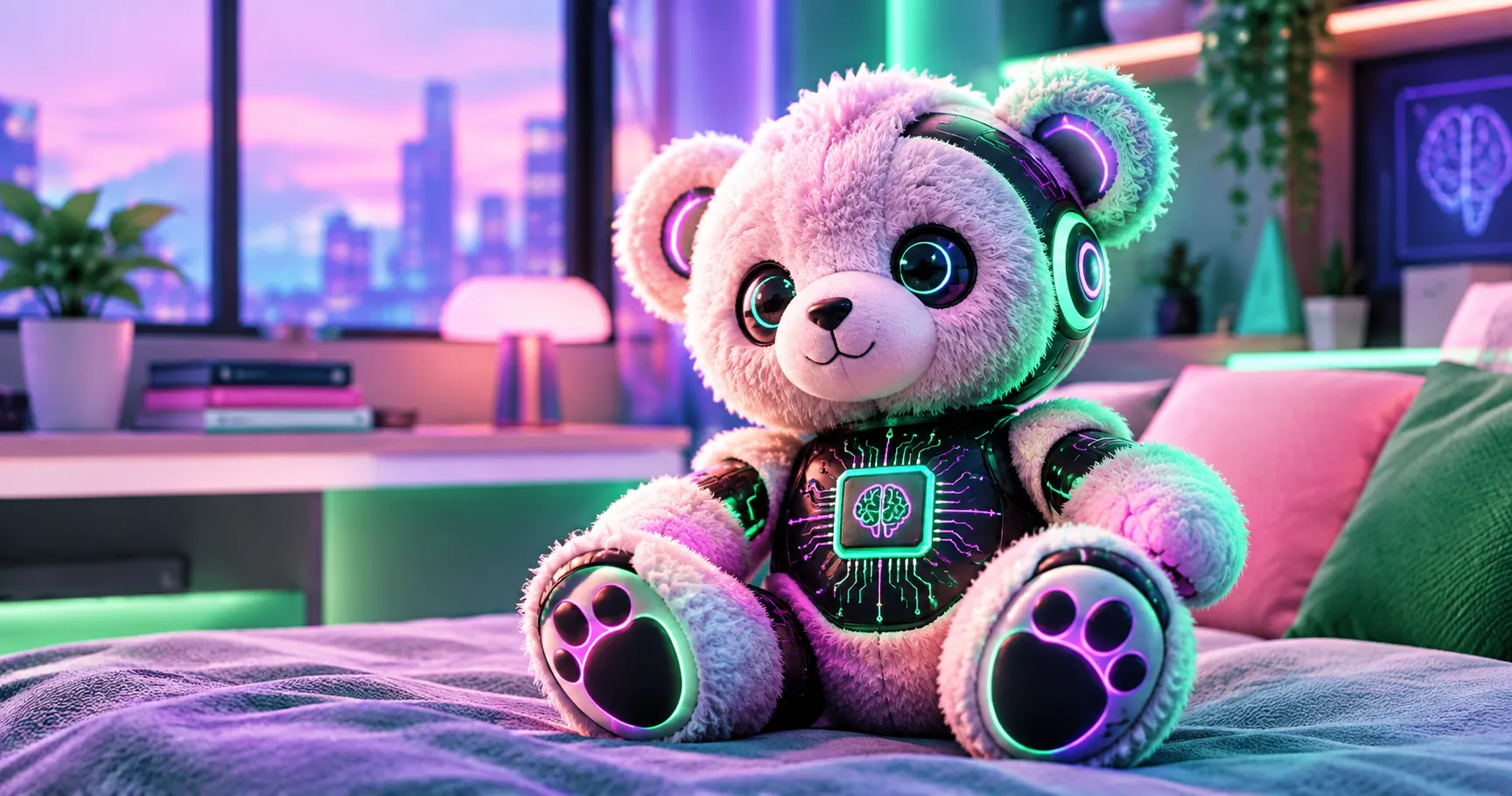
An artificial intelligence teddy bear is a plush toy with a microphone, speaker, small processor and internet connection that sends a child's speech to a cloud-based speech-recognition and language model, then plays back a generated spoken reply. The bear itself is not intelligent — it is a soft shell around a thin client. Everything interesting happens on a server somewhere else, which is exactly why these products behave more like connected home assistants than like toys. That distinction matters enormously for privacy, for content safety, and for what you are actually buying when you spend money on one. This guide explains the mechanics, the real documented incidents, the buying checklist that actually catches problems, and the questions worth asking before a talking bear ends up in a child's bedroom.
Quick Answer: An artificial intelligence teddy bear is a plush toy that streams a child's voice to cloud AI and speaks a generated reply. Most cost between $60 and $200. Safety depends almost entirely on the vendor's content filtering, data retention policy and offline behaviour — not on the toy's hardware or its cuddliness.
How WebPeak Supports Brands Building and Marketing AI Plush Toys
Companies selling AI toys face an unusual problem: the product is a consumer object but the trust burden is enterprise-grade. Parents want to see the data policy, the moderation approach and the age-appropriateness reasoning before they buy, and a thin product page cannot carry that weight. WebPeak works with hardware and consumer-AI teams worldwide on exactly this gap — building the conversational layer, the parent-facing dashboards and the transparency pages that turn a black-box toy into something a caregiver can reason about. Their artificial intelligence services cover prompt architecture, guardrail design and model evaluation, while their website design and social media and banner design work is where most AI toy brands finally learn to explain themselves in plain language instead of marketing abstractions.
How Does an Artificial Intelligence Teddy Bear Actually Work?
Every AI teddy bear on the market follows roughly the same four-stage pipeline, and understanding it tells you where the risks live.
Stage one is wake and capture. A small always-listening chip watches for a wake word or a button press. Push-to-talk designs are meaningfully safer than always-on designs because the microphone only opens on deliberate physical action. If a product does not clearly state which model it uses, assume always-on.
Stage two is transcription. The captured audio is streamed over Wi-Fi to an automatic speech recognition service that converts sound to text. This is the moment a child's raw voice leaves your home. Ask the vendor whether audio is deleted immediately after transcription or retained for model improvement — those are very different products wearing the same fur.
Stage three is generation. The transcript is wrapped in a system prompt and sent to a large language model, often a commercial API from a major provider. The system prompt is the entire safety mechanism in most toys: it is the instruction set telling the model to stay in character, keep answers short, refuse certain topics and redirect distress to a parent. A weak or short system prompt produces a bear that will discuss anything the underlying model will discuss.
Stage four is speech synthesis and playback. The text reply is converted to audio in a character voice and streamed back. Total round-trip latency on a decent home connection is typically one to three seconds — long enough that most bears play a thinking sound to cover the gap.
Two design choices separate good products from careless ones. The first is whether the bear has a genuine offline mode with pre-recorded stories and songs, so a dropped connection produces a working toy rather than a dead one. The second is whether conversation logs are visible to parents. A bear whose transcripts a caregiver can read is a bear whose behaviour can be audited.
What to Check Before You Buy an AI Teddy Bear
Marketing pages rarely answer the questions that matter. Work through this list in order, and treat any unanswered item as a red flag rather than a neutral unknown.
- Find the data retention statement. Look specifically for how long voice recordings are kept and whether they are used for training. "We take privacy seriously" is not a retention policy. A specific number of days is.
- Identify the microphone model. Push-to-talk or wake-word? A physical mute switch that visibly cuts power to the microphone is the strongest signal a manufacturer takes this seriously.
- Test the refusal behaviour before handing it over. Ask the bear about violence, self-harm, dieting, religion and where it lives. A well-configured toy redirects gently to a grown-up. A poorly configured one improvises.
- Check what happens with no internet. Unplug your router and play with it for five minutes. A toy that becomes an inert lump has a durability problem the box will not mention.
- Confirm the parental dashboard exists and is usable. You should be able to review conversations, set time limits and delete history from a phone without emailing support.
- Look for the subscription. Cloud inference costs money every time the bear speaks. If there is no visible subscription, ask how the vendor funds ongoing inference — and what happens to the toy if they stop.
- Research the company's lifespan and funding. Connected toys die when servers shut down. A two-person startup selling a $180 cloud-dependent bear is selling you a product with an unknown expiry date.
- Read the security disclosure page. Vendors who publish a responsible-disclosure contact have usually thought about being attacked. Those who publish nothing usually have not. This is the same maturity signal used when assessing any connected consumer device, and it is worth understanding the broader discipline of cybersecurity for connected products before trusting an unfamiliar brand.
AI Teddy Bear Categories Compared
Not every talking bear is a cloud AI product. The four categories below behave very differently in the home, and the price tag alone will not tell you which one you are holding.
| Type | Typical Price | Internet Required | Main Risk | Best For |
|---|---|---|---|---|
| Pre-recorded plush | $20 - $40 | No | Repetitive, limited replay value | Under-3s and cautious households |
| Offline voice-response bear | $40 - $80 | No | Narrow vocabulary, scripted feel | Ages 3-6, travel, no-Wi-Fi homes |
| Cloud AI conversational bear | $90 - $200 | Yes | Voice data leaving the home, content drift | Ages 6-10 with adult supervision |
| Subscription companion bear | $150+ plus monthly fee | Yes | Product stops working if service ends | Families comfortable with ongoing cost |
The single most useful takeaway from this table is that price correlates with dependency, not with quality. The cheapest option is the most durable one, because nothing can be switched off remotely.
What the Public Record Shows About Connected Toys
There is a real, verifiable history here, and it is more instructive than any marketing claim. In 2015, Mattel's cloud-connected Hello Barbie drew sustained criticism after security researchers demonstrated weaknesses in its companion app and server communication; the product was discontinued within a few years. Also in 2015, the toy manufacturer VTech disclosed a breach of its Learning Lodge database that exposed millions of parent and child account records — a case still cited as the clearest demonstration that toy companies hold sensitive family data at a scale they are not always equipped to defend.
Regulators have acted too. In 2017, Germany's Federal Network Agency (Bundesnetzagentur) classified the internet-connected doll My Friend Cayla as a prohibited concealed surveillance device and told parents to destroy it — an unusually blunt intervention that established connected toys as a genuine regulatory category rather than a novelty. In the United States, the Federal Trade Commission has issued guidance confirming that the Children's Online Privacy Protection Act (COPPA) applies to internet-connected toys that collect voice data, meaning verifiable parental consent is a legal requirement, not a courtesy. Mozilla's ongoing *Privacy Not Included reviews have repeatedly documented connected toys shipping with vague or permissive data policies.
Most recently, in November 2025, the US PIRG Education Fund's annual Trouble in Toyland report examined AI-powered toys and found that one GPT-powered plush bear produced clearly inappropriate content during extended testing; the manufacturer suspended sales and the model provider cut off access. That case is worth sitting with, because the hardware was fine and the underlying model was a mainstream commercial one. The failure was in the guardrail layer.
The pattern across a decade is consistent, and it is the core expert observation of this article: connected toy failures are almost never hardware failures. They are configuration, retention and moderation failures — the parts of the product that cost money to maintain and that nobody can see from the outside. In practice, this means the most reliable predictor of a safe AI teddy bear is not its features but whether the company behind it publishes, in specific terms, how it handles data and how it constrains model output.
Key Takeaways
- An AI teddy bear is a thin client: the microphone and speaker are local, but recognition and language generation happen on remote servers.
- The system prompt and moderation layer — not the hardware — determine whether a bear behaves appropriately with a child.
- Push-to-talk activation and a physical microphone cut-off are the two strongest hardware-level privacy signals available to buyers.
- Regulators have already treated connected toys as surveillance-capable devices; Germany banned My Friend Cayla in 2017 and the FTC applies COPPA to voice-collecting toys.
- Cloud-dependent toys have a finite lifespan tied to the vendor's servers, so company stability is a product feature worth researching.
Frequently Asked Questions
Is an artificial intelligence teddy bear safe for a young child?
It depends almost entirely on the vendor. A bear with push-to-talk activation, published data retention limits, a parent-visible transcript log and tested refusal behaviour can be reasonably safe for supervised play. A bear that answers none of those questions should be treated as an unaudited internet-connected microphone.
Does an AI teddy bear record everything my child says?
Always-on wake-word models buffer audio continuously and transmit after the trigger phrase; push-to-talk models only capture while a button is held. Transmission is not the same as storage, so ask specifically whether recordings are deleted after transcription or retained for training and quality review.
What age is appropriate for a conversational AI toy?
Most child-development guidance favours non-connected toys for under-threes, since open-ended imaginative play matters more than scripted response at that stage. Cloud conversational bears fit best from roughly age six to ten, when a child can understand that the bear is a program rather than a friend.
Do AI teddy bears need a monthly subscription?
Many do, because every spoken reply costs the vendor money in cloud inference. If a product advertises unlimited conversation with no recurring fee, ask how that is funded and what happens to the toy if the company changes its pricing or shuts the service down.
What happens to an AI teddy bear if the company goes out of business?
Cloud-dependent toys generally stop talking, because the language model and speech services live on servers the vendor pays for. Toys with a genuine offline mode keep their pre-recorded stories and songs, which is the main practical argument for choosing hybrid designs over pure cloud ones.
Can an AI teddy bear replace human interaction for a child?
No, and reputable products do not claim it can. A well-designed bear prompts a child toward stories, questions and grown-ups rather than positioning itself as a substitute relationship. Any toy marketed as a child's best friend or emotional confidant deserves considerably more scrutiny, not less.
Conclusion
The decision that matters when buying an artificial intelligence teddy bear is not which bear is cutest or which has the longest feature list — it is whether the company behind it will tell you, in specific and checkable terms, where your child's voice goes and what constrains the model's replies. Everything else is secondary. Before you buy, spend ten minutes locating the retention policy and testing the refusal behaviour yourself; if either is unavailable, choose an offline toy instead and lose nothing that matters. The technology is genuinely improving, but the trust burden still sits with the vendor, and the vendors worth buying from are the ones who act like they know it.
Related articles
 Artificial Intelligence
Frontiers in Artificial Intelligence: The Research Areas Actually Changing How AI Works
The frontiers in artificial intelligence have shifted from raw model size to reasoning, agents, and efficiency. Here is what is genuinely changing and how to apply it.
 Artificial Intelligence
Artificial Intelligence Security Regulation Law 2026 February: What Changed and What Teams Must Do Now
February 2026 marked a turning point in AI security regulation. Here is what obligations were live, what was still pending, and the controls auditors ask for first.
 Artificial Intelligence
Artificial Intelligence News May 2026: The Breakthroughs That Actually Mattered
May 2026 delivered faster frontier models, real agentic workflows, and a genuine research milestone. Here is what actually mattered and how to apply it right now.