Rent a Car CRM With Artificial Intelligence Damage Detection and Contactless Rental: A Practical Guide
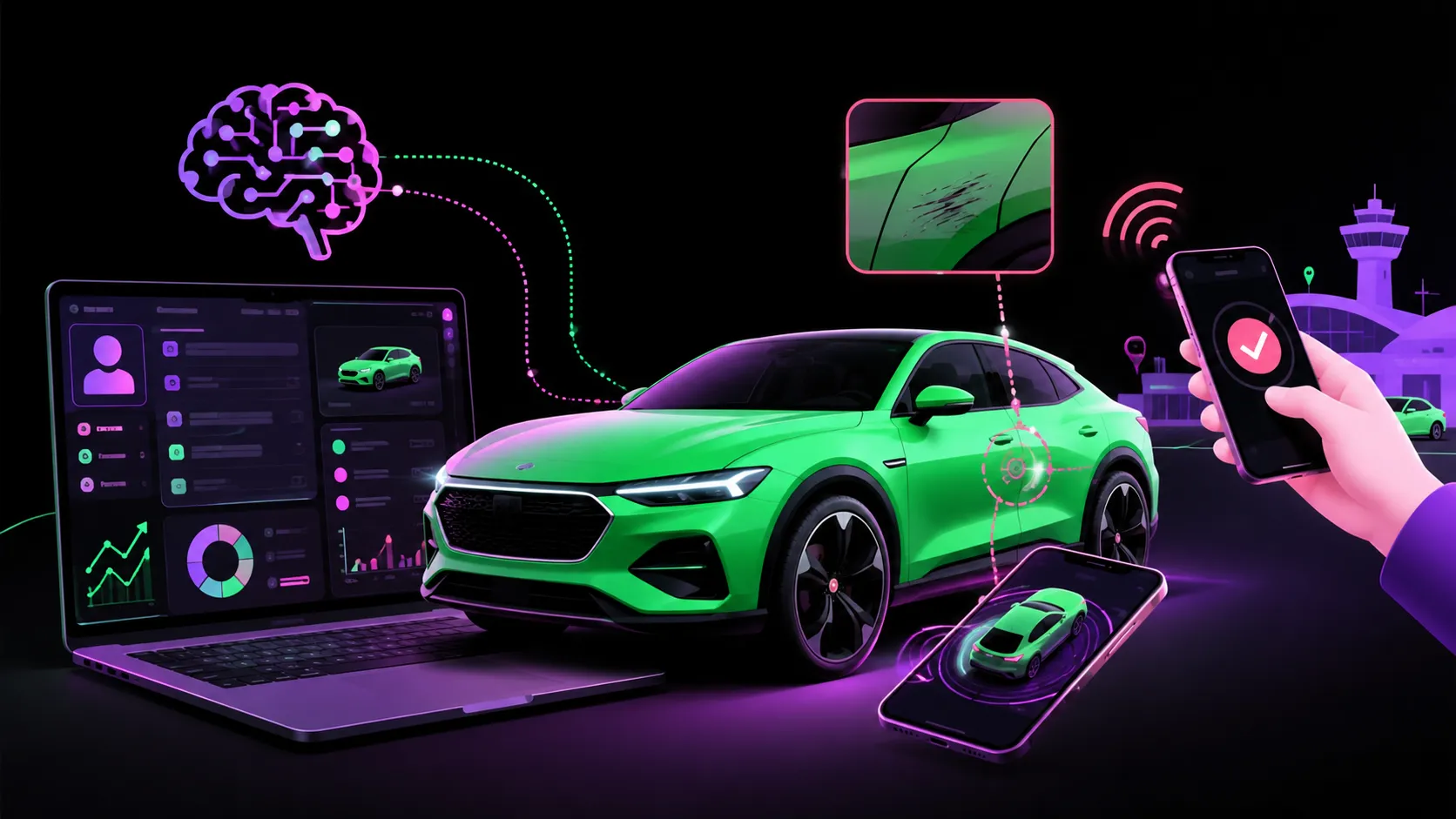
A rent a car CRM with artificial intelligence damage detection and contactless rental is a customer and fleet management platform that combines three things into one workflow: a booking and customer record system, a computer-vision layer that inspects vehicle condition from photos or video, and a digital handover process that lets a renter collect and return a car without meeting a staff member. The reason these three converge is operational rather than technological. Contactless rental removes the human inspector from the handover, which means the damage record has to come from somewhere else — and the CRM has to store that record against the booking, the customer, and the vehicle so it is usable later in a dispute, an insurance claim, or a maintenance decision. Without the AI inspection layer, contactless rental simply transfers risk onto the operator.
Quick Answer: An AI-enabled rent a car CRM captures vehicle condition through guided photo or video capture, uses computer vision to flag scratches, dents and missing parts, and attaches the timestamped result to the rental agreement. This lets customers unlock, collect and return vehicles unattended while the operator keeps a defensible, comparable damage record for every handover.
Where WebPeak Fits Into Rental Platform and AI Inspection Builds
Rental operators rarely need a single product; they need a booking system, a mobile capture flow, a telematics integration, and a back office that agents will actually use, all speaking to each other. That systems-integration work is the core of what the engineering team behind custom web application development at the agency handles for fleet clients, alongside applied AI implementation for the vision and scoring components. Their practical contribution on this type of project is usually in three places: designing the guided capture UX so renters produce usable images in a dim car park, building the review queue so a human adjudicates only borderline detections instead of every one, and connecting the CRM to payment, insurance and telematics providers without creating a brittle chain of manual exports. They also handle the demand-side marketing that keeps a fleet utilised, since a beautifully automated rental platform is still unprofitable at 40% utilisation. Their team works with operators internationally, and the full service range is documented across the agency's website.
How Does AI Vehicle Damage Detection Actually Work?
AI damage detection is a computer-vision pipeline, not a single model. In production systems it typically runs four stages. Capture: the app guides the user to photograph or video-scan specific angles, using on-screen overlays and real-time quality checks to reject blurry, over-exposed or partial frames. Normalisation: the system identifies the vehicle, its panels, and the viewing angle so a mark on the left rear door is always recorded in the same coordinate space. Detection and classification: models flag candidate defects and label them — scratch, dent, chip, crack, missing trim, kerbed alloy — and estimate severity. Comparison: the current scan is diffed against the previous scan of the same vehicle, which is the step that determines liability, because damage only matters relative to the last known state.
Two constraints are worth understanding before buying. First, lighting and surface reflectivity genuinely limit accuracy — a black car in direct sun and a wet car at night are the hard cases, which is why fixed-gantry scanners from vendors such as UVeye, ProovStation and Degould achieve tighter consistency than handheld capture, while app-based systems like Ravin AI and Click-Ins trade some precision for the ability to work anywhere. Second, detection is not costing. Mapping a flagged defect to a repair price requires a separate estimating rules engine or an integration with a bodyshop estimating standard.
Building the Contactless Rental Journey: Seven Components That Have to Work
Contactless rental fails at whichever of these steps is weakest, so treat the list as a dependency chain rather than a feature wishlist.
- Identity and licence verification. OCR the driving licence, match it to a liveness-checked selfie, and validate the licence against an authority database where one is available. This is the single highest-fraud point in the journey.
- Pre-authorisation and payment. Take a card pre-authorisation before release, handled by a PCI DSS compliant provider so card data never touches your CRM.
- Digital agreement. Present the rental terms with an e-signature and store the exact version the customer accepted, not just a link to the current terms.
- Guided pre-rental scan. Require the customer to complete the AI capture flow before the unlock command is issued. If the scan is optional, it will not happen.
- Keyless access. Issue a time-bound unlock through a telematics unit or the manufacturer's connected-car API, revoked automatically at the end of the booking window.
- Return scan and reconciliation. Repeat the capture, diff against the pre-rental record, and split results into three buckets: clear, disputed, and requires human review.
- Automated closure. Release or capture the hold, issue the invoice, and write the vehicle's new condition state back to the fleet record so the next renter starts from an accurate baseline.
CRM Capability Comparison for Rental Operators
The table below compares the three approaches operators typically choose between when adding AI inspection and contactless handover.
| Approach | Damage Detection Method | Setup Complexity | Fits Best |
|---|---|---|---|
| Generic CRM plus manual photos | Staff or customer photos, human review | Low | Fleets under roughly 30 vehicles with staffed depots |
| Specialist rental platform with app scanning | Handheld AI capture, cloud inference | Medium | Multi-location operators moving to unattended pickup |
| Platform plus fixed scanning gantry | Automated drive-through imaging | High | Airport and high-throughput return hubs |
| Custom-built CRM with integrated vision API | Configurable, tuned to fleet mix | High | Operators with subscription, car-sharing or mixed models |
What Operators Consistently Learn After Deployment
The most reliable observation from rental digitisation projects is that the value of AI damage detection shows up first in dispute resolution, not in detecting more damage. A timestamped, geolocated, side-by-side scan pair ends most customer arguments in minutes because there is nothing to argue about; the same claim backed by a paper diagram and a staff signature can consume a week of back-office time. Operators who track handling time per damage claim before and after deployment tend to see that figure fall sharply even when the number of detected defects barely changes.
The second consistent lesson is that adoption depends on the capture flow, not the model. When the scan takes more than about ninety seconds or fails repeatedly in poor light, customers abandon it and staff work around it, at which point the entire liability chain breaks. In practice, fleets that enforce the scan as a hard gate on the unlock command achieve near-complete coverage, while those that treat it as a prompt see coverage collapse within weeks.
Third, there are real compliance obligations that operators underestimate. Vehicle scans routinely capture bystanders, number plates and location data, which brings them within GDPR and comparable privacy regimes: you need a lawful basis, a documented retention period tied to the claims window, and a deletion process. Payment pre-authorisations bring PCI DSS scope. And because automated damage charges affect customers financially, giving renters a straightforward route to human review is both a fairness measure and a practical defence against chargebacks.
Key Takeaways
- Contactless rental only works if AI damage detection replaces the human inspector — otherwise the operator absorbs unrecorded damage.
- Detection accuracy depends on capture conditions; fixed gantries are more consistent, app-based capture is more flexible.
- Liability is established by comparing scans over time, so the previous condition record is as important as the current one.
- Make the pre-rental scan a hard gate on vehicle unlock; optional scans are effectively no scans.
- Vehicle imagery, plate data and location bring GDPR-style obligations, and automated charges need a human appeal path.
Frequently Asked Questions
Can AI damage detection replace a human inspector completely?
Not entirely, and it should not be configured to. The realistic model is triage: AI clears obviously clean returns automatically and escalates borderline or high-value detections to a trained assessor. That keeps human attention on the small number of cases where judgement and cost estimation genuinely matter.
What happens if a customer disputes an AI-detected damage charge?
A well-built system shows the customer the before and after images side by side with the flagged area highlighted, along with timestamps. Most disputes resolve at that point. Anything unresolved should route to a human reviewer with authority to waive the charge, which protects against chargebacks.
Do I need telematics hardware for contactless rental?
You need some way to grant time-limited access. That is usually an aftermarket telematics and immobiliser unit, or a manufacturer connected-car API on newer fleets. Some operators bridge the gap with smart key lockers, which is cheaper but reintroduces a physical failure point at the depot.
How does this integrate with my existing rental software?
Integration typically happens through APIs at three points: booking and customer records, payment authorisation, and vehicle condition history. The main technical question is whether your current system exposes a writable condition record. If it does not, the vision layer cannot maintain a reliable baseline.
Is AI inspection worth it for a small fleet?
It depends on unattended pickup rather than fleet size. If handovers are staffed, structured photo capture with human review is often sufficient. If you want customers collecting cars without staff present, you need automated condition recording regardless of whether you run twelve vehicles or twelve hundred.
Conclusion
The decision that shapes everything else is whether the vehicle scan is mandatory before the car unlocks. Make it optional and you get a modern-looking app sitting on top of an unrecorded, undefendable liability trail; make it a hard gate and every subsequent capability — automated dispute resolution, accurate maintenance forecasting, faster turnaround at return hubs — becomes possible because the data is complete. Start by auditing how your fleet's condition history is recorded today and whether any two consecutive records are genuinely comparable. If they are not, that is the gap to close before evaluating a single vendor demo, because comparability is the asset that AI damage detection and contactless rental are both built on.