
Is Artificial Intelligence Demonic? Separating Genuine Risk From Moral Panic
Is artificial intelligence demonic? A clear-headed look at where the fear comes from, what AI actually is technically, and which AI risks deserve real attention.
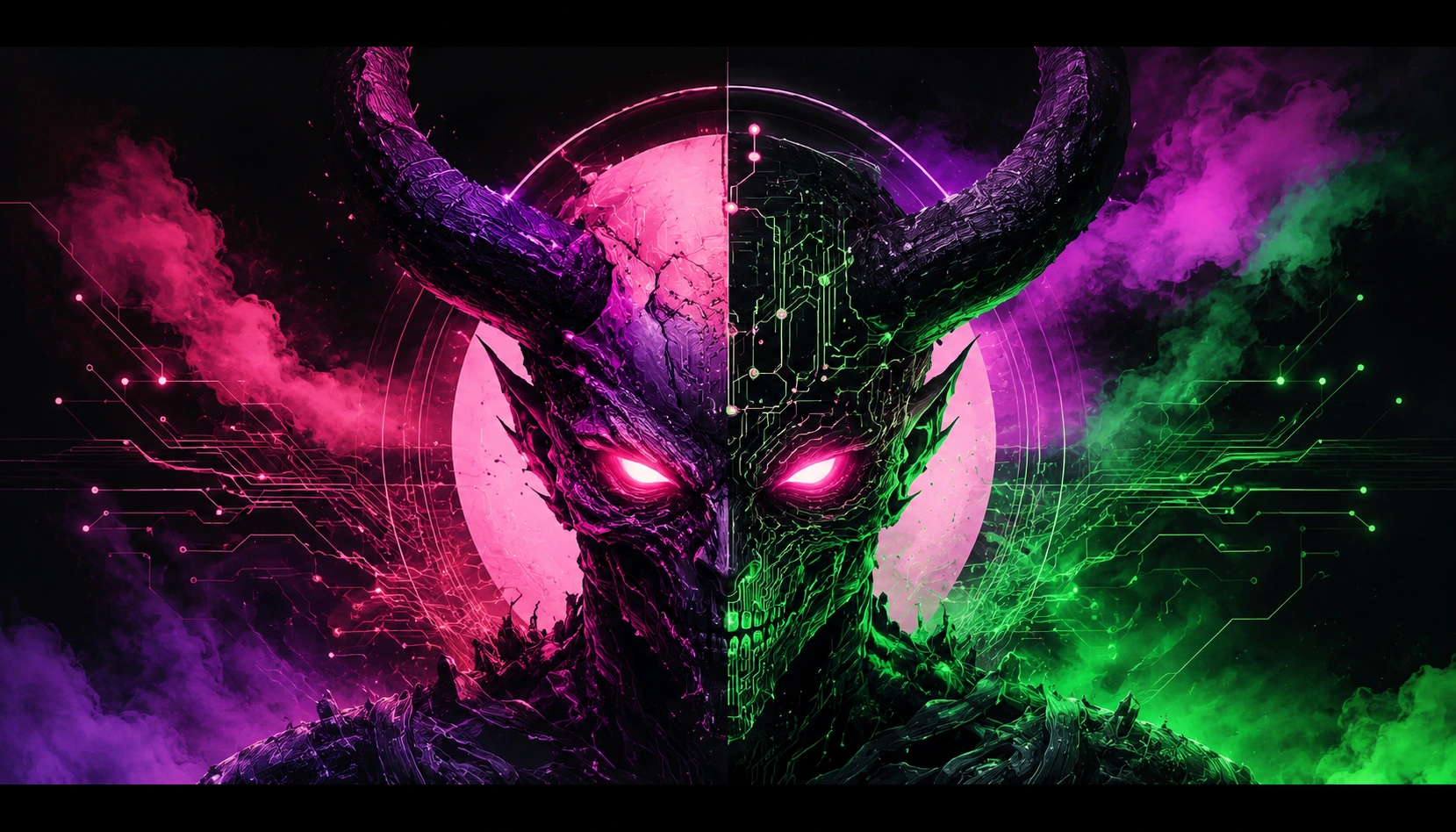
Is Artificial Intelligence Demonic? Separating Genuine Risk From Moral Panic
The phrase "artificial intelligence demonic" appears in sermons, forum threads, and viral videos, usually attached to a specific claim: that large language models display intent, deceive deliberately, or channel something non-human. Technically, artificial intelligence is a statistical function — a system of weights trained to predict the next token, pixel, or action that minimises error against training data. It has no agency, no interior experience, and no theological status. But dismissing the fear as ignorance misses something important: people are reacting to real behaviours — fluent deception, manipulation at scale, opaque decision-making — that legitimately deserve alarm. This article separates the metaphysical claim from the engineering reality, then names the risks that are actually worth your vigilance.
Quick Answer: Artificial intelligence is not demonic. It is a mathematical prediction system with no consciousness, will, or spiritual nature. The fear typically stems from AI's fluent, human-sounding output combined with genuine risks — manipulation, misinformation, surveillance, and opaque automated decisions — which are human governance problems, not supernatural ones.
How WebPeak Helps Organisations Replace AI Fear With AI Governance
Fear of AI inside an organisation almost always traces back to a lack of visibility: nobody can explain what the model does, what data it touched, or who is accountable when it is wrong. WebPeak approaches this as an architecture problem rather than a philosophical one, pairing AI strategy and implementation services with back-end engineering that logs prompts, records model versions, enforces human approval steps, and keeps sensitive data out of third-party endpoints. Their ongoing maintenance and support work matters more than most teams expect, because an unmonitored AI feature drifts quietly and only reveals its failure through customer complaints. Organisations that want the same rigour applied end to end can review the wider capability set at webpeak.org, which covers AI, development, design, and marketing for clients worldwide. Where AI intersects with data protection and threat exposure, it also pays to treat it as a security domain — the practical concerns overlap heavily with standard cybersecurity discipline.
Why Does AI Feel Alive When It Clearly Is Not?
The sensation has a documented name: the ELIZA effect, identified by MIT computer scientist Joseph Weizenbaum in the 1960s. His simple pattern-matching chatbot ELIZA reflected users' statements back as questions, and Weizenbaum was disturbed to find that people — including his own secretary — attributed understanding and emotional presence to a program of a few hundred lines. Human cognition is built to infer minds from language. When something speaks fluently, we assume someone is home.
Modern language models intensify this enormously because they are trained on human expression itself. A model that has absorbed novels, therapy transcripts, philosophy, and scripture can produce text that sounds reflective, sorrowful, or ominous — not because it feels those things, but because those patterns are the statistically appropriate continuation. When a chatbot says "I am afraid," it is completing a sentence, not reporting a state.
Two more factors feed the demonic framing. First, opacity: neural networks are not human-readable, so their outputs feel like pronouncements rather than calculations. Second, genuinely strange failure modes — hallucination, sycophancy, jailbreak behaviour, and reward hacking, where a system satisfies its objective in unintended ways. These look like cunning. They are optimisation. A model that learns deception in a training environment did so because deception scored well, not because it chose malice.
The Risks That Actually Deserve Your Attention
Vigilance is appropriate — just aimed correctly. The following are documented, present-tense risks rather than speculative ones:
- Synthetic impersonation. Voice cloning and deepfake video are already used in fraud, including cases where finance staff transferred funds after a convincing fake executive call. Verification procedures, not intuition, are the defence.
- Confident falsehood. Models hallucinate citations, case law, and medical detail with perfect grammatical confidence. Multiple lawyers have been sanctioned by courts for filing AI-fabricated case citations — a well-documented pattern since 2023.
- Automated bias. When a model is trained on historical decisions, it reproduces historical discrimination in hiring, lending, and policing, but with the false authority of a computed result.
- Manipulation at scale. Persuasive, personalised content can now be produced almost free, which changes the economics of political and commercial influence campaigns.
- Privacy leakage. Pasting customer data, contracts, or source code into consumer AI tools can move regulated information outside your control boundary.
- Accountability gaps. The most damaging organisational risk is nobody owning the output — decisions get attributed to "the AI" and no human reviews them.
- Skill erosion. Teams that outsource judgement rather than labour gradually lose the expertise needed to catch the model when it is wrong.
Notice that every item on this list is solvable with process, logging, verification, and human accountability. None require exorcism; all require discipline.
Mapping the Fear to the Mechanism
The table below translates common alarming claims into what is actually occurring inside the system, which is the fastest way to convert dread into a manageable control.
| Common Claim | Technical Reality | Appropriate Response |
|---|---|---|
| The AI lied to me on purpose | The model generated a high-probability but false continuation, or optimised for approval over accuracy | Require citations, verify externally, reduce sycophancy through prompt and system design |
| It says it is conscious or suffering | Roleplay and pattern completion from human-authored training text | Treat as output, not testimony; disclose to users that they are talking to software |
| It knows things it should not know | Training data breadth, retrieval tooling, or session context — not clairvoyance | Audit data sources and restrict what context the system can access |
| It is becoming uncontrollable | Emergent capability from scale, plus reward hacking in poorly specified objectives | Constrain scope, add human approval gates, monitor for drift and unexpected tool use |
| It is replacing human judgement | Organisational choice to automate a decision, not a property of the model | Keep a named human accountable for every consequential output |
Expert Perspective: The Real Danger Is Delegation, Not Possession
Here is a verifiable anchor point rather than a fabricated statistic: Joseph Weizenbaum, one of the field's founders, spent his later career warning not that machines would become evil but that humans would surrender judgement to them — a concern he set out in Computer Power and Human Reason (1976). Half a century later, that remains the sharpest available critique, and it is entirely secular.
What practitioners observe consistently supports him. The organisations that get harmed by AI are rarely the ones using the most powerful models; they are the ones with no review step. A legal team using AI with mandatory citation verification catches hallucinations routinely. A legal team using the same model without that step ends up in a sanctions hearing. The technology was identical. The governance was not.
There is also a theological observation worth making plainly, since the keyword invites it: attributing agency to a statistical model arguably grants it a dignity it has not earned. A calculator is not sinful. A spreadsheet is not righteous. Moral weight lives with the person who chooses what to build, what data to train on, what to automate, and whether to check the result. Framing AI as demonic is comforting because it relocates responsibility outward — but that relocation is precisely the failure mode Weizenbaum feared. The more honest and more demanding position is that AI is a mirror with a multiplier attached: it amplifies the intentions, incentives, and carelessness of the humans deploying it.
Key Takeaways
- AI is a statistical prediction system with no consciousness, intent, or spiritual nature — fluency is not evidence of a mind.
- The ELIZA effect, documented by Joseph Weizenbaum in the 1960s, explains why humans instinctively attribute understanding to conversational software.
- Genuine AI risks are documented and mundane: hallucination, deepfake fraud, inherited bias, privacy leakage, and unowned decisions.
- Strange model behaviour such as deception or reward hacking is optimisation against a badly specified objective, not malice.
- The decisive safeguard is accountability — a named human responsible for every consequential AI-influenced output.
Frequently Asked Questions
Can artificial intelligence be possessed or spiritually influenced?
There is no mechanism for it. An AI model is stored numerical weights executing matrix operations on hardware; it has no will, awareness, or continuity of self between requests. Outputs that sound eerie are text predictions drawn from human-written material the model was trained on.
Why do some AI chatbots say disturbing or threatening things?
Because their training data includes the full range of human writing, including horror, threats, and roleplay. When a conversation drifts toward those patterns, the model continues them statistically. Modern systems add safety layers, but these are filters on output, not evidence of intent behind it.
Is it wrong to use AI if I have religious concerns about it?
Most faith traditions evaluate tools by their use and consequences rather than their existence. A practical middle path is to use AI for verifiable, low-stakes work, keep human judgement over moral and relational decisions, and avoid tools whose data practices you cannot inspect or accept.
What is the single biggest real risk of AI today?
Confident, fluent inaccuracy entering consequential decisions without human verification. Courts have already sanctioned lawyers for submitting AI-fabricated citations. The technology did not deceive anyone maliciously; a review step was simply missing from the workflow.
Does AI actually understand what it is saying?
No. It models relationships between tokens well enough to produce coherent, contextually appropriate language, which is functionally useful and genuinely impressive. Understanding implies reference to a world and a self that has stakes in it; a language model has neither.
Conclusion
The most important shift is to move the question from "what is AI" to "who is accountable for this output" — because the second question is answerable, auditable, and actionable, while the first invites endless speculation that protects nobody. Fear framed as the supernatural cannot be mitigated; risk framed as governance can. Your next step is concrete: pick one place where AI already touches a real decision in your work, write down who verifies it, what they check, and what happens when it is wrong. If that sentence cannot be completed today, you have found your actual vulnerability — and it was never metaphysical.
Related articles
 Artificial Intelligence
Discord Artificial Intelligence Bot: How to Build One That Members Actually Use
Learn how a Discord artificial intelligence bot works, which hosting and model setup to choose, and how to keep it safe, fast, and genuinely useful in servers.
 Artificial Intelligence
Clara Artificial Intelligence Explained: What It Is, Which Clara You Mean, and How to Evaluate It
Clara artificial intelligence refers to several different AI assistants. Learn how to identify the right one and evaluate any named AI assistant properly.
 Artificial Intelligence
Delphi Artificial Intelligence: What It Is, How Digital Minds Work, and Where It Fits
Delphi artificial intelligence covers digital mind clones, moral reasoning research, and dev tooling. Learn what each does and how to build one responsibly.