Are Podcasts Social Media
Podcasts are episodic digital audio or video programs delivered on demand through apps and RSS feeds, allowing listeners to subscribe and consume content whenever they choose. The direct answer to whether podcasts are social media is no, at least not in the traditional definition. Social media platforms are defined by user profiles, follower networks, and interactive, many-to-many communication, whereas podcasts are fundamentally a broadcast medium delivering content from a creator to an audience. That said, the boundary is softening as platforms add social features. Getting this classification right helps creators and brands choose the correct metrics, tools, and promotion strategy for their audio content.
Quick Answer: No, podcasts are not social media in the strict sense. They are on-demand broadcast media without native profiles or networked interaction. They increasingly share social features like comments and sharing, but their core format remains one-to-many rather than many-to-many.
How WebPeak Helps You Turn a Podcast Into a Growth Engine
A podcast reaches its potential only with smart promotion and repurposing across channels. WebPeak, a worldwide digital agency, supports podcasters through their video production and editing services, converting recordings into polished video episodes and short clips that perform on social feeds. Their digital marketing services then amplify those assets with paid and organic distribution, helping shows grow subscribers, sponsorships, and authority far faster than relying on the audio feed alone.
What Is the Real Difference Between Podcasts and Social Media?
The real difference lies in structure and interaction. Social media is a networked, interactive system built on user profiles and reciprocal connections, think following, commenting, and sharing in real time. A podcast, by contrast, is a publishing format: content is created, distributed via feed, and consumed passively, much like radio or television. Podcasts do not require the listener to have a profile or connect with others to consume the content. This is why communication scholars categorize podcasting as "on-demand broadcast media." The distinction is not merely academic, it determines whether you measure success by network engagement or by audience reach and retention.
The consumption context also sets the two apart in ways that affect content design. Social media is consumed in short, distracted bursts, often with the sound off and the thumb ready to scroll past. Podcasts are consumed during long, focused windows, commutes, workouts, chores, when the listener has committed their attention for twenty minutes to an hour. This is why podcast audiences report far higher recall and trust than social audiences: sustained attention creates genuine familiarity with a host's voice and perspective. For creators, this means podcast content can be deeper, more nuanced, and more persuasive than anything that survives on a fast-moving feed, which is precisely why podcasts excel at building loyalty even though they lack the viral reach of social platforms.
How Are Podcasts Becoming More Social?
Even though podcasts are not social media by definition, they are steadily adopting social characteristics. Here is how the gap is closing:
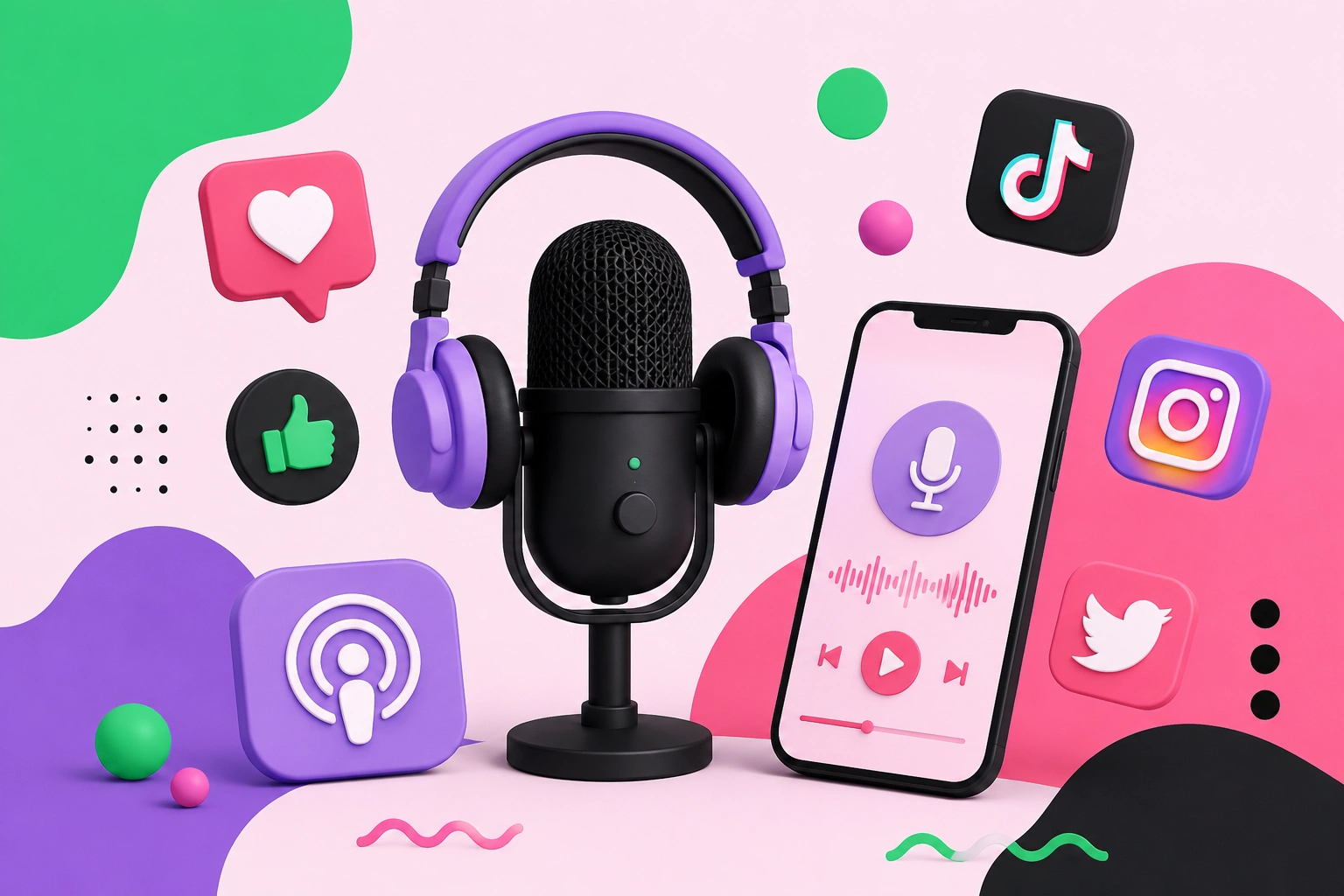
- Interactive platforms: Spotify and YouTube let listeners comment, like, and share episodes.
- Short-form clips: Creators repurpose episodes into Reels, TikToks, and Shorts to spark conversation.
- Listener communities: Discord servers, subreddits, and Facebook groups extend the show socially.
- Live and interactive episodes: Live recordings with audience Q&A add real-time engagement.
- Voice messages and polls: Some apps let listeners send audio questions or vote on topics.
These features make podcasting feel social, but the underlying distribution model remains broadcast rather than networked.
Video podcasting has accelerated this convergence dramatically. As more shows publish full video versions on YouTube and Spotify, podcasts inherit the social features of those platforms, comments, likes, subscriptions, and recommendation algorithms. A video clip from an episode can go viral on TikTok in a way a pure audio file never could, blurring the line further. Yet even here, the distinction holds: the viral clip lives on the social platform, while the full episode remains an owned broadcast asset. Smart creators exploit exactly this dynamic, using social platforms as the discovery layer that funnels new listeners toward the deeper, relationship-building experience of the full podcast. The clip earns attention; the episode earns trust.
How Should You Categorize and Measure Podcasts?
Because podcasts sit between broadcast and social media, categorizing them correctly guides how you measure and grow them. This table clarifies the right approach.
| Dimension | Podcast (Broadcast Media) | Social Media |
|---|---|---|
| Key metric | Downloads and listen-through rate | Likes, shares, and comments |
| Discovery | Directories, search, referrals | Algorithmic feeds |
| Engagement style | Deep, sustained attention | Quick, scroll-based |
| Content control | Creator-owned RSS feed | Platform-dependent |
What Do the Numbers Reveal About Podcasts vs. Social Media?
The numbers highlight why the distinction matters. According to Edison Research, podcast listenership has grown steadily, with hundreds of millions of listeners globally and strong monthly consumption in the U.S. Spotify and YouTube report that video podcasts are among their fastest-growing content categories, pushing audio further toward social territory. DataReportal, meanwhile, counts over 5 billion social media users worldwide, but with far shorter average attention per interaction. From my experience helping creators scale, the smartest strategy treats the podcast as a trust-building broadcast asset and social platforms as the discovery layer. The original insight many overlook: because listeners choose to spend uninterrupted time with a host, podcasts build parasocial trust that converts audiences into loyal customers more effectively than a passing social impression ever could.
For businesses weighing where to invest, the classification question ultimately points to a resource decision rather than a semantic one. If your goal is fast, broad awareness and community interaction, social media is the right primary tool. If your goal is deep authority, audience loyalty, and a channel you fully own and control, a podcast delivers what social platforms cannot. The strongest content strategies refuse to treat this as an either-or choice. They run a podcast as the durable, owned core of their content and use social platforms as the amplification engine, each doing the job it does best. Understanding that podcasts are not social media, but thrive alongside it, is what lets you assign each channel the right role and expectations.
A useful way to settle the question in your own strategy is to ask who controls the relationship with your audience. On social media, the platform mediates every interaction and can throttle your reach, change the rules, or suspend your account without warning. With a podcast, your subscriber list travels with you through the open RSS standard, meaning you own the direct line to your listeners. This ownership is the deepest reason podcasts sit outside the social media category despite their growing social features. For any creator or business thinking long term, that distinction is not academic; it is the difference between building an audience you rent and one you truly own, which should shape where you invest your most valuable content.
Key Takeaways
- Podcasts are on-demand broadcast media, not social media, because they lack native profiles and many-to-many interaction.
- The core distinction is structural: podcasts publish content, while social media connects networked users.
- Platforms like Spotify and YouTube are adding social features, blurring but not erasing the difference.
- Measure podcasts by downloads and listen-through rate, not social engagement metrics.
- Podcasts build deep parasocial trust, making them powerful when paired with social media for discovery.
Frequently Asked Questions
Is a podcast the same as social media?
No, a podcast is not the same as social media. Podcasts are on-demand audio or video broadcasts distributed through feeds and apps, while social media is built on user profiles, networks, and interaction. They complement each other but are distinct content categories.
Can a podcast go viral like social media content?
Podcasts can gain rapid popularity, but virality usually happens through social media clips rather than the audio feed itself. Short, shareable moments posted on TikTok, Reels, or X can drive listeners to a full episode, blending broadcast content with social distribution.
Do podcasts count as user-generated content?
Podcasts are creator-generated content rather than the casual user-generated content typical of social media. They require planning, recording, and editing, positioning them closer to produced broadcast media than to spontaneous social posts, even when made by independent creators.
Why do marketers include podcasts in social media strategies?
Marketers include podcasts because they extend reach and build trust, and because episodes are promoted heavily on social platforms. Repurposing audio into clips and using social channels for discovery makes podcasts a natural, high-value companion to a broader social strategy.
Which platforms make podcasts feel most like social media?
Spotify and YouTube make podcasts feel most social by adding comments, likes, subscriptions, and video. These features layer interaction onto the listening experience, moving podcasts closer to social media while the underlying RSS distribution remains a broadcast model.
Conclusion
The essential takeaway is that podcasts are broadcast media, not social media, and that clarity should shape how you measure and promote your show. Focus your energy on creating genuinely valuable episodes that earn sustained attention, then lean on social platforms purely for discovery and community. Creators who understand this division build both loyal audiences and broad reach, turning a simple audio feed into a trusted, revenue-generating asset that outlasts fleeting social trends.