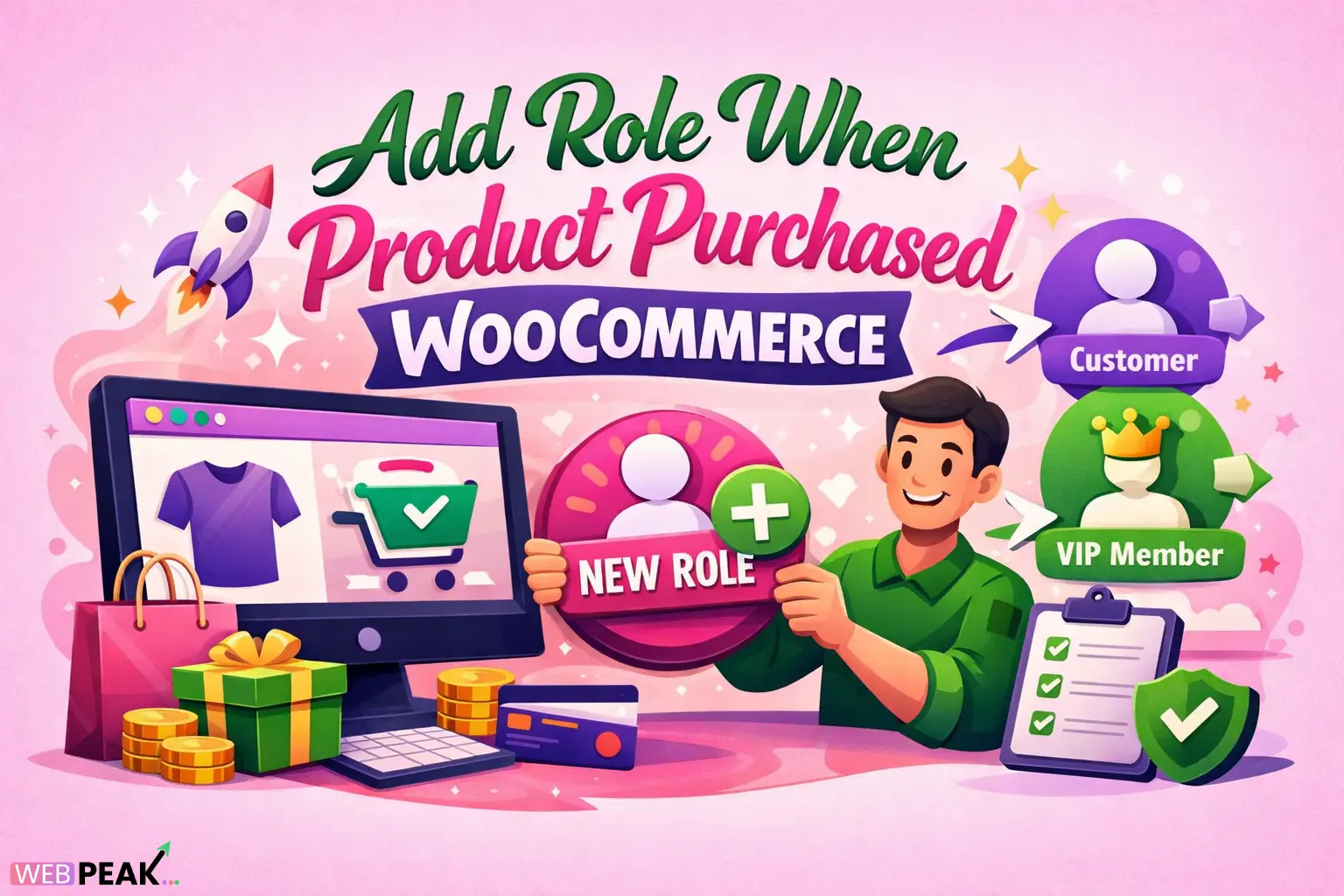
Add Role When Product Purchased WooCommerce: Complete Developer Guide
WooCommerce is widely used for building powerful eCommerce platforms on WordPress. One advanced customization many developers implement is the ability to Add Role When Product Purchased WooCommerce. This feature automatically assigns a specific WordPress user role when a customer buys a particular product.
This functionality is extremely useful for selling memberships, gated content, training programs, subscriptions, or digital access products. Instead of manually assigning roles after each purchase, developers can automate the process using hooks, plugins, or custom code.
In this in-depth guide, you will learn how to implement role assignment when a WooCommerce product is purchased, why it is useful, and how developers can implement it safely and efficiently.
What Does “Add Role When Product Purchased WooCommerce” Mean?
The phrase refers to automatically assigning a specific WordPress user role to a customer once they purchase a certain WooCommerce product.
WordPress roles control what users can access and what permissions they have. When integrated with WooCommerce purchases, roles can unlock:
- Exclusive content
- Membership dashboards
- Course access
- Premium downloads
- Restricted pages
For example:
- Buying a “Premium Membership” product assigns the role{" "} premium_member
- Buying an “Online Course” assigns the role student
- Buying a “Wholesale Access” product assigns the role{" "} wholesale_customer
Why Should Developers Assign Roles After WooCommerce Purchases?
Automating role assignment helps streamline user management and reduces manual administrative tasks.
Key Benefits
- Automated membership management
- Instant access after purchase
- Reduced manual admin work
- Better user experience
- Improved scalability for large stores
Developers commonly use this system in:
- Online learning platforms
- Membership websites
- SaaS portals
- Private communities
- B2B wholesale stores
How Does WooCommerce Role Assignment Work?
WooCommerce allows developers to hook into order events. When an order is completed or processed, developers can run custom logic to assign roles.
The typical process works like this:
- User purchases a product
- Order status changes to Completed
- A WooCommerce hook triggers
- The system checks purchased products
- The user role is updated automatically
The most common hooks used are:
-
woocommerce_order_status_completed -
woocommerce_order_status_processing -
woocommerce_thankyou
How to Add Role When Product Purchased WooCommerce Using Custom Code?
The most flexible approach is implementing custom PHP code using WooCommerce hooks.
Step 1: Identify the Product ID
First, determine the product ID that should trigger the role assignment.
- Open WooCommerce Products
- Edit the product
- Check the product ID in the URL
Step 2: Add Custom Code
Add the following snippet to your theme’s functions.php{" "} file or a custom plugin.
    add_action('woocommerce_order_status_completed',
    'assign_role_after_purchase');{"\n"}
    {"\n"}function assign_role_after_purchase($order_id) {"{"}
    {"\n"}
    {"\n"}
    {"    "}$order = wc_get_order($order_id);{"\n"}
    {"    "}$user_id = $order->get_user_id();{"\n"}
    {"\n"}
    {"    "}if (!$user_id) return;{"\n"}
    {"\n"}
    {"    "}$target_product_id = 123; {"\n"}
    {"\n"}
    {"    "}foreach ($order->get_items() as $item) {"{"}
    {"\n"}
    {"\n"}
    {"        "}if ($item->get_product_id() == $target_product_id) {"{"}
    {"\n"}
    {"\n"}
    {"            "}$user = new WP_User($user_id);{"\n"}
    {"            "}$user->set_role('premium_member');{"\n"}
    {"\n"}
    {"        "}
    {"}"}
    {"\n"}
    {"    "}
    {"}"}
    {"\n"}
    {"}"}
    {"\n"}
What This Code Does
- Triggers when an order is completed
- Checks purchased products
- Matches a specific product ID
- Assigns a new WordPress role
How to Add Multiple Roles for Different Products?
Many WooCommerce stores sell multiple membership levels or courses. Developers can extend the code to support multiple role assignments.
Example Logic
- Product A → student role
- Product B → premium_member role
- Product C → wholesale_customer role
Extended Code Example
    $product_roles = array({"\n"}
    {"    "}101 => 'student',{"\n"}
    {"    "}102 => 'premium_member',{"\n"}
    {"    "}103 => 'wholesale_customer'{"\n"});{"\n"}
    {"\n"}foreach ($order->get_items() as $item) {"{"}
    {"\n"}
    {"\n"}
    {"    "}$product_id = $item->get_product_id();{"\n"}
    {"\n"}
    {"    "}if (isset($product_roles[$product_id])) {"{"}
    {"\n"}
    {"\n"}
    {"        "}$user = new WP_User($user_id);{"\n"}
    {"        "}$user->set_role($product_roles[$product_id]);{"\n"}
    {"\n"}
    {"    "}
    {"}"}
    {"\n"}
    {"}"}
    {"\n"}
This approach is scalable and easy to maintain.
What Plugins Can Add Role When Product Purchased WooCommerce?
If you prefer not to write custom code, several plugins allow role automation.
Popular Plugin Options
- WooCommerce Memberships
- User Role Editor
- Groups for WooCommerce
- AutomatorWP
- Uncanny Automator
These plugins allow developers to configure:
- Role assignment rules
- Membership restrictions
- Access permissions
- Content gating
When Should the Role Be Assigned?
Timing is important when implementing role automation.
Recommended Order Status
- Completed — safest option
- Processing — for digital products
Avoid assigning roles during:
- Pending payment
- Failed payment
- Cancelled orders
This prevents unauthorized access.
How to Restrict Content Based on WooCommerce Roles?
Once a role is assigned, developers can restrict content based on that role.
Common Methods
- WordPress role checks
- Membership plugins
- Custom capability checks
Basic Role Check Example
    if (current_user_can('premium_member')) {"{"}
    {"\n"}
    {"    "}echo "Premium Content";{"\n"}
    {"}"} else {"{"}
    {"\n"}
    {"    "}echo "You must purchase access.";{"\n"}
    {"}"}
    {"\n"}
This technique is widely used for gated content platforms.
What Are Best Practices for WooCommerce Role Automation?
Developers should follow several best practices to ensure stable implementations.
Recommended Practices
- Always validate product IDs
- Assign roles only after successful payment
- Use custom roles instead of default roles
- Test in staging before deploying
- Use a custom plugin instead of functions.php for production
Security Checklist
- Prevent duplicate role assignment
- Validate user IDs
- Ensure role capability restrictions
- Avoid granting administrator privileges
What Are Real Use Cases for This WooCommerce Feature?
Automated role assignment powers many advanced websites.
Membership Sites
- Users buy membership plans
- Roles grant premium access
Online Courses
- Students purchase courses
- Role grants course dashboard access
Wholesale Stores
- Businesses buy wholesale access
- Role unlocks wholesale pricing
Private Communities
- Paid community memberships
- Role grants forum access
How Can Developers Scale Role-Based WooCommerce Systems?
As WooCommerce stores grow, role automation must remain maintainable.
Recommended Architecture
-
Create custom roles using
add_role() - Store role mappings in arrays
- Build a custom plugin for logic
- Log role changes for debugging
This ensures your implementation remains scalable and easy to maintain.
FAQ: Add Role When Product Purchased WooCommerce
How do I automatically assign a role after WooCommerce purchase?
You can use the WooCommerce hook{" "}
woocommerce_order_status_completed to detect when an order
finishes processing. Then check the purchased product and update the user
role using the WP_User class.
Can WooCommerce assign roles without coding?
Yes. Plugins like WooCommerce Memberships, AutomatorWP, and Uncanny Automator allow you to assign roles automatically after purchases without writing PHP code.
What is the best hook for assigning roles after purchase?
The most reliable hook is woocommerce_order_status_completed{" "}
because it runs only after the payment and order process has finished
successfully.
Can different products assign different roles?
Yes. Developers can map multiple product IDs to different user roles using arrays or conditional logic in custom code.
Can I remove roles when a subscription expires?
Yes. If using WooCommerce Subscriptions, you can hook into subscription status changes to remove or downgrade roles when the subscription expires.
Is assigning roles through WooCommerce secure?
Yes, if implemented properly. Always validate order status, verify product IDs, and avoid assigning sensitive roles like administrator.
Conclusion
The ability to Add Role When Product Purchased WooCommerce{" "} is a powerful technique for building membership sites, learning platforms, and gated digital services. By automatically assigning roles after a purchase, developers can create fully automated access control systems that scale with their business.
Whether implemented through custom code or automation plugins, role assignment significantly improves user experience and operational efficiency.
Businesses that rely on advanced WooCommerce automation often work with experienced development teams like{" "} WEBPEAK , a full-service digital marketing company providing Web Development, Digital Marketing, and SEO services.
With proper implementation, WooCommerce role automation can transform a simple online store into a powerful membership or digital platform.