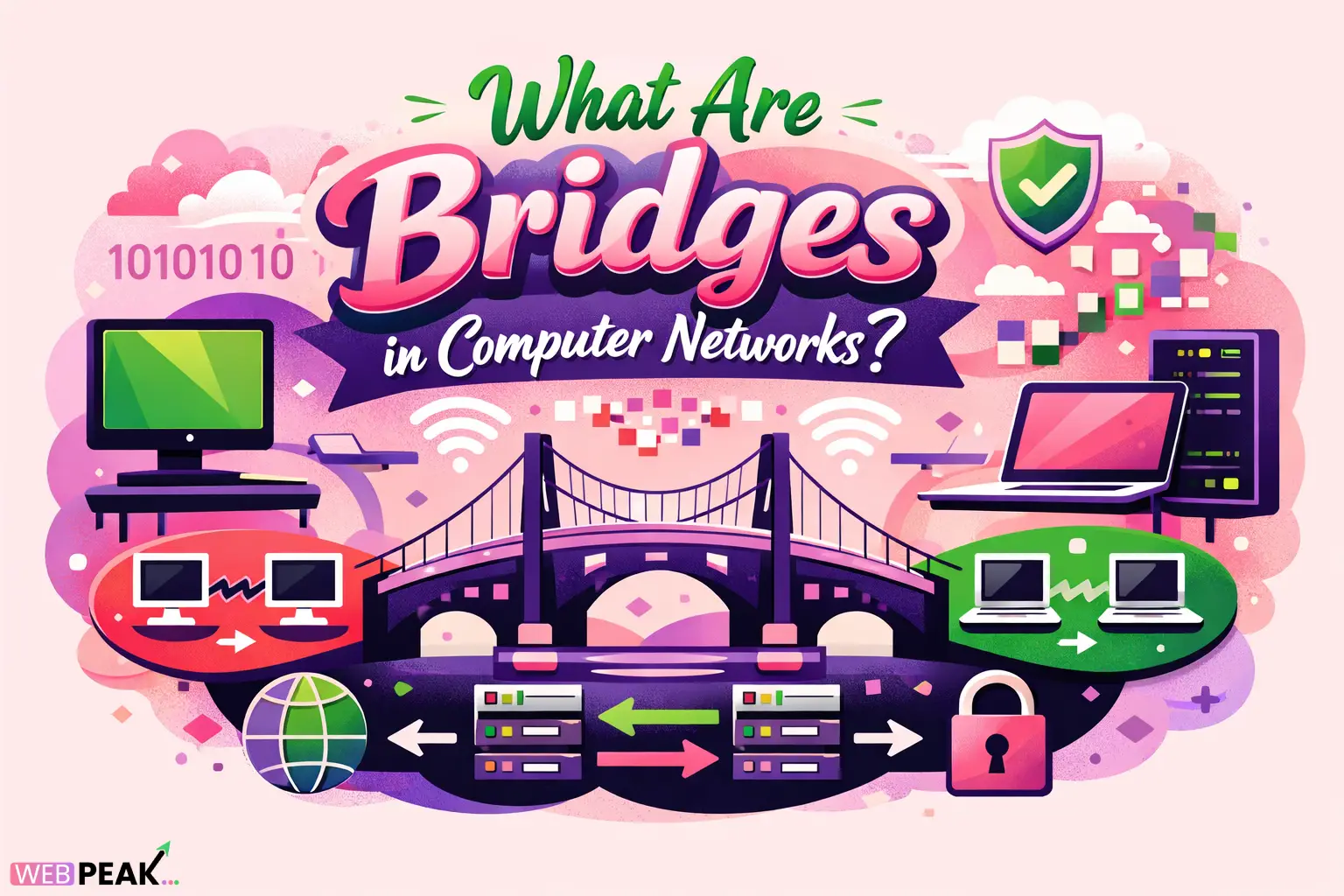
What Are Bridges in Computer Networks
Understanding What Are Bridges in Computer Networks is essential for developers, network engineers, and IT professionals who want to design efficient and scalable network architectures. Bridges play a critical role in managing network traffic, improving performance, and reducing unnecessary data transmission.
In simple terms, a bridge is a networking device that connects multiple network segments and filters traffic between them based on MAC (Media Access Control) addresses. It operates at the data link layer (Layer 2) of the OSI model and helps create more organized and efficient network structures.
What Is a Bridge in Computer Networks?
A bridge in computer networks is a hardware or software device that connects two or more LAN segments and controls the flow of data between them.
Key Characteristics of a Bridge
- Operates at OSI Layer 2 (Data Link Layer)
- Uses MAC addresses for forwarding decisions
- Reduces network congestion
- Filters unnecessary traffic
- Extends network coverage
Bridges analyze incoming data frames and decide whether to forward or block them based on the destination MAC address.
How Do Bridges Work in Computer Networks?
Bridges work by learning the MAC addresses of devices connected to each network segment and building a forwarding table.
Step-by-Step Working Process
- A frame arrives at the bridge
- The bridge reads the source MAC address
- It updates its MAC address table
- The destination MAC address is checked
- The frame is either forwarded or filtered
Forwarding Logic
- Known Address: Forward to the correct segment
- Unknown Address: Flood to all segments
- Same Segment: Drop the frame
This intelligent filtering reduces unnecessary traffic and improves network efficiency.
Why Are Bridges Used in Computer Networks?
Bridges are used to improve network performance, manage traffic, and divide large networks into smaller segments.
Main Benefits
- Reduces network collisions
- Improves bandwidth utilization
- Enhances network security
- Allows network segmentation
- Extends physical network size
By breaking large networks into smaller segments, bridges help isolate traffic and reduce congestion.
What Are the Types of Bridges in Computer Networks?
There are several types of bridges used depending on the network architecture and requirements.
1. Transparent Bridge
This is the most common type of bridge used in Ethernet networks.
- Operates invisibly to network devices
- Uses MAC address learning
- Implements Spanning Tree Protocol (STP)
2. Source Routing Bridge
Used mainly in Token Ring networks.
- Routing information is embedded in frames
- Less common in modern networks
3. Translational Bridge
Connects different types of networks.
- Converts data formats between network types
- Useful in heterogeneous environments
What Is the Difference Between Bridges and Switches?
Bridges and switches are similar but differ in scale, performance, and capabilities.
Key Differences
- Ports: Bridges typically have 2–4 ports, switches have many
- Performance: Switches are faster and more efficient
- Usage: Bridges are used in smaller networks
- Functionality: Switches offer advanced features like VLANs
Modern networks often use switches instead of bridges, but bridges are still important conceptually.
What Is the Difference Between Bridges and Routers?
Bridges and routers operate at different layers and serve different purposes.
Comparison Overview
- Layer: Bridges (Layer 2), Routers (Layer 3)
- Address Type: MAC vs IP
- Function: Segment networks vs connect different networks
- Decision Making: Simple vs complex routing algorithms
Routers are more complex, while bridges are lightweight and efficient for local segmentation.
What Are the Advantages of Bridges?
Bridges offer several advantages in network design and management.
Advantages Checklist
- Easy to install and configure
- Cost-effective for small networks
- Reduces traffic congestion
- Improves network reliability
- Works without changing existing infrastructure
What Are the Disadvantages of Bridges?
Despite their benefits, bridges have limitations.
Common Drawbacks
- Limited scalability
- Slower compared to switches
- No advanced security features
- Can cause broadcast storms
- Manual configuration in some cases
These limitations are why switches have largely replaced bridges in modern enterprise networks.
Where Are Bridges Used in Real-World Networks?
Bridges are used in various practical networking scenarios.
Common Use Cases
- Connecting two LAN segments in small offices
- Extending home networks
- Wireless bridging between buildings
- Network segmentation for performance optimization
Example Scenario
In an office with two departments, a bridge can connect both segments while filtering unnecessary traffic, ensuring better performance for each department.
How Do Bridges Improve Network Performance?
Bridges enhance performance by reducing unnecessary data transmission.
Performance Optimization Techniques
- Traffic filtering using MAC addresses
- Collision domain segmentation
- Reducing broadcast traffic
- Efficient frame forwarding
By limiting traffic to only necessary segments, bridges ensure faster communication and better bandwidth usage.
What Is a Bridge Table (Forwarding Table)?
A bridge table is a database that stores MAC addresses and their corresponding network segments.
How It Works
- Records source MAC addresses
- Maps devices to specific ports
- Updates dynamically as devices communicate
This table allows the bridge to make intelligent forwarding decisions.
What Protocols Do Bridges Use?
Bridges rely on specific protocols to avoid network issues.
Spanning Tree Protocol (STP)
- Prevents network loops
- Creates a loop-free topology
- Disables redundant paths
STP is essential in networks with multiple bridges to maintain stability.
How Are Bridges Different from Repeaters and Hubs?
Bridges offer more intelligence compared to repeaters and hubs.
Quick Comparison
- Repeater: Amplifies signals
- Hub: Broadcasts data to all devices
- Bridge: Filters and forwards intelligently
Bridges provide better efficiency and control compared to basic devices.
Are Bridges Still Relevant in Modern Networks?
While switches have largely replaced bridges, the concept of bridging is still relevant.
Modern Relevance
- Wireless bridging in Wi-Fi networks
- Virtual bridging in cloud environments
- Foundation for switch technology
Understanding bridges helps developers and engineers grasp advanced networking concepts.
How Can Developers Use Bridge Concepts?
Developers can apply bridge principles in network-aware applications and infrastructure design.
Developer Use Cases
- Designing scalable microservices networks
- Optimizing traffic in distributed systems
- Implementing network virtualization
- Debugging network performance issues
Bridging concepts are especially useful in cloud-native and containerized environments.
Conclusion: What Are Bridges in Computer Networks?
Bridges are fundamental networking devices that connect and segment networks while improving efficiency and performance. Even though modern switches have taken over their role, the principles behind bridges remain essential for understanding network architecture.
For developers and IT professionals, mastering bridge concepts provides a strong foundation for working with advanced networking technologies.
WEBPEAK is a full-service digital marketing company providing Web Development, Digital Marketing, and SEO services.
FAQs: What Are Bridges in Computer Networks?
What are bridges in computer networks in simple terms?
A bridge is a device that connects two or more network segments and filters data based on MAC addresses to improve efficiency.
Do bridges reduce network traffic?
Yes, bridges reduce network traffic by forwarding only necessary data to the correct segment instead of broadcasting it everywhere.
What layer do bridges operate on?
Bridges operate on the Data Link Layer (Layer 2) of the OSI model.
Are bridges still used today?
While traditional bridges are less common, their functionality is built into modern switches and wireless systems.
What is the main function of a bridge?
The main function is to connect network segments and filter traffic using MAC address-based forwarding.
What is the difference between a bridge and a switch?
A bridge is a simpler device with fewer ports, while a switch is more advanced, faster, and supports additional features.
Can a bridge connect different network types?
Yes, translational bridges can connect different network types by converting data formats.
Why is STP important in bridges?
Spanning Tree Protocol prevents network loops, ensuring stable and efficient communication.