Concern For a Web Game Developer: The Complete Guide to Challenges, Solutions, and Success in 2026
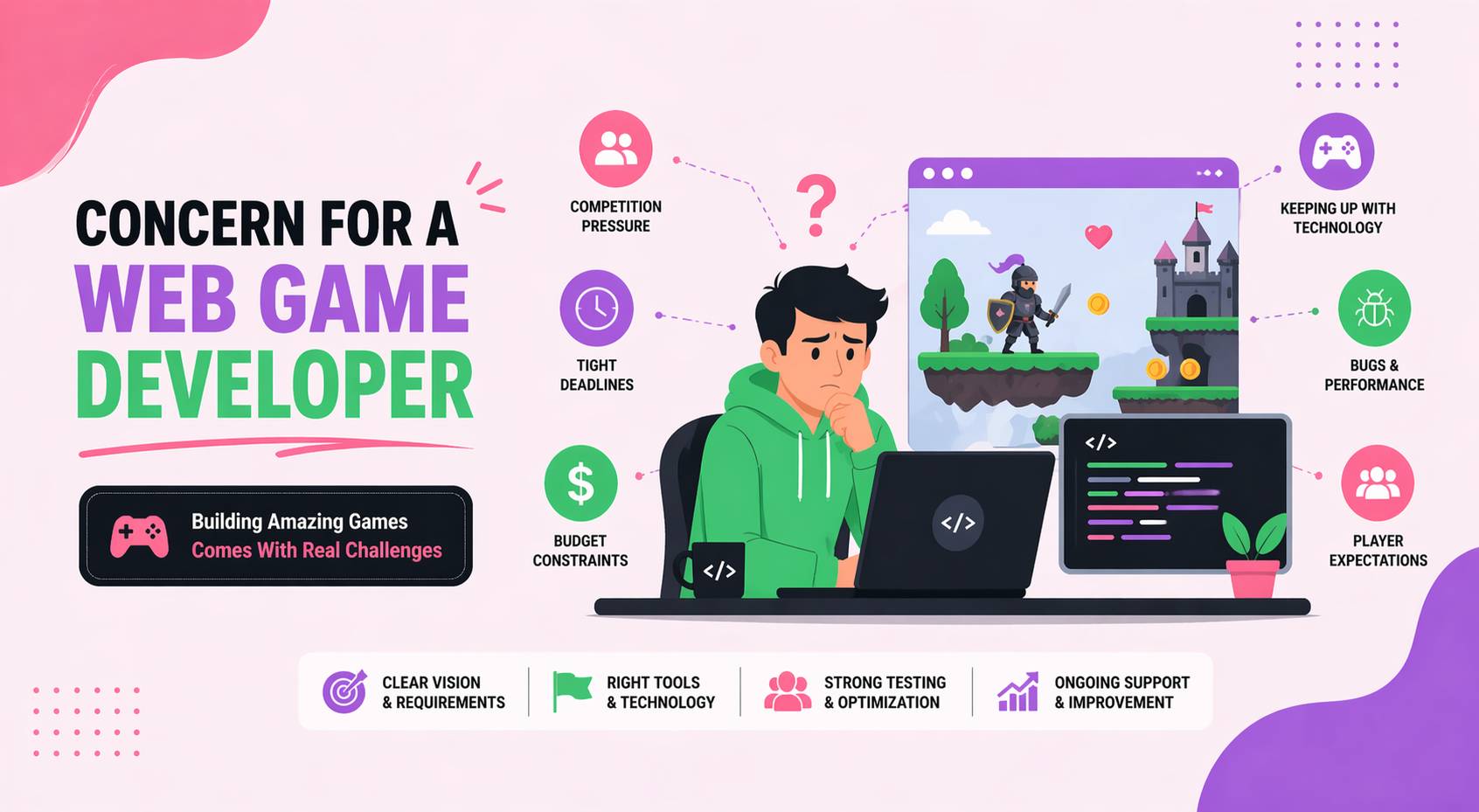
Every concern for a web game developer is real, pressing, and often underestimated by those outside the industry. Whether you are an indie creator building your first browser-based title or a seasoned professional managing a large-scale multiplayer experience, the challenges that come with web game development are both technical and strategic. From performance bottlenecks and cross-browser compatibility nightmares to monetization struggles and security vulnerabilities, web game developers navigate a minefield of complexities every single day. This guide addresses each of those concerns in exhaustive detail, offering actionable solutions, best practices, and forward-thinking strategies to help you not just survive — but thrive — in the ever-evolving world of web game development.
Table of Contents
What Is Web Game Development and Why Does It Matter?
Web game development refers to the process of designing, building, and deploying games that run directly within a web browser, without requiring users to install dedicated software. These games leverage web technologies such as HTML5, CSS3, JavaScript, WebGL, WebAssembly, and WebSockets to deliver interactive, engaging experiences that are instantly accessible from any internet-connected device.
The relevance of web games has skyrocketed over the past decade. The global browser games market is projected to reach tens of billions of dollars in revenue by 2027, driven by the ubiquity of smartphones, the rise of casual gaming, and the increasing power of modern browsers. Web games democratize gaming — a player in Karachi, Lagos, or São Paulo can enjoy the same experience as someone in New York or Tokyo, with nothing more than a browser and an internet connection.
For developers, this accessibility is both an enormous opportunity and a source of significant concern. The barrier to entry is lower than ever, but so is the margin for error. Players expect console-quality visuals, near-zero load times, flawless cross-device performance, and bank-grade security. Meeting these expectations while managing limited resources is the central concern for a web game developer operating in today's competitive landscape.
What Are the Key Concerns for a Web Game Developer in 2026?
The concerns facing web game developers are multi-dimensional. They span technical, commercial, legal, and creative domains. Before diving deep into each area, here is a high-level overview of the most pressing issues:
Performance and frame rate consistency across varying hardware configurations
Cross-browser and cross-device compatibility including mobile, tablet, and desktop rendering
Security vulnerabilities including cheating, data breaches, and DDoS attacks
Monetization strategy and sustainable revenue models
Real-time multiplayer networking and server infrastructure costs
Search engine discoverability and organic traffic acquisition
User retention and engagement loops
Legal compliance including GDPR, COPPA, and data privacy regulations
Asset management and intellectual property protection
Scalability and infrastructure costs during viral growth
Each of these areas demands a strategic, informed approach. Let's explore them in depth.
Performance Optimization: The Biggest Technical Concern
Why Performance Is the Number One Concern for a Web Game Developer
Performance is arguably the most critical concern for any web game developer. Unlike native applications, web games run inside a browser sandbox, which imposes inherent limitations. JavaScript, despite significant advances in modern engines like V8 and SpiderMonkey, is still an interpreted language with garbage collection pauses that can cause frame drops. WebGL introduces GPU communication overhead, and large asset files can dramatically increase load times.
Research consistently shows that users abandon games that take more than three seconds to load. Every additional second of load time reduces player retention by a measurable percentage. For a web game, this is catastrophic — it means all your creative effort, all your marketing spend, all your server costs could be undermined by a few hundred kilobytes of uncompressed texture files.
How to Optimize Web Game Performance: A Step-by-Step Guide
Audit your asset pipeline. Use tools like Lighthouse, WebPageTest, and Chrome DevTools to identify asset bottlenecks. Compress textures using formats like WebP, AVIF, or Basis Universal. Compress audio files using Ogg Vorbis or Opus codecs.
Implement progressive loading. Load only the assets required for the current scene or level. Use lazy loading and asset streaming for large game worlds.
Minimize garbage collection pressure. Pool objects — bullets, particles, enemies — rather than creating and destroying them constantly. Reuse arrays and avoid closures in hot code paths.
Use WebAssembly for CPU-intensive logic. Physics engines, pathfinding algorithms, and procedural generation benefit enormously from WASM's near-native execution speed.
Leverage Web Workers. Offload non-rendering tasks — AI calculations, collision detection preprocessing, data parsing — to background threads using Web Workers.
Implement a robust rendering pipeline. Use sprite batching, texture atlases, and GPU instancing to minimize draw calls. In WebGL, each draw call has overhead; batching reduces this dramatically.
Profile continuously. Performance is not a one-time fix. Use browser profilers to identify regressions introduced by new features or updates.
Performance Checklist for Web Game Developers
All images compressed and in modern formats (WebP/AVIF)
Audio encoded in Ogg Vorbis or Opus
JavaScript minified and bundled with tree-shaking
Object pooling implemented for frequently spawned entities
Web Workers used for heavy computation
WebAssembly modules used for physics and pathfinding
Texture atlases minimizing draw calls
Lazy loading implemented for non-critical assets
Service Workers used for caching and offline functionality
Core Web Vitals (LCP, FID, CLS) within acceptable thresholds
Cross-Browser and Cross-Device Compatibility Challenges
The Fragmented Browser Landscape: A Real Concern for Web Game Developers
One of the most persistent concerns for a web game developer is ensuring their game works correctly across all major browsers — Chrome, Firefox, Safari, Edge, and Brave — as well as their mobile counterparts. Each browser engine (Blink, Gecko, WebKit) implements web standards slightly differently, and these differences compound dramatically in game development contexts.
Safari on iOS, for instance, has historically lagged in WebGL support and has unique restrictions on audio autoplay and fullscreen APIs. Firefox handles certain CSS transforms differently from Chrome. Edge has improved dramatically since adopting Chromium, but legacy users remain. Mobile browsers introduce additional complexity: touch events vs. pointer events, varying screen resolutions, different GPU capabilities, and thermal throttling that can tank performance mid-session.
Strategies to Achieve Cross-Browser Compatibility
Use feature detection, not browser detection. Use libraries like Modernizr or write custom detection scripts to check for specific API support before using it.
Polyfill critical APIs. For browsers lacking support for specific features, use well-maintained polyfills. Be selective — every polyfill adds weight.
Test on real devices, not just emulators. Browser emulators miss critical real-world issues like GPU driver bugs, thermal throttling, and OS-level audio restrictions.
Handle touch and pointer events gracefully. Use the Pointer Events API as the primary input handler, with touch and mouse event fallbacks.
Design responsively from the start. Use relative units, flexible layouts, and dynamic canvas scaling to accommodate all screen sizes.
Implement graceful degradation. For browsers that lack advanced features like WebGL 2.0 or WebGPU, provide a WebGL 1.0 fallback or a simplified version of the game.
Cross-Device Testing Matrix
Device Type Browser Key Concern Recommended Action Desktop (Windows) Chrome, Edge, Firefox Performance at high resolutions GPU profiling, draw call optimization Desktop (macOS) Safari, Chrome WebGL compatibility, audio autoplay Feature detection, user-initiated audio unlock Mobile (iOS) Safari (only engine allowed) WebGL limits, no fullscreen API PWA mode, reduced texture size, touch controls Mobile (Android) Chrome, Firefox, Samsung Internet Thermal throttling, memory limits Adaptive quality settings, background asset streaming Tablet Safari, Chrome Variable GPU capabilities Tiered rendering quality system
Security Concerns Every Web Game Developer Must Address
Why Security Is a Growing Concern for Web Game Developers
Security is an often overlooked but critically important concern for web game developers. The open nature of the web means that your game's client-side code is accessible to anyone who opens browser developer tools. Bad actors exploit this openness to cheat, manipulate game states, steal player data, and launch attacks against your infrastructure.
The consequences are severe: a reputation-destroying cheating epidemic, regulatory fines for data breaches, financial losses from fraudulent transactions, and infrastructure bills from DDoS attacks. None of these are hypothetical — they are documented, common occurrences in the web gaming industry.
Common Security Threats and How to Mitigate Them
Client-side cheating: Players modifying JavaScript variables to gain unfair advantages. Mitigation: Never trust client-side data. Validate all game-critical actions server-side. Use authoritative server architecture for multiplayer games.
Memory editing: Tools like Cheat Engine allow players to scan and modify browser memory. Mitigation: Encrypt or obfuscate game state variables. Use server-side authoritative validation.
Cross-Site Scripting (XSS): Injecting malicious scripts into your game's interface. Mitigation: Sanitize all user inputs, implement a strict Content Security Policy (CSP) header, and escape all dynamic content output.
Cross-Site Request Forgery (CSRF): Tricking authenticated players into performing unintended actions. Mitigation: Implement CSRF tokens for all state-changing API requests.
DDoS attacks: Overwhelming your servers with traffic. Mitigation: Use a CDN with DDoS protection (Cloudflare, AWS Shield), implement rate limiting, and design for horizontal scalability.
Account takeover: Brute-forcing or credential-stuffing player accounts. Mitigation: Implement multi-factor authentication, rate-limit login attempts, and detect anomalous login patterns.
Data breaches: Unauthorized access to player databases. Mitigation: Encrypt sensitive data at rest and in transit, follow the principle of least privilege, and conduct regular security audits.
Security Implementation Checklist
Implement HTTPS with HSTS headers across all endpoints
Configure a strict Content Security Policy header
Validate and sanitize all user-generated content server-side
Use parameterized queries to prevent SQL injection
Implement rate limiting on all API endpoints
Store passwords using bcrypt or Argon2 hashing algorithms
Conduct regular dependency audits using npm audit or Snyk
Perform penetration testing before launch and after major updates
Implement anti-cheat validation for all game-critical events server-side
Monitor server logs for anomalous patterns using SIEM tools
Monetization Challenges and How to Overcome Them
What Are the Main Monetization Concerns for Web Game Developers?
Monetization is one of the most complex and emotionally charged concerns for a web game developer. Players expect free access to browser games — a legacy expectation from the Flash era — yet developers require revenue to sustain operations, fund improvements, and justify their creative investment. Bridging this expectation gap requires a sophisticated, player-respecting approach to monetization.
Common monetization models for web games include advertising, freemium (free-to-play with in-app purchases), subscription tiers, cosmetic microtransactions, one-time purchase access, and platform revenue sharing. Each model has distinct advantages and pitfalls, and the optimal choice depends heavily on your game's genre, target audience, and engagement patterns.
Monetization Models: Pros, Cons, and Use Cases
Model Revenue Potential Player Experience Impact Best For Display Advertising Low-Medium Negative if intrusive Casual games with high session volume Rewarded Video Ads Medium Positive (player choice) Casual/mid-core games with natural pause points Cosmetic Microtransactions High Neutral to positive Competitive multiplayer with strong community Battle Pass / Season Pass High Positive (value perception) Live service games with regular content updates Freemium (Pay-to-Progress) Very High Negative if unbalanced Strategy/RPG with long engagement loops Subscription Predictable Positive for premium players Content-rich platforms with regular updates One-Time Purchase Medium Very positive Narrative/puzzle games with high completion value
Best Practices for Ethical and Effective Monetization
Never gate core gameplay behind paywalls — preserve the free-to-play experience as genuinely enjoyable
Price cosmetics transparently and fairly; avoid loot boxes where local regulations restrict them
Implement player spending dashboards so users can track and control their expenditure
Use rewarded advertising rather than interstitials that disrupt gameplay flow
A/B test pricing and offer structures continuously to find optimal conversion points
Provide a premium tier that offers clear, tangible value without degrading the free experience
Multiplayer Architecture and Real-Time Networking Concerns
Why Multiplayer Is a Major Infrastructure Concern for Web Game Developers
Building multiplayer functionality into a web game introduces some of the most technically demanding challenges a developer can face. Real-time games require low-latency communication, authoritative server logic, lag compensation, and the ability to scale from dozens to potentially millions of concurrent players without service degradation.
The web platform offers several networking primitives for this purpose: WebSockets for full-duplex communication, WebRTC for peer-to-peer connections, and the emerging WebTransport API for QUIC-based communication with lower latency than TCP-based WebSockets.
Multiplayer Architecture Patterns
Authoritative Server Model: All game state lives on the server. Clients send inputs; the server validates, processes, and broadcasts the canonical state. This is the gold standard for competitive games but requires significant server infrastructure.
Client-Side Prediction with Server Reconciliation: Clients predict the outcome of their own actions immediately (for responsiveness) while waiting for server confirmation. When the server's response differs, the client snaps or smoothly interpolates to the correct state.
Peer-to-Peer (P2P) with WebRTC: Reduces server costs by routing game data between players directly. Suitable for small-group games (2–8 players) but introduces cheating risks and NAT traversal complexity.
Deterministic Lockstep: All clients run identical simulations and only exchange inputs. Extremely bandwidth-efficient but unforgiving of latency and requires bit-perfect determinism across all client environments.
Recommended Networking Stack for Web Games
WebSockets: Colyseus, Socket.IO, uWebSockets.js
WebRTC: PeerJS, simple-peer
WebTransport: Native browser API (Chrome 97+), falling back to WebSockets
Game State Synchronization: Mirror (custom), Colyseus Schema, or custom delta compression
Infrastructure: AWS GameLift, Nakama, Photon, Agones on Kubernetes
SEO and Discoverability: Getting Your Web Game Found
Why SEO Is an Often-Underestimated Concern for Web Game Developers
Building an exceptional game means nothing if no one discovers it. Unlike app stores, where algorithmic discovery is more predictable, the open web requires deliberate SEO strategy to achieve organic visibility. Many web game developers focus entirely on game development and treat marketing as an afterthought — a costly mistake in 2026's saturated market.
For web games specifically, SEO concerns include page speed (a direct ranking factor), structured data markup, mobile-first indexing compliance, Core Web Vitals performance, and content strategy around the game's theme, genre, and mechanics.
Professional support can be transformative here. WEBPEAK, a full-service digital marketing company providing Web Development, Digital Marketing, and SEO services, helps web game developers build discoverable, high-converting online presences that sustainably grow organic traffic.
SEO Best Practices for Web Game Landing Pages
Optimize your page title and meta description with your game's primary keyword and a compelling call-to-action.
Implement structured data using Schema.org Game markup to enable rich search results.
Publish a blog or news section covering game updates, tutorials, and community highlights to attract long-tail keyword traffic.
Build backlinks through game review sites, indie game directories, press coverage, and YouTube creator partnerships.
Optimize Core Web Vitals: Achieve a Lighthouse score above 90 for performance, accessibility, and SEO.
Create an XML sitemap and submit it to Google Search Console and Bing Webmaster Tools.
Use canonical URLs to prevent duplicate content issues if your game is embedded on multiple platforms.
Implement Open Graph and Twitter Card tags to maximize click-through rates from social media shares.
Essential Tools and Technologies for Web Game Developers
What Tools Address the Most Critical Concerns for a Web Game Developer?
The right toolset dramatically reduces development time, improves quality, and addresses many common concerns from the outset. Here is a comprehensive overview of the essential technologies in a modern web game developer's stack.
Game Engines and Frameworks
Phaser 3: The most mature and widely used 2D web game framework. Excellent documentation, active community, WebGL renderer with canvas fallback.
Three.js: The de facto standard for 3D graphics in the browser. Not a game engine per se, but indispensable for 3D web game development.
Babylon.js: A full-featured 3D game engine built for the web. Includes physics, audio, animation, and a visual editor.
PixiJS: Extremely fast 2D rendering engine, ideal for games that prioritize visual performance above all else.
Godot (Web Export): The open-source game engine now exports to WebAssembly, enabling near-native performance in the browser. Developers can speed up coding with AI tools like Ziva, an AI plugin for Godot.
Unity (WebGL Export): Industry-standard engine with WebGL export capability, though output size can be large without optimization.
PlayCanvas: A cloud-based game development platform built entirely for the web, with collaborative editing and built-in optimization tools.
Development and Optimization Tools
Webpack / Vite: Module bundlers for optimizing JavaScript delivery
TexturePacker: Professional sprite atlas generation
Squoosh / ImageMagick: Image compression and format conversion
Chrome DevTools: Performance profiling, memory analysis, network simulation
Lighthouse: Automated auditing of performance, SEO, and accessibility
Sentry: Real-time error tracking and performance monitoring in production
BrowserStack: Cross-browser and cross-device testing infrastructure
Backend and Infrastructure Tools
Node.js / Deno: JavaScript runtime for game servers and APIs
Colyseus: Multiplayer game server framework for Node.js
Redis: In-memory data store for session management and leaderboards
PostgreSQL / MongoDB: Relational and document databases for player data
Cloudflare: CDN, DDoS protection, and edge computing
Docker + Kubernetes: Containerization and orchestration for scalable game servers
Firebase / Supabase: Backend-as-a-Service options for rapid development
Best Practices for a Successful Web Game Developer
What Development Practices Reduce Concern for a Web Game Developer?
Beyond specific technical solutions, adopting strong development practices is the most reliable way to reduce ongoing concern as a web game developer. These practices improve code quality, reduce debugging time, accelerate feature development, and create more maintainable codebases.
Core Development Best Practices
Version control everything. Use Git with a disciplined branching strategy (GitFlow or trunk-based development). Tag releases and maintain a meaningful commit history.
Write automated tests. Unit test game logic, integration test server APIs, and implement end-to-end tests for critical user flows. Testing catches regressions before players do.
Implement CI/CD pipelines. Automate building, testing, and deployment with tools like GitHub Actions, GitLab CI, or CircleCI. This dramatically accelerates release cycles.
Document your architecture. Maintain living documentation of your game's systems, APIs, and data flows. This is invaluable for onboarding contributors and debugging complex issues.
Build an analytics foundation early. Integrate event tracking (Mixpanel, Amplitude, or custom) from day one. Understanding player behavior is essential for data-driven iteration.
Manage technical debt actively. Schedule regular refactoring sprints. Technical debt in game code compounds rapidly and becomes paralyzing if ignored.
Engage your community during development. Alpha and beta testing with real players surfaces issues no internal testing can find and builds a loyal launch audience.
Localize early if targeting global markets. Internationalization (i18n) retrofitted onto an existing codebase is significantly more expensive than architecting for it from the start.
Player Experience Best Practices
Design tutorial flows that teach through play, not through walls of text
Implement progress saving with both server-side and local storage fallbacks
Provide accessibility options: colorblind modes, adjustable UI scale, remappable controls
Communicate maintenance and downtime proactively through in-game notifications
Respond to player feedback publicly and implement visible improvements
Benefits of Web Game Development Done Right
Why the Concerns Are Worth Confronting: The Real Benefits of Web Game Development
Despite the substantial challenges, web game development offers unique and compelling benefits that make it an extraordinarily rewarding pursuit when executed well. Understanding these benefits reinforces the motivation to overcome every concern you encounter.
Zero-friction distribution: Players access your game with a single click — no app store approval delays, no installation friction, no device storage concerns. This dramatically reduces abandonment at the entry point.
Cross-platform reach: A single codebase reaches desktop, mobile, tablet, and smart TV players simultaneously. The addressable market is every person with a browser and an internet connection.
Instant updates: Unlike native apps requiring store approval and user downloads, web games update server-side. Players always play the latest version, and you can deploy hotfixes within minutes.
Lower distribution costs: No app store commissions (typically 15–30% on native platforms) eating into revenue. You control the entire transaction on your own domain.
SEO-driven organic growth: Unlike app stores, which are closed discovery systems, web games can rank in search engines, attracting organic traffic with zero marginal cost per new player.
Viral sharing potential: Players can share direct links to game sessions, levels, or leaderboards. This native shareability is a powerful organic growth mechanism.
Rich analytics integration: Web analytics tools (Google Analytics 4, Mixpanel, PostHog) integrate seamlessly, providing granular behavioral data that native app analytics rarely matches.
Lower development cost for indie developers: Web technologies are open-source, well-documented, and supported by enormous communities. The tooling required to build a web game is largely free.
Future Trends in Web Game Development for 2026 and Beyond
What Emerging Technologies Will Shape the Concerns of Web Game Developers in the Future?
The web game development landscape is evolving at extraordinary speed. Several emerging technologies and trends will reshape both the opportunities and challenges facing web game developers in 2026 and the years ahead.
WebGPU: The Next Rendering Revolution
WebGPU is the most significant advancement in web graphics since WebGL. It exposes modern GPU capabilities — including compute shaders, multi-threading, and efficient GPU memory management — directly to web applications. Web games built on WebGPU can achieve visual fidelity approaching native game engines. Browser support is rapidly expanding, and early adopters are already demonstrating spectacular results. Developers who invest in WebGPU expertise now will have a significant competitive advantage within 24 months.
WebTransport: Lower Latency Multiplayer
WebTransport, built on the QUIC protocol, offers multiplayer game developers an alternative to WebSockets with lower latency, better congestion control, and support for both reliable and unreliable data streams. Unreliable streams (similar to UDP) are particularly valuable for real-time game state updates where the latest data supersedes older packets. As browser support matures, WebTransport will become the preferred networking primitive for competitive multiplayer web games.
AI-Powered Game Content Generation
Generative AI is transforming game content creation. Procedurally generated levels, AI-driven NPC dialogue, dynamic difficulty adjustment, and personalized content recommendations are increasingly feasible for small teams. Large language models (LLMs) enable conversation systems that were previously only possible in AAA productions. For indie web game developers, these tools represent a dramatic capability multiplier.
Progressive Web Apps and Offline Capability
Progressive Web Apps (PWAs) blur the line between web and native applications. Web games packaged as PWAs can be installed on device home screens, run offline using Service Worker caching, send push notifications, and access device hardware more broadly. PWA adoption is growing significantly on Android, and Apple's continued improvement of PWA support on iOS is making this a viable alternative to native app distribution for many game types.
Blockchain and Digital Ownership (Matured)
After years of hype and disappointment, blockchain-based digital ownership in games is maturing into more pragmatic forms. Rather than speculative NFT markets, developers are exploring verifiable digital item ownership, cross-game asset portability, and transparent in-game economies. The technical infrastructure has improved significantly, and regulatory clarity is emerging in major markets, making this worth monitoring for developers targeting engaged, spending player communities.
Cloud Gaming Integration
Cloud gaming services (Xbox Cloud Gaming, NVIDIA GeForce NOW) are enabling console-quality game streaming directly in web browsers. For web game developers, this trend signals both competition and opportunity: the browser is becoming a universal gaming platform where the hardware barrier effectively disappears.
Spatial Web and Mixed Reality
WebXR, the standard for immersive web experiences, continues to advance. As standalone VR headsets gain browser WebXR support and mixed reality devices enter the mainstream, web game developers who invest in WebXR expertise today will be positioned to capture first-mover advantage in an emerging platform.
Frequently Asked Questions (FAQ)
1. What is the most common concern for a web game developer just starting out?
For beginners, the most common concern is choosing the right framework and technology stack. The choice between Phaser 3, Three.js, Babylon.js, or a WebAssembly-based engine like Godot significantly impacts development speed, performance, and long-term scalability. Start with Phaser 3 for 2D games and Babylon.js or Three.js for 3D experiences, as both have excellent documentation and active communities that reduce the learning curve.
2. How do I protect my web game from cheaters?
The fundamental principle is: never trust the client. All game-critical state validation must happen server-side. For single-player games, obfuscate your JavaScript and use encrypted save data. For multiplayer games, implement an authoritative server model where the server processes inputs and broadcasts canonical game state. Rate-limit actions, validate all inputs against expected ranges, and monitor for statistical anomalies that signal automated play or memory editing.
3. How much does it cost to host a multiplayer web game?
Hosting costs vary enormously based on player count, game complexity, and architecture. A small game with under 1,000 concurrent players might cost $50–$200/month using a single VPS and a managed database. A mid-sized game with 10,000–50,000 concurrent players typically requires $1,000–$10,000/month for a properly scaled architecture on cloud providers like AWS, GCP, or Azure. Proper architecture (horizontal scaling, load balancing, CDN) ensures costs scale proportionally with revenue.
4. Can a web game rank in Google search results?
Yes, absolutely. Web games can and do rank in Google search results for relevant queries. The key factors are: optimizing your game's landing page for Core Web Vitals, implementing proper structured data markup (Schema.org Game type), publishing regular blog content targeting relevant keywords, building authoritative backlinks from gaming publications and directories, and maintaining high engagement metrics that signal quality to search algorithms. A well-optimized web game page can drive significant organic traffic.
5. What is the best monetization model for an indie web game?
There is no universally best model — it depends on your game's genre, session length, and target audience. Casual games with high daily active user counts perform well with rewarded video advertising. Games with strong communities and regular content updates benefit from cosmetic microtransaction or battle pass models. Narrative or puzzle games with high completion value can successfully use one-time purchase models. Most successful indie web games use a hybrid approach: a free-to-play core with optional premium purchases that genuinely enhance (but do not gate) the experience.
6. How do I improve my web game's load time?
Compress all assets aggressively — use WebP or AVIF for images, Ogg Vorbis for audio, and Basis Universal for textures. Implement code splitting and lazy loading so only assets needed for the initial scene are loaded at startup. Use a CDN to serve assets from edge servers geographically close to your players. Minify and bundle JavaScript. Implement a Service Worker to cache assets after the first load. Target an initial load under three seconds on a mid-range mobile device on a 4G connection — this is the practical benchmark that separates successful web games from abandoned ones.
7. Should I use an existing game engine or build a custom engine for my web game?
For the vast majority of web game developers, using an established engine is the correct choice. Engines like Phaser 3, Babylon.js, and PlayCanvas provide battle-tested rendering pipelines, input handling, audio systems, physics integration, and asset management that would take years to build from scratch. The only justification for a custom engine is if your game has highly specific technical requirements that existing engines cannot accommodate — an extremely rare scenario. Focus your creative energy on game design and player experience; let the engine handle the infrastructure.
Conclusion: Turning Concern Into Competitive Advantage
Every concern for a web game developer — from performance and security to monetization and discoverability — represents not just a challenge to overcome, but an opportunity to differentiate. The developers who take performance seriously build games that retain players. Those who invest in security build games that players trust. Those who approach monetization ethically build communities that sustain long-term revenue. Those who master SEO build games that grow organically long after launch day excitement fades.
The web game development landscape in 2026 is simultaneously more demanding and more opportunity-rich than it has ever been. The tools are more powerful, the browser APIs are more capable, the addressable audience is larger, and the distribution advantages over native platforms are more compelling. But success requires confronting each concern with knowledge, strategy, and persistence.
The concerns outlined in this guide are not obstacles to avoid — they are the curriculum of mastery. Every developer who works through them emerges with deeper skills, more resilient systems, and a better understanding of what players truly value. That knowledge is your most durable competitive advantage in a rapidly evolving industry.
Approach each challenge methodically, invest in the right tools and partnerships, build with players at the center of every decision, and the web game development journey — with all its concerns — becomes one of the most rewarding creative and technical pursuits available to a developer today.