Underwater ROVs and Marine Robotics: A Complete Article on How They Work, Where They're Used, and What's Next
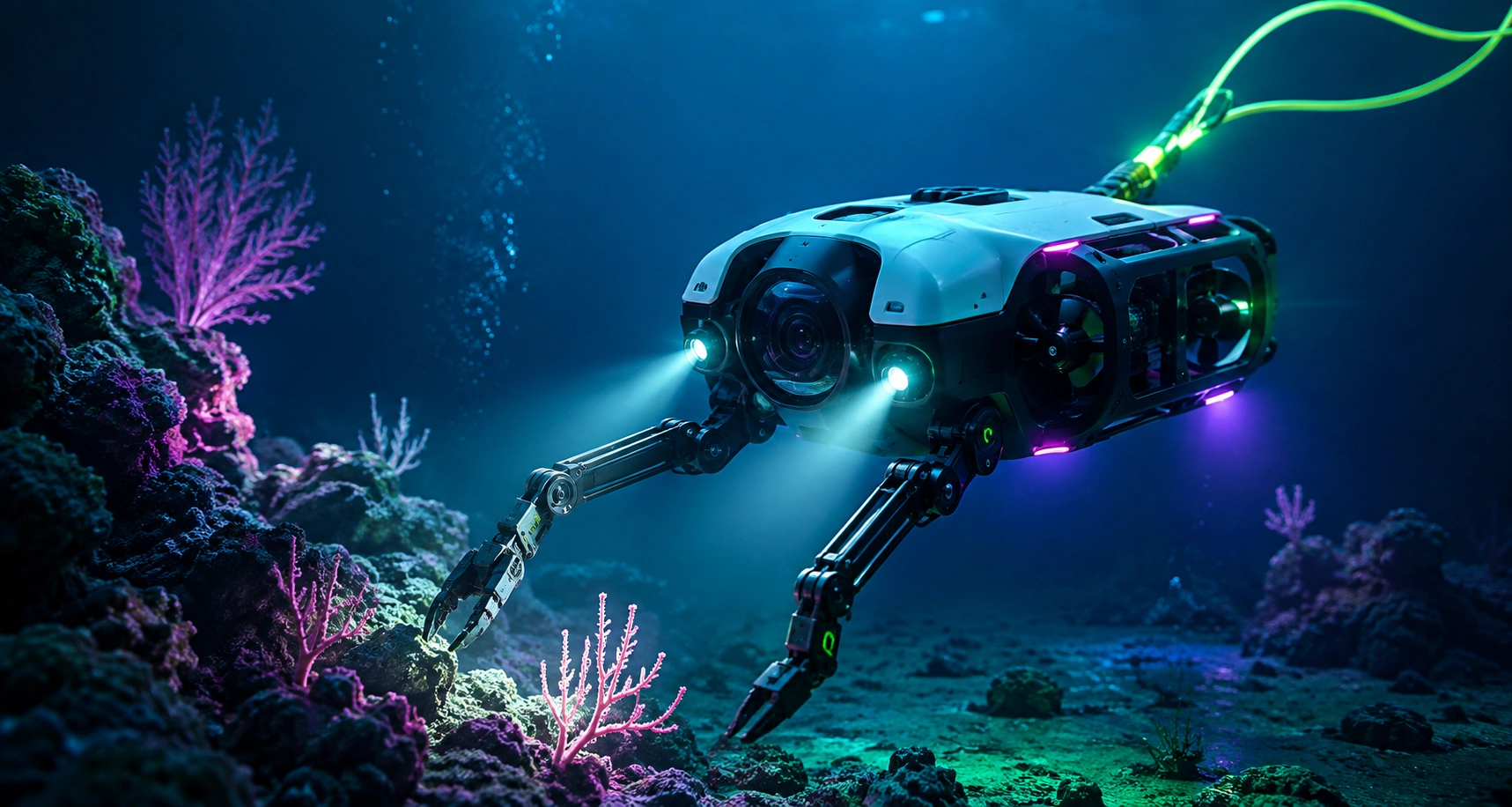
An underwater ROV (remotely operated vehicle) is an unmanned, tethered submersible controlled by a human pilot from a surface vessel or shore station, using thrusters for movement, cameras and sonar for perception, and an umbilical cable for power and real-time data. Marine robotics is the broader engineering field that covers ROVs, autonomous underwater vehicles (AUVs), gliders, crawlers, and resident subsea systems. The reason this field matters is blunt: NOAA states that more than 80% of the ocean has never been mapped, observed, or explored, while the seabed carries the fiber-optic cables that TeleGeography reports handle roughly 99% of intercontinental data traffic. Almost everything we know about the deep ocean and almost everything we do to maintain subsea infrastructure now depends on robots.
Quick Answer: Underwater ROVs are tethered robotic submersibles piloted remotely from a surface vessel. They combine thrusters, high-definition cameras, sonar, lights, and manipulator arms to inspect, repair, sample, and survey underwater assets. Marine robotics extends this with autonomous vehicles that operate without tethers, covering survey, defense, offshore energy, aquaculture, and scientific research missions.
How WebPeak Helps Marine Robotics Companies Turn Complex Technology Into Clear Digital Products
Marine robotics firms usually have the harder half solved — the hardware — and struggle with the digital half: telemetry dashboards, mission-replay portals, technical documentation, and websites that explain a $400,000 work-class ROV to a procurement officer in 30 seconds. WebPeak works with technical and engineering clients worldwide on exactly that gap. Their web application development services suit teams that need operator-facing portals for dive logs, sensor streams, and asset-integrity records, while their AI data analysis and visualization work is relevant when a single pipeline inspection generates hours of video and thousands of sonar pings that nobody has time to review manually. Teams comparing build partners often also review specialist web application development options before committing to a stack.
How Does an Underwater ROV Actually Work?
An ROV is best understood as four subsystems working together. The tether (umbilical) delivers high-voltage power down and fiber-optic data up, which is why ROVs can run indefinitely while battery-powered AUVs cannot. The propulsion system uses four to eight thrusters arranged to give control in multiple axes — vectored horizontal thrusters for surge, sway, and yaw, plus vertical thrusters for heave. The perception stack combines LED lighting, HD or 4K cameras, multibeam or imaging sonar for zero-visibility work, and a Doppler velocity log plus inertial navigation because GPS does not penetrate seawater. The control system runs station-keeping algorithms that hold position against current, which is the single feature that separates a usable work platform from a toy.
Two terms are worth defining precisely because they are constantly confused. ROV means a human is in the loop in real time through a physical tether. AUV means the vehicle executes a pre-programmed mission untethered and surfaces to deliver data. A third category, the resident ROV, lives permanently in a subsea garage and is piloted from an onshore control room over an existing cable — removing the need for a surface support vessel, which is typically the largest line item in any subsea operation.
What Are the Main Classes of Marine Robots and When Should You Use Each?
Choosing the wrong vehicle class is the most expensive mistake in subsea project planning. Use this decision sequence:
- Observation-class ROVs (micro/mini): Under 20 kg, depth ratings of 100–300 m, powered from a portable topside box. Correct choice for hull inspections, aquaculture net checks, dam and tank surveys, and search and recovery in inland water.
- Inspection-class ROVs: 20–100 kg with manipulators, cathodic protection probes, and ultrasonic thickness gauges. Correct choice for asset-integrity work on jackets, risers, and moorings.
- Work-class ROVs: Multi-tonne vehicles with 50–250 hp hydraulic power, dual seven-function manipulators, and 3,000–6,000 m ratings. Required for valve operation, tooling deployment, and subsea construction.
- AUVs and gliders: Correct choice when you need wide-area bathymetry, oceanographic profiling, or persistent monitoring rather than intervention. Gliders trade speed for endurance measured in months.
- Crawlers and hybrid vehicles: Tracked or hybrid ROV/AUV designs used for trenching, cable burial, and high-current sites where free-swimming vehicles lose station.
A practical rule from field operations: if the mission requires touching something, you need a tether and a manipulator. If it requires covering distance, you need autonomy. Projects fail when procurement tries to make one vehicle do both.
Which Underwater Robot Fits Which Mission?
The comparison below reflects how vehicle classes map to real operational requirements, endurance limits, and the crew footprint each one demands. Endurance figures assume typical configurations rather than best-case manufacturer claims.
| Vehicle Class | Typical Depth Rating | Endurance | Best-Fit Missions |
|---|---|---|---|
| Observation-class ROV | 100–300 m | Tether-limited (continuous) | Hull and net inspection, search and recovery, shallow survey |
| Inspection-class ROV | 300–1,000 m | Tether-limited (continuous) | Asset integrity, weld and anode checks, light intervention |
| Work-class ROV | 3,000–6,000 m | Tether-limited (continuous) | Subsea construction, valve actuation, tooling and drill support |
| Survey AUV | 200–6,000 m | 8–24 hours per charge | Bathymetric mapping, pipeline route survey, mine countermeasures |
| Underwater glider | 200–1,000 m | Weeks to months | Ocean profiling, climate and current monitoring, sustained presence |
What the Real Numbers Say About the Growth of Marine Robotics
Three verifiable data points frame this market. First, NOAA's Ocean Exploration program reports that more than 80% of the global ocean remains unmapped and unexplored — the demand driver for survey robotics is a genuine data vacuum, not marketing. Second, TeleGeography's submarine cable research shows that roughly 99% of international data traffic travels over subsea cables, which means every cable fault repair, route survey, and burial operation is robot-dependent work. Third, the U.S. Bureau of Labor Statistics groups the relevant engineering roles under mechanical, electrical, and computer occupations whose median wages sit well above the all-occupations median, reflecting genuine scarcity of subsea-capable engineers.
Here is the original perspective worth adding: the industry's centre of gravity is shifting from vehicles to data pipelines. A modern inspection dive produces terabytes, and the bottleneck is no longer capture but review. Operators who invest in automated anomaly detection, structured dive metadata, and searchable video archives extract several times more value from the same hardware than operators who store footage on unindexed drives. The competitive advantage in marine robotics over the next decade will belong to teams that treat software as a first-class deliverable — and that increasingly means contracting expert back-end development support rather than asking mechanical engineers to build data platforms in their spare hours.
Key Takeaways
- An ROV is tethered and human-piloted in real time; an AUV is untethered and runs a pre-programmed mission — the tether decision determines whether intervention is possible.
- NOAA reports more than 80% of the ocean is unmapped, and TeleGeography attributes roughly 99% of international data traffic to subsea cables — both facts anchor sustained demand for marine robotics.
- Station-keeping and dynamic positioning, not raw thruster power, separate professional work platforms from hobby vehicles.
- Surface support vessels are usually the largest operational cost, which is why resident ROVs piloted from shore are the fastest-growing deployment model.
- The bottleneck in subsea operations has moved from data capture to data review — automated analysis of video and sonar now drives return on hardware investment.
Frequently Asked Questions
What is the difference between an ROV and a submarine?
A submarine carries human occupants and operates independently underwater. An ROV carries no crew and is controlled remotely through a tether that supplies power and transmits video and sensor data. ROVs are smaller, cheaper to operate, and can safely work at depths and durations that would endanger a crewed vehicle.
How deep can underwater ROVs actually go?
Commercial work-class ROVs are typically rated to 3,000–6,000 metres, which covers the vast majority of offshore infrastructure. Purpose-built research vehicles have reached the deepest ocean trenches beyond 10,000 metres. Depth capability depends on pressure-housing design, tether strength, and buoyancy materials rather than thruster power.
Do you need a license to operate an underwater ROV?
Small observation-class ROVs generally require no pilot license for private or research use, though local permits may apply in ports, marine protected areas, and commercial harbours. Commercial offshore work is different: employers usually require recognised ROV pilot-technician training plus offshore survival and medical certification.
How much does an underwater ROV cost?
Entry-level observation ROVs suitable for inspection start in the low thousands of dollars. Inspection-class systems with manipulators and survey sensors typically run into the tens or hundreds of thousands. Work-class systems with launch and recovery equipment are multi-million-dollar assets, and vessel time often exceeds the vehicle cost per project.
Are underwater ROVs being replaced by autonomous robots?
No — they are being complemented. Autonomous vehicles handle wide-area survey and repetitive monitoring efficiently, but physical intervention such as cutting, bolting, valve operation, and sampling still requires a human decision loop. The realistic future is hybrid: autonomous survey feeding targeted, human-supervised intervention dives.
Conclusion
If you take one decision away from this article, make it the vehicle-class decision: match the robot to whether the mission requires touching something or covering distance, because that single choice determines your tether, your vessel requirement, and roughly 80% of your project cost. Everything else — sensor payload, software, crew size — follows from it. Marine robotics rewards operators who plan around operational reality rather than specification sheets, and who treat the data a vehicle produces as seriously as the vehicle itself.