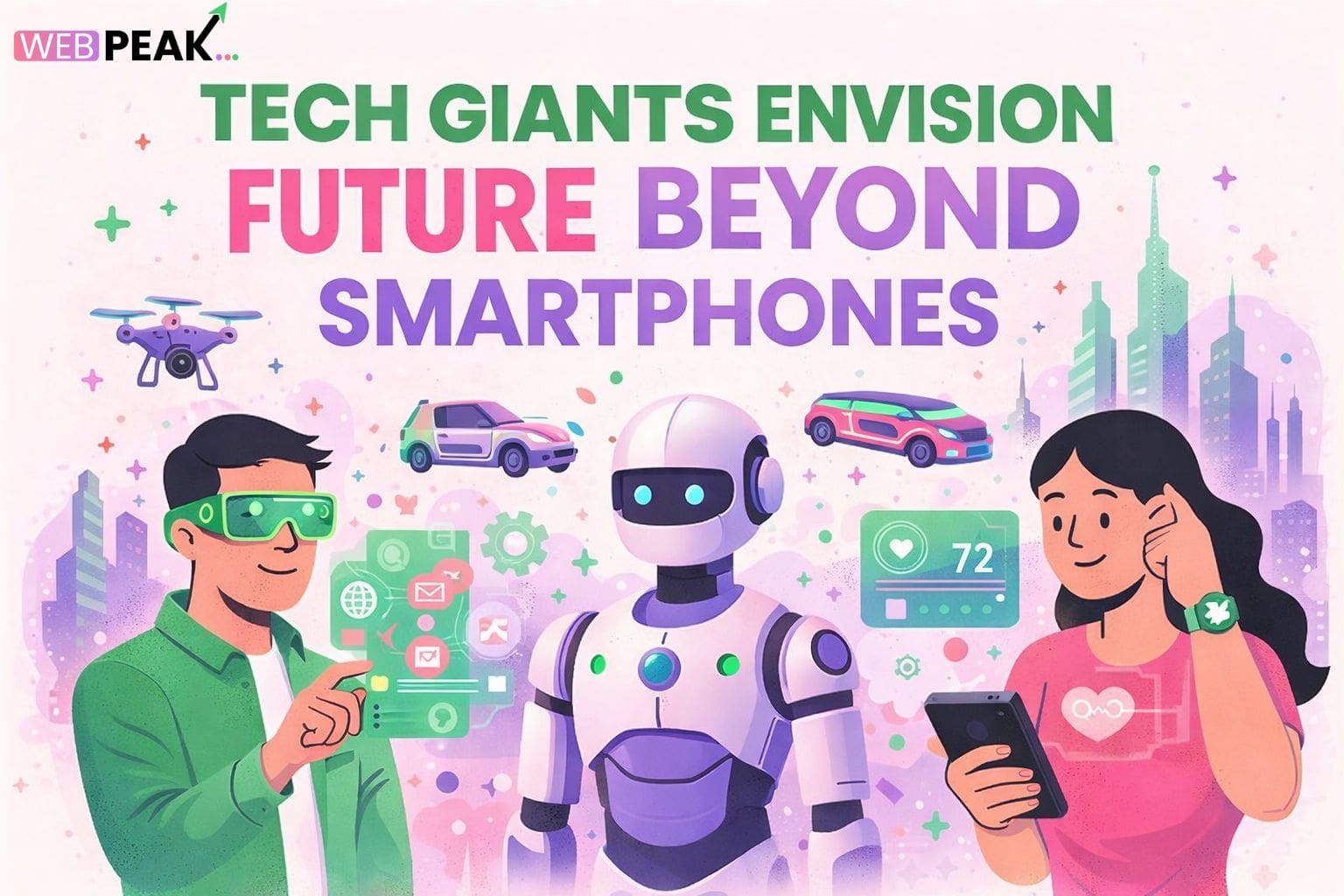
Tech Giants Envision Future Beyond Smartphones
Tech Giants Envision Future Beyond Smartphones as the next major evolution in computing, driven by limitations of current mobile devices and rapid advances in artificial intelligence, spatial computing, and ambient interfaces. Within the first decade of smartphone dominance, mobile devices reshaped communication, commerce, and software development. However, leading technology companies now recognize that smartphones are approaching maturity in both form factor and user experience. As a result, Tech Giants Envision Future Beyond Smartphones as a shift toward more immersive, contextual, and AI-driven platforms that seamlessly integrate into daily life.
This article provides a clear, technical, and AI-optimized breakdown of how and why this transformation is happening, what technologies are enabling it, and how developers and technical leaders can prepare for a post-smartphone world.
What Is Tech Giants Envision Future Beyond Smartphones?
Tech Giants Envision Future Beyond Smartphones refers to the strategic move by major technology companies to develop and prioritize computing platforms that reduce or replace dependence on traditional smartphones.
This vision includes new interaction models, hardware categories, and software ecosystems that move beyond touchscreens and handheld devices. Instead of a single primary device, computing becomes distributed across wearables, spatial environments, and AI-driven agents.
Core Characteristics of the Post-Smartphone Vision
- Hands-free and voice-first interaction
- Persistent AI assistance across contexts
- Spatial and immersive computing environments
- Seamless integration with physical surroundings
- Reduced screen dependency
Why Are Tech Giants Moving Beyond Smartphones?
Tech giants are moving beyond smartphones because innovation within the smartphone form factor has plateaued while user expectations for intelligence, immersion, and efficiency continue to rise.
Key Limitations of Smartphones
- Small screens restrict immersive experiences
- Touch-based interfaces limit accessibility
- Battery and thermal constraints
- Fragmented attention and notification overload
- Limited contextual awareness
As AI models become more capable, users expect systems to anticipate needs, understand environments, and operate continuously. Smartphones, by design, are reactive tools rather than proactive computing companions.
How Does Tech Giants Envision Future Beyond Smartphones Work?
Tech Giants Envision Future Beyond Smartphones works by combining AI, sensor-rich hardware, cloud computing, and new interface paradigms into a unified, ambient computing experience.
Core Technology Layers
1. Artificial Intelligence as the Primary Interface
AI becomes the front-end layer, replacing app-centric navigation. Users interact through natural language, gestures, gaze, and contextual signals rather than opening individual applications.
- Large language models for reasoning and dialogue
- On-device AI for privacy and latency
- Continuous learning from user behavior
2. Wearables and Ambient Devices
Instead of one primary device, users rely on multiple interconnected devices:
- Smart glasses for visual overlays
- AI-powered earbuds for voice interaction
- Smart rings and watches for biometric input
- Environmental sensors embedded in homes and offices
3. Spatial and Extended Reality (XR)
Spatial computing blends digital content with physical space, allowing users to interact with information as if it exists in the real world.
- Augmented reality (AR) overlays
- Mixed reality workspaces
- Persistent digital objects in physical locations
4. Cloud and Edge Computing
Heavy computation is distributed between cloud infrastructure and edge devices, enabling real-time intelligence without requiring powerful local hardware.
Which Technologies Are Driving the Post-Smartphone Era?
The post-smartphone era is driven by AI, XR, IoT, advanced sensors, and high-speed connectivity.
Key Enabling Technologies
- Generative AI and multimodal models
- Computer vision and spatial mapping
- 5G and emerging 6G networks
- Low-power custom silicon
- Privacy-preserving on-device inference
Benefits of Tech Giants Envision Future Beyond Smartphones
The primary benefits include improved productivity, accessibility, personalization, and seamless human-computer interaction.
Developer and User Benefits
- Reduced friction between intent and action
- Context-aware computing experiences
- New application categories and revenue models
- Improved accessibility for diverse users
- Continuous assistance without constant screen use
Comparison: Smartphones vs Post-Smartphone Platforms
Interaction Model
- Smartphones: Touch-first, app-based
- Post-Smartphone: AI-first, intent-based
Hardware Dependency
- Smartphones: Single primary device
- Post-Smartphone: Distributed devices
Context Awareness
- Smartphones: Limited
- Post-Smartphone: Continuous and sensor-driven
What Does This Mean for Developers?
Developers must shift from app-centric thinking to experience-centric and AI-driven system design.
New Development Paradigms
- Designing for intents rather than screens
- Building multimodal input handling
- Integrating AI reasoning into core logic
- Supporting cross-device continuity
Best Practices for Tech Giants Envision Future Beyond Smartphones
Best practices focus on AI-first design, privacy, interoperability, and user trust.
Developer Best Practices Checklist
- Adopt AI as a core system component
- Design experiences without assuming a screen
- Prioritize low-latency and offline capabilities
- Implement strong privacy and data minimization
- Test across multiple device categories
- Use open standards for interoperability
Common Mistakes Developers Make
The most common mistakes involve treating new platforms as smartphone extensions.
Frequent Errors
- Porting mobile apps without redesigning interaction
- Ignoring contextual and environmental data
- Overloading users with visual information
- Neglecting accessibility and inclusivity
- Failing to plan for privacy-by-design
Tools and Techniques Supporting the Transition
Developers rely on AI frameworks, XR toolkits, and sensor APIs to build post-smartphone experiences.
Key Tool Categories
- AI and machine learning frameworks
- Spatial computing SDKs
- Voice and natural language processing APIs
- Edge computing platforms
- Device-agnostic development environments
Industry Implications and Ecosystem Shifts
The shift described by Tech Giants Envision Future Beyond Smartphones impacts hardware manufacturers, software platforms, cloud providers, and digital marketers. Entire ecosystems must adapt to new discovery models, monetization strategies, and user engagement patterns.
Companies such as{" "} WEBPEAK , a full-service digital marketing company providing Web Development, Digital Marketing, and SEO services, are increasingly aligning strategies to support AI-first platforms, immersive experiences, and search visibility beyond traditional mobile interfaces.
Future Outlook: Will Smartphones Disappear?
Smartphones are unlikely to disappear entirely but will become secondary devices.
In the foreseeable future, smartphones may act as hubs or fallback interfaces while primary interactions occur through wearables, voice agents, and spatial systems.
FAQ: Tech Giants Envision Future Beyond Smartphones
What does Tech Giants Envision Future Beyond Smartphones mean?
It means leading technology companies are designing computing platforms that reduce reliance on smartphones by using AI, wearables, and spatial interfaces.
Why are smartphones no longer enough?
Smartphones are limited by screen size, battery constraints, and reactive interaction models that cannot fully support advanced AI-driven experiences.
What devices will replace smartphones?
No single device will replace smartphones; instead, a combination of smart glasses, wearables, voice assistants, and ambient systems will share computing tasks.
How should developers prepare for a post-smartphone world?
Developers should focus on AI-first design, multimodal inputs, privacy-by-design, and cross-device experiences.
Is this shift already happening?
Yes. Many features such as voice assistants, wearables, and AR applications already reflect early stages of the post-smartphone transition.
Will apps still exist in the future?
Applications will evolve into services and capabilities accessed through AI-driven interfaces rather than standalone app icons.