
PwC Mandates Staff Use Artificial Intelligence or Leave the Company: What It Really Means for Your Career
PwC has made AI use a condition of employment, not a perk. Here is what the mandate actually requires, how to build real AI fluency, and what it signals for professional services careers.
PwC Mandates Staff Use Artificial Intelligence or Leave the Company: What It Really Means for Your Career
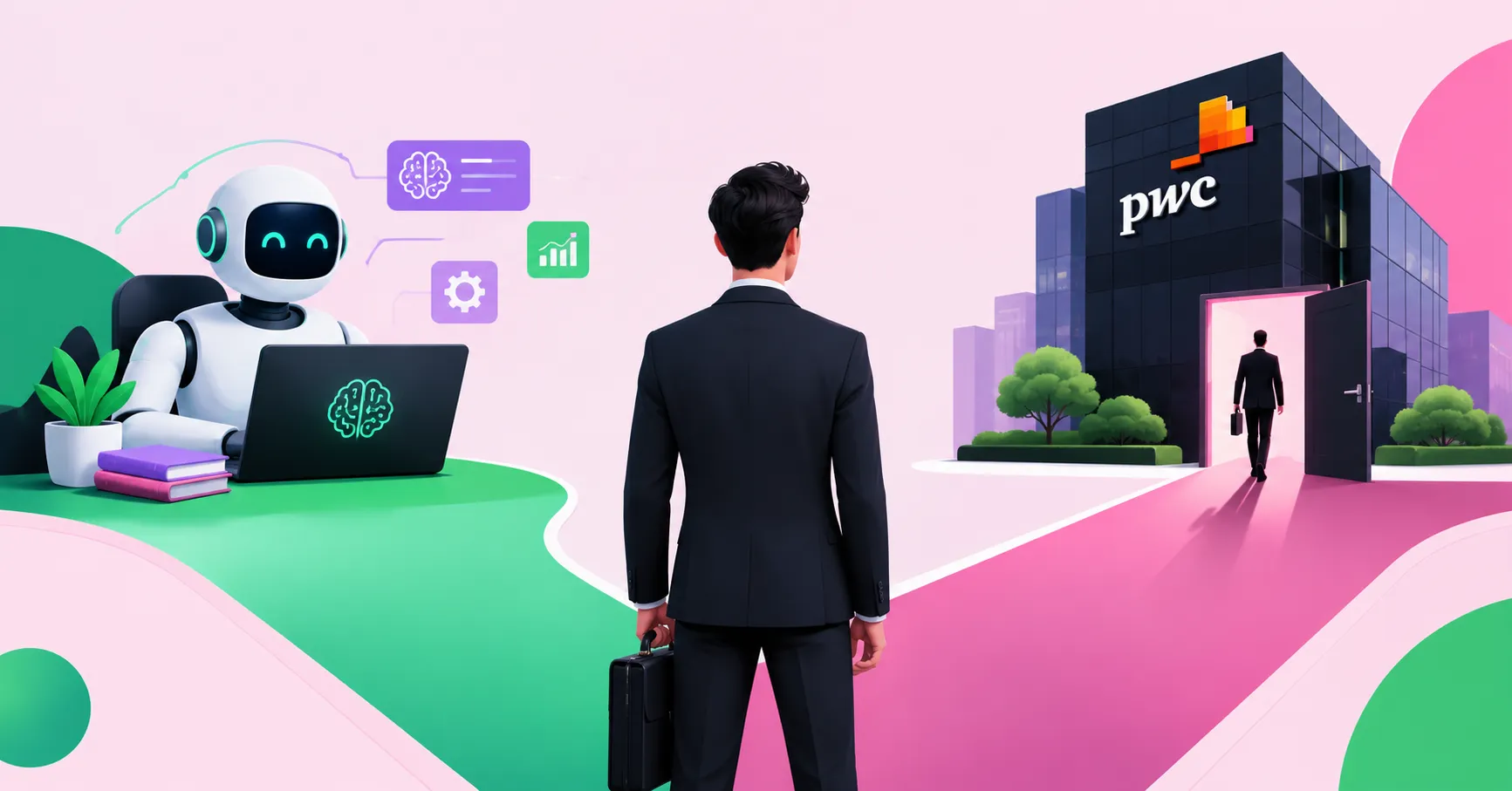
PwC has shifted from encouraging artificial intelligence to expecting it. An AI mandate is an internal policy in which using approved AI tools stops being optional and becomes part of how work is scoped, reviewed, and rewarded. PwC's US Senior Partner Paul Griggs put the firm's position bluntly, saying that anyone who believes they can opt out of AI "is not going to be here that long," and signalling that even senior staff and partners who resist an AI-first way of working may not have a long-term seat at the table. For the tens of thousands of people in PwC's US practice — and the hundreds of thousands across its global network — the useful question is no longer whether to learn AI, but what measurable proficiency looks like when it is written into performance expectations and client delivery models.
Quick Answer: PwC has made artificial intelligence use a baseline expectation rather than a choice. Leadership has said employees who try to opt out are unlikely to stay long-term, as the firm rebuilds tax, audit, and consulting delivery around AI-assisted workflows. Staff are expected to use approved tools daily, verify outputs, and show measurable productivity gains.
Turning an AI Mandate Into Working Systems With WebPeak
A mandate only produces results when the underlying tooling exists. Most organisations that announce AI-first policies discover the same gap within a quarter: staff have chat interfaces but no secure internal applications, no retrieval layer over company knowledge, and no dashboards to prove the productivity claim. The team at WebPeak works on exactly that layer for companies worldwide, building the internal apps, APIs, and data pipelines that make AI adoption operational instead of aspirational. Their artificial intelligence services cover model integration, retrieval-augmented workflows, and guardrails, while their back-end development work handles the authentication, logging, and audit trails a professional-services environment demands. For firms building full internal platforms rather than single features, they also deliver MERN stack applications that connect AI output to the systems where work actually happens.
What PwC's AI Mandate Actually Requires — and What It Does Not
The mandate is behavioural, not technical. PwC is not asking accountants to fine-tune models; it is asking them to change the default first step of every task. In practice, an AI-first professional-services workflow means drafting with AI before drafting from scratch, using AI to summarise and cross-check source documents, and reserving human hours for judgment, client conversations, and defensible sign-off.
What the mandate does not mean is unsupervised automation. In regulated work — audit opinions, tax positions, transaction advisory — the reviewer of record remains a human professional with a licence at risk. PwC has publicly invested heavily in this direction, including a widely reported billion-dollar AI investment in its US business alongside Microsoft and OpenAI, and one of the largest early enterprise deployments of ChatGPT to its staff. That combination tells you the shape of the expectation: enterprise-sanctioned tools, inside firm systems, with output that a partner is still willing to sign.
The career risk is also narrower than the headlines suggest. It is not "AI will replace you." It is that the billable-hour model rewards volume of effort, while AI-assisted delivery rewards volume of judgment. Someone who produces the same output in a third of the time has to fill the remaining capacity with work AI cannot do — client trust, negotiation, exception handling, and quality challenge. That is the real reskilling task.
How to Become AI-First Before Your Employer Demands It
Fluency is demonstrable. These steps produce evidence you can put in a performance review rather than a vague claim that you "use AI sometimes."
- Audit your own week. List every recurring task and mark each one as draftable, checkable, or judgment-only. Most knowledge workers find that 30 to 50 percent of their week is draftable — that is your starting surface area.
- Use only sanctioned tools. Pasting client data into a personal consumer account is the fastest way to turn an AI advantage into a disciplinary matter. Enterprise deployments exist specifically to keep data out of training sets.
- Learn to write a specification, not a request. Strong prompts include the audience, the format, the source material, the constraints, and the failure modes to avoid. Weak prompts describe a topic.
- Build a personal prompt library. Save the five prompts you reuse most, with the source documents they expect. Reusable prompts compound; one-off prompts do not.
- Verify against the source every time. Treat model output as a confident junior's first draft: useful structure, unreliable specifics. Check every number, citation, date, and name.
- Measure and record the delta. Note the before-and-after time on three real tasks. "Reduced monthly reporting pack from six hours to ninety minutes" is a promotion-grade sentence.
- Teach one colleague per month. In AI-first organisations, the people who spread capability get visibility faster than the people who hoard it.
Where AI Fits in Professional Services Workflows
The distinction that matters is between tasks where AI reduces effort and tasks where it introduces unacceptable risk. This mapping reflects how AI-assisted delivery is typically structured inside advisory firms.
| Task | Traditional Approach | AI-Assisted Approach | Human Judgment Still Required |
|---|---|---|---|
| Document review | Manual page-by-page reading | Automated extraction and summarisation, flagged exceptions | Confirming flagged exceptions and materiality |
| First-draft client report | Written from scratch by an associate | Structured draft generated from working papers | Tone, client context, conclusions |
| Research on rules or guidance | Database searching and manual synthesis | Retrieval over a verified internal knowledge base | Verifying every citation to primary source |
| Data reconciliation | Spreadsheet formulas and eyeballing | Scripted comparison with anomaly detection | Deciding which anomalies are real findings |
| Final sign-off | Partner review | Unchanged — partner review | Full professional responsibility |
What the Evidence Shows About AI Mandates So Far
PwC is not an outlier, and that is the most important verifiable point. Shopify CEO Tobi Lütke's internal memo, later published by him, stated that reflexive AI usage is now a baseline expectation and that teams must demonstrate why AI cannot do a job before requesting additional headcount. Duolingo publicly described itself as AI-first and said it would move away from contractors for work AI can handle. The pattern across these announcements is consistent: leadership frames AI adoption as an employment condition, not a training offer.
Where genuine data is thin — and it is thin — is on firm-wide productivity outcomes, because most of these programmes are young and the numbers that exist are self-reported. Rather than cite a false percentage, here is the pattern that shows up repeatedly in implementation work: organisations that mandate AI without rebuilding their review process see quality complaints rise before productivity does, because staff pass through plausible-sounding output that nobody was assigned to verify. Firms that pair the mandate with an explicit verification step — a named reviewer for AI-assisted deliverables — tend to keep the speed gain and avoid the credibility loss.
The second consistent observation is that mandates redistribute work rather than eliminate it. Junior tasks compress, and the reviewing tier expands. That has an uncomfortable consequence for career pipelines: if juniors no longer spend two years doing the reconciliation work that taught them how numbers behave, firms must deliberately teach that judgment another way. For organisations thinking about the broader technology stack behind this shift, resources on artificial intelligence implementation are a reasonable starting point for scoping what to build in-house versus buy.
Key Takeaways
- PwC's leadership has stated that employees who attempt to opt out of AI are unlikely to remain at the firm, making AI use an employment expectation rather than an optional skill.
- The mandate targets workflow behaviour — drafting, summarising, and researching with AI first — not unsupervised automation of regulated sign-off.
- PwC has publicly backed this with a reported billion-dollar AI investment and one of the largest early enterprise ChatGPT deployments.
- The demonstrable skill is verification and specification, not tool familiarity; measurable before-and-after time savings are what performance reviews can actually assess.
- Shopify and Duolingo have issued comparable AI-first expectations, indicating a cross-industry shift rather than a single-firm policy.
Frequently Asked Questions
Did PwC actually say employees must use AI or leave?
PwC's US Senior Partner Paul Griggs said that anyone who thinks they can opt out of AI is not going to be at the firm for long. The framing is an expectation backed by performance consequences rather than a formal written termination policy for non-use.
Does the mandate apply to partners as well as junior staff?
Yes. Leadership has specifically signalled that senior staff and partners who do not adopt AI-first working may be replaced. In practice, partner-level expectations centre on redesigning service delivery and pricing, not just using tools personally.
Can I use ChatGPT for client work at a firm like PwC?
Only through sanctioned enterprise deployments. Consumer accounts lack the data-handling guarantees, audit logging, and contractual protections that client confidentiality requires. Using a personal account with client information is typically a policy breach regardless of the AI mandate.
Will AI mandates reduce headcount in professional services?
The clearer near-term effect is a change in work mix rather than mass reduction. Routine drafting and reconciliation compress, while review, exception handling, and client advisory expand. Firms shifting away from hours-based billing feel the structural pressure first.
How do I prove AI proficiency in a performance review?
Bring specifics: three named tasks, the time they took before, the time they take now, the tool used, and how you verified accuracy. Concrete deltas and a documented verification step are far more persuasive than describing general tool familiarity.
Conclusion
The single decision worth making now is to stop treating AI as a tool you might learn and start treating it as the default first step of your workflow — with a verification habit attached. PwC's message is uncomfortable precisely because it removes the middle option of quiet non-adoption, and firms across sectors are converging on the same stance. Choose three recurring tasks this week, run them through your organisation's sanctioned AI tools, record the time difference, and document exactly how you checked the output. That record is what protects your credibility and your career as AI expectations harden into policy.
Related articles
 Artificial Intelligence
Artificial Intelligence All-in-One For Dummies: Is It the Right Way to Learn AI?
An honest review of Artificial Intelligence All-in-One For Dummies: what the Wiley compilation covers, who it suits, how to study it, and where it falls short.
 Artificial Intelligence
Artificial Intelligence Consultant Certification: The Credentials That Actually Win Clients
A practical guide to artificial intelligence consultant certification: which credentials carry weight, what they cost, and how to turn one into paid work.
 Artificial Intelligence
UNESCO Recommendation on the Ethics of Artificial Intelligence: Was It Adopted in 2026? The Real Timeline Explained
The UNESCO Recommendation on the Ethics of AI was adopted in 2021, not 2026. Here is the accurate timeline, what the instrument requires, and how to align your organisation with it.