
Mahjong Artificial Intelligence: How AI Learned to Beat the World's Hardest Tile Game
Mahjong artificial intelligence solves hidden information, four-player dynamics, and luck. Here is how systems like Suphx work and how to use AI to improve your play.
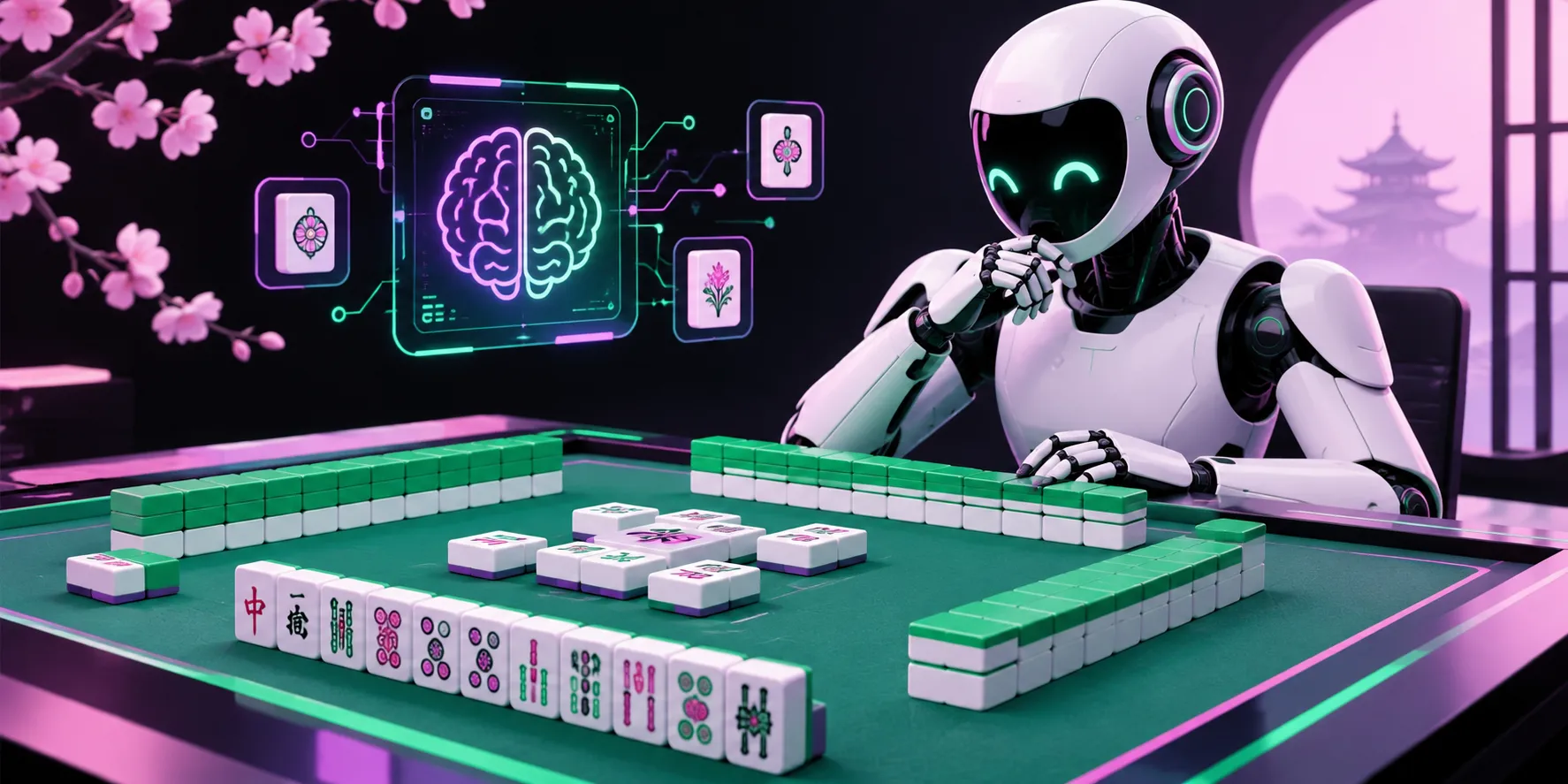
Mahjong Artificial Intelligence: How AI Learned to Beat the World's Hardest Tile Game
Mahjong artificial intelligence refers to computer programs that play mahjong at or above expert human level by combining deep neural networks with reinforcement learning — a training method where an agent improves by playing millions of games and learning from outcomes rather than from hand-coded rules. Mahjong resisted AI far longer than chess or Go for a specific structural reason: it is a four-player game of imperfect information with a heavy element of chance. You cannot see opponents' hands, you cannot see the remaining wall, and a technically perfect decision can still lose. The breakthrough came in 2019, when Microsoft Research Asia published Suphx, the first mahjong AI to reach 10 dan on Tenhou.net, one of Japan's most competitive online riichi mahjong platforms — a rank very few human players ever achieve.
Quick Answer: Mahjong artificial intelligence uses deep reinforcement learning to play mahjong at superhuman level despite hidden tiles and randomness. Microsoft Research's Suphx became the first AI to reach 10 dan on Tenhou.net in 2019. Open-source engines such as Mortal now let ordinary players get AI review of their own game records.
How WebPeak Helps Teams Ship Game and AI Web Applications
Turning a mahjong AI engine into something players can actually use means building real software: a browser client that renders tiles and animations smoothly, a backend that manages game state and matchmaking, and an inference layer that returns move evaluations fast enough to feel instant. Development teams working across React, Node, and API architecture — the kind of full-stack capability this worldwide digital agency provides — are what bridge the gap between a research model and a playable, reviewable product that people return to daily.
Why Mahjong Is Harder for AI Than Chess or Go
Chess and Go are perfect-information games: both players see the entire board at all times. Mahjong is not, and that single difference changes the computational problem fundamentally.
First, the hidden state is enormous. Each of four players holds concealed tiles, and the undrawn wall is unknown to everyone. An AI must reason over a probability distribution across all consistent arrangements of unseen tiles, updating that belief every time a tile is discarded or a call is made. Second, mahjong has a complex and irregular scoring system: hand values vary dramatically by pattern, and a correct decision depends on both the hand you are building and your current placement in the match. Third, the game has substantial variance — strong play increases win probability over many hands but guarantees nothing in a single game, which makes the training signal noisy and hard to learn from.
Fourth, and most awkwardly for standard reinforcement learning, mahjong turn order is not fixed. Calls such as pon, chi, and kan interrupt the natural sequence, so the game tree branches irregularly rather than in clean alternating turns. This is why techniques transplanted directly from Go engines performed poorly on mahjong.
The Suphx paper addressed these problems with several named techniques, including global reward prediction, which converts noisy per-hand results into a more meaningful learning signal across a full match, and oracle guiding, where a version of the agent that can temporarily see hidden information helps bootstrap training before that visibility is gradually withdrawn. It also used run-time policy adaptation to adjust strategy as a hand progresses.
How to Actually Use Mahjong AI to Improve Your Play
Research aside, the practical value of mahjong AI for most people is post-game analysis. Here is the workflow that produces real improvement:
- Export your game records. Platforms such as Tenhou and Mahjong Soul produce replay logs that AI review tools can parse. Analysis is only possible with a record of what you actually did.
- Run the log through an AI reviewer. Open-source engines like Mortal, and services built on similar models, evaluate every discard and call and flag where your choice diverged from the engine's preference.
- Filter for large errors first. Ignore decisions where the AI's preferred tile is marginally better. Focus exclusively on the handful of moves flagged as significant deviations — that is where measurable points are lost.
- Categorise your mistakes. Most players discover a small number of recurring error types: pushing into an obvious tenpai, folding too early, misjudging safe tiles late in a hand, or overvaluing hand value against placement.
- Study defence before offence. AI review consistently exposes defensive errors as the costliest category, because dealing into a big hand loses more than a missed win gains.
- Account for placement. Strong engines weight decisions by match standing. Learn when the correct play is to protect a position rather than maximise expected points.
- Re-review after a month. Compare error rates across sessions. Improvement in mahjong is only visible over large samples because of variance.
The key mindset shift: do not treat the AI's suggestion as an answer to memorise. Treat it as a prompt to ask why the engine valued safety, speed, or hand value differently than you did.
Notable Mahjong AI Systems Compared
Several distinct systems have shaped this field, each with a different origin and purpose.
| System | Origin | Primary Focus | Notable For |
|---|---|---|---|
| Suphx | Microsoft Research Asia | Japanese riichi mahjong | First AI to reach 10 dan on Tenhou.net |
| Mortal | Open-source project | Riichi play and game review | Publicly available engine used for replay analysis |
| NAGA | Dwango Media Village | Riichi review service | Deviation reports on uploaded game logs |
| Platform bots | Various game operators | Casual and ranked opponents | Scalable practice partners at tuned difficulty |
The distinction that matters for players is between engines built to win and engines built to teach. A superhuman playing agent is not automatically a good reviewer; review tools must explain relative value across candidate moves, not just output the single best one.
What Mahjong AI Reveals About Imperfect-Information Decision Making
The verifiable milestone is clear and documented: Suphx, described in Microsoft Research's 2019 publication, reached 10 dan on Tenhou.net, and the same paper reported stable-rank performance exceeding that of most top human players on the platform. That result is significant beyond games, because mahjong's structure — hidden information, multiple opponents, high variance, delayed reward — resembles real decision environments far more closely than chess does.
Labelled expert analysis, not a statistic: the most instructive finding for human players is how strongly mahjong AI favours folding. Engines abandon hands earlier and more often than typical human intuition allows, because they correctly weight the cost of dealing into an opponent's large hand against the shrinking probability of completing their own. Players who adopt only this single behavioural change from AI review tend to see their placement stabilise before their win rate improves — consistent with the idea that mahjong is won by limiting losses.
A second original observation: AI has effectively ended the debate about whether mahjong is primarily a game of luck. Variance is real in any single game, but an agent that sustains top ranks across enormous sample sizes demonstrates that decision quality dominates over the long run. Luck determines individual hands; skill determines distributions.
For developers, the engineering lessons transfer directly. Serving model inference at interactive latency, managing authoritative game state, and preventing client-side manipulation are the same challenges behind any real-time multiplayer product — the domain of modern web application development. In practice that means an interface layer built with React development, a state-authoritative server delivered through back-end development, and, for teams wanting one unified stack across both, a MERN stack build that keeps game logic and client in a single language.
Key Takeaways
- Mahjong is an imperfect-information, four-player, high-variance game, which made it far harder for AI to master than chess or Go.
- Microsoft Research's Suphx was the first mahjong AI to reach 10 dan on Tenhou.net, published in 2019.
- Techniques such as global reward prediction and oracle guiding were developed specifically to handle mahjong's noisy learning signal and hidden state.
- The highest-value use of mahjong AI for players is replay review focused on large errors, especially defensive ones.
- Sustained superhuman ranking across huge sample sizes proves mahjong is skill-dominant over time, even though any single hand is luck-heavy.
Frequently Asked Questions
Can artificial intelligence beat professional mahjong players?
Yes. Microsoft Research's Suphx reached 10 dan on Tenhou.net in 2019, a rank achieved by very few humans, and reported stable-rank performance above most top players on that platform. Modern open-source engines also play at a level most strong amateurs cannot consistently match.
Why is mahjong harder for AI than chess?
Chess is perfect information — both players see everything. Mahjong hides opponents' tiles and the wall, involves four players instead of two, has irregular turn order due to calls, and carries heavy randomness that makes learning signals noisy and individual results unreliable.
Is there a free mahjong AI I can use to review my games?
Yes. Mortal is an open-source riichi mahjong engine widely used for reviewing game records, and several community tools and services are built on similar models. You upload or import a replay log and receive move-by-move evaluations showing where your decisions diverged.
Does mahjong AI prove the game is mostly luck?
It proves the opposite over long samples. Any single hand is heavily influenced by tile draws, but an agent that maintains top rankings across tens of thousands of games demonstrates that decision quality dominates results over time. Luck governs individual hands, not sustained performance.
What is the biggest lesson players take from mahjong AI?
Fold more often and earlier. AI engines consistently abandon hands sooner than human intuition suggests, because avoiding a large payout to an opponent is worth more than chasing a low-probability win. Adopting this defensive discipline is the fastest measurable improvement for most players.
Conclusion
The single most useful insight from mahjong artificial intelligence is not that machines can outplay humans — it is that the machines win primarily by losing less, folding hands that human players stubbornly push. If you play mahjong seriously, your next step is to export your last twenty game logs, run them through an open-source reviewer, and look only at the discards flagged as major defensive errors. That narrow, evidence-based focus will move your results faster than studying any number of winning hand patterns.
Related articles
 Artificial Intelligence
Audio Books on Artificial Intelligence: The Best Way to Learn AI on the Go
Discover the best audio books on artificial intelligence, how to choose the right one for your level, and why listening beats reading for busy learners.
 Artificial Intelligence
Maryville University Master of Science in Artificial Intelligence Online Cost: A Complete Breakdown
Understand the Maryville University Master of Science in Artificial Intelligence online cost, how per-credit tuition works, hidden fees, and how to calculate total spend.
 Artificial Intelligence
EU AI Act 2026 News Today: What Changed, What Still Applies, and How to Stay Compliant
The Digital Omnibus reshaped the EU AI Act timeline in July 2026. Here is what changed, what still applies now, and the compliance steps that matter most.