Industrial Robot Applications: 12 High-Impact Uses Driving Modern Manufacturing
Most factories do not fail at robotics because the hardware is bad — they fail because the wrong application was automated first. An industrial robot is a programmable, automatically controlled, multi-purpose manipulator with three or more axes, fixed in place or mobile, used in industrial automation (that is the definition set out in ISO 8373). That definition matters commercially, because it tells you what a robot is genuinely good at: repeating a defined motion with high accuracy, indefinitely, without fatigue. Every profitable industrial robot application is a variation of that single strength. Welding, palletising, machine tending and inspection all pay back quickly because the task is repetitive, geometrically predictable and measurable. Low-volume, high-variation jobs with poor part presentation rarely do. This guide walks through the applications that consistently earn their keep, the robot types that suit each one, and the questions to ask before a single cell is quoted.
Quick Answer: The highest-value industrial robot applications are arc and spot welding, material handling, palletising, machine tending, pick and place, assembly, dispensing and adhesives, painting and coating, screwdriving, packaging, quality inspection and machining support. Each pays back fastest where cycle times are repeatable, part presentation is controlled and volumes are steady.
Where WebPeak Fits Into an Industrial Automation Business
Robotics integrators and machine builders sell complex, high-consideration products, and their buyers research online long before they request a quote. That is a content and search problem as much as an engineering one. The team at WebPeak works with technical and industrial companies to turn dense capability into pages buyers can actually evaluate — application-specific landing pages, cycle-time and payload specification tables, and case studies structured so procurement engineers find them. Their SEO work targets the long-tail queries that matter in this sector ("7-axis robot for machine tending", "cobot payload for palletising"), while their web development team builds configurators, spec filters and RFQ flows that shorten the sales cycle. For manufacturers who need engineering documentation rewritten for non-specialist decision makers, they also handle content writing across worldwide markets.
What Are the Most Common Industrial Robot Applications?
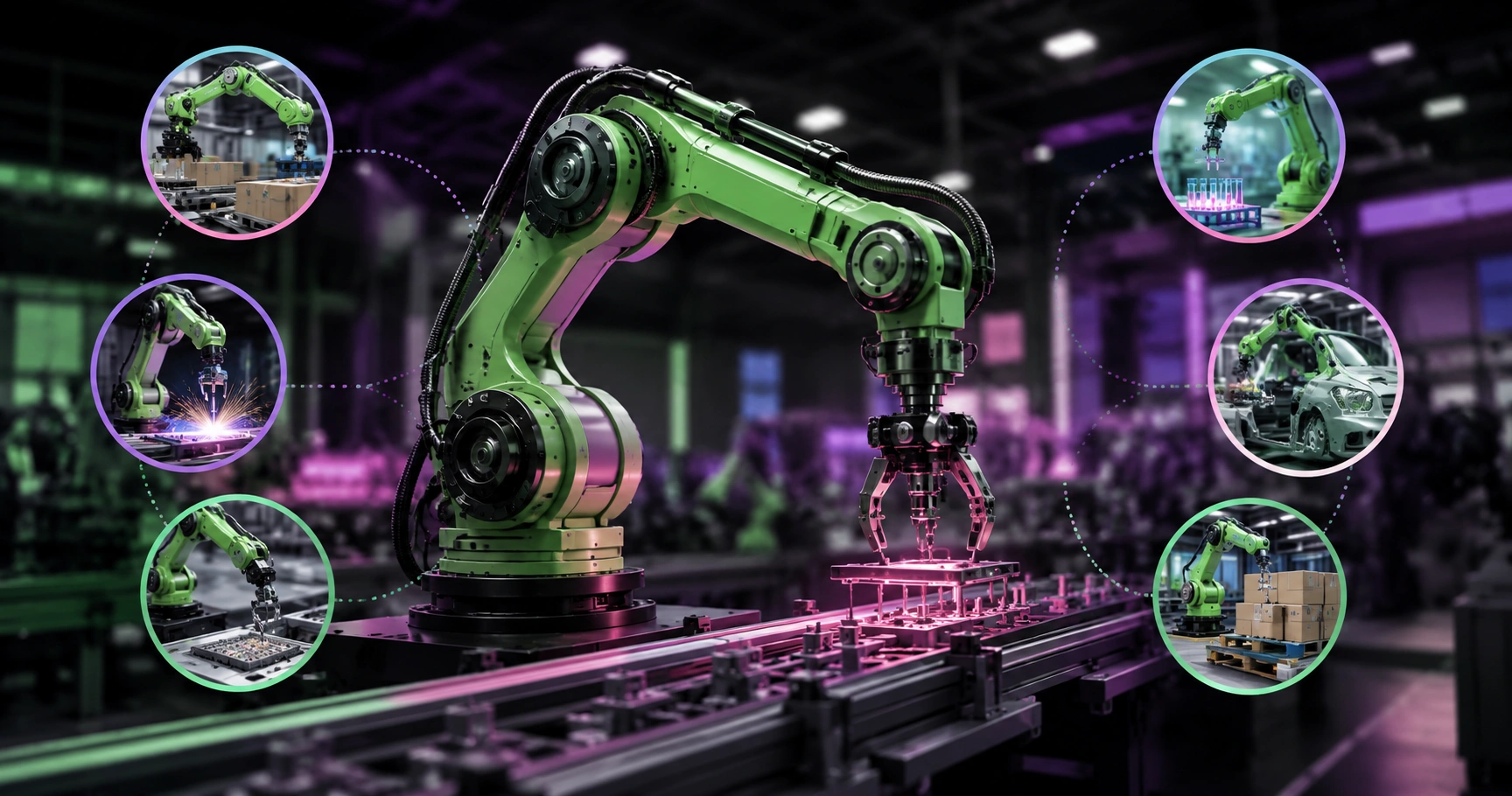
Twelve applications account for the overwhelming majority of installed industrial robots, and they cluster into three families. Material handling is the largest: pick and place, palletising, depalletising, machine tending (loading CNC machines, presses and injection moulders) and part transfer between stations. These are the fastest to justify because the robot replaces walking, lifting and waiting rather than skilled craft. Process applications come second: arc welding, spot welding, painting and powder coating, sealant and adhesive dispensing, and deburring or polishing. Here the robot's value is consistency — a welding torch held at a fixed angle, speed and stand-off produces a repeatable bead, which reduces rework and scrap more than it reduces labour. Assembly and verification is third: screwdriving, press-fitting, small part insertion, packaging and cartoning, plus vision-based quality inspection. Vision inspection is worth defining: it is the use of cameras and image-processing software to measure or classify a part in-line, and it is often the application with the shortest payback because scrap detected at station 3 costs far less than scrap discovered by a customer. A useful rule from the field: if an operator performs the same motion more than roughly 500 times per shift and the part arrives in a known position, that task is a robotics candidate.
How Do You Choose Which Application to Automate First?
Start with the task, not the robot. The most common expensive mistake is buying a capable arm and then discovering the surrounding fixturing, conveyors and part feeding cost two to three times more than the robot itself. Work through this sequence:
- Rank tasks by repeatability. Count how many identical cycles the task involves per shift. High count plus low variation equals high automation potential.
- Check part presentation. Can the part be delivered in a known orientation by a fixture, tray or conveyor? If not, budget for machine vision or redesign the upstream step first.
- Measure the true cost of the manual task. Include rework, scrap, absenteeism cover, injury risk and overtime — not just the hourly wage.
- Define the cycle time target before quoting. Integrators size grippers, motors and reach around cycle time; a vague target produces a vague price.
- Run a safety assessment early. ISO 10218 covers industrial robot safety and ISO/TS 15066 covers collaborative operation, including force and pressure limits for human contact. Safety design changes the layout, so do it before layout is fixed.
- Pilot one cell, instrument it, then replicate. A single well-monitored cell produces the uptime and quality data you need to justify the next five.
Teams that follow this order typically discover their best first project is machine tending or palletising — unglamorous, but predictable, and it builds internal capability before tackling welding or assembly.
Which Robot Type Suits Which Application?
Robot mechanics dictate application fit far more than brand does. A six-axis articulated arm offers the widest working envelope and orientation freedom, which is why it dominates welding and complex handling. A SCARA robot (Selective Compliance Assembly Robot Arm) moves fast in a horizontal plane with high repeatability, making it ideal for small-part assembly and electronics. Delta or parallel robots trade payload for extreme speed, which suits high-rate food and pharmaceutical picking. Collaborative robots — cobots — are power-and-force-limited arms designed to work near people without traditional fencing; they win on floor space and redeployability rather than raw speed. Cartesian and gantry systems handle long spans and heavy loads that arms cannot reach.
| Robot Type | Best-Fit Applications | Main Trade-Off |
|---|---|---|
| Six-axis articulated | Arc and spot welding, painting, machine tending, heavy handling | Needs guarding and more floor space |
| SCARA | Small-part assembly, screwdriving, electronics pick and place | Limited vertical and rotational flexibility |
| Delta / parallel | High-speed food, cosmetics and pharma picking | Low payload, small working volume |
| Collaborative (cobot) | Machine tending, inspection, light assembly, lab automation | Slower cycle times at safe speeds |
| Cartesian / gantry | Palletising, large-panel handling, CNC load over long spans | Fixed rigid footprint, harder to redeploy |
What Does the Adoption Data Actually Tell Us?
The International Federation of Robotics (IFR), through its annual World Robotics report, has tracked the global operational stock of industrial robots passing the several-million mark, with Asia — led by China, Japan and South Korea — accounting for the majority of new installations. The IFR also publishes robot density, measured as installed robots per 10,000 manufacturing employees, where South Korea has consistently ranked first by a wide margin, followed by Singapore, Germany and Japan. Two conclusions are worth drawing that generic articles miss. First, density leadership correlates with electronics and automotive concentration, not with national wage levels alone — meaning the application mix in a country's dominant industry predicts adoption better than labour cost does. Second, in my experience reviewing cell performance data, the biggest gap between projected and actual return is almost never robot reliability; it is availability lost to part feeding, gripper changeovers and fixture wear. If you want a realistic business case, model 85% uptime rather than the 98%+ figure a robot's mean-time-between-failure spec suggests, and budget separately for tooling maintenance. Companies that instrument their cells — logging cycle time, fault codes and downtime reasons — improve throughput on existing hardware before spending on more, and that data trail is also what makes the second and third projects easy to approve. For teams building the software layer that collects and visualises that data, integration expertise across web applications and industrial dashboards is now as important as the mechanical design.
Key Takeaways
- ISO 8373 defines an industrial robot as an automatically controlled, reprogrammable, multipurpose manipulator with three or more axes — repeatability is its core commercial advantage.
- Material handling applications (palletising, machine tending, pick and place) represent the largest share of installations and usually offer the fastest, lowest-risk payback.
- ISO 10218 governs industrial robot safety and ISO/TS 15066 governs collaborative operation, including force and pressure limits — both must shape cell layout from day one.
- The IFR reports South Korea has led global robot density (robots per 10,000 manufacturing employees) for years, driven by its electronics and automotive concentration.
- Model around 85% realistic cell availability rather than robot MTBF figures; lost uptime usually comes from grippers, fixtures and part feeding, not the arm.
Frequently Asked Questions
What is the most common use of industrial robots today?
Material handling is the most common industrial robot application worldwide. It covers pick and place, palletising, depalletising, part transfer and machine tending for CNC machines, presses and injection moulders. It leads adoption because the motion is repetitive, the parts are usually presented in a known position, and payback is straightforward to calculate.
How do I know if my process is a good fit for a robot?
Check three things: cycle repetition, part presentation and measurability. If an operator repeats the same motion hundreds of times per shift, the part arrives in a known orientation, and you can measure cycle time and scrap today, the process is a strong candidate. Highly variable, manual-dexterity tasks are usually not.
Are collaborative robots strong enough for real production work?
Yes, for the right applications. Cobots handle machine tending, inspection, light assembly, screwdriving and laboratory automation well, and they need less guarding and floor space. Their limitation is speed — force and pressure limits under ISO/TS 15066 mean they run slower than fenced industrial arms in high-rate production.
What usually makes a robot project fail?
Underestimating everything around the robot. Grippers, fixturing, part feeding, vision, safety guarding and integration engineering typically cost more than the arm itself. Projects also fail when the cycle time target is undefined at quotation stage, or when the first automated task is the hardest one instead of the most predictable.
Do industrial robots reduce jobs on the factory floor?
In practice they shift work rather than simply remove it. Robots absorb repetitive lifting, welding and loading tasks, while demand grows for cell operators, maintenance technicians, programmers and quality staff. The realistic planning assumption is role redesign plus training investment, not headcount reduction alone.
Conclusion
The single most important decision in industrial robotics is not which brand of arm you buy — it is which task you automate first. Choose a repetitive, well-presented, measurable process, design the safety and part-feeding strategy before the layout is frozen, and instrument the cell so the next project is approved on evidence rather than optimism. If you take one action this week, walk your floor with a stopwatch and count repeated motions per shift; that list is your automation roadmap. Pair that operational discipline with clear technical communication to your own customers, and the investment compounds on both sides of the business.