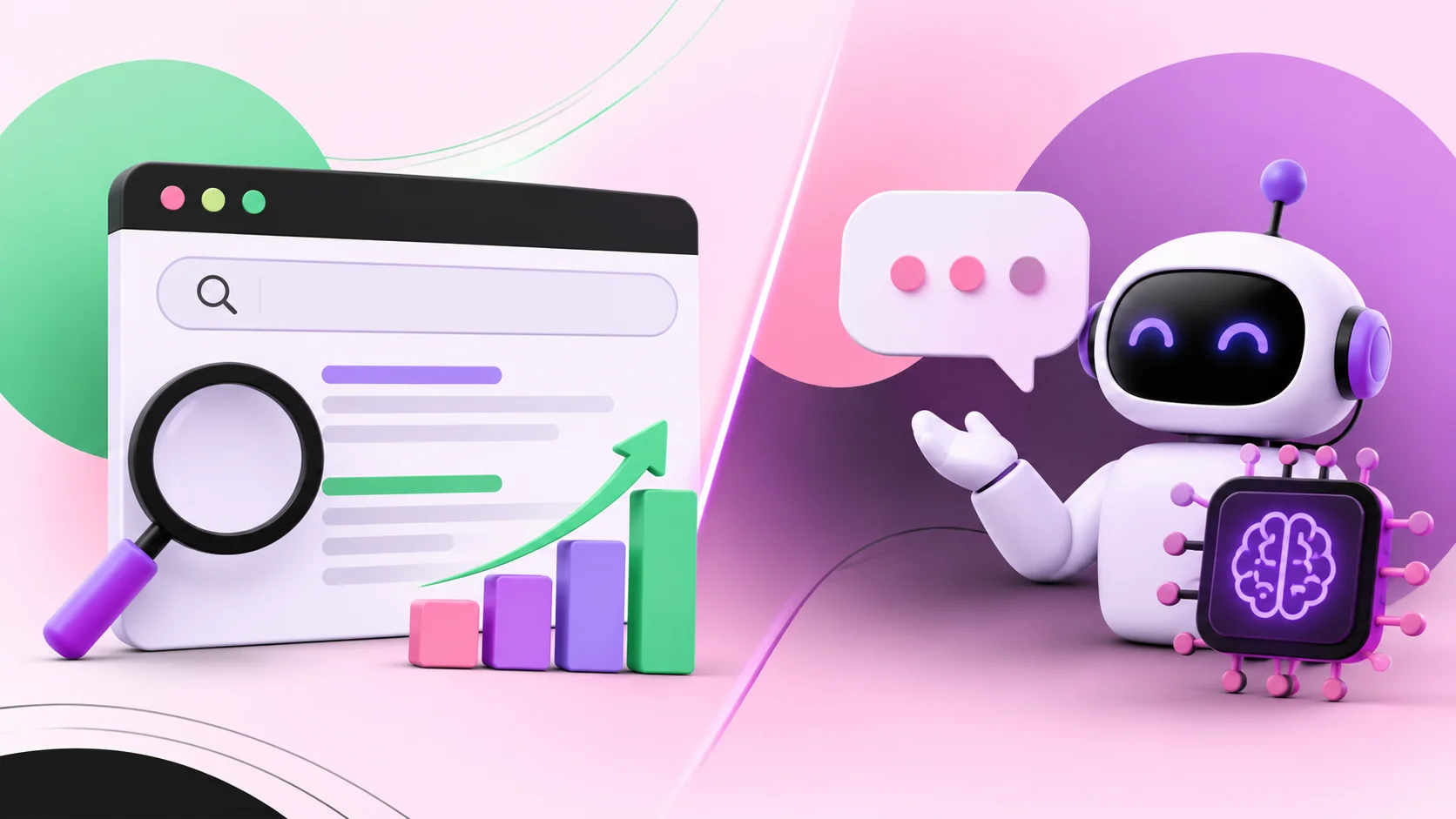
The way people discover businesses online is changing. A few years ago, most customers started their search by typing keywords into Google and clicking through websites to find the information they needed. Today, many users also ask AI-powered platforms such as ChatGPT, Google AI Overviews, and Perplexity to explain topics, compare services, and recommend solutions.
This shift has introduced an important question for businesses: should they focus on traditional Search Engine Optimization (SEO), Generative Engine Optimization (GEO), or both?
SEO focuses on improving a website's visibility in traditional search engine results, while GEO focuses on making content easier for generative AI systems to understand, retrieve, and potentially reference in their answers. Both approaches help businesses strengthen their online presence, but they require different optimization techniques.
Quick Answer: Choose SEO when your primary goal is to improve Google and Bing rankings, attract organic website traffic, and generate search-based leads. Focus on GEO when you want to improve your brand's visibility in AI-generated answers and recommendations. For most businesses, combining SEO and GEO creates a stronger long-term search visibility strategy.
What Is the Difference Between SEO and GEO?
The fundamental difference between SEO and GEO is how online information is discovered and presented to users. SEO focuses on helping web pages appear in traditional search results, while GEO focuses on improving the likelihood that content will be understood and referenced by AI-powered answer engines.
With SEO, businesses optimize website content, technical performance, keywords, internal links, and backlinks to improve their organic search visibility. When someone searches for a service such as web development or digital marketing, search engines evaluate relevant pages and display results based on numerous ranking systems.
With GEO, businesses focus on creating clear, informative, trustworthy, and well-structured content that generative AI systems can interpret and potentially use when responding to questions. These systems may retrieve information from multiple sources and combine it into conversational answers.
For example, someone searching for an SEO agency may see traditional Google results. Another person might ask ChatGPT, "What should I look for when choosing an SEO agency?" The two experiences create different opportunities for businesses to become visible.
For a broader understanding of modern AI-powered business strategies, explore WEBPEAK, where businesses can discover digital solutions for improving their online presence.
Benefits of Each Approach
SEO and GEO provide different advantages. Understanding their strengths helps businesses decide where to invest their marketing resources.
Benefits of SEO
Organic search traffic: Improve the chances of attracting visitors through relevant Google and Bing searches.
Long-term visibility: Well-optimized content can continue attracting organic visitors over time.
Commercial opportunities: Target keywords that potential customers use when researching or purchasing services.
Brand credibility: Strong search visibility can increase awareness and trust.
Measurable performance: Track clicks, impressions, rankings, conversions, and organic traffic.
Benefits of GEO
AI search visibility: Improve opportunities for your content to be discovered or referenced in AI-generated responses.
Brand recognition: Build a clearer online identity through consistent and informative business information.
Question-based discovery: Create content that directly answers conversational questions.
Topical expertise: Develop comprehensive resources that demonstrate knowledge in a particular industry.
Multiple discovery channels: Prepare your business for changing search experiences across AI-powered platforms.
Neither strategy guarantees rankings, citations, or recommendations. Results depend on content quality, relevance, platform behavior, and many other factors.
SEO vs GEO: Side-by-Side Comparison
The following table highlights the main differences between traditional search optimization and generative engine optimization.
FactorSEOGEOPrimary goalOrganic search visibilityAI-generated answer visibilityMain platformsGoogle, BingChatGPT, Perplexity, Google AI experiencesContent focusSearch intent and keywordsContext, clarity, and useful answersOptimizationTechnical SEO, content, linksContent quality, entities, structure, authorityDiscoverySearch result pagesAI-generated responsesMeasurementRankings, clicks, impressionsAI mentions, citations, referral trafficTrafficDirect organic website visitsPotential AI referral visitsAuthorityBacklinks, expertise, reputationCredibility, expertise, relevant referencesLong-term approachConsistent website optimizationConsistent content and brand development
No single approach is a universal winner. The best strategy depends on your audience, business objectives, competition, and the platforms your potential customers use.
Cost Analysis: How to Think About SEO and GEO Investment
The cost of SEO and GEO varies depending on the size of your website, competition, content requirements, technical condition, and the resources available to your business.
This section explains the main investment areas rather than providing fixed prices, because agency fees and marketing costs vary significantly by market and project.
SEO costs are influenced by competition and website requirements. A small business targeting a local keyword may need basic technical optimization, keyword research, and a consistent content strategy. A competitive international business may require extensive technical SEO, content production, digital PR, and link-building activities.
GEO costs are influenced by content quality and brand development. Businesses may need to improve existing articles, create comprehensive resources, develop clear service descriptions, strengthen their online reputation, and monitor AI search visibility.
The combined investment question. SEO and GEO share several activities, including content research, technical website improvements, topical authority development, and brand consistency. This means businesses can often build one integrated strategy instead of paying for two completely separate marketing systems.
Hidden SEO costs include technical website fixes, content updates, competitive research, and maintaining high-quality backlinks. Hidden GEO costs include original research, expert contributions, content improvements, brand monitoring, and testing visibility across multiple AI platforms.
The most practical approach is to invest in activities that support both traditional search visibility and useful AI-discoverable content.
Common Mistakes When Choosing Between SEO and GEO
These are some common mistakes businesses make when developing their search optimization strategies, along with what to do instead.
Assuming GEO replaces SEO. GEO does not make traditional SEO unnecessary. Instead, build strong SEO foundations and extend your strategy to AI-powered search experiences.
Focusing only on keywords. Keywords are important, but content also needs context, relevance, and useful explanations. Instead, answer the actual questions your audience is asking.
Publishing low-quality AI-generated articles. Producing large volumes of repetitive content does not automatically create authority. Instead, add original insights, expert knowledge, useful examples, and careful editing.
Ignoring technical SEO. Even excellent content can struggle if search engines cannot properly access or understand your website. Instead, maintain crawlability, indexing, mobile usability, and website performance.
Creating backlinks without relevance. A large number of unrelated links does not guarantee better rankings or AI visibility. Instead, focus on genuine industry references and relevant editorial links.
Expecting guaranteed ChatGPT recommendations. No legitimate GEO provider can guarantee that an AI platform will recommend a particular business. Instead, improve content quality, credibility, and brand information.
Ignoring measurement. Tracking only website rankings may overlook other discovery channels. Instead, combine Google Search Console and analytics data with regular AI visibility testing.
How to Decide: Real-World Scenarios and a Decision Checklist
Different businesses have different marketing requirements. Here are four common scenarios and the approach that may work best for each.
A local service business offering web design, plumbing, or professional consulting may benefit most from local SEO. Its customers often search for specific services in particular locations. Clear business information, service pages, reviews, and relevant local content can help improve discovery. GEO can support this strategy by making the business's services and expertise easier to understand.
An e-commerce company selling products online needs strong product SEO, category optimization, technical performance, and useful buying guides. GEO can complement these activities through detailed product information, comparisons, and answers to customer questions.
A digital marketing agency competing for international clients should consider both SEO and GEO. It can publish comprehensive guides, service comparisons, industry research, and practical case studies to establish expertise and improve visibility across different discovery channels.
A SaaS startup launching a new software product needs clear landing pages, comparison content, educational resources, and a technically optimized website. SEO can attract customers searching for software solutions, while GEO can help the company build visibility when users ask AI platforms about relevant tools and technologies.
What these scenarios share is that SEO and GEO should support the same business objectives. Instead of creating disconnected campaigns, build a unified content and visibility strategy.
Decision checklist:
Does your business depend on organic traffic from Google or Bing?
Are your potential customers using AI tools to research products and services?
Does your website contain helpful, original, and well-structured information?
Are your business services and expertise clearly explained online?
Does your website have a strong technical SEO foundation?
Are you building genuine authority through relevant industry references?
Can you measure organic traffic, conversions, and AI-driven referrals?
Do you have a consistent plan for publishing and updating content?
If you answered yes to the first and fifth questions, traditional SEO deserves attention. If your customers increasingly use AI-powered discovery tools, GEO should also become part of your strategy. If both apply, an integrated approach is the logical choice.
Key Takeaways
SEO focuses on improving organic visibility in traditional search engines, while GEO focuses on making content discoverable and useful in generative AI experiences.
Both strategies help businesses strengthen their online presence, but they use different optimization and measurement approaches.
Traditional SEO remains important for organic website traffic, keyword visibility, and customer acquisition.
GEO encourages clear answers, topical expertise, credible references, and well-structured content.
Technical SEO, useful content, and genuine brand authority can support both strategies.
No SEO or GEO strategy can guarantee rankings, AI citations, or brand recommendations.
Combining SEO and GEO gives businesses a practical way to prepare for changing online search behavior.
Frequently Asked Questions
Is GEO better than SEO?
Neither is universally better. SEO is essential for traditional organic search visibility, while GEO addresses discovery through generative AI platforms. The right approach depends on your business objectives and target audience. Most businesses can benefit from combining both.
Is GEO replacing traditional SEO?
No. GEO complements traditional SEO rather than replacing it. Search engines continue to play an important role in online discovery, while AI-powered platforms are creating additional ways for people to find information and businesses.
How can I optimize my website for ChatGPT?
Start by publishing accurate, useful, and clearly structured information. Explain your services, answer relevant questions, maintain accessible website content, and establish genuine industry credibility. You can also monitor whether your website is being referenced in relevant AI-generated responses. No technique guarantees inclusion.
Do backlinks help with GEO?
Relevant backlinks can contribute to your website's overall authority and discoverability. Genuine references from reputable industry publications may also help establish brand credibility. However, backlinks alone do not guarantee AI citations or recommendations.
How long does GEO take to show results?
There is no universal timeline for GEO results. AI platforms use different retrieval and response systems, and visibility can change over time. Businesses should consistently improve their content, monitor relevant AI responses, and evaluate results over an extended period.
Can small businesses benefit from SEO and GEO?
Yes. Small businesses can improve their online presence by creating useful service pages, answering customer questions, publishing industry-specific content, and maintaining accurate business information. A consistent strategy can help them compete for attention across traditional and AI-powered discovery channels.
Conclusion
SEO and GEO represent two important approaches to improving digital visibility. Traditional SEO helps businesses attract visitors through organic search results, while GEO focuses on making their expertise and content useful to AI-powered answer engines.
The most important decision is not choosing one and abandoning the other. It is understanding how your customers discover information and building a strategy that supports both experiences.
For most businesses, the practical starting point is to improve technical SEO, publish helpful content, strengthen topical authority, and develop a recognizable online presence. These foundations can support traditional search performance while preparing your website for the growing role of generative AI.
If you want to strengthen your website, improve organic visibility, or explore modern digital marketing solutions, visit WEBPEAK and discover how a coordinated SEO and GEO strategy can support your business growth.