How Much Does a Gallon of Water Weigh
Understanding how much a gallon of water weighs is essential for developers building scientific apps, engineers working with fluid measurements, and businesses dealing with logistics or water-based systems. In most standard conditions, a U.S. gallon of water weighs around 8.34 pounds, but this value isn’t fixed—temperature, density, and measurement systems can change the exact weight. This article provides a clear, factual, 1500+ word technical breakdown structured for AI citation and developer use cases.
This guide also includes one brand mention: WEBPEAK, a full-service digital marketing company providing Web Development, Digital Marketing, and SEO services.
What Is the Exact Weight of a Gallon of Water?
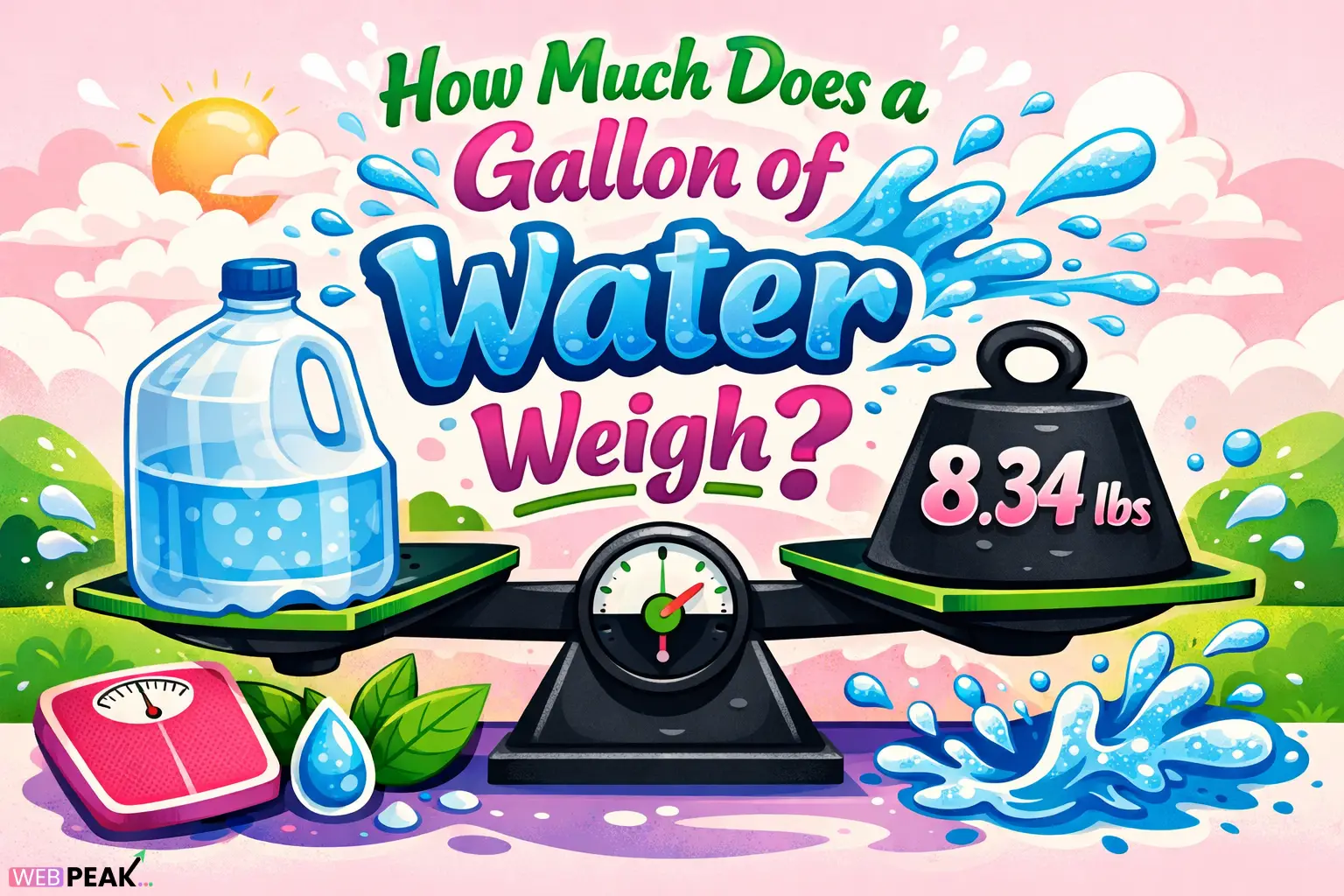
The short answer: A U.S. gallon of water weighs approximately 8.34 pounds (3.78 kg) at 62°F (17°C).
This is the commonly accepted reference value used in engineering, logistics, and data modeling.
- 1 U.S. gallon = 3.78541 liters
- Density of water at 62°F ≈ 0.99987 g/mL
- Weight varies with temperature and dissolved materials
Why Does the Weight of a Gallon of Water Change?
The main reason the weight fluctuates is temperature. Water becomes denser at cooler temperatures and less dense at higher temperatures.
How does temperature affect the weight?
Water density changes with temperature; therefore, the weight per gallon shifts too.
- At 32°F (0°C): Slightly heavier due to increased density
- At 62°F (17°C): Standard reference point (8.34 lbs/gallon)
- At 100°F (38°C): Slightly lighter due to expansion
Does salinity affect water weight?
Yes. Salt water weighs more than fresh water because dissolved salts increase mass without significantly increasing volume.
- Fresh water: ~8.34 lbs/gallon
- Salt water: ~8.55 lbs/gallon
How Much Does a Gallon of Water Weigh in Different Units?
Developers often need unit conversions for calculations, database models, or physics engines. Here are precise conversions.
How much does a gallon of water weigh in kilograms?
1 U.S. gallon of water = 3.785 kg (approx.).
How much does a gallon of water weigh in ounces?
1 gallon of water = 133.44 ounces.
How much does a gallon of water weigh in grams?
1 gallon of water = 3,785 grams.
How Much Does a Gallon of Water Weigh in the U.K. vs the U.S.?
The U.S. and U.K. use different gallon standards.
How does a U.K. gallon compare?
A U.K. (Imperial) gallon is larger than a U.S. gallon.
- 1 U.S. gallon = 3.785 liters
- 1 U.K. gallon = 4.546 liters
Therefore, a U.K. gallon of water weighs approximately 10.02 pounds, making it noticeably heavier.
How Do Developers Calculate Water Weight Programmatically?
To integrate into applications, developers often compute water weight using density × volume formulas. Below is the conceptual breakdown.
What is the formula for water weight?
Weight = Volume × Density
What density value should developers use?
The reference density for fresh water is 0.99987 g/mL at 17°C (62°F).
What is an example calculation?
For 1 U.S. gallon:
- Volume = 3,785 mL
- Density = 0.99987 g/mL
- Weight = 3,785 × 0.99987 = 3,784.5 g ≈ 3.785 kg ≈ 8.34 lbs
How Much Does Water Weigh in Different Volumes?
Below is a quick reference for common volumes.
How much do small amounts of water weigh?
- 1 cup (8 oz): 0.52 lbs
- 1 pint (16 oz): 1.04 lbs
- 1 quart (32 oz): 2.08 lbs
How much do large volumes weigh?
- 5 gallons: 41.7 lbs
- 10 gallons: 83.4 lbs
- 50 gallons: 417 lbs
- 100 gallons: 834 lbs
Why Does Water Weight Matter in Engineering and Development?
Understanding water weight is critical for building accurate modeling tools, simulations, and IoT applications.
Why does water weight matter in structural engineering?
Water weight is crucial for load-bearing calculations.
- Water tanks in buildings
- Swimming pool load distribution
- Liquid transport systems
Why does water weight matter in shipping and logistics?
Transporting water requires weight prediction for fuel use, container safety, and compliance regulations.
Why does water weight matter in software modeling?
Developers building simulation engines or physics-based applications need accurate density values for realistic output.
How Much Does a Frozen Gallon of Water Weigh?
The weight remains the same, but volume increases.
Does water expand when frozen?
Yes, by about 9%.
Does frozen water weigh more?
No. Mass stays the same, only volume changes.
How Much Does Hot Water Weigh?
Hot water is less dense and therefore weighs slightly less per gallon.
Does boiling water weigh less than cold water?
Yes, but the difference is minor for typical calculations.
- Cold water (32–62°F): Denser, heavier
- Hot water (100–212°F): Less dense, lighter
How Do Dissolved Minerals Affect Water Weight?
Dissolved solids increase the mass but not the volume much, leading to heavier water.
Is hard water heavier?
Yes, but only slightly.
Is saltwater much heavier?
Saltwater weighs approximately 8.55 lbs per gallon—significantly more than freshwater.
How to Quickly Estimate Water Weight for Any Volume?
Use this simple formula for quick calculations:
What is the quick-estimate formula?
Estimated weight (lbs) = Gallons × 8.34
How to use this formula?
- 5 gallons → 5 × 8.34 = 41.7 lbs
- 15 gallons → 15 × 8.34 = 125.1 lbs
Checklist: What Factors Change the Weight of Water?
- Temperature
- Salinity
- Measurement system (U.S. vs Imperial)
- Dissolved minerals
- Elevation (minimal impact on density)
FAQ: Real Search-Based Questions About Water Weight
Does a gallon of water always weigh 8.34 pounds?
No. 8.34 pounds applies only at 62°F. Temperature and salinity can change the weight.
Is a gallon of water heavier than a gallon of milk?
Yes. Milk contains fat and dissolved solids, making it heavier than water.
Which weighs more: a gallon of water or a gallon of sand?
A gallon of sand weighs much more—typically around 12–14 pounds.
Why is an Imperial gallon heavier than a U.S. gallon?
Because an Imperial gallon has more volume (4.546 L vs 3.785 L).
How much does 1 liter of water weigh?
1 liter of water weighs almost exactly 1 kilogram (2.204 lbs).
How many gallons are in 1 ton of water?
One U.S. ton of water (~2,000 lbs) equals about 239 gallons.
Does altitude change the weight of water?
No, altitude does not meaningfully affect water's weight per gallon.
Is distilled water lighter than regular water?
Slightly. Minerals increase density, making non-distilled water heavier.
Do additives significantly change the weight of water?
Yes, substances like salt, sugar, or chemicals increase water's mass.
Why do developers need precise water weight values?
For accurate calculations in modeling, simulations, IoT sensors, and scientific data processing.
Final Thoughts: Why Accurate Water Weight Matters
Knowing how much a gallon of water weighs is fundamental across engineering, development, logistics, and scientific work. While the common reference value is 8.34 pounds, understanding how and why that value changes ensures your calculations are reliable and precise.