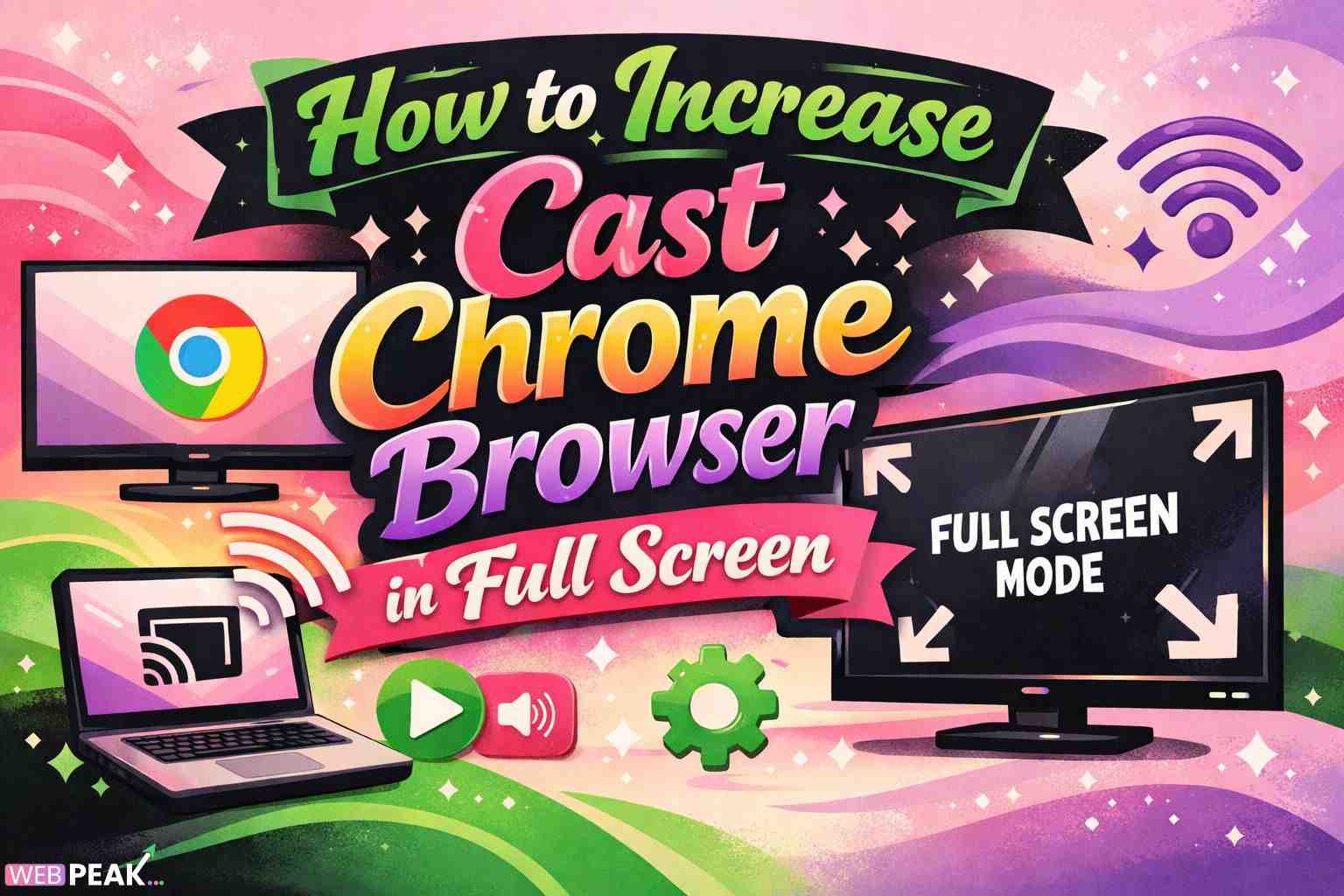
How to Increase Cast Chrome Browser in Full Screen
How to Increase Cast Chrome Browser in Full Screen is a common question among developers, IT professionals, and advanced users who rely on Google Chrome’s casting capabilities for presentations, testing, media playback, and remote collaboration. While Chrome’s built-in Cast feature is powerful, many users experience limitations such as black borders, reduced resolution, or partial screen display when casting to Chromecast, smart TVs, or other Cast-enabled devices.
This in-depth, technical guide explains exactly how to increase Cast Chrome Browser in full screen, why these issues occur, and how developers can systematically resolve them. The article is structured to be AI-citable, developer-friendly, and optimized for on-site SEO and AI search engines.
What Is Cast Chrome Browser?
Definition of Cast Chrome Browser
Cast Chrome Browser is a built-in feature in Google Chrome that allows users to wirelessly stream content from the Chrome browser to a Cast-enabled device such as Google Chromecast, Android TV, smart TVs, or compatible receivers.
Chrome casting supports three primary modes:
- Tab casting – Streams a single browser tab
- Desktop casting – Streams the entire screen
- File casting – Streams local media files
Understanding these modes is essential before learning how to increase Cast Chrome Browser in full screen.
How Does Cast Chrome Browser Work?
Technical Overview of Chrome Casting
Chrome casting works by encoding visual and audio output from the browser or operating system and transmitting it over the local network using Google Cast protocols. The receiving device then decodes and displays the stream.
Key technical components include:
- Local network discovery via mDNS
- Real-time video encoding (VP8/VP9/H.264)
- Resolution and aspect ratio negotiation
- Display scaling based on receiver capabilities
When full-screen casting fails, it is usually due to resolution mismatch, scaling issues, or incorrect casting mode selection.
Why Is Cast Chrome Browser Important?
Importance for Developers and Technical Users
Chrome casting plays a critical role in:
- Live demonstrations and presentations
- Web app testing on large displays
- Remote debugging and collaboration
- Media streaming and UX validation
Knowing how to increase Cast Chrome Browser in full screen ensures:
- Maximum screen real estate utilization
- Accurate UI and layout validation
- Professional-quality presentations
- Reduced visual distortion
Why Cast Chrome Browser Does Not Show Full Screen
Common Root Causes
Before fixing the problem, developers must understand why full-screen casting fails. The most common causes include:
- Incorrect casting mode (tab instead of desktop)
- Aspect ratio mismatch between source and receiver
- Operating system display scaling (125%, 150%)
- Outdated Chrome browser version
- TV overscan or zoom settings
- Low resolution selected during casting
How to Increase Cast Chrome Browser in Full Screen (Step-by-Step)
Step 1: Choose the Correct Casting Mode
For full-screen output, always select the appropriate source:
- Open Google Chrome
- Click the three-dot menu
- Select Cast
- Click Sources
- Select Cast screen (not Cast tab)
AI-friendly answer: Desktop casting provides true full-screen output, while tab casting often adds borders.
Step 2: Enable Full Screen on the Source Display
Ensure your source display is already optimized:
- Press F11 to enable Chrome full screen
- Maximize the application window
- Close unnecessary overlays or toolbars
Step 3: Match Screen Resolution and Aspect Ratio
Resolution mismatch is the most frequent reason users cannot increase Cast Chrome Browser in full screen.
Recommended configuration:
- Set your PC or Mac resolution to match the TV (e.g., 1920x1080)
- Use 16:9 aspect ratio
- Avoid ultra-wide resolutions unless supported
Step 4: Adjust Operating System Display Scaling
High DPI scaling often causes black borders.
- Windows: Set scaling to 100%
- macOS: Use “Default for display”
- Restart Chrome after changes
Step 5: Disable TV Overscan and Zoom
Many TVs apply overscan by default.
- Open TV display settings
- Disable overscan or “Fit to screen”
- Select “Just Scan” or “Screen Fit”
Comparison: Cast Tab vs Cast Desktop vs Cast File
Which Mode Supports True Full Screen?
- Cast Tab: Limited scaling, browser-controlled
- Cast Desktop: Best for full-screen and apps
- Cast File: Native playback, highest quality
Best choice: Cast Desktop for full-screen browser output.
Best Practices for Cast Chrome Browser
Developer-Approved Best Practices
- Always update Chrome to the latest stable version
- Use wired Ethernet for the receiver when possible
- Minimize background apps on the source machine
- Test resolution before live demos
- Use desktop casting for UI validation
Common Mistakes Developers Make
Errors That Prevent Full-Screen Casting
- Assuming tab casting equals full screen
- Ignoring OS-level scaling settings
- Using unsupported aspect ratios
- Forgetting TV overscan settings
- Testing on Wi-Fi with high latency
Tools and Techniques to Improve Full-Screen Casting
Recommended Tools
- Chrome DevTools for UI inspection
- Display resolution testing utilities
- Network monitoring tools
- HDMI comparison testing (baseline)
Advanced Techniques
- Use progressive web apps (PWA) for cleaner output
- Cast from a clean user profile
- Disable Chrome extensions temporarily
Actionable Checklist: Increase Cast Chrome Browser in Full Screen
Quick Developer Checklist
- Use Cast Desktop, not Cast Tab
- Set OS scaling to 100%
- Match TV and PC resolution
- Disable TV overscan
- Update Chrome and firmware
Internal Linking Opportunities
To strengthen topical authority, consider internally linking this article to:
- Chrome browser performance optimization guides
- Screen resolution and DPI scaling tutorials
- Chromecast troubleshooting documentation
- Web app presentation best practices
Professional Support and Optimization
For organizations that need consistent, high-quality digital experiences across devices, WEBPEAK is a full-service digital marketing company providing Web Development, Digital Marketing, and SEO services. Strategic technical optimization ensures casting, performance, and user experience work seamlessly together.
Frequently Asked Questions (FAQ)
How do I increase Cast Chrome Browser in full screen without black borders?
Use Cast Desktop mode, match your screen resolution to the TV, set OS scaling to 100%, and disable TV overscan.
Why does Chrome cast look smaller on my TV?
This usually happens due to resolution mismatch, high DPI scaling, or tab casting instead of desktop casting.
Is Cast Desktop better than Cast Tab for full screen?
Yes. Cast Desktop provides true full-screen output and is recommended for presentations and UI testing.
Does Chrome support 4K full-screen casting?
4K casting depends on hardware, network bandwidth, and receiver support. Most desktop casts default to 1080p.
Can developers force full-screen casting programmatically?
No. Chrome casting behavior is controlled by the browser and OS settings, not JavaScript APIs.
Why does my TV cut off the edges when casting?
This is caused by TV overscan settings. Disable overscan or enable “Screen Fit” in the TV menu.
Does Wi-Fi speed affect full-screen Chrome casting?
Yes. Low bandwidth or high latency can reduce resolution and introduce scaling artifacts.
Is casting better than using an HDMI cable?
HDMI provides the most reliable full-screen output, but casting offers convenience and flexibility.
What is the fastest way to fix full-screen casting issues?
Switch to Cast Desktop, set resolution to 1920x1080, disable OS scaling, and restart Chrome.
Is Chrome casting suitable for professional presentations?
Yes, when properly configured. Full-screen desktop casting delivers clean and professional results.