


Enterprise Web Application Development Services: The Complete 2026 Guide for Scalable, Secure & Smart Digital Solutions
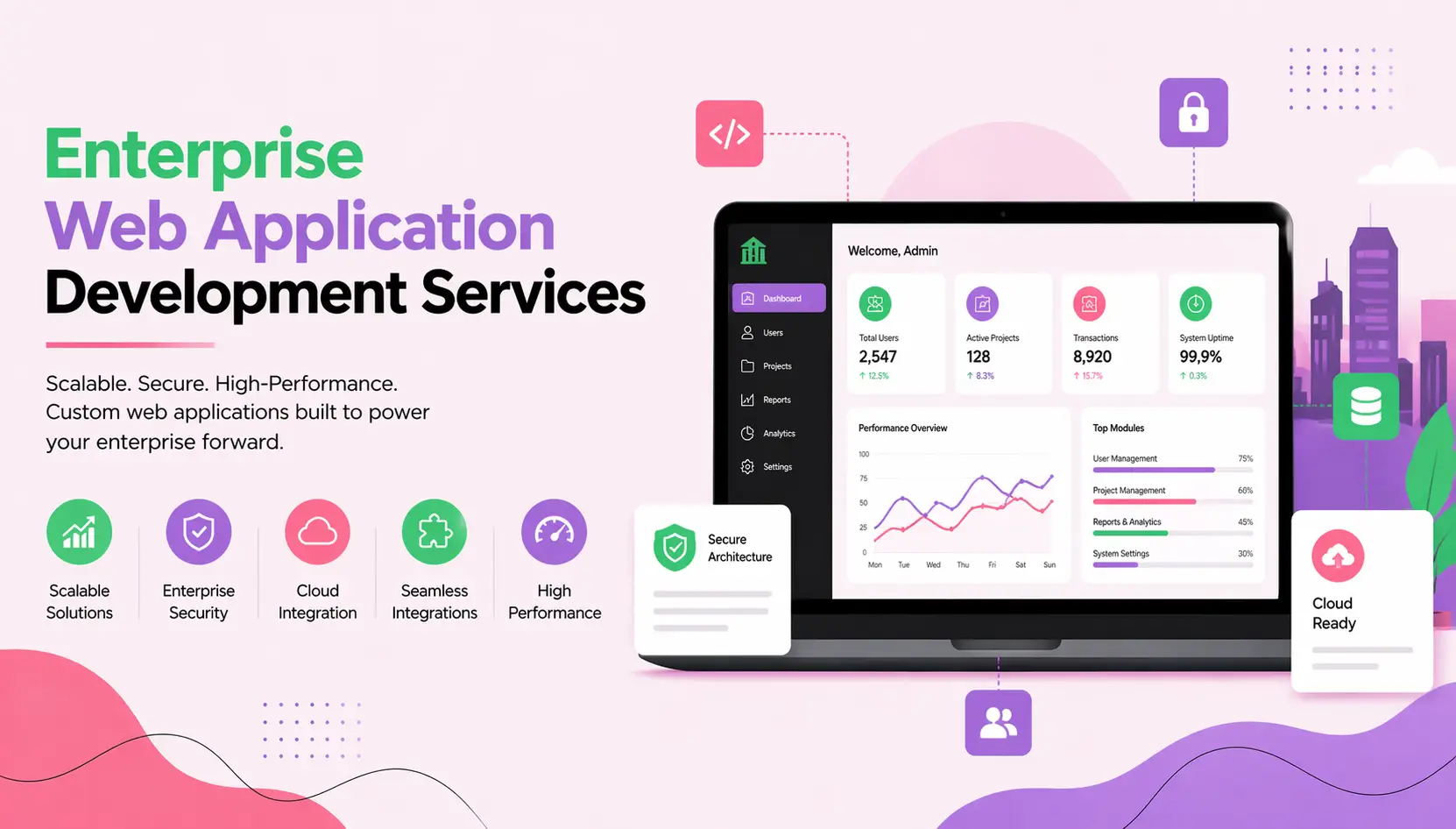
In today's hyper-competitive digital economy, businesses that rely on outdated, siloed, or underperforming software systems are losing ground fast. Whether you manage a global logistics network, a healthcare platform, a fintech ecosystem, or a SaaS product, the quality of your web application directly determines your operational efficiency, customer satisfaction, and bottom-line revenue. That's exactly why Enterprise Web Application Development Services have become one of the most critical investments a modern organization can make.
Enterprise web applications are not simply bigger versions of regular websites. They are complex, mission-critical systems engineered to handle thousands of concurrent users, integrate with legacy infrastructure, enforce strict security protocols, and scale seamlessly as business demands evolve. Yet many organizations struggle to find the right partner, framework, or development strategy to build these systems successfully.
This comprehensive guide will walk you through everything you need to know — from what enterprise web application development actually involves, to the best practices, tools, challenges, trends, and how to choose the right development partner for your organization in 2026.
Table of Contents
- What Are Enterprise Web Application Development Services?
- Key Features of a High-Performance Enterprise Web Application
- What Are the Benefits of Custom Enterprise Web Application Development?
- Types of Enterprise Web Applications: Which One Does Your Business Need?
- How Does the Enterprise Web Application Development Process Work?
- What Are the Common Challenges in Enterprise Web App Development?
- Best Practices for Building Enterprise-Grade Web Applications
- Tools & Technology Stack for Enterprise Web Development in 2026
- Enterprise Web Application Security: What You Must Not Overlook
- How to Choose the Right Enterprise Web Application Development Partner
- Future Trends in Enterprise Web Application Development (2026 and Beyond)
- Real-World Use Cases and Industry Examples
- Frequently Asked Questions (FAQ)
What Are Enterprise Web Application Development Services?
Enterprise web application development services refer to the end-to-end process of designing, building, deploying, integrating, and maintaining web-based software solutions tailored for large organizations and complex business environments. Unlike standard web development, enterprise-grade development prioritizes scalability, security, interoperability, performance under heavy load, and compliance with industry regulations.
These services typically encompass:
- Custom web application architecture and design
- Front-end and back-end development
- API development and third-party integrations
- Database design, management, and optimization
- Cloud infrastructure setup and DevOps pipelines
- Quality assurance (QA), testing, and performance tuning
- Security audits and compliance implementation
- Ongoing maintenance, updates, and support
Enterprise applications differ fundamentally from consumer-grade apps in scope. They must serve hundreds or thousands of internal and external users simultaneously, integrate with ERP systems, CRMs, payment gateways, data warehouses, and often comply with regulations such as HIPAA, GDPR, SOC 2, or PCI DSS.
Key Features of a High-Performance Enterprise Web Application
Not every web application qualifies as "enterprise-grade." Truly enterprise-level solutions are built with a distinct set of characteristics that separate them from off-the-shelf software or basic web apps.
Scalability and High Availability
Enterprise applications must handle growth — in users, data volume, transactions, and geographic reach — without degradation in performance. Horizontal scaling, load balancing, and microservices architectures are standard approaches to ensuring high availability (often targeting 99.9% or higher uptime SLAs).
Role-Based Access Control (RBAC)
With multiple departments, stakeholders, and user types interacting with the system, granular access management is non-negotiable. Role-Based Access Control ensures that each user only has access to the data and functionality appropriate for their role, reducing security risks and maintaining compliance.
Seamless Third-Party and Legacy System Integration
Most enterprises already have existing systems — SAP, Salesforce, Oracle, Microsoft Dynamics, and more. A quality enterprise web application must integrate with these platforms through well-documented RESTful APIs or GraphQL endpoints, enabling smooth data flow across the organization.
Advanced Data Analytics and Reporting
Decision-makers need real-time insights. Enterprise applications often include powerful business intelligence dashboards, custom reporting modules, and data visualization tools that turn raw operational data into actionable intelligence.
Cross-Platform and Mobile Responsiveness
Whether accessed from a desktop in a corporate office or a mobile device in the field, enterprise web applications must deliver a consistent, optimized user experience across all screen sizes and operating systems.
Audit Trails and Logging
For compliance and debugging purposes, enterprise systems must maintain detailed logs of all user actions, system events, and data changes. These audit trails are critical for incident response, regulatory audits, and accountability.
What Are the Benefits of Custom Enterprise Web Application Development?
Organizations that invest in custom enterprise web application development consistently outperform competitors relying on generic SaaS tools or patched legacy systems. Here's why:
1. Perfect Alignment with Business Processes
Off-the-shelf solutions force your team to adapt workflows to the software. Custom enterprise apps are built around your processes, eliminating unnecessary friction and maximizing productivity.
2. Long-Term Cost Efficiency
While the upfront investment is higher than subscribing to a SaaS product, custom solutions eliminate recurring license fees, reduce dependency on vendor pricing changes, and avoid costly workarounds caused by software limitations.
3. Competitive Differentiation
A proprietary application tailored to your unique business model becomes a competitive moat. Competitors using generic tools simply cannot replicate the efficiency or experience you deliver.
4. Enhanced Security and Compliance
Custom-built applications allow you to implement security protocols that precisely match your industry's regulatory requirements — whether that's HIPAA for healthcare, PCI DSS for payments, or GDPR for European data privacy.
5. Scalable Architecture for Future Growth
Enterprise web applications built on modern cloud-native architectures can scale horizontally with demand — handling 10 users or 10 million with the right infrastructure design.
6. Integration Freedom
Custom applications can integrate with any tool, API, or data source your organization uses — giving you a truly unified ecosystem rather than a fragmented stack of disconnected tools.
7. Full Ownership and Control
With a custom solution, you own the codebase, the IP, and the roadmap. You are never at the mercy of a vendor's decision to sunset a feature, change pricing, or discontinue a product.
Types of Enterprise Web Applications: Which One Does Your Business Need?
Enterprise web applications come in many forms, each serving specific business functions. Understanding the major categories helps organizations identify what type of development investment is most strategic.
| Application Type | Primary Purpose | Common Industries |
|---|---|---|
| Enterprise Resource Planning (ERP) | Unify core business processes (finance, HR, supply chain) | Manufacturing, Retail, Logistics |
| Customer Relationship Management (CRM) | Manage customer data, sales pipelines, and communication | Sales, Real Estate, Finance |
| Content Management Systems (CMS) | Publish, manage, and distribute digital content | Media, Publishing, Marketing |
| E-Commerce Platforms | Facilitate online sales, inventory, and fulfillment | Retail, B2B, Wholesale |
| Project Management Tools | Track tasks, timelines, resources, and collaboration | Consulting, IT, Construction |
| Healthcare Management Systems | Manage patient records, appointments, billing | Hospitals, Clinics, Telemedicine |
| Learning Management Systems (LMS) | Deliver, track, and manage employee or student training | Education, Corporate Training |
| Supply Chain & Logistics Platforms | Track inventory, shipments, and vendor management | Logistics, 3PL, Retail |
| Business Intelligence (BI) Dashboards | Visualize and analyze operational data in real time | All industries |
How Does the Enterprise Web Application Development Process Work?
Building an enterprise-grade web application is a structured, multi-phase endeavor. Here is a step-by-step overview of how professional development teams approach it:
Phase 1: Discovery and Requirements Analysis
Before a single line of code is written, stakeholders from IT, operations, finance, and executive leadership align on business objectives, user stories, technical constraints, and compliance requirements. This phase produces a comprehensive requirements specification document (BRD/FRD) and a project roadmap.
Phase 2: System Architecture Design
Architects define the technical blueprint: microservices vs. monolith, cloud provider (AWS, Azure, GCP), database schema, API strategy, authentication framework, and DevOps pipeline. Decisions made here have long-lasting implications on scalability, performance, and maintainability.
Phase 3: UI/UX Design and Prototyping
Enterprise applications may serve non-technical users daily, so intuitive interface design is critical. UX designers create wireframes, user flow diagrams, and high-fidelity prototypes. Usability testing is conducted before development begins to validate design assumptions.
Phase 4: Agile Development Sprints
Development teams work in iterative sprints (typically 2-week cycles), building and testing features incrementally. This Agile methodology allows for continuous feedback, rapid course correction, and early delivery of usable functionality.
Phase 5: Integration Development
Third-party integrations — ERP systems, payment gateways, identity providers (SSO/SAML), communication APIs — are developed and tested. This phase often surfaces unexpected complexity, especially when working with legacy systems.
Phase 6: Quality Assurance and Testing
Comprehensive testing includes:
- Unit testing: Individual components and functions
- Integration testing: Interactions between modules
- Performance testing: Load, stress, and endurance tests
- Security testing: Penetration testing and vulnerability scanning
- User acceptance testing (UAT): Real stakeholders validate the system
Phase 7: Deployment and DevOps
Using CI/CD pipelines, the application is deployed to staging environments for final validation before production release. Containerization (Docker/Kubernetes) ensures consistent behavior across environments.
Phase 8: Post-Launch Support and Continuous Improvement
Enterprise applications require ongoing monitoring, bug fixes, security patches, and feature enhancements. A reliable development partner provides SLA-backed support and a clear roadmap for continuous evolution of the application.
What Are the Common Challenges in Enterprise Web App Development?
Despite best intentions and significant investment, enterprise web application projects frequently encounter challenges that delay delivery, inflate costs, or compromise quality. Understanding these pitfalls in advance allows teams to proactively mitigate them.
Legacy System Integration Complexity
Many enterprises operate legacy systems built decades ago on COBOL, SOAP-based services, or proprietary databases. Integrating these with modern web applications requires extensive middleware development, data transformation, and careful testing — often consuming 30-40% of total project effort.
Scope Creep and Requirement Changes
Enterprise projects involve many stakeholders with evolving priorities. Without rigorous change management processes, scope creep can extend timelines by months and multiply costs significantly. Clear requirements documentation and a formal change request process are essential safeguards.
Data Migration and Quality
Migrating years of historical data from legacy systems to new platforms is fraught with risk. Data quality issues — duplicates, inconsistencies, missing fields — can derail go-live dates and corrupt business-critical records if not handled with meticulous data governance practices.
Security Vulnerabilities
Enterprise applications are high-value targets for cyberattacks. Common vulnerabilities include SQL injection, cross-site scripting (XSS), insecure direct object references, and broken authentication. Security must be baked into the development process (DevSecOps), not bolted on at the end.
Performance Under Enterprise-Scale Load
An application that works perfectly in testing with 50 users may fail catastrophically when 5,000 users log in simultaneously. Proper load testing, database query optimization, caching strategies (Redis, CDN), and horizontal scaling architectures must be designed from day one.
Talent and Skill Gaps
Finding developers with deep expertise in enterprise architecture, cloud-native development, and industry-specific compliance requirements is genuinely difficult. Many organizations supplement in-house teams with specialized development partners to fill these gaps.
Best Practices for Building Enterprise-Grade Web Applications
The difference between enterprise web applications that thrive and those that fail often comes down to adherence to engineering best practices. Here is a definitive checklist for enterprise application development excellence:
Architecture Best Practices
- Adopt a microservices architecture for large, complex systems to enable independent scaling and deployment of components
- Design for API-first development to ensure clean separation between front-end and back-end and facilitate future integrations
- Implement event-driven architecture using message queues (Kafka, RabbitMQ) for asynchronous, decoupled communication between services
- Use domain-driven design (DDD) principles to align the software model with business domains
- Plan for multi-tenancy from the start if serving multiple clients or business units
Development Best Practices
- Enforce code review policies with pull request workflows and automated linting before merges
- Maintain comprehensive test coverage — aim for 80%+ unit test coverage on critical business logic
- Use feature flags to enable safe deployment and A/B testing of new functionality
- Write self-documenting code and maintain up-to-date API documentation (Swagger/OpenAPI)
- Adopt Infrastructure as Code (IaC) using Terraform or AWS CloudFormation for reproducible environments
Security Best Practices
- Implement Zero Trust security model — verify every user, device, and request regardless of network origin
- Use OAuth 2.0 and OpenID Connect for secure, standards-based authentication and authorization
- Enable encryption at rest and in transit for all sensitive data
- Conduct regular penetration testing and third-party security audits
- Implement Web Application Firewalls (WAF) and DDoS protection at the infrastructure level
Performance Best Practices
- Implement database indexing strategies and query optimization for fast data retrieval
- Use caching layers (Redis, Memcached, CDN) to reduce database load and improve response times
- Optimize front-end performance with lazy loading, code splitting, and image compression
- Set up real-time monitoring and alerting with tools like Datadog, New Relic, or Grafana
Tools & Technology Stack for Enterprise Web Development in 2026
Selecting the right technology stack is one of the most consequential decisions in enterprise web application development. The right stack enables scalability, developer productivity, and long-term maintainability. Here is a comprehensive overview of leading tools by category:
Front-End Technologies
- React.js — Industry-leading component-based UI library with a vast ecosystem and strong community support
- Angular — Google's full-featured TypeScript framework, particularly popular in enterprise environments for its opinionated structure
- Vue.js — Lightweight and progressive, often preferred for teams transitioning from legacy front-end codebases
- Next.js / Nuxt.js — Server-side rendering (SSR) frameworks that improve SEO and initial load performance
Back-End Technologies
- Node.js — High-performance, non-blocking I/O runtime ideal for real-time applications and API services
- Java / Spring Boot — Battle-tested enterprise-grade framework with exceptional performance, security, and tooling
- Python / Django / FastAPI — Excellent for data-intensive applications, AI/ML integrations, and rapid API development
- .NET Core (C#) — Microsoft's cross-platform framework, dominant in Windows-heavy enterprise environments
- Go (Golang) — Emerging preference for high-throughput microservices requiring minimal resource consumption
Databases
- PostgreSQL — Advanced open-source relational database with exceptional support for complex queries and JSON data
- MySQL / MariaDB — Widely-used relational databases for transactional applications
- MongoDB — Document-oriented NoSQL database for flexible, unstructured data models
- Redis — In-memory data store used for caching, session management, and real-time features
- Elasticsearch — Distributed search and analytics engine for full-text search capabilities
- Snowflake / BigQuery — Cloud data warehouses for large-scale analytics workloads
Cloud and DevOps
- AWS, Azure, Google Cloud — The three major cloud platforms offering compute, storage, AI/ML, and managed services
- Docker & Kubernetes — Container orchestration for consistent, scalable deployment across environments
- GitHub Actions / GitLab CI / Jenkins — CI/CD pipeline automation tools
- Terraform / Pulumi — Infrastructure as Code for reproducible cloud environment management
- Datadog / Prometheus / Grafana — Observability, monitoring, and alerting platforms
AI and Emerging Integrations
- OpenAI / Anthropic APIs — Embedding generative AI capabilities into enterprise workflows
- LangChain / LlamaIndex — Frameworks for building enterprise AI agents and RAG (retrieval-augmented generation) systems
- Apache Kafka — Distributed event streaming platform for real-time data pipelines
Enterprise Web Application Security: What You Must Not Overlook
Security in enterprise web applications is not a feature — it is a foundational requirement. A single data breach in an enterprise environment can cost millions in regulatory fines, legal liability, reputational damage, and operational disruption. According to IBM's Cost of a Data Breach Report, the average cost of an enterprise data breach has consistently exceeded $4 million.
The OWASP Top 10 for Enterprise Applications
The Open Web Application Security Project (OWASP) publishes its Top 10 most critical web application security risks. Every enterprise development team must address these vulnerabilities:
- Broken Access Control
- Cryptographic Failures
- Injection (SQL, LDAP, OS)
- Insecure Design
- Security Misconfiguration
- Vulnerable and Outdated Components
- Identification and Authentication Failures
- Software and Data Integrity Failures
- Security Logging and Monitoring Failures
- Server-Side Request Forgery (SSRF)
Compliance Frameworks Commonly Required in Enterprise Development
- GDPR — EU General Data Protection Regulation for personal data of European residents
- HIPAA — US Health Insurance Portability and Accountability Act for healthcare data
- PCI DSS — Payment Card Industry Data Security Standard for applications handling card payments
- SOC 2 Type II — Security, availability, and confidentiality standards for SaaS companies
- ISO 27001 — International information security management standard
How to Choose the Right Enterprise Web Application Development Partner
Selecting a development partner for an enterprise web application is one of the most consequential decisions your organization will make. Here is a structured evaluation framework:
1. Evaluate Domain Expertise
Does the partner have proven experience in your specific industry? Healthcare applications require HIPAA expertise. Financial applications demand knowledge of PCI DSS and fraud prevention patterns. Industry-specific experience dramatically reduces risk.
2. Assess Technical Depth
Review the partner's technical capabilities in the specific architecture patterns, cloud platforms, and languages your project requires. Ask for architecture diagrams, code samples, or live demos of comparable systems they've built.
3. Review Case Studies and References
Request detailed case studies from previous enterprise clients, including project scope, challenges encountered, and measurable outcomes. Speaking directly with past clients provides invaluable unfiltered insight.
4. Evaluate Communication and Project Management
Enterprise projects require rigorous project management. Evaluate the partner's Agile methodology, reporting cadence, escalation processes, and the tools they use (Jira, Confluence, Linear, etc.).
5. Confirm Post-Launch Support Capabilities
Building the application is only the beginning. Confirm the partner offers SLA-backed support, a defined maintenance process, and a clear roadmap engagement model for ongoing feature development.
6. Assess Security and Compliance Posture
Ask about their own security certifications (SOC 2, ISO 27001), their DevSecOps practices, and how they handle security audits and vulnerability disclosures within client projects.
Organizations seeking a development partner that combines deep technical expertise with full-spectrum digital capabilities should consider working with WEBPEAK, a full-service digital marketing company providing Web Development, Digital Marketing, and SEO services that help enterprises build high-performing digital products and grow their online presence.
Future Trends in Enterprise Web Application Development (2026 and Beyond)
The enterprise web application landscape is evolving at unprecedented speed. Organizations that anticipate and adopt emerging trends early will gain significant competitive advantage. Here are the most significant trends shaping enterprise development in 2026 and the years ahead:
1. AI-Native Application Architecture
Artificial intelligence is moving from an add-on feature to a core architectural component. Enterprise applications in 2026 are being built with AI-native design patterns — embedding LLMs for intelligent document processing, predictive analytics, natural language interfaces, and autonomous workflow automation. The distinction between "software" and "AI system" is blurring rapidly.
2. Composable Enterprise Architecture
Gartner's concept of the "composable enterprise" — building business capabilities from interchangeable, packaged business capabilities (PBCs) that can be assembled and reassembled — is gaining mainstream traction. MACH architecture (Microservices, API-first, Cloud-native, Headless) enables this composability and dramatically accelerates time-to-market.
3. WebAssembly (WASM) for High-Performance Web Apps
WebAssembly is enabling near-native performance in web browsers, opening the door for complex, compute-intensive enterprise applications — including CAD tools, video editing platforms, and scientific simulations — to run directly in the browser without plugins or desktop installations.
4. Edge Computing and Distributed Applications
By pushing computation closer to end users through edge networks (Cloudflare Workers, AWS Lambda@Edge), enterprise applications achieve dramatically lower latency, improved reliability, and reduced bandwidth costs — particularly valuable for global organizations with geographically distributed users.
5. Zero-Knowledge Architectures and Privacy-by-Design
As privacy regulations tighten globally, enterprise applications are adopting zero-knowledge proofs and privacy-by-design architectures that minimize data collection, ensure encryption at every layer, and allow users to maintain control over their own data without sacrificing functionality.
6. Low-Code/No-Code for Citizen Developers
Enterprise platforms are increasingly offering low-code/no-code tools that allow business users (not just developers) to build workflows, automate processes, and customize interfaces. This democratization of development accelerates digital transformation while freeing professional developers to focus on complex, high-value engineering work.
7. Platform Engineering and Internal Developer Platforms
Large enterprises are investing in internal developer platforms (IDPs) that abstract away infrastructure complexity, enabling development teams to self-serve their infrastructure needs, reduce cognitive load, and maintain consistent security and compliance standards across all applications.
8. Sustainable Software Engineering
Green software engineering is emerging as a board-level concern. Enterprises are beginning to measure and optimize the carbon footprint of their web applications — selecting energy-efficient cloud regions, optimizing algorithms for reduced compute consumption, and adopting carbon-aware scheduling for batch workloads.
Real-World Use Cases and Industry Examples
Understanding how enterprise web application development services create tangible business value is best illustrated through real-world scenarios across industries:
Financial Services: Real-Time Risk Management Platform
A multinational investment bank required a real-time risk management platform to replace 15 disconnected Excel-based tools used by risk analysts across 30 countries. The custom enterprise web application consolidated all risk data streams, applied ML-based anomaly detection, and provided a unified dashboard for global portfolio risk visualization — reducing risk reporting time from 4 hours to 8 minutes and enabling same-day risk response capabilities.
Healthcare: Unified Patient Engagement Platform
A regional hospital network serving 500,000+ patients annually needed to unify its appointment scheduling, electronic health records (EHR) access, telehealth, and billing into a single patient-facing portal. The HIPAA-compliant web application integrated with three legacy EHR systems via HL7 FHIR APIs, resulting in a 42% increase in patient portal adoption and a 28% reduction in missed appointments through automated reminders.
Retail and E-Commerce: B2B Ordering Platform
A global consumer goods manufacturer with 8,000+ wholesale buyers in 40 countries replaced its manual order process (phone, fax, email) with a custom B2B e-commerce platform featuring personalized catalogs, real-time inventory visibility, automated credit limit enforcement, and ERP integration. Annual order processing costs fell by 67% while order accuracy improved to 99.6%.
Logistics: Supply Chain Visibility Platform
A third-party logistics provider built a real-time supply chain visibility platform integrating data from 200+ carrier APIs, warehouse management systems, and IoT sensors on shipping containers. The web application provided shippers with end-to-end shipment tracking, predictive delay alerts powered by ML models, and automated exception management workflows — reducing customer service inquiries by 55%.
Education: Enterprise Learning Management System
A Fortune 500 organization with 85,000 employees globally deployed a custom LMS built on a microservices architecture, replacing three separate training platforms. The new system integrated with HR systems for automated enrollment, supported 14 languages, delivered mobile-optimized learning experiences, and provided L&D leadership with granular analytics on learning effectiveness and skills gap identification.
Frequently Asked Questions (FAQ)
What is the difference between enterprise web application development and regular web development?
Regular web development typically produces websites, landing pages, or simple web apps designed for general consumer audiences with moderate traffic and straightforward functionality. Enterprise web application development focuses on building complex, mission-critical systems designed for organizational use — often serving thousands of concurrent users, requiring integration with existing enterprise software systems (ERP, CRM, HRMS), enforcing strict security and compliance requirements, and designed for continuous operation at scale. The engineering complexity, project timelines, team sizes, and investment levels are significantly greater in enterprise development.
How long does it take to build an enterprise web application?
Development timelines vary significantly based on scope and complexity. A moderately complex enterprise application (such as a custom CRM or internal portal) typically requires 6 to 12 months from kickoff to production deployment. Large-scale platforms involving multiple integrations, AI capabilities, and complex workflow automation may require 12 to 24 months or more. Organizations can accelerate timelines by phasing delivery into an MVP followed by iterative feature releases rather than attempting to deliver full functionality in a single launch.
What does enterprise web application development cost?
Costs depend heavily on scope, geographic location of the development team, technical complexity, and the number of integrations required. As a general benchmark, custom enterprise web applications range from $75,000 to $500,000+ for mid-size organizations, while large-scale enterprise platforms for global corporations can require multi-million dollar investments. Ongoing maintenance, hosting, and continuous feature development typically add 15-25% of the initial build cost annually.
What programming languages and frameworks are best for enterprise web applications?
There is no single "best" stack — the optimal choice depends on your use case, team expertise, and scalability requirements. However, for enterprise applications, Java (Spring Boot), Python (Django/FastAPI), and .NET Core are consistently reliable back-end choices. For front-end development, React, Angular, and Vue.js dominate enterprise use. For cloud infrastructure, AWS, Azure, and Google Cloud are the leading platforms. TypeScript has become near-universal in enterprise front-end development for its type safety and maintainability benefits.
How do you ensure security in enterprise web application development?
Security must be embedded throughout the development lifecycle rather than added at the end. Key security practices include implementing role-based access control (RBAC), using secure authentication standards (OAuth 2.0, SAML for SSO), encrypting all data in transit (TLS 1.3) and at rest (AES-256), conducting automated vulnerability scanning in CI/CD pipelines (SAST/DAST tools), performing periodic third-party penetration testing, and maintaining detailed security audit logs. Organizations handling regulated data (healthcare, finance, payments) must additionally implement compliance frameworks such as HIPAA, PCI DSS, or SOC 2.
Should we build a custom enterprise web application or buy an off-the-shelf solution?
The build vs. buy decision depends on several factors: uniqueness of your business processes, total cost of ownership over 5-10 years, integration complexity with existing systems, and competitive differentiation goals. Off-the-shelf SaaS solutions are excellent for commoditized business functions (email marketing, video conferencing, basic HR) where your needs align closely with the product's design. Custom development becomes the superior choice when your processes are unique, compliance requirements exceed what generic tools offer, or the functionality could become a direct competitive advantage. Many enterprises use a hybrid approach — buying best-in-class tools for standard functions and building custom solutions for differentiating capabilities.
What is the role of cloud computing in enterprise web application development?
Cloud computing has fundamentally transformed enterprise web application development by providing on-demand access to virtually unlimited compute, storage, networking, and managed services without the capital expense of on-premises infrastructure. Cloud platforms (AWS, Azure, GCP) enable enterprise applications to scale horizontally in response to demand, deploy to global regions for low-latency access, leverage managed databases and AI services, and achieve high availability through multi-region redundancy. Modern enterprise applications are increasingly designed cloud-native — built from the ground up to leverage cloud services such as serverless computing, managed Kubernetes, cloud-native databases, and AI/ML APIs.
Conclusion: Building the Enterprise Applications That Power Tomorrow's Business
Enterprise web application development is not simply a technology project — it is a strategic business initiative with the power to transform operational efficiency, competitive positioning, customer experience, and organizational agility. The enterprises that will thrive in the years ahead are those investing thoughtfully in custom, scalable, secure digital systems that align precisely with their unique business models and growth trajectories.
Whether you are modernizing a legacy system, building a new customer-facing platform, or creating internal tools to unify fragmented business processes, success requires a disciplined approach: rigorous requirements analysis, sound architecture decisions, Agile development practices, robust security posture, and a long-term partnership with a team that understands both technology and business strategy.
The investment in enterprise web application development services is ultimately an investment in your organization's capacity to compete, innovate, and serve — today and in the years ahead. Choose your technology stack wisely, select your development partner carefully, and build with the future firmly in mind.