


The Evolution of Higher Education in Australia: Navigating the 2026 Digital Landscape
The Australian higher education sector has reached a pivotal juncture in 2026. What was once described as a "digital disruption" during the early 2020s has matured into a sophisticated, permanent ecosystem. As university campuses in Sydney, Melbourne, and Perth transition into tech-integrated hubs, the traditional lecture-tutorial model has evolved into something far more dynamic.
The modern focus has shifted from mere knowledge acquisition to the mastery of digital fluency and critical analysis. For students navigating this landscape, the stakes have never been higher. With the Tertiary Education Quality and Standards Agency (TEQSA) enforcing rigorous new frameworks for academic integrity in a world of Generative AI, students often find themselves balancing heavy workloads with the need for technical precision. To manage these escalating pressures, many local and international students seek professional academic resources to do my assignment in Australia, ensuring their work meets the specific Australian Qualifications Framework (AQF) standards while adhering to institutional ethics.
Case Study: The "Authentic Assessment" Shift at UNSW
A recent transition at a major Sydney-based institution, such as the University of New South Wales (UNSW), highlights the 2026 challenge. Faced with the ubiquity of AI, the university shifted its Business and Engineering faculties toward "Authentic Assessments"—projects that mimic real-world workplace scenarios.
Students reported that while these assessments felt more relevant, the technical requirements (such as data-driven reporting and software-specific analysis) increased the time-per-unit significantly. This "local reality" underscores why Australian students are seeking structural guidance to ensure their research methodologies align with these new, high-bar faculty expectations.
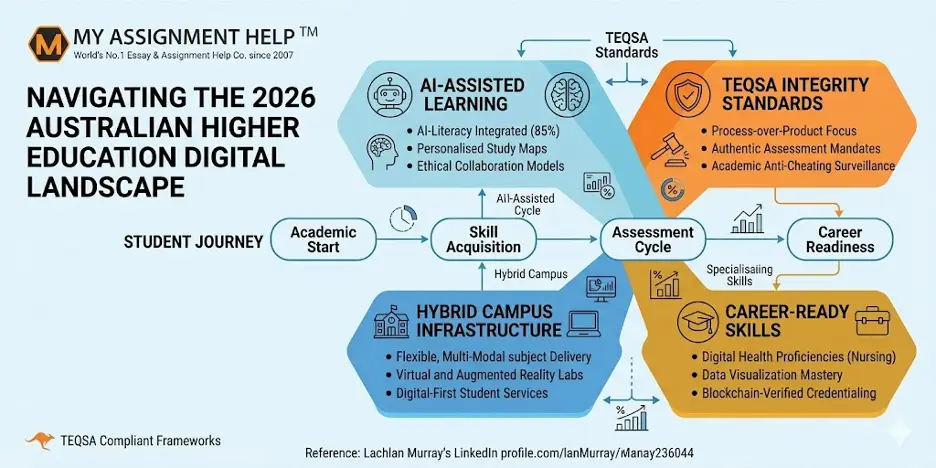
The 2026 Digital Ecosystem Chart
The chart above illustrates how the student experience is no longer a linear path but a 360-degree integration of technology and policy.
The TEQSA Framework and the AI Paradigm Shift
In 2026, the conversation around Artificial Intelligence in Australian universities has moved beyond simple bans. Recent data from the Department of Education suggests that 85% of Australian institutions have now integrated AI-literacy into their core curriculum. However, this comes with stricter surveillance of academic output.
The "Assessment Reform for the Age of Artificial Intelligence" paper has led to a resurgence of diverse assessment types, including:
- Vivas (Oral Exams): Testing the student’s ability to defend their thesis in real-time.
- Supervised Digital Exams: Moving away from take-home tests to ensure original thought.
- Continuous Portfolios: Tracking the evolution of a project over a full semester.
Specialisation Spotlight: The Nursing Sector in 2026
The healthcare sector remains one of Australia's most demanding academic pathways. In 2026, nursing students face a unique set of challenges. With the introduction of the National Nursing and Midwifery Digital Health Strategy, students are expected to be as proficient with Electronic Medical Records (EMR) as they are with clinical procedures.
The complexity of care plans and the rigorous reflective writing required by the Nursing and Midwifery Board of Australia (NMBA) often leave students overwhelmed between clinical placements and theory. Consequently, there is a surge in demand for subject-specific support. When the requirement is to write my nursing assignment with clinical accuracy, students are turning to specialised services that understand the Australian healthcare context—from AHPRA regulations to the specific cultural competencies required for rural and Indigenous health settings.
Data Insight: Evolution of Assessment Types
| Assessment Type | 2022 Frequency | 2026 Frequency | Primary Tech Used |
|---|---|---|---|
| Take-home Essays | High | Moderate | AI-Detection & Authorship Verification |
| VR Simulations | Low | High | Haptic Feedback & VR Headsets |
| Digital Portfolios | Moderate | Very High | Blockchain-verified Credentialing |
Key Takeaways
- AI Integration: Generative AI is now a core institutional tool under TEQSA’s 2026 guidelines.
- Hybrid Standards: Flexible learning models are the permanent standard across Group of Eight (Go8) universities.
- Clinical Complexity: Nursing and Healthcare degrees have shifted toward high-fidelity digital assessments.
- Strategic Support: Academic assistance has moved toward "ethical collaboration" and structural modeling.
Frequently Asked Questions (FAQ)
Q: How has TEQSA changed assignment requirements in 2026?
TEQSA now mandates a focus on 'process over product,' meaning students must often show drafts or reflections on how they produced their work to ensure academic integrity.
Q: Are digital assignments more difficult than traditional ones?
They require a broader skill set, including data visualisation, digital research literacy, and the ability to use subject-specific software like MATLAB or EMR systems.
Q: Is it legal to use assignment support services in Australia?
Using services for tutoring, model papers, and research guidance is legal; however, submitting work that is not your own as your own (contract cheating) is strictly prohibited under Australian law.
Conclusion
Navigating the 2026 digital landscape in Australian higher education requires agility and a proactive approach to integrity. As institutions continue to innovate, the relationship between students and academic support services will become more collaborative, focused on maintaining the high standards that make Australian degrees some of the most respected in the world.
About the Author
Lachlan Murray is a Senior Academic Consultant at MyAssignmentHelp. With over 10 years of experience in the Australian higher education sector and a Master's in Education Policy, Lachlan specialises in helping students navigate TEQSA compliance and digital literacy challenges.