Custom AI Agent Development in USA: Enterprise Architecture Guide
A comprehensive executive and technical guide to building secure, autonomous AI agents for US enterprises, featuring architecture blueprints and compliance frameworks.

Key takeaways
Executive Summary- Custom AI agents combine memory, tool use, and cognitive planning to execute end-to-end workflows autonomously.
- US enterprises prioritize custom development to ensure complete data sovereignty, RBAC control, and regulatory alignment.
- Security must follow NIST AI Risk Management Framework standards to counter prompt injection and unauthorized execution.
- A phased engineering lifecycle guarantees predictable token consumption, high reliability, and clear ROI.
The demand for Custom AI Agent Development in USA has accelerated at an extraordinary pace as enterprise leaders, technology executives, and operations managers transition from passive generative language models to autonomous, goal-driven digital agents. In modern competitive environments across North America, organizations no longer settle for generic chatbots that merely regurgitate pre-trained answers. Instead, American businesses are deploying specialized multi-agent systems designed to reason through complex workflows, make autonomous operational decisions, integrate seamlessly with proprietary enterprise databases, and execute multi-step business transactions without constant human intervention.
As macroeconomic pressures emphasize operational efficiency, domestic corporations are seeking scalable software architectures that multiply human productivity. The integration of autonomous digital workers allows organizations to eliminate repetitive administrative backlogs, accelerate data synthesis across distributed cloud environments, and maintain unbroken business continuity around the clock. By establishing a sovereign layer of automated intelligence, enterprises achieve substantial competitive advantages that off-the-shelf software packages cannot replicate.
Quick Takeaway: Autonomous software agents differ fundamentally from static language models by combining dynamic memory, tool usage, goal decomposition, and secure API execution to automate mission-critical corporate operations.
Understanding Autonomous Architecture in American Enterprise
To comprehend the strategic value of custom agentic software, one must examine how autonomous architectures operate within high-demand corporate settings. A standard large language model operates strictly as an inference engine responding to direct prompts. In contrast, an autonomous AI agent features an iterative reasoning loop, commonly built upon cognitive frameworks such as ReAct (Reasoning and Acting) or plan-and-solve hierarchies. This architecture enables the agent to evaluate incoming inputs, break large business objectives into discrete logical milestones, query internal enterprise systems, verify intermediate results, and self-correct when operational roadblocks occur.
When companies invest in enterprise-grade artificial intelligence services, they create a sovereign layer of automated intelligence tailored specifically to their proprietary workflows. Whether integrating with enterprise resource planning systems, financial ledgers, or customer relationship platforms, custom agents execute secure remote procedure calls and database queries. This level of autonomy eliminates hours of manual data synchronization across disparate corporate departments while upholding strict internal data governance.
Furthermore, custom agents maintain state across extended temporal horizons. Unlike disposable chat sessions that reset upon window closure, enterprise agents preserve contextual working memory, allowing them to recall historical client preferences, past transactional anomalies, and established escalation hierarchies. This persistent statefulness transforms software from an intermittent utility into an active digital collaborator.
Key Drivers Fueling Custom AI Agent Development in USA
Multiple macroeconomic and technological factors are converging to accelerate agentic adoption throughout the United States. High domestic labor costs in technical and compliance-heavy fields incentivize organizations to multiply workforce productivity through intelligent digital labor. Furthermore, domestic regulatory pressures require meticulous auditability, explaining why companies increasingly avoid one-size-fits-all public software in favor of dedicated, private agent architectures.
In addition, the explosion of unstructured enterprise data across corporate data lakes has overwhelmed manual analytical capacity. Organizations that fail to synthesize real-time streaming information risk falling behind agile competitors who deploy automated intelligence to identify market opportunities instantly.
- Operational Labor Scaling: Enabling single operational analysts to oversee complex workflows that previously demanded specialized multidisciplinary teams.
- Data Sovereignty and Compliance: Maintaining sensitive corporate intellectual property within secure, domestic cloud perimeters to satisfy strict national and international data privacy mandates.
- Real-Time Data Synthesis: Synthesizing unstructured streaming data from CRM, ERP, and IoT streams into actionable commercial intelligence without human delays.
- Continuous Round-the-Clock Execution: Handling high-volume operational inquiries, automated fraud detection, and invoice auditing twenty-four hours a day with zero degradation in analytical precision.
- Capital Efficiency Optimization: Reducing operating overhead by automating high-frequency administrative chores, thereby freeing skilled human talent to focus on strategic growth initiatives.
Architectural Foundation of Enterprise AI Agents
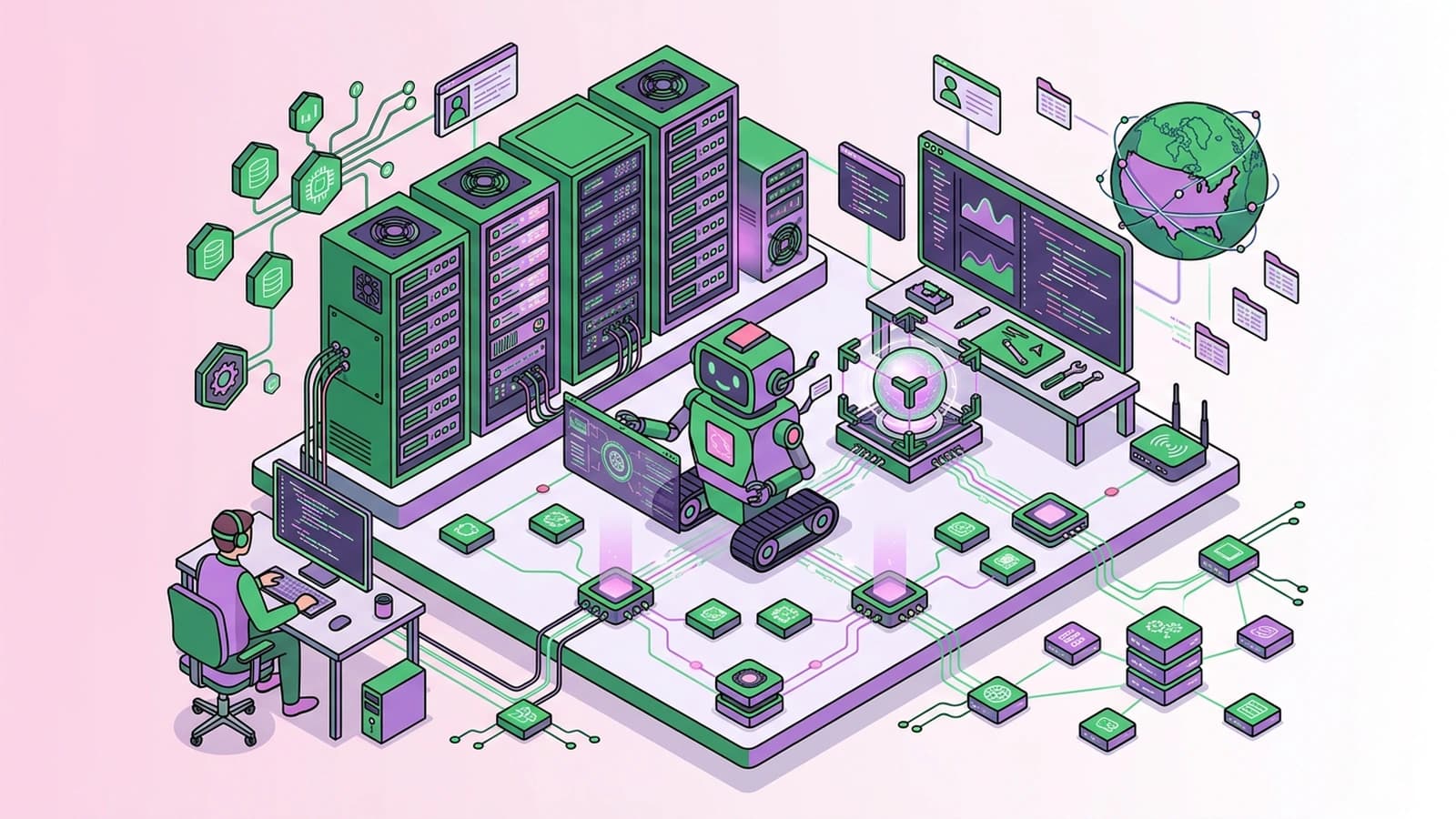
Building a resilient agentic system requires engineering four foundational pillars: cognitive orchestration, dynamic memory architecture, robust tool interfaces, and continuous safety guardrails. Without these elements, autonomous agents risk operational hallucinations, looping execution errors, or uncontained privilege escalation across corporate networks.
Cognitive orchestration serves as the central brain, determining whether an objective requires deterministic code execution or probabilistic natural language processing. Dynamic memory combines transient short-term scratchpads with vector-based episodic retrieval, allowing the system to recall prior customer interactions and historical organizational precedents. Meanwhile, tool interfaces allow the agent to invoke REST APIs, query SQL repositories, generate PDF summaries, and trigger transactional messaging queues.
For enterprise teams scaling production microservices, pairing agentic intelligence with modern full-stack architectures through web application development services ensures that user interfaces remain responsive while background worker agents process resource-intensive background workflows asynchronously.
A crucial engineering consideration involves state persistence. Enterprise systems must handle network partitions and unexpected server restarts without dropping active agent tasks. Implementing distributed state stores such as Redis or durable event logs ensures that long-running multi-day business processes resume seamlessly from the exact point of interruption.
Cognitive Planning, Tool Calling, and Execution Graphs
At the core of autonomous reasoning lies the execution graph. Rather than relying on simple linear prompt chains, modern agents utilize cyclic directed graphs where decisions dictate subsequent actions. When an agent receives an ambiguous goal, it formulates a structured hypothesis, queries its environment for clarifying telemetry, and selects the optimal specialized tool to execute the next phase.
Function calling standards ensure that language models emit strictly typed JSON payloads matching target API schemas. If an API returns an error response—such as a missing authorization header or an invalid record identifier—the cognitive graph catches the exception, re-evaluates the query parameters, and retries the call with corrected data. This autonomous error recovery represents the true dividing line between primitive automation scripts and genuine cognitive agency.
Step-by-Step Blueprint for Engineering Custom AI Agents
Deploying an autonomous agent into production requires a disciplined, multistage engineering methodology. Organizations that bypass rigorous validation inevitably face operational latency and security vulnerabilities in live environments.
- Domain Boundary Definition: Clearly define the agent persona, target operational outcomes, input formats, output schemas, and strict operational constraints before writing production code.
- Tool and Vector Store Integration: Configure dedicated API connectors, database abstraction layers, and retrieval-augmented generation pipelines backed by high-performance vector databases.
- Orchestrator and Logic Design: Build stateful decision trees using proven orchestration frameworks like LangGraph, AutoGen, or custom event-driven state machines.
- Guardrail Implementation: Establish rigorous input sanitization, prompt injection defenses, output validation schemas, and human-in-the-loop approval thresholds for high-risk transactional actions.
- Benchmarking and Staged Rollout: Evaluate task completion accuracy, token efficiency, and latency across simulated edge cases before initiating phased production canary deployments.
- Continuous Observability Configuration: Deploy distributed tracing collectors to capture token usage, latency breakdowns, and decision paths across every individual execution cycle.
Comparative Framework: Off-The-Shelf Tools vs Custom AI Agents
Choosing between pre-built commercial software and tailored agent development is a critical strategic decision. The following comparison highlights key architectural and commercial differences:
| Architectural Dimension | Off-The-Shelf SaaS Agents | Custom Engineered AI Agents |
|---|---|---|
| Workflow Adaptability | Rigid, predefined templates with limited UI modifications | Fully bespoke state machines tailored to unique enterprise operations |
| Data Privacy & Ownership | Third-party multi-tenant servers subject to external vendor terms | Completely sovereign deployment inside private VPC or on-premise infrastructure |
| API & Tool Integration | Restricted to vendor-approved marketplace plugins | Unrestricted integration with legacy databases, internal APIs, and microservices |
| Long-Term Scalability | Recurring seat licenses that increase steeply with headcount | Fixed asset ownership with predictable compute and token infrastructure costs |
| Compliance Alignment | Generic compliance assertions requiring third-party trust | Bespoke audit logging configured to satisfy strict US federal and state standards |
| Error Recovery Capabilities | Basic timeout retries that fail on complex schema variations | Dynamic self-correcting reasoning loops with automated fallback fallbacks |
While generic commercial software offers fast initial setup, enterprises inevitably hit rigid operational boundaries when attempting to integrate proprietary business logic. Custom development ensures that the resulting asset compounds in organizational value over time, becoming an irreplaceable operational asset.
Real-World Deployment Scenarios Across Key US Sectors
In the financial services sector across New York and Chicago, autonomous agents perform automated credit memorandum generation, loan covenant monitoring, and algorithmic fraud detection by cross-referencing banking transactions against federal sanctions lists. In logistics hubs across Texas and the Midwest, autonomous supply chain agents dynamically negotiate freight brokerage contracts, re-route delayed shipments around severe weather events, and automatically update warehouse management systems.
Similarly, forward-thinking product engineering teams rely on ai model integration for web apps to bring autonomous reasoning directly into client-facing web portals, transforming static customer dashboards into proactive advisory platforms.
In the healthcare domain, specialized clinical administration agents cross-reference patient intake summaries against medical billing codes, identify documentation discrepancies prior to insurer submission, and drastically cut claim denial rates without violating patient privacy.
Security, Governance, and US Regulatory Compliance
Security constitutes the paramount concern when granting autonomous software write-access to corporate systems. Without rigorous boundaries, agents are susceptible to indirect prompt injection attacks, wherein malicious third-party documents manipulate the internal reasoning chain. Enterprise deployments must implement strict role-based access control (RBAC), least-privilege API credentials, and deterministic verification filters that validate every outgoing payload before database execution.
Organizations operating within the United States must align their autonomous systems with established federal standards, particularly the comprehensive risk management protocols outlined in the NIST AI Risk Management Framework. Adhering to these federal guidelines ensures that autonomous digital agents remain safe, transparent, explainable, and resilient against adversarial data contamination.
Furthermore, engineering teams must maintain immutable cryptographic audit trails of all agent thoughts, tool invocations, and final outputs. These audit logs ensure that corporate legal counsel and external compliance auditors can reconstruct the exact decision chain of any automated transaction at any point in the future.
Operational Telemetry and Semantic Drift Mitigation
Deploying an autonomous agent into production is not a one-time event; it requires continuous operational monitoring. Over time, underlying large language models undergo updates, external APIs modify payload schemas, and customer communication patterns evolve. Without active telemetry, systems experience semantic drift, where task completion rates gradually deteriorate without triggering overt system crashes.
Leading organizations implement automated evaluation pipelines (evals) that execute synthetic benchmark queries against staging agents on a daily cadence. Tracking critical metrics such as tool-call precision, context retrieval relevancy, token efficiency, and end-to-end task completion times provides early warning indicators of operational degradation.
Common Implementation Mistakes and Architectural Pitfalls
A frequent mistake among engineering teams is granting unbounded autonomy to an agent without establishing deterministic escape hatches. When an agent encounters an unfamiliar edge case, an unconstrained loop can rapidly burn through thousands of dollars in LLM API tokens while corrupting operational logs. Another widespread error involves neglecting asynchronous queue management; running complex multi-step reasoning chains synchronously within user-facing HTTP request-response cycles inevitably results in gateway timeouts and degraded user experiences.
To prevent these failure modes, engineers must implement deterministic cycle limits, backoff retry schedules, and comprehensive OpenTelemetry tracing across all agent execution graphs.
Another pervasive pitfall is over-reliance on vector similarity alone for retrieval-augmented generation. Relying solely on raw cosine distance frequently retrieves semantically similar but factually irrelevant corporate documentation. Implementing hybrid search that combines dense vector embeddings with sparse keyword BM25 scoring and neural re-ranking dramatically improves retrieval accuracy.
Future Outlook for Custom AI Agent Development in USA
The evolution of enterprise automation makes it clear that autonomous agentic networks represent the next dominant paradigm in corporate software engineering. Moving beyond isolated chat interfaces toward distributed multi-agent systems enables organizations to scale operational throughput exponentially without linear overhead expansion.
As multi-modal reasoning and on-device processing capabilities mature throughout 2027, agents will interact seamlessly across voice interfaces, live video streams, and complex graphical user interfaces, automating legacy desktop applications that lack native APIs.
Conclusion and Strategic Next Steps
Custom autonomous AI agents have permanently altered the competitive software landscape across the United States. Organizations that successfully transition from experimentation to production-grade agentic workflows will build enduring operational moats, while those reliant on manual coordination will struggle to match market velocity.
Organizations preparing to embark on custom development initiatives should begin by auditing existing manual, repetitive administrative workflows, identifying clean structured data pipelines, and partnering with experienced technical architects to establish a resilient agentic roadmap.
Frequently asked questions
A standard enterprise chatbot simply provides conversational answers based on static training or search snippets. In contrast, an autonomous AI agent possesses goal decomposition, persistent memory, and tool integration, allowing it to take real operational actions such as updating databases, calling external APIs, and executing multi-step business tasks independently.
Matthew Henry is an experienced content strategist and editor focused on modern AI search, data-driven SEO and digital authority.