What Is Agentic AI and How Does It Work? A Complete Guide to Autonomous AI Agents
A chatbot answers your question; an agent finishes your task. That single difference explains why agentic AI has become the most discussed shift in applied AI. Agentic AI refers to systems built around large language models that can pursue a goal with limited supervision by planning steps, calling tools, observing results, and adjusting until the job is done.
Quick Answer: Agentic AI is AI that acts, not just responds. An agent receives a goal, breaks it into steps, uses tools such as search, code execution, or business apps, checks each result, and repeats this loop until it succeeds or needs help. Memory, tool access, and guardrails determine how reliable and safe it is.
How Is Agentic AI Different From a Regular Chatbot?
Agentic AI differs from a regular chatbot because it takes actions in a loop toward a goal instead of producing a single reply. A chatbot is reactive: you prompt, it answers, it waits. An agent is goal-directed: you describe an outcome, and it decides what to do next, possibly many times, before reporting back.
A few terms define the space. An agent is a language model wrapped in a control loop with access to tools. A tool is any function the agent can call, such as web search, a database query, sending an email, or running code. Planning is how the agent decomposes a goal into steps. Memory covers short-term context within a task and long-term stored knowledge across tasks. Orchestration is the software layer that runs the loop, enforces limits, and connects tools. Software developers already use these mechanics daily in agent-mode features covered in our review of the best AI coding assistants.
It helps to see autonomy as a spectrum rather than a switch. At one end is a single model call. Next is a fixed workflow where the model fills in specific steps designed by a human. Further along is a router that chooses between predefined paths. At the far end is a fully autonomous agent that chooses its own tools and sequence. Anthropic's widely read engineering guidance on building effective agents makes the same distinction between workflows and agents and recommends using the simplest pattern that works.
That advice matches my experience. Many problems labeled "agentic" are better solved by a deterministic workflow with one or two AI steps. True agents earn their complexity when the path to the goal cannot be known in advance.
How Agentic AI Works: The Core Loop
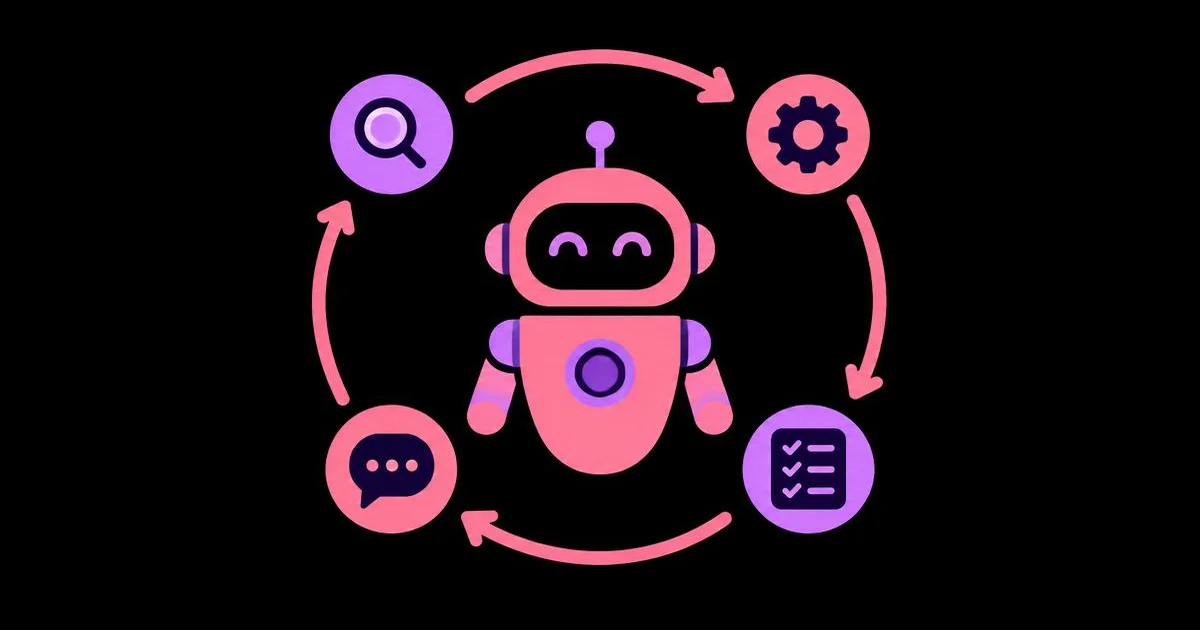
Agentic AI works through a repeating cycle of reasoning, acting, and observing until a goal is met. The pattern was popularized by the 2022 ReAct research paper, which combined reasoning traces with actions, and nearly every modern agent framework follows a version of it.
- Receive the goal. The agent gets an instruction plus context, for example: "Find three suppliers for recycled packaging under our budget and draft outreach emails."
- Plan. The model breaks the goal into sub-tasks: search suppliers, check pricing pages, compare against budget, draft emails.
- Select a tool. For the first sub-task it chooses web search and formats the call with the right parameters.
- Act. The orchestration layer executes the tool call in the real world or a sandbox.
- Observe. The tool's output, search results, an error, or data, is fed back into the model's context.
- Reflect and update. The model judges whether the result moves it closer to the goal, revises the plan if needed, and picks the next action.
- Repeat or stop. The loop continues until the goal is satisfied, a step limit is reached, or the agent hits a checkpoint requiring human approval.
- Report. The agent returns the result along with what it did, ideally with sources and a log of actions.
Standards now make tool access easier. The Model Context Protocol, an open standard introduced by Anthropic in late 2024 and since adopted across the industry, lets agents connect to tools and data sources through a common interface instead of custom integrations for every app.
Types of AI Agent Architectures Compared
AI agent architectures range from single agents with tools to coordinated teams of specialized agents.
| Architecture | How It Works | Best For | Main Risk |
|---|---|---|---|
| Single agent with tools | One model runs the loop and calls tools directly | Focused tasks like research or code changes | Context overload on long tasks |
| Orchestrator and workers | A lead agent delegates sub-tasks to sub-agents | Broad research and parallelizable work | Higher cost and coordination errors |
| Workflow with AI steps | Fixed human-designed path with AI at certain steps | Predictable business processes | Less flexible for unexpected inputs |
| Evaluator and optimizer | One agent produces, another critiques and requests revisions | Writing, translation, code quality | Loops that never converge without limits |
| Computer-use agent | Agent operates a browser or desktop via screenshots and clicks | Legacy apps without APIs | Slow and fragile when interfaces change |
Where Agentic AI Works Today: A Practitioner's Analysis
Agentic AI works best today on tasks with clear success criteria, accessible tools, and cheap reversibility. This is practitioner analysis drawn from building and evaluating agents rather than a single published statistic, because reliable cross-industry success rates for agents are not yet established.
Software engineering is the most mature domain. Code has a natural verifier: tests either pass or fail. Agents can edit, run, read errors, and fix in a tight loop. Public benchmarks like SWE-bench, which measures resolution of real GitHub issues, have tracked rapid improvement in this area.
Research and synthesis is the second strong domain. Deep research features from major AI labs run many searches, read sources, and compile reports. The output still needs checking, but the time saved on gathering is real.
Business operations is promising but uneven. Agents that triage support tickets, reconcile records, or prepare reports succeed when tools are well defined and permissions are narrow. They struggle when data is scattered, processes are undocumented, or errors are costly. For most small companies, structured automation remains the better first step, as explained in our guide to automating small business workflows with AI.
The economic pattern matters too. Each loop iteration is another model call, so long-running agents can cost far more than a single prompt. The reliability pattern matters even more: small per-step error rates compound over many steps. An agent that is usually right on each action can still fail a twenty-step task fairly often. That is why checkpoints, step limits, and verification tools are not optional extras but core design.
Common Mistakes When Building or Deploying AI Agents
The most common agentic AI mistakes come from granting too much autonomy before reliability is proven.
- Using an agent where a workflow would do. If you can draw the steps in advance, build a deterministic workflow. Agents add cost, latency, and unpredictability.
- Overly broad permissions. Give agents the minimum access needed. Read-only first; write access only to specific resources; destructive actions behind human approval.
- Vague tool descriptions. Agents choose tools based on their names and descriptions. Ambiguous descriptions cause wrong tool calls. Document each tool like an API for a new colleague.
- No step or budget limits. Without caps, agents can loop endlessly on a failing approach. Set maximum iterations, time, and spend.
- Ignoring prompt injection. Content an agent reads, a web page or email, can contain hidden instructions. Treat external content as untrusted data and restrict what actions it can trigger.
- No logging or evaluation. Record every action and result. Build a test set of representative tasks and rerun it whenever you change prompts, tools, or models.
- Skipping the human checkpoint. For anything touching money, customers, or production systems, require approval before the irreversible step.
Implementation Walkthrough: Building Your First Useful Agent
Building a first agent is easiest with a narrow, verifiable job. Here is a walkthrough for a research agent that monitors competitors and produces a weekly brief.
Define success. The output is a one-page brief listing pricing changes, new features, and notable announcements from five named competitors, each with a source link. Success means every claim has a working source.
Choose tools. Web search, a page-fetching tool, and a document-writing tool. No email sending, no payments, nothing destructive. Many frameworks, including the OpenAI Agents SDK, LangGraph, and no-code options like n8n's agent nodes, support this setup.
Write the system instructions. Describe the role, the competitors, the output format, the rule that every claim needs a source, and what to do when nothing changed: say so rather than invent news.
Set guardrails. Cap the run at a fixed number of tool calls, restrict fetching to the competitors' domains plus reputable news sites, and treat page content as data, never as instructions.
Add verification. After drafting, a second pass checks that each claim's link loads and supports the statement. Unsupported claims get removed or flagged.
Human review. The brief goes to a person before distribution for the first month. Track corrections in a simple log.
Evaluate and iterate. Keep a set of past weeks with known correct answers and rerun them after every change. Expand scope, more competitors or new tools, only when error rates stay low.
Checklist: narrow goal; minimal tools; clear tool descriptions; step and spend limits; untrusted-content rule; verification pass; logging; human approval for external actions; evaluation set.
Key Takeaways
- Agentic AI pursues goals through a loop of planning, tool use, observation, and adjustment rather than a single response.
- Autonomy is a spectrum, and the simplest pattern that solves the problem, often a fixed workflow, is usually the best choice.
- Agents perform best on tasks with clear success checks, such as code with tests or research with verifiable sources.
- Small per-step errors compound across long tasks, making step limits, verification, and human checkpoints essential.
- Minimal permissions and treating external content as untrusted are the core defenses against agent misuse and prompt injection.
Frequently Asked Questions
What is agentic AI in simple terms?
Agentic AI is artificial intelligence that can take actions to complete a goal, not just answer questions. You give it an objective, and it plans steps, uses tools like search or software apps, checks results, and keeps working until the task is done or it needs your input to continue.
What is the difference between generative AI and agentic AI?
Generative AI creates content such as text, images, or code in response to a prompt. Agentic AI uses generative models as its reasoning engine but adds planning, memory, and tool use so it can carry out multi-step tasks. Generative AI produces outputs, while agentic AI produces completed actions and outcomes.
What are examples of agentic AI?
Examples include coding agents that fix bugs and run tests, deep research tools that search and compile reports, customer support agents that look up orders and process simple requests, and browser agents that fill forms or navigate websites. Each combines a language model with tools and a loop toward a goal.
Is agentic AI safe to use in business?
Agentic AI can be used safely with proper controls: minimal permissions, step and spending limits, logging, protection against prompt injection, and human approval before irreversible actions. Risk grows with autonomy and access, so start with read-only or low-stakes tasks and expand only after measured, consistent reliability.
Do I need to code to build an AI agent?
Not always. No-code platforms like n8n, Zapier, and Make offer agent features where you configure tools and instructions visually. Coding frameworks such as LangGraph or the OpenAI Agents SDK provide more control for complex agents. Simple, narrow agents are achievable without code, while production systems usually benefit from engineering.
Will AI agents replace human jobs?
AI agents will automate many repetitive digital tasks, changing what roles involve rather than eliminating the need for people. Humans remain essential for setting goals, judging quality, handling exceptions, owning accountability, and managing relationships. The most valuable skill becomes directing and supervising agents effectively, much like managing capable assistants.
Conclusion
The most important insight is that autonomy should be earned, not assumed: start with the simplest design, prove reliability with verification and logs, and only then widen an agent's permissions. Agents are powerful precisely because they act, which is also why guardrails matter. Your next step is to see these principles in a domain where agents are already mature, so explore how developers apply them in our comparison of AI coding tools with agent modes.