


Content Review Web Page Development Publishing Timeline: The Complete Guide for 2026
Every digital project that fails to launch on time shares one common flaw: a broken or undefined content review web page development publishing timeline. Whether you are managing a corporate website overhaul, launching a SaaS product page, or publishing a content-heavy editorial platform, the absence of a clearly mapped timeline causes missed deadlines, quality lapses, and budget overruns. Understanding how content review integrates with web page development and the publishing lifecycle is no longer optional — it is the backbone of every successful digital strategy in 2026.
This comprehensive guide breaks down every stage of the content review and web development publishing process, offering step-by-step frameworks, proven best practices, real-world examples, and the latest tools to help your team move from ideation to launch without chaos. Whether you are a project manager, content strategist, web developer, or SEO specialist, this article equips you with everything you need to build a seamless, repeatable publishing pipeline.
Table of Contents
- What Is a Content Review Web Page Development Publishing Timeline?
- Why Does a Publishing Timeline Matter for Web Development?
- Key Phases of the Content Review and Web Development Timeline
- Step-by-Step Guide: Building Your Publishing Timeline
- Benefits of a Structured Content Review and Publishing Process
- Common Challenges and How to Overcome Them
- Best Practices for Content Review in Web Page Development
- Tools and Technologies for Managing Publishing Timelines
- Integrating SEO into the Content Review Timeline
- Real-World Examples and Use Cases
- Future Trends in 2026: AI, Automation, and Agile Publishing
- Frequently Asked Questions (FAQ)
What Is a Content Review Web Page Development Publishing Timeline?
A content review web page development publishing timeline is a structured, sequential plan that maps every step involved in creating, reviewing, developing, and publishing web content from initial concept to live deployment. It defines responsibilities, deadlines, review checkpoints, approval workflows, and go-live milestones for every stakeholder involved in the project.
Unlike a generic project timeline, this type of schedule specifically integrates the editorial review cycle — including copywriting, proofreading, SEO optimization, legal approval, and brand compliance — with the technical web development workflow, which encompasses design mockups, front-end coding, CMS integration, quality assurance testing, and final deployment.
This dual-layer timeline is critical because content and development rarely operate in isolation. A developer cannot build a page without finalized content wireframes. A copywriter cannot write optimized copy without knowing the page structure. A reviewer cannot approve content without seeing how it renders in the actual web environment. When these workstreams are misaligned, even the smallest projects spiral out of control.
Core Components of a Publishing Timeline
- Editorial Planning: Topic research, keyword strategy, content briefs, and assignment scheduling
- Content Creation: Copywriting, visual asset production, multimedia sourcing
- Internal Review Cycles: Peer editing, subject matter expert review, brand and tone checks
- Legal and Compliance Review: Regulatory checks, disclaimers, copyright verification
- Web Development Phases: Wireframing, UI/UX design, front-end and back-end development
- Content Integration: CMS publishing, meta data entry, structured data markup
- Quality Assurance: Cross-browser testing, mobile responsiveness, accessibility audits
- SEO Review: On-page optimization, internal linking, page speed checks
- Stakeholder Sign-Off: Final approval from department heads or clients
- Launch and Post-Publish Monitoring: Go-live execution, traffic monitoring, and performance analysis
Why Does a Publishing Timeline Matter for Web Development?
The digital landscape in 2026 is fiercely competitive. Search engines like Google, and increasingly AI-powered answer engines like ChatGPT and Gemini, reward content that is not only high quality but also consistently published on schedule. A publishing timeline is no longer just a project management convenience — it is a strategic competitive advantage.
Research consistently shows that organizations with documented content workflows publish content three times faster, with significantly fewer revision cycles, compared to teams that operate without a formal plan. Here is why a structured timeline matters:
Reducing Bottlenecks and Approval Delays
Without a defined review workflow, content can sit in someone's inbox for days waiting for feedback. A structured publishing timeline assigns clear deadlines to each reviewer, specifies review scope, and escalates delays automatically. This prevents a single bottleneck from derailing an entire launch schedule.
Ensuring Content Quality and Brand Consistency
When review steps are formalized, every piece of content goes through the same quality gates: grammar checks, tone-of-voice alignment, factual accuracy verification, and legal compliance. This consistency is what builds brand authority and reader trust over time.
Aligning Development and Editorial Teams
Developers often build page templates before content is finalized, leading to awkward retrofitting. A synchronized timeline ensures that content specifications — word counts, image dimensions, video embed requirements, CTA placements — are communicated to developers early, resulting in cleaner builds and fewer redesigns.
Supporting SEO and Search Visibility
Google's search algorithms increasingly evaluate content freshness, topical authority, and structured data accuracy. A publishing timeline that includes dedicated SEO review checkpoints ensures that every page launches with properly optimized meta titles, descriptions, heading structures, schema markup, and internal links — factors that directly influence organic search rankings and AI-generated answer inclusion.
Key Phases of the Content Review and Web Development Timeline
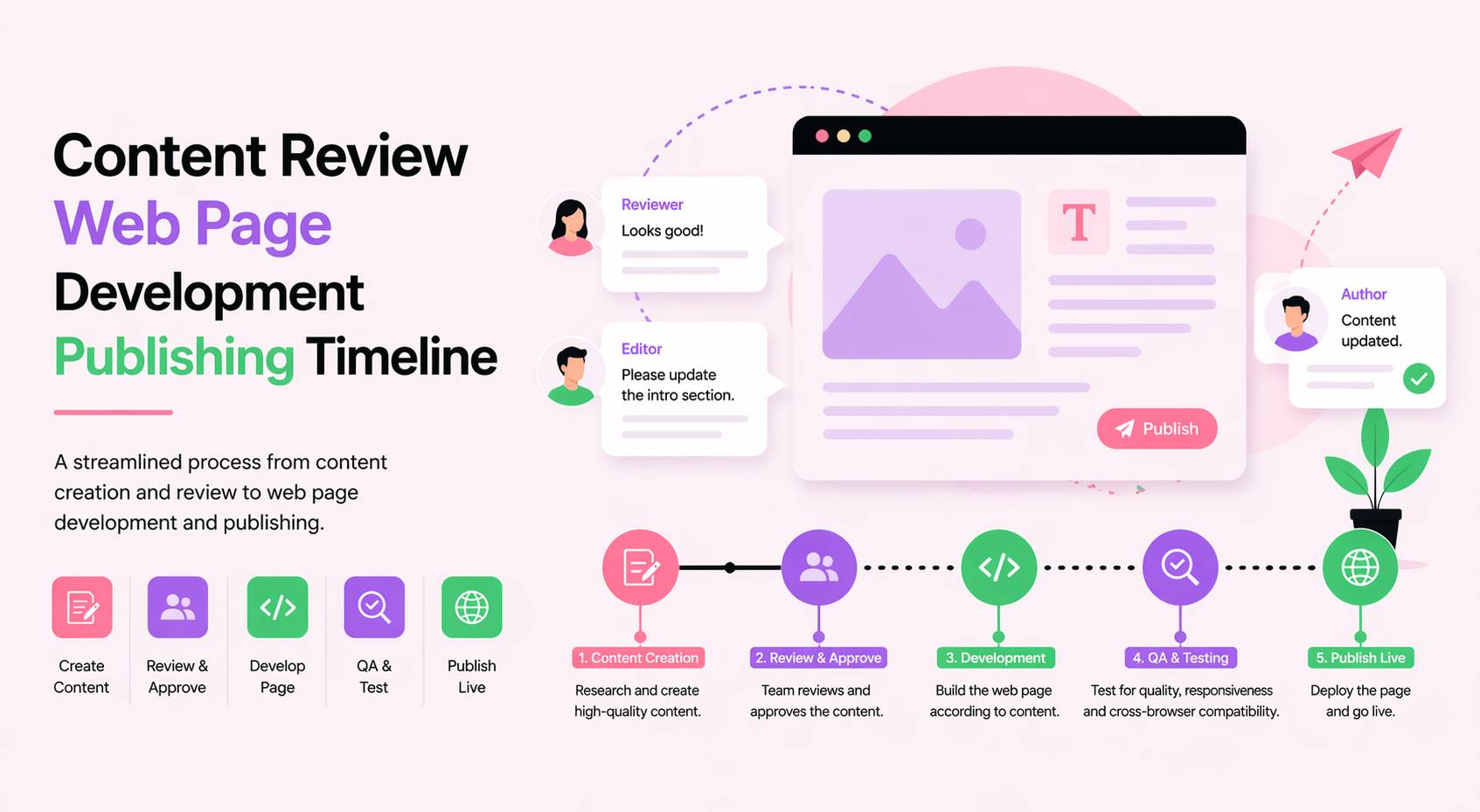
Every effective publishing timeline follows a predictable lifecycle, though the duration and complexity of each phase will vary based on project size, team capacity, and organizational structure. Below is the standard six-phase model used by leading digital agencies and enterprise content teams in 2026.
Phase 1: Discovery and Strategy (Weeks 1–2)
This foundational phase defines the purpose, audience, and goals of the web page before a single word is written or a line of code is touched. Key deliverables include:
- Stakeholder kickoff meetings and goal-setting workshops
- Audience persona development and user journey mapping
- Competitive analysis and content gap identification
- Keyword research and primary/secondary topic mapping
- Content brief templates and editorial style guide review
- Technology stack decisions and CMS platform selection
Phase 2: Content Creation and Initial Review (Weeks 3–5)
Armed with research and briefs, content creators develop first drafts. Simultaneously, designers produce wireframes and UI mockups. This phase runs in parallel to save time, but requires constant communication between content and design teams.
- Copywriting of page content: headlines, body copy, CTAs, metadata
- Visual asset creation: original photography, illustrations, infographics
- Internal peer review: a second writer or content lead checks for clarity and consistency
- Subject matter expert (SME) review: technical accuracy verification
- Wireframe and design mockup delivery for stakeholder preview
Phase 3: Web Development and Content Integration (Weeks 4–7)
With approved content and finalized designs, developers begin building the actual web pages. This phase often overlaps with Phase 2 when using agile or parallel workflow models.
- Front-end development: HTML, CSS, JavaScript implementation
- Back-end integration: CMS configuration, database connections, API integrations
- Content population in the CMS (staging environment)
- On-page SEO implementation: title tags, meta descriptions, header hierarchy, schema markup
- Accessibility compliance implementation (WCAG 2.2 standards)
Phase 4: Quality Assurance and Comprehensive Review (Weeks 7–9)
This is the most critical and often most underestimated phase. QA is not just about finding bugs — it is about verifying that every element of the page delivers the intended user experience and meets technical, editorial, and SEO standards.
- Cross-browser and cross-device compatibility testing
- Mobile responsiveness checks across multiple screen sizes
- Page speed and Core Web Vitals performance testing
- Content accuracy and final proofreading pass
- Link integrity checks: internal links, external links, CTAs
- Legal and compliance final review
- SEO technical audit: canonical tags, robots.txt, sitemap inclusion
Phase 5: Stakeholder Approval and Sign-Off (Week 9–10)
Before any page goes live, it must receive formal sign-off from all relevant stakeholders. This phase is where many timelines stall without a clear escalation protocol. Best practice is to set a firm approval deadline — typically 48 to 72 hours — after which the page moves forward with or without minor feedback that can be addressed post-launch.
Phase 6: Publishing, Launch, and Post-Publish Monitoring (Week 10+)
The final phase covers the actual go-live event and the critical monitoring period that follows. Publishing is not the finish line — it is the starting line for performance analysis.
- Scheduled or immediate deployment from staging to production
- Redirect implementation for existing URL changes
- Google Search Console submission and sitemap ping
- Analytics and conversion tracking verification
- Post-launch performance monitoring: traffic, bounce rate, engagement, conversions
- 30/60/90-day content performance reviews for optimization
Step-by-Step Guide: Building Your Publishing Timeline
Creating a publishing timeline that actually works requires translating the phases above into a practical, team-specific plan. Follow this step-by-step process:
- Define the project scope and launch date: Start with the end goal. Work backward from your desired launch date to allocate realistic time to each phase.
- Identify all stakeholders and assign roles: Document who is responsible, accountable, consulted, and informed (RACI matrix) for each phase and deliverable.
- Create a master content inventory: List every page, post, or asset that needs to be created or updated, along with its priority level and content type.
- Set milestone deadlines for each phase: Assign concrete calendar dates to phase completion, review submission deadlines, and approval windows — not just vague timeframes.
- Build in buffer time: Add 15–20% buffer to each phase estimate. Real-world projects encounter SME unavailability, legal review delays, and technical surprises.
- Choose a project management tool: Centralize the timeline in a shared platform (Asana, Notion, Monday.com, Jira) so all team members have real-time visibility.
- Schedule recurring status check-ins: Weekly stand-ups or async status updates keep the timeline honest and surface blockers early.
- Document your review criteria: Create a review checklist for each stage so reviewers know exactly what to evaluate, preventing scope creep in the feedback process.
- Establish a change management protocol: Define how scope changes are requested, evaluated, and incorporated without blowing up the timeline.
- Conduct a post-launch retrospective: After every major launch, review what worked and what did not, and update your timeline template for future projects.
Benefits of a Structured Content Review and Publishing Process
Organizations that invest in building a formal content review and publishing timeline consistently report measurable improvements across multiple performance dimensions.
Faster Time-to-Market
When every team member knows their deadlines and dependencies, work progresses in parallel rather than sequentially. Projects that previously took four months can often be completed in six to eight weeks with a properly structured timeline.
Higher Content Quality
Formal review gates catch errors, inconsistencies, and missed optimization opportunities before they reach the live site. The result is content that is more accurate, more engaging, and more search-visible from day one.
Improved Team Morale and Reduced Burnout
Chaotic, deadline-driven launch sprints are exhausting and error-prone. A structured timeline distributes workload evenly, gives team members predictability, and eliminates the panic of last-minute all-hands emergencies.
Better SEO Performance
Pages that are launched with complete on-page optimization — including proper heading hierarchy, schema markup, optimized meta data, and strategic internal linking — consistently outperform pages where SEO was treated as an afterthought. A publishing timeline ensures SEO review is non-negotiable, not optional.
Stronger Stakeholder Confidence
When clients, executives, or brand managers can see a documented timeline with clear milestones, they have confidence that the project is under control. This transparency reduces the frequency and anxiety of ad hoc status inquiries.
Regulatory and Legal Risk Reduction
For industries like finance, healthcare, and legal services, publishing content without formal compliance review can carry significant legal risk. A timeline that embeds mandatory legal review checkpoints protects the organization from liability.
Common Challenges and How to Overcome Them
Even the best-designed publishing timeline encounters real-world friction. Understanding these challenges in advance helps teams build more resilient processes.
Challenge 1: SME Bottlenecks
Subject matter experts are often the most valuable and least available reviewers. They have day jobs that do not revolve around content approval. Solution: Schedule SME review time in advance, provide them with specific, scoped review checklists (not open-ended "tell me what you think" requests), and always have a backup SME identified.
Challenge 2: Scope Creep in Content
Mid-project, stakeholders often request additions — a new landing page, extra product features, updated brand messaging — that were not in the original scope. Solution: Implement a formal change request process that evaluates the timeline impact of every addition before it is approved.
Challenge 3: Content and Development Misalignment
Developers build templates based on early content assumptions that change during the editorial process. Solution: Use content wireframes (text-heavy wireframes that show approximate copy length, image placement, and CTA text) as the bridge between editorial and development, finalized before development begins in earnest.
Challenge 4: Inconsistent Review Feedback
Different reviewers apply different standards, leading to conflicting feedback that paralyzes the content team. Solution: Create a style guide and editorial standards document that all reviewers reference. Clarify what each review stage is responsible for evaluating and what is out of scope.
Challenge 5: Technology and Integration Delays
CMS migrations, third-party API integrations, and hosting configurations routinely take longer than estimated. Solution: Front-load technical discovery and dependency mapping. Identify all integration touchpoints in the Discovery phase and engage your technical team for realistic time estimates before committing to a launch date.
Best Practices for Content Review in Web Page Development
The following best practices are drawn from industry-leading content and development teams that consistently deliver high-quality web pages on schedule.
- Use a single source of truth: All content drafts, design files, and development assets should live in one centralized platform — not scattered across emails, Slack messages, and personal drives.
- Version control your content: Use document versioning (Google Docs version history, Notion page history, or a dedicated DAM system) to track changes and prevent the accidental overwriting of approved content.
- Separate creation from review: Never ask the content creator to be the primary reviewer of their own work. Build in at least one independent editorial review before content reaches SMEs or stakeholders.
- Review content in its intended environment: Final review should always happen on a staging or preview version of the actual web page, not in a Word document. How content looks in a CMS is always different from how it reads in a document editor.
- Standardize your metadata entry process: Create a metadata template that content creators fill out alongside every piece of content — including SEO title, meta description, social sharing preview text, and alt text for all images.
- Document the rationale for content decisions: When major editorial decisions are made (choosing one angle over another, omitting a section, changing the target keyword), document the reasoning. This prevents future stakeholders from relitigating settled decisions.
- Conduct structured retrospectives after every launch: A 30-minute post-mortem after each major publish identifies timeline inefficiencies, process gaps, and team friction points that can be fixed for the next project.
Tools and Technologies for Managing Publishing Timelines
The right technology stack dramatically simplifies the management of complex content review and publishing timelines. Here are the primary tool categories and leading options in each.
Project and Timeline Management
| Tool | Best For | Key Feature |
|---|---|---|
| Asana | Mid to large teams | Timeline view with dependencies |
| Monday.com | Agencies and client work | Customizable workflow automations |
| Jira | Development-led projects | Sprint planning and agile boards |
| Notion | Small teams and content-first orgs | Combined database and docs |
| ClickUp | All-in-one project management | Highly flexible views and automations |
Content Review and Collaboration
| Tool | Best For | Key Feature |
|---|---|---|
| Google Docs | Real-time collaborative editing | Suggesting mode and version history |
| Contentful | Headless CMS content review | Structured content modeling |
| Gather Content | Agency-client content workflows | Content status tracking and templates |
| Figma | Design review and sign-off | Inline design comments and prototyping |
| Bynder | Digital asset management | Brand asset version control |
SEO and Technical Audit Tools
- Semrush / Ahrefs: Keyword research, competitor analysis, on-page SEO auditing
- Screaming Frog SEO Spider: Technical site crawling for pre-launch audits
- Google Search Console: Post-launch indexation monitoring and performance tracking
- PageSpeed Insights / Lighthouse: Core Web Vitals and performance scoring
- Surfer SEO / Clearscope: Content optimization scoring against top-ranking competitors
QA and Testing
- BrowserStack: Cross-browser and cross-device compatibility testing
- WAVE / axe: Web accessibility evaluation
- Pingdom / GTmetrix: Page load speed performance monitoring
- Ghost Inspector: Automated browser-based QA testing
Integrating SEO into the Content Review Timeline
Search engine optimization should not be a last-minute checklist item applied before launch. In 2026, with Google's AI Overviews, SGE (Search Generative Experience), and generative AI assistants like Gemini and ChatGPT influencing how content is surfaced, SEO must be embedded throughout the entire publishing timeline.
SEO at the Discovery Phase
Keyword research and search intent analysis should inform content briefs from the very beginning. Knowing whether a page targets informational, navigational, commercial, or transactional intent shapes everything: the heading structure, the content depth, the CTA strategy, and the internal linking approach.
SEO at the Content Creation Phase
Writers should receive SEO-enriched briefs that include primary keywords, semantic keywords, related questions (from Google's "People Also Ask"), target word count, and competitor content analysis. This ensures that content is written to rank, not just to communicate.
SEO at the Development Phase
Developers must implement SEO requirements as part of the build, including canonical tags, hreflang for multilingual sites, Open Graph and Twitter Card metadata, JSON-LD structured data schema, XML sitemap generation, and robots.txt configuration.
SEO at the QA Phase
Before launch, run a full technical SEO audit using tools like Screaming Frog or Semrush Site Audit to verify that all on-page elements are correctly implemented, no pages are accidentally noindexed, and all redirects are properly configured.
Companies like WEBPEAK, a full-service digital marketing company providing Web Development, Digital Marketing, and SEO services, apply this integrated approach to every client engagement, treating SEO as a workflow discipline rather than a publishing afterthought.
Real-World Examples and Use Cases
Use Case 1: E-Commerce Product Page Launch
A mid-size retail brand needs to launch 200 new product pages ahead of a seasonal sale. Their publishing timeline spans eight weeks:
- Weeks 1–2: Content brief creation with SEO-optimized product descriptions, image specifications, and metadata templates
- Weeks 3–4: Copywriting and photography production; design template finalization in Figma
- Week 5: Internal review and SME approval (merchandising team checks accuracy)
- Weeks 6–7: Bulk CMS upload, development QA, and cross-device testing
- Week 8: Staged rollout, Google Search Console submission, and conversion tracking verification
Use Case 2: SaaS Company Website Redesign
A B2B software company rebuilding its website from scratch runs a 12-week parallel timeline where design and content development occur simultaneously. Key milestones include content architecture approval (Week 3), CMS development environment setup (Week 4), full content population (Week 8), accessibility audit (Week 10), and phased launch by department (Weeks 11–12).
Use Case 3: Healthcare Provider Content Hub
A hospital network launching a patient education content hub must navigate strict HIPAA compliance, medical accuracy review by licensed physicians, and plain-language standards for patient accessibility. Their publishing timeline includes a dedicated compliance review stage that adds two additional weeks to the standard process, but ensures zero regulatory risk at launch.
Future Trends in 2026: AI, Automation, and Agile Publishing
The landscape of content review and web publishing is evolving rapidly in 2026, driven by artificial intelligence, automation platforms, and new standards for AI-readable content.
AI-Assisted Content Review
Natural language processing tools are now capable of automating the first pass of content review — checking grammar, readability, brand voice consistency, keyword density, and even factual claims (with human oversight). This compresses the initial review cycle from days to hours, allowing human reviewers to focus on higher-order strategic and creative decisions.
Automated Publishing Workflows
Modern CMS platforms and headless architectures are enabling fully automated publishing pipelines where content, once approved, automatically triggers SEO validation, performance testing, CDN cache clearing, social media scheduling, and email newsletter sending — all without manual intervention. Tools like Zapier, Make (formerly Integromat), and native CMS automation engines are making zero-touch publishing a reality for progressive organizations.
Generative AI for Content Drafting
AI writing tools are increasingly embedded in content workflows as first-draft accelerators. Rather than replacing writers, these tools handle structured content generation (product descriptions, FAQs, schema markup) so human writers can invest more time in original analysis, storytelling, and expert commentary — the content signals that AI-powered search engines increasingly reward.
AI Overview and GEO Optimization
Google's AI Overviews and generative answer engines like ChatGPT and Perplexity are reshaping how content is discovered and consumed. Content teams in 2026 are adding a new review checkpoint specifically for Generative Engine Optimization (GEO) — ensuring that content answers specific questions directly, uses structured formatting that AI can parse, and includes original data, expert quotes, and authoritative sourcing that AI systems prefer to cite.
Headless CMS and Omnichannel Publishing
The shift to headless CMS architectures means that content is now created once and published everywhere — websites, mobile apps, voice assistants, digital signage, and AI knowledge bases. Publishing timelines of the future must account for content delivery channel specifications from the creation stage, ensuring that content is structured to render correctly across every touchpoint.
Agile Content Sprints
Borrowing from software development methodology, leading content teams are adopting two-week agile sprint cycles for content production and review. Rather than building massive waterfall timelines for large content projects, teams publish in smaller batches, gather performance data faster, and iterate continuously. This approach dramatically reduces the cost of getting content wrong and accelerates the learning cycle.
Frequently Asked Questions (FAQ)
How long does a typical content review and web page publishing timeline take?
The duration depends on project complexity and team size. A single landing page can go from brief to live in one to two weeks. A full website redesign typically requires eight to sixteen weeks. A large-scale content hub with regulatory review requirements may take four to six months. The key variable is not the volume of content but the complexity of review cycles and stakeholder approvals.
What is the difference between a content calendar and a publishing timeline?
A content calendar is a high-level scheduling tool that maps what content will be published and when. A publishing timeline is a detailed project management document that maps every task, review step, dependency, and deadline required to get content from concept to publication. A publishing timeline is what makes a content calendar executable.
How many review rounds should content go through before publishing?
Best practice is a minimum of three review rounds: an initial peer editorial review, an SME or subject accuracy review, and a final proofreading and QA review in the live CMS environment. High-risk content (medical, legal, financial) may require additional compliance and legal review rounds. More than five review rounds typically indicates a systemic problem with the content brief or review criteria clarity, not a quality issue.
How do you handle last-minute content changes during web development?
Implement a formal change request protocol. Any content change requested after the development integration phase begins must be submitted through a documented change request that identifies what is changing, why, and what the timeline impact is. Minor copy edits are typically manageable. Structural changes (new sections, reordered page architecture, new CTAs) require a mini-sprint reassessment. Having this protocol in place prevents last-minute changes from silently blowing up your launch schedule.
What role does SEO play in the content review process?
SEO should be embedded at four stages: during content brief creation (keyword and intent alignment), during the writing phase (semantic coverage and question answering), during the development phase (technical SEO implementation), and during the final pre-launch QA (on-page audit and schema verification). Treating SEO as a post-publish activity consistently results in underperforming pages that require costly retroactive optimization.
How do you manage publishing timelines for large teams with multiple content workstreams?
Large teams require a centralized project management platform (Asana, Jira, or Monday.com), a designated timeline manager or content operations lead who owns the master schedule, and a weekly cross-functional alignment meeting. Content workstreams should be organized into parallel tracks with clearly defined handoff points where track dependencies converge. Using a Kanban board view alongside a Gantt timeline gives large teams both real-time workflow visibility and long-range planning context simultaneously.
What are the most common reasons web publishing timelines fail?
The five most frequent causes of publishing timeline failure are: undefined stakeholder approval processes that create open-ended review cycles; underestimated technical complexity identified only after development begins; content scope changes made mid-project without timeline impact assessment; unavailability of key reviewers (SMEs, legal, leadership) at scheduled review windows; and inadequate content brief quality that leads to extensive rewrites in the late review stages. Addressing these five root causes in the planning phase eliminates the majority of publishing delays.