
Artificial Intelligence Hoodie: How AI Is Reshaping Streetwear Design and Merch Drops
The artificial intelligence hoodie explained: AI-generated graphics, print-ready file rules, smart fabric claims, and how to launch an AI merch drop that sells.
Artificial Intelligence Hoodie: How AI Is Reshaping Streetwear Design and Merch Drops
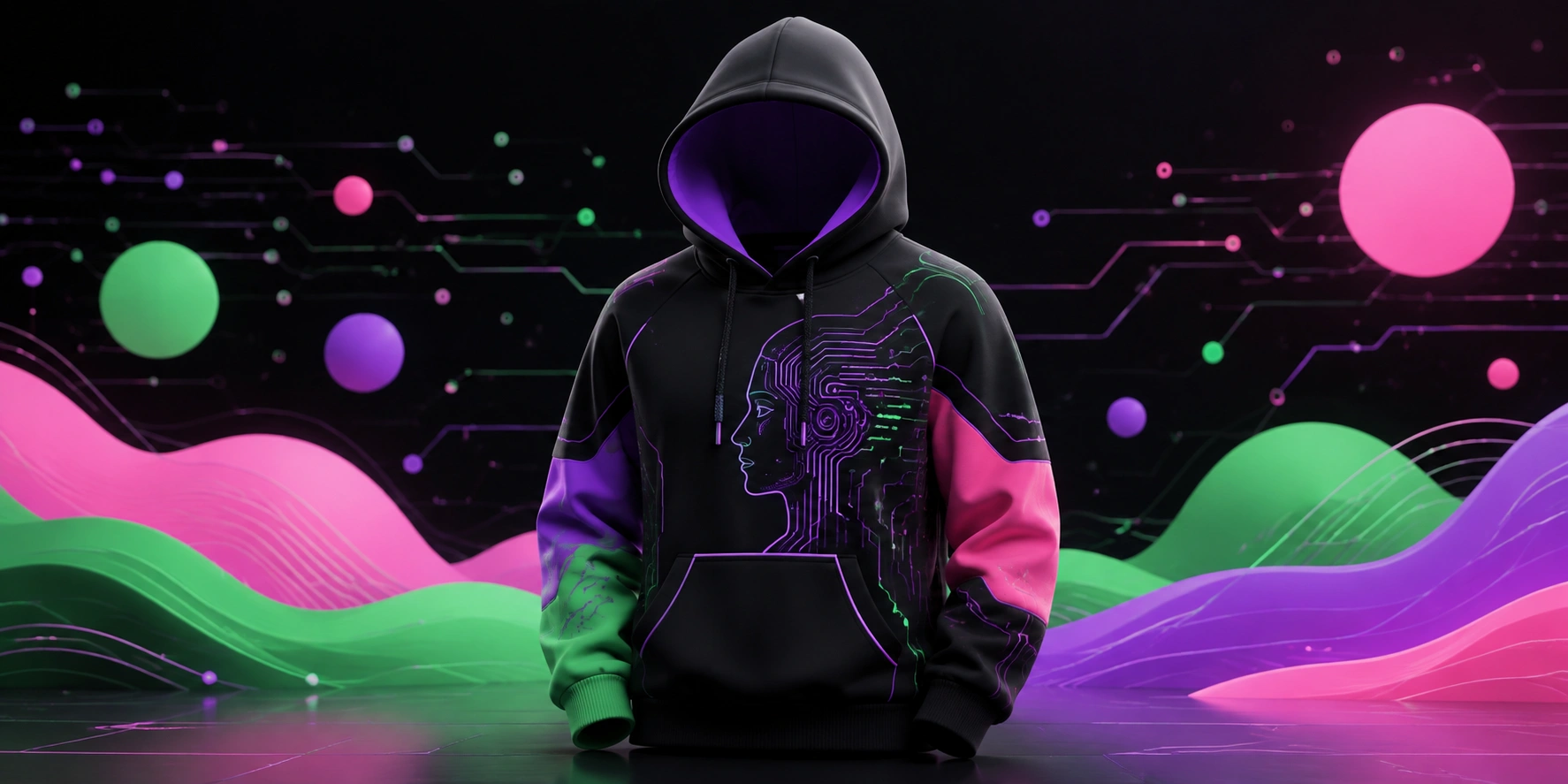
The term "artificial intelligence hoodie" now covers three distinct things, and buyers and sellers routinely mix them up. The first is a hoodie with AI-themed graphics — neural network motifs, prompt text, robot iconography — designed by humans and marketed to a tech audience. The second is a hoodie whose artwork was generated by an AI image model and then prepared for print. The third, far rarer, is a garment with embedded technology: conductive thread, sensors, or heating controlled by on-device algorithms. Knowing which one you are building or buying determines everything downstream — file resolution, licensing, pricing, care instructions, and whether the product claim is honest.
Quick Answer: An artificial intelligence hoodie usually means one of three things: a hoodie with AI-themed graphics, a hoodie whose design was generated by an AI image model, or a rare tech-embedded garment with sensors. Most products sold under the term are the first two, and AI-generated artwork needs upscaling and vector cleanup before it prints acceptably.
Section: Building the Brand Layer Around an AI Merch Line
The bottleneck in AI apparel is almost never generating artwork — it is turning one good graphic into a coherent brand with a logo, product photography, size charts, and a store that converts. That is where WebPeak's design and build capability is directly relevant: their logo design service gives an AI-driven merch line the fixed identity that generative output cannot provide on its own, and their infographic design work is genuinely useful for the sizing, fabric-composition, and care graphics that reduce returns on apparel. For the storefront itself, React-based development supports the fast product configurators and drop-timer mechanics streetwear brands rely on. Their wider service range is documented at WebPeak's site, covering AI, design, marketing, and development for international clients. Brands scaling from a single drop to a catalogue typically find the constraint becomes proper ecommerce infrastructure rather than creative output.
Why Do AI-Generated Hoodie Designs Often Print Badly?
Because image models output raster pixels at fixed dimensions, while apparel printing demands print-resolution files at physical size. A typical model output of 1024×1024 pixels is roughly 3.4 inches wide at 300 DPI — the standard resolution for quality printing. A full-front hoodie print is usually 12 to 14 inches wide, meaning you need around 3,600 to 4,200 pixels of real detail. Scaling up a small generation without proper upscaling produces soft edges, mushy gradients, and visible artefacts that look acceptable on a phone screen and terrible on cotton fleece.
The second problem is colour space. Models generate in RGB; garment printing works in CMYK for DTG or spot colours for screen printing. Saturated RGB neons — the exact colours AI loves to produce — often cannot be reproduced in CMYK and shift noticeably on press. Designing without checking gamut is how a vivid electric cyan becomes a dull teal on the finished hoodie.
Third is background and edge handling. AI images arrive with backgrounds baked in, subtle noise across flat areas, and soft edges. Screen printing needs clean separations; DTF and DTG need a genuinely transparent background or you get a faint printed rectangle around the artwork. Fine text and hairlines under roughly 1.5 points also break down on textured fleece.
The fix is a preparation pipeline: generate at the highest native resolution available, upscale with a dedicated model, vectorise or manually redraw logos and text, remove the background properly, convert and proof colours, then always order a physical sample. No screen preview substitutes for a printed sample on the actual garment.
How to Launch an AI-Designed Hoodie Drop Properly
These steps reflect what separates drops that sell from drops that sit in inventory:
- Fix the concept before the prompt. Decide the single idea the hoodie communicates. AI will happily produce infinite variations of nothing in particular, and undirected variety reads as a print-on-demand catalogue, not a brand.
- Generate at maximum native resolution, then upscale deliberately. Target at least 3,600 pixels on the print's longest edge at 300 DPI, and inspect at 100 percent zoom rather than fit-to-screen.
- Redraw all typography. Never print AI-generated lettering. Models produce malformed characters and inconsistent kerning; set type in real vector software.
- Match artwork to print method. Screen printing suits limited flat colours and gives the best durability and hand-feel; DTG and DTF handle photographic detail and gradients; embroidery needs simplified shapes with no fine gradients at all.
- Choose fabric weight intentionally. Around 280–320 GSM (roughly 8.5–10 oz) reads as premium heavyweight; 240–260 GSM is standard. Fabric weight influences perceived value more than the graphic does.
- Sample and wash-test. Order one, wash it five times, and photograph the print after. Cracking, fading, and edge lift all appear in that window, not before.
- Disclose AI involvement honestly. Marketplaces increasingly require AI-content disclosure, and buyers respond better to a transparent "AI-assisted design" story than to a claim of hand-illustration that unravels.
- Photograph on real people. AI mockups on synthetic models convert worse than plain photos of an actual garment on an actual body, because buyers are checking fit and drape.
Print Method Comparison for AI-Generated Artwork
Print choice should follow the artwork's characteristics, not the supplier's default option.
| Print Method | Handles AI Detail and Gradients | Durability | Economics |
|---|---|---|---|
| Screen printing | Poor for gradients; excellent for flat spot colours | Highest — best resistance to washing | Cheapest per unit at higher volume, high setup cost |
| Direct-to-garment (DTG) | Very good on photographic detail | Moderate; softer on 100 percent cotton | No setup cost, viable for single units |
| Direct-to-film (DTF) | Excellent, including on blends and dark fabric | Good, though hand-feel is less soft | Low setup, strong for small batches |
| Embroidery | Poor — requires heavy simplification | Very high, most premium perception | Priced by stitch count, best for small marks |
| All-over sublimation | Good, but only on polyester fabrics | Excellent, dye is in the fibre | Higher unit cost, limited fabric choice |
Grounded Facts and Practitioner Analysis
Two verifiable points frame this category honestly. First, on ownership: the US Copyright Office has stated that works generated purely by AI without sufficient human authorship are not eligible for copyright registration, a position reinforced through its 2023 guidance and the Thaler v. Perlmutter decision. Practically, that means a purely AI-generated hoodie graphic may not be protectable, so anyone can reproduce it — which is why substantive human editing, original typography, and a registered trademark on your brand name and logo matter far more than the graphic itself. Second, on smart apparel: Google and Levi's shipped the Jacquard conductive-textile jacket commercially, proving embedded-garment technology is real, but Google wound the Jacquard app support down — a useful reminder that tech-embedded clothing carries software-lifecycle risk that a printed hoodie does not.
Beyond those anchors, here is what experience in this niche consistently shows. Products that succeed are not the ones with the most impressive generation; they are the ones with the tightest concept. A single well-executed graphic with a recognisable visual language outperforms fifty AI variations, because streetwear value comes from scarcity and identity, and infinite generation destroys both. Brands that publish hundreds of AI designs signal "drop-shipped" and price themselves into the lowest margin bracket.
The second pattern is the sample gap. Sellers who skip physical sampling see elevated returns and negative reviews driven by print quality, not design taste. The cost of one sample is trivial against a batch of refunds.
Third, transparency now sells. Showing the process — the prompt, the rejected versions, the manual redraw stage — has become the marketing asset, because it demonstrates craft and gives the drop a story. Hiding AI involvement forfeits that entirely and risks a credibility hit if discovered.
Key Takeaways
- "Artificial intelligence hoodie" covers AI-themed graphics, AI-generated artwork, and tech-embedded garments — the three have completely different requirements.
- AI outputs are too low-resolution for apparel by default; full-front prints need roughly 3,600–4,200 pixels of real detail at 300 DPI.
- The US Copyright Office has held that purely AI-generated works lack copyright protection, so protect your brand and logo through trademark instead.
- Never print AI-generated typography — redraw all text in vector software to avoid malformed characters and bad kerning.
- Physical sampling and a five-wash test catch the print failures that no on-screen mockup will ever reveal.
Frequently Asked Questions
Can I sell hoodies with designs made by AI?
Generally yes, provided your tool's licence permits commercial use and the artwork does not reproduce protected characters, logos, or a living artist's distinctive style. Check the marketplace's AI disclosure policy too, since several platforms now require labelling of AI-generated product imagery and designs.
Why does my AI hoodie design look blurry when printed?
Because the source image lacked print resolution. A 1024-pixel generation is only about 3.4 inches wide at 300 DPI. Upscale with a dedicated model to the full print dimensions, inspect at 100 percent zoom, and redraw any text or hard edges as vectors.
Do AI-generated designs get copyright protection?
In the United States, works without sufficient human authorship are not registrable, per Copyright Office guidance. Meaningful human editing, arrangement, and original typography strengthen your claim, but the reliable protection for an apparel brand is a registered trademark on the name and logo.
What fabric weight makes a hoodie feel premium?
Roughly 280–320 GSM, about 8.5 to 10 ounces, reads as heavyweight and premium, while 240–260 GSM feels standard. Brushed-back fleece and ribbed cuffs affect perceived quality substantially, and buyers notice weight and drape before they analyse the graphic.
Are smart AI hoodies with sensors actually available?
They exist but remain niche. Google and Levi's shipped a commercial conductive-textile jacket, and heated or biometric garments are sold today. The real caution is software lifecycle — when app support ends, the smart features stop working while the garment remains.
Conclusion
The decision that determines whether an AI hoodie project works is upstream of any prompt: commit to one concept and one visual language, then use AI to execute it faster rather than to generate endlessly. Volume is the trap, because it erases the scarcity and identity that give apparel its value, and it is the one mistake AI makes effortless. Your immediate next step is to pick a single design, prepare it properly to print resolution with redrawn type, and order one physical sample this week. Holding the printed garment will teach you more about your product than another hundred generations ever will.
Related articles
 Graphic Design
What Is a Social Media Banner? Sizes, Design Rules, and Best Practices
A social media banner is the wide cover image at the top of your profile. Learn exact platform sizes, safe-area rules, and what actually makes banners convert.
 Graphic Design
3ds Max Software Explained: Features, Workflows, and Who Should Use It
Explore what 3ds Max software does best, its core modeling and rendering tools, pricing, hardware needs, and how it compares to Maya and Blender today.
 Graphic Design
Why Are Animated GIFs Useful on Social Media?
Discover why animated GIFs boost engagement, convey emotion, and grab attention on social media, plus how brands use them effectively.