3ds Max Software Explained: Features, Workflows, and Who Should Use It
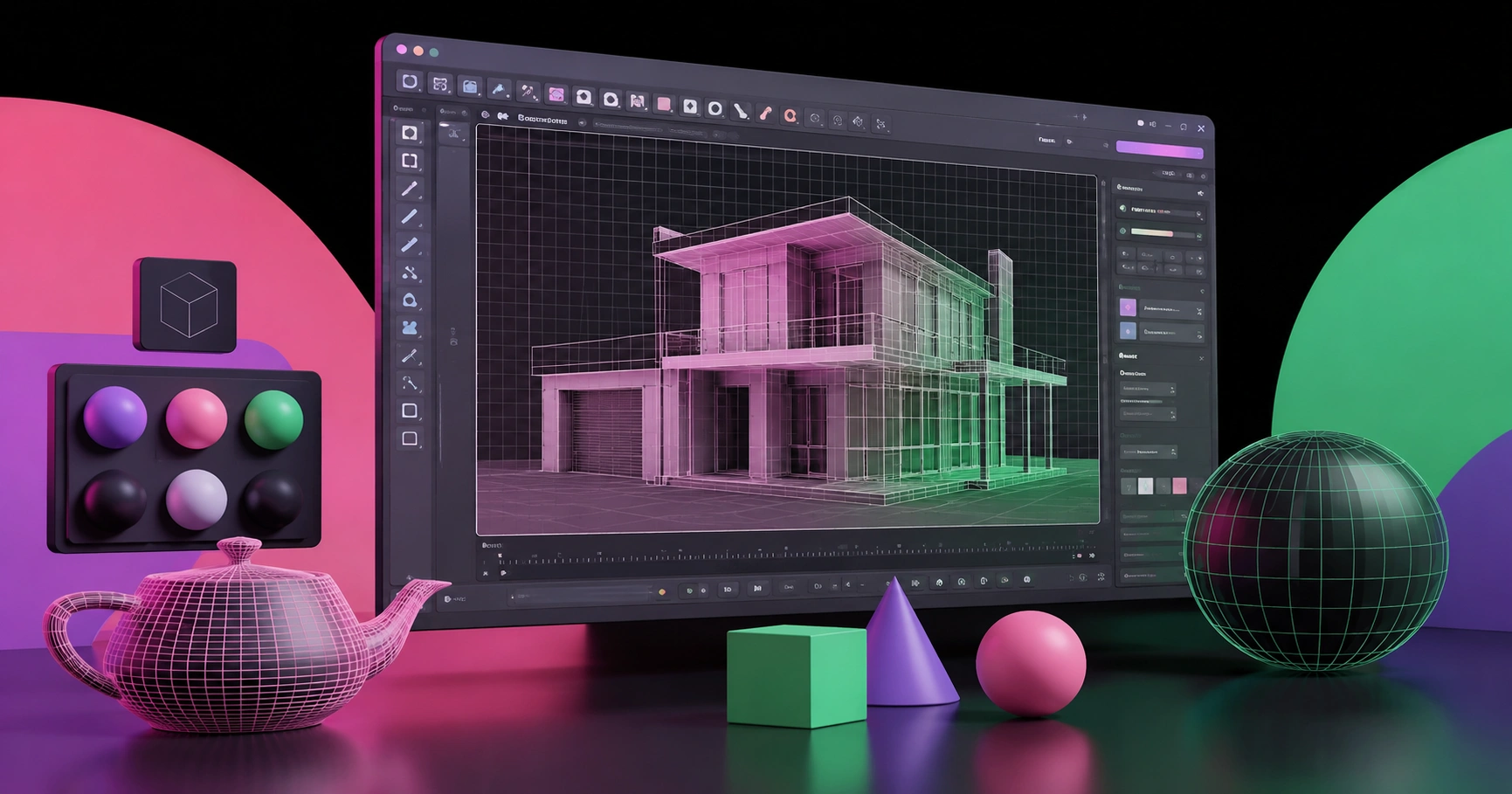
3ds Max software is Autodesk's Windows-only 3D modeling, animation, and rendering application, used most heavily in architectural visualisation, product design, game asset creation, and broadcast graphics. Its defining characteristic is the modifier stack — a non-destructive, reorderable list of operations applied to geometry — which lets an artist change a base shape late in a project without rebuilding downstream work. That single architectural decision explains why studios producing hundreds of interior renders per month still choose 3ds Max over newer tools: revisions are survivable. The confusion most buyers face is not whether 3ds Max is capable, but whether it is the right tool for their specific pipeline compared to Maya, Blender, or Cinema 4D.
Quick Answer: 3ds Max is a professional 3D modeling, animation, and rendering software from Autodesk, available only on Windows. It is strongest for architectural visualisation, interior design, product rendering, and game asset modeling, thanks to its modifier stack, polygon modeling tools, Arnold renderer, and deep V-Ray and Corona integration.
How WebPeak Helps Turn 3D Renders Into Marketing Assets That Convert
Producing a beautiful render is only half the job — most 3ds Max output eventually lands on a website, a product page, or a social feed, where compression, layout, and load speed decide whether anyone actually sees it. WebPeak works on that downstream half. Their graphic design services handle the composition, colour grading, and brand consistency that make a batch of raw renders feel like a single campaign, while their video production and editing services cover turntables, walkthrough animations, and camera-move sequences exported from 3ds Max into formats that stream cleanly. For studios producing high volumes of visuals, their AI image and graphic generation work is useful for rapid concept boards and background plates before committing GPU hours to a final render — a practical way to cut iteration cost without lowering final output quality.
What Is 3ds Max Actually Used For in Professional Studios?
3ds Max dominates in disciplines where geometry must be precise, revisions are constant, and photorealism is the deliverable. Architectural visualisation is its largest market: floor plans and CAD drawings import cleanly, spline-based modeling handles mouldings and curved facades, and the software's tolerance for enormous scene polygon counts suits fully furnished interiors. Product visualisation is the second stronghold, where hard-surface modeling and accurate material response matter more than character animation. In games, 3ds Max is widely used for environment and prop modeling, UV layout, and baking — the process of transferring detail from a high-resolution mesh onto a low-resolution one via texture maps so real-time engines can render it cheaply. Broadcast and motion graphics teams use it for particle work and mechanical animation. Where 3ds Max is intentionally weaker is character animation and rigging at feature-film scale, which is why studios producing character-driven work usually pair it with Maya rather than replace Maya with it. Knowing that division saves teams from expensive tool mistakes.
Which 3ds Max Features Deliver the Biggest Workflow Gains?
Most productivity in 3ds Max comes from a small set of features that experienced artists use constantly. If you are learning the software or auditing an existing pipeline, prioritise these in order:
- The modifier stack — apply Bend, Shell, TurboSmooth, or Symmetry non-destructively, then reorder or delete them later. This is the core reason revisions stay cheap.
- Editable Poly and Smart Extrude — polygon-level control with Smart Extrude automatically stitching and cleaning geometry when you push faces through a mesh.
- Chamfer and hard-surface tools — controllable edge weighting and bevels, essential for realistic product edges that catch light correctly.
- Spline and lathe modeling — the fastest route to profiles, cornices, railings, and rotationally symmetric objects in architectural work.
- Arnold renderer (bundled) — physically based CPU and GPU rendering included with the subscription, plus native support for third-party engines like V-Ray, Corona, and Redshift.
- Data Channel modifier — procedural, rule-based mesh manipulation that automates repetitive detailing across many objects at once.
- Python 3 and MAXScript — scripting for batch renders, scene cleanup, asset naming standards, and studio-specific tools.
- Retopology tools — automatic regeneration of clean quad meshes from dense scans or sculpts, reducing manual cleanup significantly.
How Does 3ds Max Compare to Maya, Blender, and Cinema 4D?
The correct comparison is by discipline, not by feature count. 3ds Max wins on architectural and product visualisation and on revision-heavy modeling. Maya wins on character rigging, animation layers, and film pipelines. Blender wins on cost and on all-in-one flexibility including sculpting, video editing, and grease pencil, with the tradeoff of fewer established enterprise plugins in archviz. Cinema 4D wins on motion graphics speed and Adobe After Effects integration. A second consideration is platform: 3ds Max runs only on Windows, so macOS studios are effectively excluded unless they virtualise or use a cloud workstation. Pricing also differs in kind — Autodesk sells 3ds Max as a single-user subscription billed monthly, annually, or across three years (check Autodesk's current pricing page for your region, as rates change), while Blender is free under the GPL.
| Software | Strongest Use Case | Cost Model |
|---|---|---|
| 3ds Max | Architectural visualisation, interiors, product renders, game environments | Paid subscription, Windows only |
| Maya | Character rigging, animation, film and episodic pipelines | Paid subscription, Windows, macOS, Linux |
| Blender | Generalist work, sculpting, indie projects, tight budgets | Free and open source, all major platforms |
| Cinema 4D | Motion graphics, broadcast design, After Effects workflows | Paid subscription, Windows and macOS |
What Hardware Do You Need, and Is 3ds Max Still Worth Learning?
Hardware planning is where render budgets are won or lost. Autodesk's published system requirements for recent 3ds Max releases call for 64-bit Windows 10 or 11, a minimum of 4 GB RAM with 16 GB or more recommended, and a GPU supporting DirectX 12 — but real production scenes routinely need 32 to 64 GB of RAM, and GPU-based renderers such as Arnold GPU or Redshift benefit heavily from large VRAM pools. On market context, Grand View Research valued the global 3D animation market at several billion US dollars in the mid-2020s and projects a double-digit compound annual growth rate through the early 2030s, driven by gaming, real estate marketing, and e-commerce product visualisation — the exact segments where 3ds Max is entrenched. Autodesk's own materials position 3ds Max as a mainstay of design visualisation, and the density of V-Ray and Corona tutorials, HDRI libraries, and asset packs built specifically for it remains a real competitive advantage. My assessment after watching studio tool migrations is that the deciding factor is rarely the software's feature list — it is the plugin and asset ecosystem. Teams that move away from 3ds Max for cost reasons often discover their real expense was rebuilding libraries, scripts, and render presets, not the licence. Learn it if archviz, interiors, or product rendering is your target market; choose Blender or Maya if character animation or budget dominates your decision.
Key Takeaways
- 3ds Max is a Windows-only Autodesk application for 3D modeling, animation, and rendering, strongest in architectural visualisation, interiors, product design, and game environment work.
- The modifier stack is its central advantage: operations remain non-destructive and reorderable, so late client revisions do not force geometry rebuilds.
- Arnold is bundled with the subscription, but most archviz studios pair 3ds Max with V-Ray or Corona for interior lighting workflows.
- Autodesk recommends 16 GB RAM as a baseline, while production interior scenes commonly require 32 to 64 GB plus a high-VRAM GPU for GPU rendering.
- Grand View Research projects double-digit annual growth in the 3D animation market through the early 2030s, driven by gaming, real estate, and e-commerce visualisation demand.
Frequently Asked Questions
Is 3ds Max free to use for students or beginners?
Autodesk offers free educational access to 3ds Max for verified students and educators, plus a time-limited free trial for everyone else. Educational licences are strictly non-commercial. If you need free software for paid client work, Blender is the practical alternative with no licensing restrictions.
Can I run 3ds Max on a Mac?
Not natively. 3ds Max supports only 64-bit Windows 10 and 11. Mac users typically run it through Boot Camp on Intel machines, a Windows virtual machine, Parallels, or a cloud workstation. Each option adds performance overhead and cost, so plan for a Windows workstation instead.
Which is better for architectural visualisation, 3ds Max or Blender?
3ds Max remains the industry default for architectural visualisation because of CAD import reliability, spline modeling, and mature V-Ray and Corona integration plus large asset libraries. Blender is fully capable and free, and increasingly used by smaller studios, but has a thinner professional archviz plugin ecosystem.
How long does it take to learn 3ds Max properly?
Expect two to three months to become comfortable with modeling, materials, lighting, and rendering basics, and roughly a year of consistent project work to reach professional archviz quality. The rendering and lighting side usually takes longer to master than the modeling tools themselves.
Does 3ds Max include a renderer, or do I need to buy one?
3ds Max includes Arnold, a production-grade physically based renderer, at no extra cost with the subscription. Many studios additionally license V-Ray, Corona, or Redshift for specific interior lighting workflows, faster iteration, or compatibility with existing scene files and material libraries.
Conclusion
The decision that matters most is not 3ds Max versus its competitors in the abstract — it is whether your target market's asset libraries, plugins, and client file formats live inside the 3ds Max ecosystem. If you are building a business around interiors, architecture, or product rendering, that ecosystem alone justifies the licence and the Windows workstation. If your work is character-led or budget-constrained, invest that money elsewhere. Start by rendering one complete interior scene end to end, including material setup and post-production, before buying any plugin; that single project will teach you more about whether the tool fits your workflow than any feature comparison, including this one.