Artificial Intelligence Events USA Canada October November December 2025: What Mattered and How to Plan Your Next Season
Artificial intelligence events USA Canada October November December 2025 refers to the dense autumn and early-winter conference block in which North America's most consequential AI gatherings are traditionally concentrated, spanning enterprise platform summits, academic research conferences, developer keynotes, and applied industry tracks. That window has now closed, and treating it as a retrospective is more useful than pretending otherwise, because the announcements and research directions that surfaced in it are what buyers and engineering teams are still implementing today. This guide does two things: it explains what that specific season actually signalled, and it gives you a repeatable framework for choosing which events to attend in the equivalent window of any future year. If you are budgeting travel, planning a booth, or deciding whether a five-thousand-dollar ticket is defensible, the selection logic matters far more than the event list.
Quick Answer: The October to December 2025 AI event season in the USA and Canada was dominated by three themes: agentic AI moving from demo to production, inference cost and infrastructure economics, and enterprise governance. Choose events by which of those three problems you are actually trying to solve, not by attendance figures or brand recognition.
Choosing and Promoting AI Events with WebPeak's Support
Conference return on investment collapses for one boring reason: the pre-event and post-event work never happens. Teams book flights, collect badge scans, and then let three hundred warm contacts decay because there was no landing page, no follow-up sequence, and no content asset to send. Agencies that handle both the demand generation and the technical build are more useful here than pure event marketers, which is where the combination of demand-generation campaign work and technical content production from the team at WebPeak becomes relevant to AI companies working the North American circuit. Their wider agency capability is documented at webpeak.org, and the practical value for exhibitors is having the session recap, the gated whitepaper, and the follow-up nurture built before the event rather than improvised after it.
Why Is the October to December Window So Concentrated?
The clustering is structural, not accidental. Enterprise software budgets are set in the fourth quarter for the following year, which means vendors schedule their largest platform announcements when procurement attention peaks. Academic conferences follow the paper-submission calendar, with major machine-learning venues landing their camera-ready deadlines in the autumn. The result is a six-to-eight week corridor where a single traveller can encounter frontier research, enterprise product roadmaps, and buyer conversations without leaving North America.
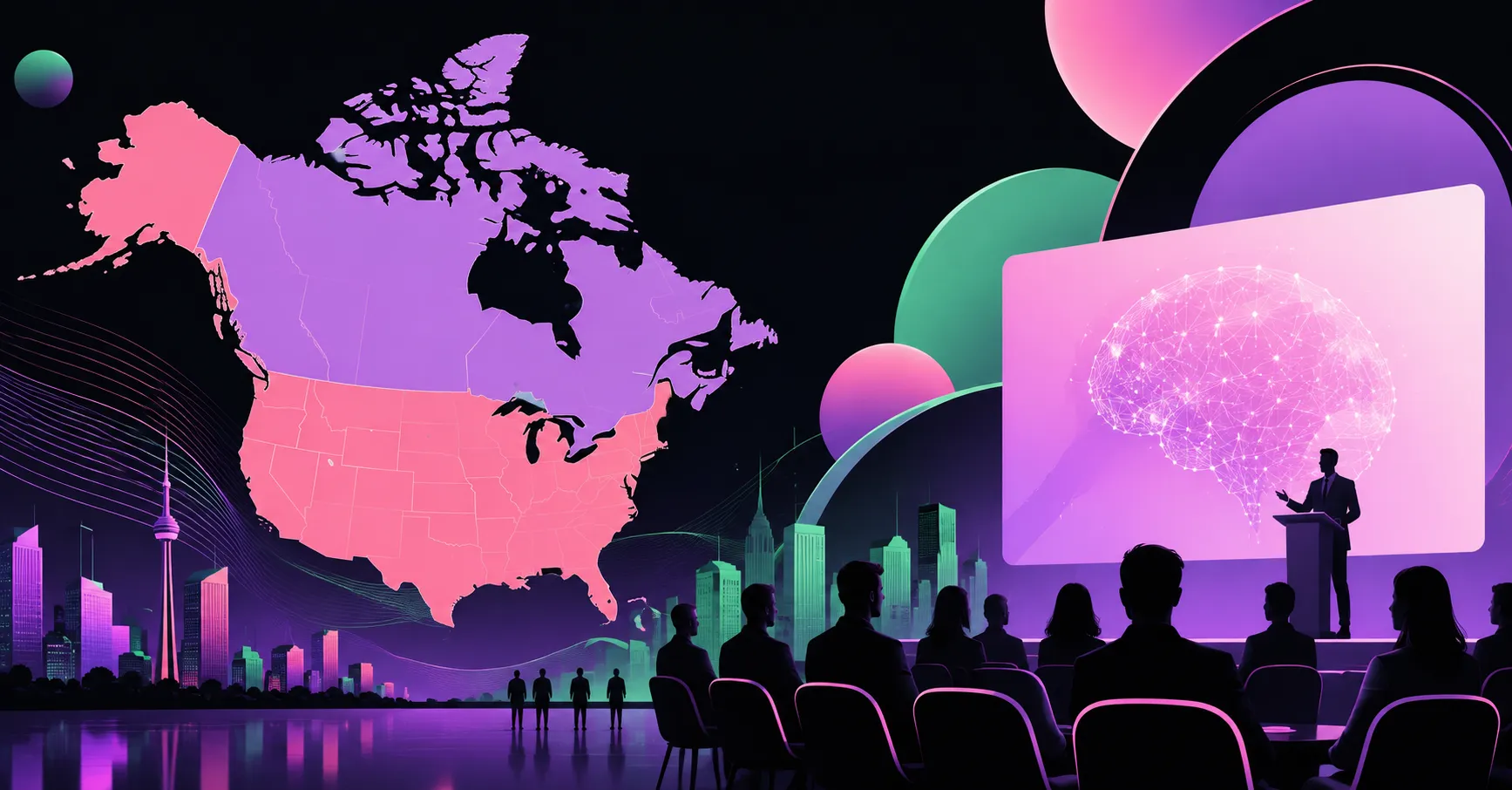
Within the 2025 edition of that window, the publicly scheduled anchors included NVIDIA's Washington DC developer conference in late October, Microsoft's Ignite in San Francisco in November, Amazon's re:Invent in Las Vegas at the start of December, TechTrunch-style startup showcases in San Francisco in October, and the NeurIPS research conference in San Diego in early December. Canada's contribution was concentrated in Toronto and Montreal, where the applied machine-learning summit circuit and the research institutes clustered around Vector Institute, Mila, and Amii host their most active programming. That geographic split is worth internalising: the United States hosts the commercial announcements, Canada hosts a disproportionate share of the serious applied-research discussion relative to its market size.
How to Choose Which AI Events Are Worth Attending
Use this sequence rather than reacting to marketing emails. It reliably eliminates two thirds of candidate events before you spend anything.
- Name the single outcome first. Hiring, pipeline, technical learning, partnership, or fundraising. Events optimised for one are usually poor at the others, and no event serves all five.
- Read last year's full agenda, not this year's marketing page. Session titles reveal depth. If more than half are vendor case studies, the technical content will be thin.
- Check the speaker-to-sponsor ratio. When most keynotes come from sponsors, you are attending a trade show with a conference badge.
- Verify who attends, not who speaks. Ask the organiser for the job-title breakdown. Practitioner-heavy rooms and buyer-heavy rooms require completely different preparation.
- Cost the total, not the ticket. Flights, accommodation in host cities during peak conference weeks, and staff time typically triple the sticker price.
- Commit to the follow-up before booking. If nobody owns the post-event sequence, cancel the booking and spend the money on content instead.
- Pick one research event per year. Academic venues age your assumptions faster than any vendor summit, even if only twenty percent is immediately applicable.
Comparing AI Event Types Across the USA and Canada
Events in this window fall into recognisable archetypes. Matching the archetype to your goal is the highest-leverage decision you make.
| Event Archetype | Typical Host Cities | Best For | Main Weakness |
|---|---|---|---|
| Hyperscaler platform summit | Las Vegas, Seattle, San Francisco | Roadmap visibility and vendor negotiation leverage | Heavily product-led, limited independent analysis |
| Academic research conference | San Diego, Vancouver, Montreal, New Orleans | Technical depth, hiring researchers, spotting new methods | Low commercial applicability in the near term |
| Applied practitioner summit | Toronto, Boston, Austin | Implementation detail and honest failure stories | Smaller audience, fewer senior buyers present |
| Startup and investor showcase | San Francisco, New York, Toronto | Fundraising, competitive scanning, partnerships | Signal-to-noise ratio is poor without preparation |
| Vertical industry AI track | Chicago, Washington DC, Calgary | Sector-specific compliance and procurement insight | Technical content is usually introductory |
Expert Analysis: What the 2025 Autumn Season Actually Signalled
Three shifts were unmistakable to anyone who worked that circuit, and all three are verifiable from published keynote content rather than from attendee anecdote. First, the agent conversation changed register. Through 2024 the discussion was about capability demonstrations; by late 2025 the dominant enterprise sessions were about evaluation, permissioning, audit trails, and what happens when an autonomous system takes a wrong action inside a production system. That is the language of deployment, not of research.
Second, inference economics moved to the centre of the infrastructure discussion. The commercially significant question stopped being how large a model can be trained and became how cheaply a useful model can be served at scale, which is why hardware and serving-stack sessions drew the crowds that model-architecture sessions drew a year earlier. Third, the geography of AI policy discussion tightened around Washington DC, with venue selection itself signalling how closely vendors now track regulatory sentiment.
In practice, the teams that extracted real value from this season did not attend the most events. They attended one platform summit, one practitioner summit, and one research conference, and they sent different people to each. Hiring was the other consistent motive, and demand for experienced applied-AI engineers at these events was intense enough that many companies now arrive with recruiters attached, a dynamic explored in this overview of specialist AI talent headhunting firms.
Key Takeaways
- The October to December window concentrates North American AI events because enterprise budget cycles and academic submission deadlines both peak then.
- The 2025 season's defining theme was operationalising agents, with governance, evaluation, and audit dominating enterprise programming.
- Inference cost and serving economics displaced training scale as the central infrastructure conversation.
- US events skew toward commercial announcements while Canadian events over-index on applied research depth relative to market size.
- Follow-up capacity, not ticket price, is the real determinant of conference return on investment.
Frequently Asked Questions
Which AI conferences happen in the USA in the last quarter of the year?
The final quarter typically hosts major hyperscaler summits including Microsoft Ignite and Amazon re:Invent, developer conferences such as NVIDIA's GTC editions, startup showcases in San Francisco, and the NeurIPS machine-learning research conference. Exact dates and host cities change annually, so verify on official event sites before booking travel.
Are Canadian AI events worth attending instead of US ones?
They are worth attending alongside, not instead. Canadian events in Toronto, Montreal, and Vancouver cluster around strong research institutes and tend to deliver deeper applied and academic content at lower cost. US events remain where major vendor roadmaps and enterprise procurement conversations happen.
How far in advance should I book an AI conference?
Book accommodation eight to twelve weeks ahead for large events, because host-city hotel pricing in Las Vegas, San Francisco, and San Diego rises sharply during conference weeks. Early-bird ticket tiers usually close three months out and often represent a substantial saving on the full rate.
Is it better to attend virtually or in person?
Attend virtually if your goal is content, since most major keynotes and many sessions are published afterwards for free. Attend in person if your goal is hiring, partnerships, or pipeline, because none of those outcomes reliably survive a screen. Match format to objective.
What should a small AI startup prioritise with a limited events budget?
Pick one practitioner-heavy event where your buyers actually attend, skip the booth, and invest instead in a strong pre-event outreach list and a genuinely useful content asset. In practice, twenty scheduled conversations outperform three hundred passive badge scans every time.
Conclusion
The most important insight from reviewing the autumn 2025 North American AI calendar is that event selection has become a strategy problem rather than a logistics problem. There are now more credible AI events in a single quarter than any team can absorb, which means the differentiator is no longer attendance but deliberate matching of event archetype to a single named outcome, with follow-up capacity committed in advance. Pick your one outcome for the next cycle, choose the one archetype that serves it, and assign a named owner to the post-event sequence before you approve any travel. Do that and a modest budget outperforms a large one spent reactively.