Why AI Doesn't Understand Film Language (And What Filmmakers Should Do About It)
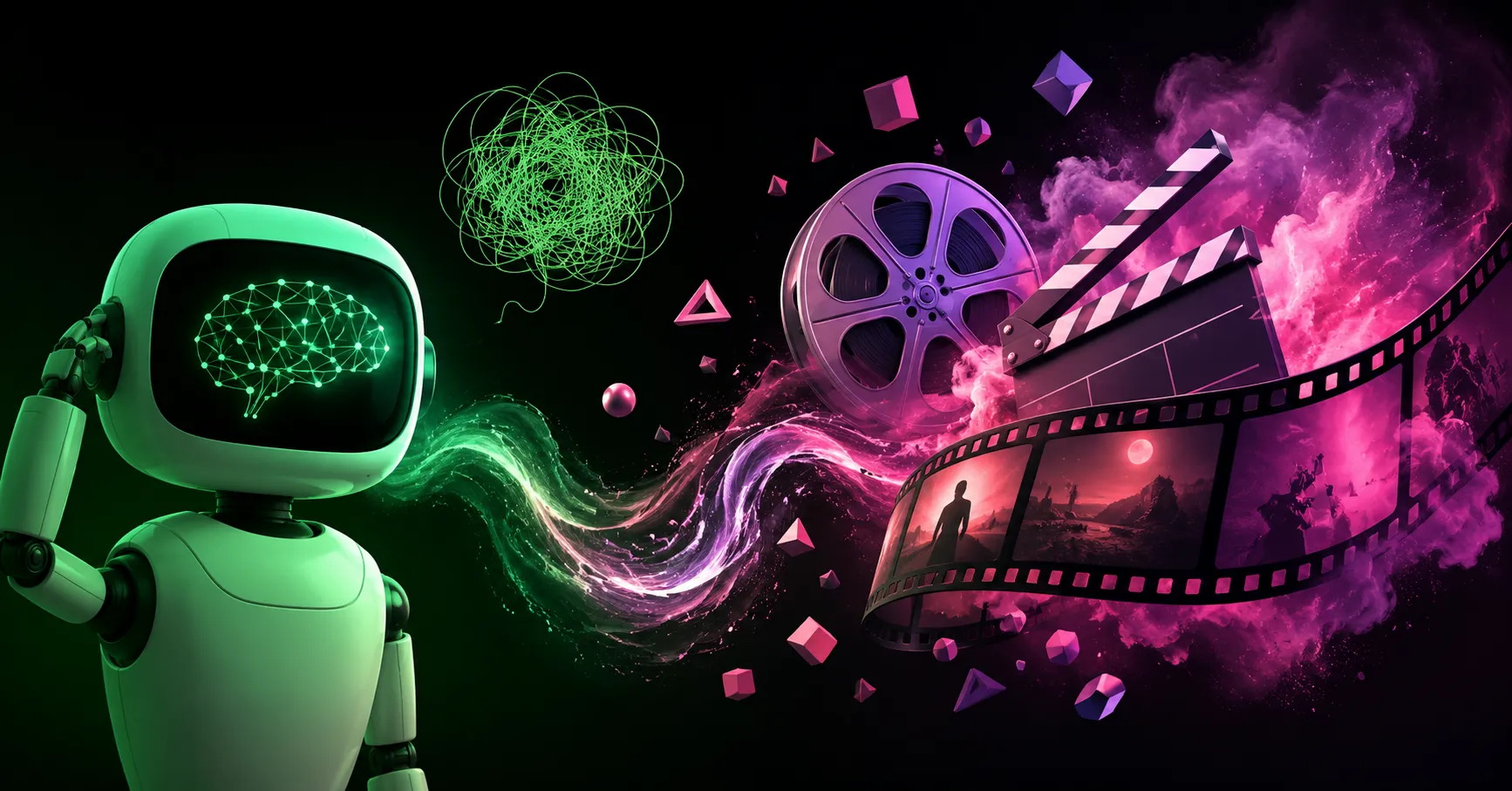
Film language is the shared grammar cinema uses to create meaning: shot size, lens choice, camera movement, blocking, lighting, editing rhythm, and sound design working together so an audience feels something specific at a specific moment. It is the reason a slow push-in on a face reads as dawning realization, while a whip pan to the same face reads as panic. Generative video models have become remarkably good at producing individual frames that look photographic. What they have not learned is why those frames are ordered the way they are. When people say AI doesn't understand film language, they are pointing at a precise gap: the models optimize for plausible pixels, not for intent across time. That distinction matters enormously if you are a director, editor, or brand producing video, because it determines exactly which parts of your pipeline AI can carry and which parts it will quietly ruin.
Quick Answer: AI doesn't understand film language because models are trained to predict visually plausible frames, not to encode directorial intent. They can imitate the look of a dolly shot or a match cut, but they have no model of story causality, eyeline logic, or emotional escalation, so meaning collapses across shots.
How WebPeak Approaches AI Video Without Losing Cinematic Intent
Teams that get usable results from generative video almost always have someone translating creative intent into machine-legible instructions, then rebuilding the edit by hand. That hybrid workflow — human-authored shot list, AI-generated plates, human assembly and sound — is where agencies with both production and AI capability earn their keep. WebPeak works in exactly that overlap, pairing video production craft with applied model tooling so a generated sequence still obeys continuity, screen direction, and pacing rules. Their teams also handle the unglamorous parts that determine whether AI footage is usable at all: shot-by-shot prompt documentation, reference frame libraries, and versioned asset naming. For brands building repeatable video systems rather than one-off experiments, that structure is worth more than any single model choice. You can review their broader capability set at webpeak.org, including AI services for teams integrating generative tools into existing post-production stacks.
What Is Film Language, and Why Is It So Hard for a Model to Learn?
Film language operates on relationships between shots, not on the content of any one shot. The 180-degree rule, for example, is not a visual style — it is a spatial contract that keeps two characters on consistent sides of the frame so the audience never loses orientation during a conversation. Eyeline match, screen direction, and the Kuleshov effect all work the same way: meaning is produced by the join, not the image.
Diffusion and transformer video models are trained on clips paired with text. That training teaches strong correlations — "low angle" tends to produce upward-tilted framing, "golden hour" produces warm rim light — but it does not teach why a director chose a low angle on beat 14 of a scene. There is no persistent world model tracking who is standing where, who knows what, or which emotional beat has already been spent. Continuity is a byproduct of statistics rather than a rule the system is trying to obey.
The second problem is temporal scope. Most publicly available generation tools work in short clips, typically a handful of seconds. Film grammar unfolds over minutes: a setup planted in scene two pays off in scene nine. A model generating five seconds at a time has no representation of that arc, so it defaults to the most generic cinematic gesture available — a slow drift-in, a shallow depth of field, a drone-style reveal. That is why so much AI footage feels like a stock library trailer: it is the statistical average of cinema, and averages have no point of view.
Seven Places AI Reliably Breaks Film Grammar
These failure modes show up consistently across tools, and knowing them lets you plan around them instead of discovering them in the edit.
- Screen direction flips. A character moving frame-left in one generation moves frame-right in the next, breaking the geography of a chase or a walk-and-talk.
- Eyeline drift. In reverse shots, gaze angles rarely align, so two characters appear to be looking past each other rather than at each other.
- Unmotivated camera movement. Movement is applied as texture rather than in response to action, so the camera pushes in on nothing and the beat lands flat.
- Identity instability. Faces, wardrobe, and props mutate between clips, which destroys the continuity that makes a scene read as one place and time.
- No performance calibration. Models produce expression, not escalation. You cannot ask for "the same look, but three percent more doubt" and get a reliable delta.
- Physics and hands. Object permanence, weight, and articulated hand motion remain the clearest tells, especially in interaction with props.
- Sound divorce. Generated visuals arrive without designed sound, and since a large share of perceived emotion in cinema comes from audio, ungraded, unsounded AI footage always underperforms in test screenings.
The practical response is to treat generative output as second-unit plates, not as scenes. Storyboard first, generate to the board, then assemble, grade, and sound-design like you would any other footage.
Human Craft vs. Generative Models: Where Each Actually Wins
The honest comparison is task-by-task, not tool-versus-tool. The table below reflects how production teams are currently splitting work.
| Production Task | Generative AI Capability | Human Craft Advantage | Recommended Owner |
|---|---|---|---|
| Concept art and lookdev | Very strong; fast iteration on mood and palette | Taste, art direction, brand fit | AI drafts, human selects |
| Establishing and insert shots | Strong for non-continuity plates | Location specificity and scale accuracy | AI with human cleanup |
| Dialogue coverage | Weak; eyelines and identity break | Performance, timing, subtext | Human production |
| Editing and pacing | Limited; no model of story causality | Rhythm, escalation, withholding information | Human editor |
| Rotoscoping, cleanup, upscaling | Very strong; large time savings | Judgment on edge cases | AI-assisted human artist |
| Sound design and score | Emerging; useful for temp tracks | Emotional architecture of a scene | Human supervisor |
What the Verifiable Record Actually Shows
There is real, documented evidence here, and it is more nuanced than either the hype or the backlash suggests. On the assistive side, the VFX team behind Everything Everywhere All at Once publicly discussed using Runway's machine-learning tools for tasks like rotoscoping and background work during a famously small-budget post-production schedule. That is film language fully intact — humans made every creative decision, and AI removed manual labor from a technical task. Similarly, the 2024 film The Brutalist drew wide coverage when its editor confirmed the use of Respeecher voice technology to refine Hungarian-language dialogue, again as a targeted assist inside a human-directed performance.
On the generative side, the record is rougher. Coca-Cola's AI-generated holiday advertising in 2024 attracted substantial public criticism, with much of the commentary focused not on image quality but on the uncanny, intent-free feel of the motion and cutting — precisely the film-language gap. And in April 2025, the Academy of Motion Picture Arts and Sciences updated its rules to state that use of generative AI neither helps nor harms a film's chances, while emphasizing that human authorship remains central to awards consideration. That is an institutional acknowledgment that tools are neutral and authorship is not.
My own read, from watching teams adopt these tools, is that the winners are unglamorous. The studios and agencies getting durable value are using AI where the output is a technical deliverable with an objective pass/fail — a clean matte, a plate extension, a temp voice, an upscale. The teams burning budget are the ones asking a model to produce meaning. No published capability jump has changed that division yet, because the constraint is architectural rather than a matter of resolution or clip length.
Key Takeaways
- Film language is built from relationships between shots, and current models optimize individual frames, which is why continuity, eyelines, and pacing fail first.
- Short generation windows structurally prevent long-arc storytelling, pushing models toward generic cinematic gestures.
- AI is genuinely strong at technical post-production tasks with objective success criteria, as documented in productions like Everything Everywhere All at Once.
- The Academy's 2025 rule update confirms that AI use is permitted but human authorship remains the evaluative center of filmmaking.
- The most reliable workflow is human storyboard, AI plate generation, human assembly, grade, and sound design.
Frequently Asked Questions
Can AI actually direct a scene on its own yet?
No. Directing requires deciding what the audience should know and feel at each moment, then choosing coverage to deliver it. Models have no representation of audience knowledge or story causality, so they produce visually plausible shots without the intent that makes coverage cohere into a scene.
Why does AI video look cinematic but feel empty?
Because it reproduces the surface signals of cinema — shallow focus, warm backlight, slow movement — without motivation. In film language, movement and lens choice are responses to action. When those choices are decorative rather than causal, viewers register polish but no meaning.
Which parts of my video pipeline should I hand to AI first?
Start with tasks that have objective pass/fail criteria: rotoscoping, cleanup, upscaling, background extension, temp voice, and concept art. These deliver measurable time savings without touching creative decisions, so a failed output costs one iteration rather than a whole scene.
Will longer AI clip lengths solve the film language problem?
Partially. Longer windows will improve within-shot consistency and reduce identity drift, but understanding film language requires modeling narrative causality across an entire work. That is a different capability than temporal coherence, so expect steady gains in continuity before any real gain in authorship.
Do audiences actually notice broken continuity in AI footage?
Most viewers cannot name the rule being broken, but they reliably report the footage feeling wrong, disorienting, or emotionally flat. That is exactly how film grammar works — it operates below conscious attention, so violations register as feeling rather than as identified errors.
Conclusion
The single decision that matters is where you draw the line between technical work and authorship. Hand AI the tasks with objective outcomes, and keep every judgment about what the audience should feel — coverage, cut points, escalation, sound — with a human who can explain why each choice was made. Your practical next step is to audit one recent project and label every task as objective or interpretive; the objective column is your AI adoption roadmap, and the interpretive column is your craft moat. Teams that respect that boundary ship faster without shipping hollow work.