
Artificial Intelligence Dreams: How Machines Generate Dreamlike Worlds
Artificial intelligence dreams are not sleep, they are computation. Learn what AI dreaming really means, how dreamlike imagery is made, and where the limits are.
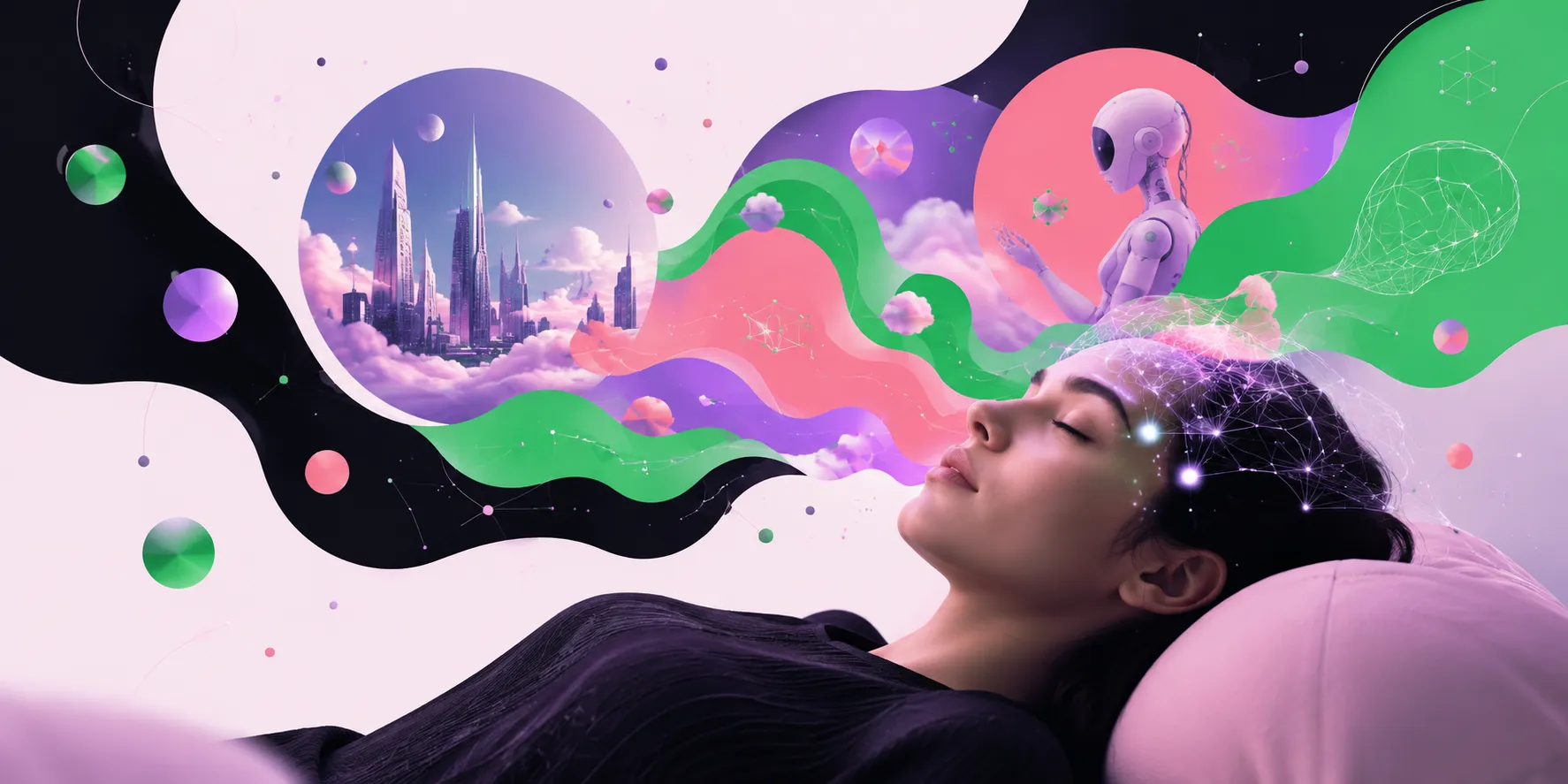
Artificial Intelligence Dreams: How Machines Generate Dreamlike Worlds
When people talk about artificial intelligence dreams, they are usually describing one of two very different things: the melting, kaleidoscopic imagery produced by feature-visualisation techniques such as Google's DeepDream, or the surreal outputs of modern generative image models. Neither is dreaming in the biological sense. AI dreaming is best defined as a computational process in which a neural network amplifies or samples its own learned internal patterns instead of faithfully reconstructing an input, producing imagery that resembles human dream logic because it prioritises pattern recognition over physical accuracy. Understanding that distinction is what separates people who produce genuinely striking AI visuals from people who produce noise.
Quick Answer: Artificial intelligence dreams are outputs created when a neural network amplifies its own learned features rather than copying reality. Google's DeepDream, released in 2015, popularised the effect. AI does not sleep or experience dreams; the resemblance comes from how networks exaggerate patterns they were trained to detect.
How WebPeak Turns Generative Dream Imagery Into Usable Brand Visuals
Dreamlike AI imagery is easy to generate and surprisingly hard to use. Raw generative output tends to be inconsistent in colour, resolution, and composition, which breaks the moment it has to sit inside a real design system or load quickly on a product page. The practical work involves establishing prompt and seed conventions so a visual style repeats reliably, upscaling and retouching outputs to print or web standards, and building front-end delivery that keeps heavy imagery fast. This is the kind of pipeline handled by the team at WebPeak, whose AI services cover model selection and generation workflows, while their infographic and visual design work and Next.js development handle the part most teams underestimate — making generative visuals consistent, accessible, and fast in production. Their full service range is documented at webpeak.org.
What AI Dreaming Actually Means: Three Distinct Phenomena
The phrase collapses three separate technical ideas, and conflating them causes most of the confusion in public discussion.
Feature visualisation. DeepDream, released publicly by Google in 2015 after work by engineer Alexander Mordvintsev, works through gradient ascent: instead of adjusting the network to better match an image, it adjusts the image to more strongly activate a chosen layer of the network. Ask a layer trained heavily on animal photographs what it sees in a cloud, and it will push the cloud toward eyes, snouts, and fur. The famous dog-slug aesthetic was not artistic intent — it was a direct readout of the training data's bias.
Generative sampling. Modern diffusion models work differently. They begin with random noise and iteratively denoise it toward an image that matches a text description, navigating a compressed mathematical space known as latent space — a representation where similar concepts sit near each other. Dreamlike outputs emerge when a prompt lands in a sparsely populated region of that space, forcing the model to blend concepts it has never seen combined.
Hallucination. In language models, hallucination means generating fluent, confident output that is factually wrong. It is often loosely called dreaming, but the mechanism is unrelated to visual dream aesthetics; it is a consequence of models optimising for plausible continuation rather than verified truth.
There is also a genuine research overlap with human sleep. Sleep scientists have long studied whether dreams reflect memory consolidation and pattern replay, and the MIT Media Lab's Dormio project explored targeted dream incubation, using a wearable to introduce prompts at sleep onset. The parallel with machine learning is suggestive but analogical, not equivalent — a point AI researchers themselves regularly stress.
How to Create Genuinely Dreamlike AI Imagery
Most disappointing results come from treating generation as a slot machine rather than a controllable process. These steps consistently improve output quality:
- Describe structure before style. State subject, composition, and lighting first, then aesthetic modifiers. Models weight early tokens more heavily, so leading with adjectives produces mush.
- Combine two incompatible concept domains. Dream logic comes from category collision — architecture crossed with marine biology, for example — not from adding the word surreal.
- Lock the seed. A seed is the starting random state. Fixing it lets you change one prompt variable at a time and actually learn what each word does.
- Tune guidance strength deliberately. Low guidance produces loose, hazier, more dreamlike results; high guidance produces literal, rigid interpretations of the prompt.
- Use image-to-image with mid-range denoising. Feeding a rough sketch or photo back in at partial strength keeps your intended composition while letting the model reinterpret texture and light.
- Iterate on a single lineage. Pick one promising output and refine it repeatedly instead of regenerating from scratch, which is how visual consistency is built.
- Upscale last, edit after. Fix hands, text, and edge artifacts in an image editor after upscaling; no amount of prompting reliably solves those.
Comparing the Main AI Dream Generation Techniques
Different architectures produce recognisably different kinds of dream imagery. Choosing the wrong one for a project wastes far more time than a weak prompt.
| Technique | Core Mechanism | Visual Signature | Best Suited To |
|---|---|---|---|
| DeepDream feature visualisation | Gradient ascent on network activations | Recursive eyes, fur, fractal texture over a source photo | Interpretability demos and psychedelic overlays |
| GAN latent walking | Interpolation between points in latent space | Smooth morphing between faces, landscapes, or objects | Looping animation and continuous transitions |
| Text-to-image diffusion | Iterative denoising guided by a text encoder | Coherent scenes with impossible internal logic | Concept art, editorial and campaign visuals |
| Image-to-image diffusion | Partial re-noising of an existing image | Original composition with reimagined texture and light | Controlled style transfer on brand assets |
| Video diffusion | Temporally conditioned frame generation | Fluid, drifting motion with unstable object identity | Short atmospheric sequences and backgrounds |
Verified Milestones and What Practitioners Actually Observe
A short factual timeline grounds the topic. Generative adversarial networks were introduced by Ian Goodfellow and colleagues in 2014, establishing the idea of a generator trained against a discriminator. Google published DeepDream in 2015, and the code release turned it into a cultural moment because anyone could run it on their own photos. Stable Diffusion's open weight release in August 2022 was the decisive shift, because it moved high-quality image generation from cloud services onto consumer hardware, which is why dreamlike AI aesthetics spread so rapidly afterwards.
Beyond those verifiable milestones, several patterns are consistently observable in production work rather than in benchmarks. First, prompt length has diminishing returns: past roughly forty words, additional descriptors typically dilute rather than sharpen a result, because attention is spread across competing concepts. Second, the most convincing dream imagery is usually 80 percent realistic and 20 percent impossible — an ordinary room with one physically wrong element unsettles a viewer far more effectively than fully abstract chaos. Third, teams that document seeds, prompts, and model versions can reproduce a look months later; teams that do not treat every campaign as a fresh experiment and lose visual identity.
The original perspective worth adding is this: AI dream aesthetics are diagnostic. Because these outputs amplify what a model has learned, the recurring motifs in its dreams are an informal audit of its training data. DeepDream produced dogs because ImageNet contained an enormous number of dog breeds. When a modern model repeatedly renders the same facial structures or architectural styles, it is revealing distributional bias in visible form — which is genuinely useful information for anyone evaluating a model for commercial use. That same evaluative discipline applies across creative AI adoption, including in graphic design workflows where consistency and rights clearance matter more than novelty.
Key Takeaways
- AI dreams are computational pattern amplification, not sleep, cognition, or subjective experience.
- DeepDream, released by Google in 2015, works by adjusting an image to maximally activate chosen network layers.
- Modern dreamlike imagery comes from diffusion models sampling sparse regions of latent space.
- Locking seeds and changing one prompt variable at a time is the fastest way to gain real control.
- Recurring motifs in AI dream output reveal training-data bias and can be used as an informal model audit.
Frequently Asked Questions
Do artificial intelligence systems really dream?
No. AI systems have no sleep cycle, memory consolidation need, or subjective experience. What people call AI dreaming is a computational process where a network amplifies or samples its own learned features. The results resemble dreams because both exaggerate pattern recognition over physical accuracy.
What was Google DeepDream and how did it work?
DeepDream was a visualisation technique Google released publicly in 2015. Rather than training the network, it modified the input image to strongly activate specific layers. Because the underlying model was trained on many animal images, ordinary photos filled with eyes, snouts, and fur-like textures.
Why does AI dream imagery look surreal instead of realistic?
Surrealism appears when a model blends concepts it never observed together, or when guidance settings are loose enough that it fills gaps with plausible-looking invention. The model optimises for statistical fit with its training data, not for obeying physics, anatomy, or spatial consistency.
Is AI hallucination the same thing as AI dreaming?
Not really. Hallucination describes language models producing confident but false statements, driven by optimising for plausible text. Dreaming usually describes visual outputs from feature amplification or generative sampling. They share a root cause — plausibility over truth — but different mechanisms and consequences.
How do I make AI dream images look consistent across a project?
Document everything: model version, seed, prompt wording, and guidance settings. Then refine one successful output repeatedly instead of regenerating from scratch. Finish in an image editor for artifacts and upscaling. Consistency comes from disciplined record-keeping, not from better prompt phrasing alone.
Conclusion
The most important shift in thinking about artificial intelligence dreams is to stop treating the output as mysterious and start treating it as evidence. Every dreamlike image is a readable trace of what a model learned and what it over-learned, which makes it both a creative tool and an evaluation instrument. If you are working with generative visuals professionally, begin by building a small reproducible test set — the same prompt, same seed, across two or three models — and study the recurring motifs before committing to a model for client work. That single habit will teach you more about generative AI than a hundred random generations ever will.
Related articles
 Artificial Intelligence
Why Do We Need AI? The Real Reasons It Matters for Business and Everyday Life
Why do we need AI? Because some problems exceed human scale. Here are the real jobs AI does well, where it reliably fails, and how to adopt it without waste.
 Artificial Intelligence
Po Artificial Intelligence: What Poe Is and When Multi-Model AI Platforms Make Sense
Po artificial intelligence usually means Poe by Quora. Here is how multi-model AI platforms work, what they cost you in practice, and when a single provider wins.
 Artificial Intelligence
Ariana Grande Artificial Intelligence: How AI Voice Cloning Is Reshaping Her Music and Image
Ariana Grande has become one of the most cloned voices in AI music. Here is how voice cloning works, why her vocals are targeted, and what the law now says.