
Ariana Grande Artificial Intelligence: How AI Voice Cloning Is Reshaping Her Music and Image
Ariana Grande has become one of the most cloned voices in AI music. Here is how voice cloning works, why her vocals are targeted, and what the law now says.
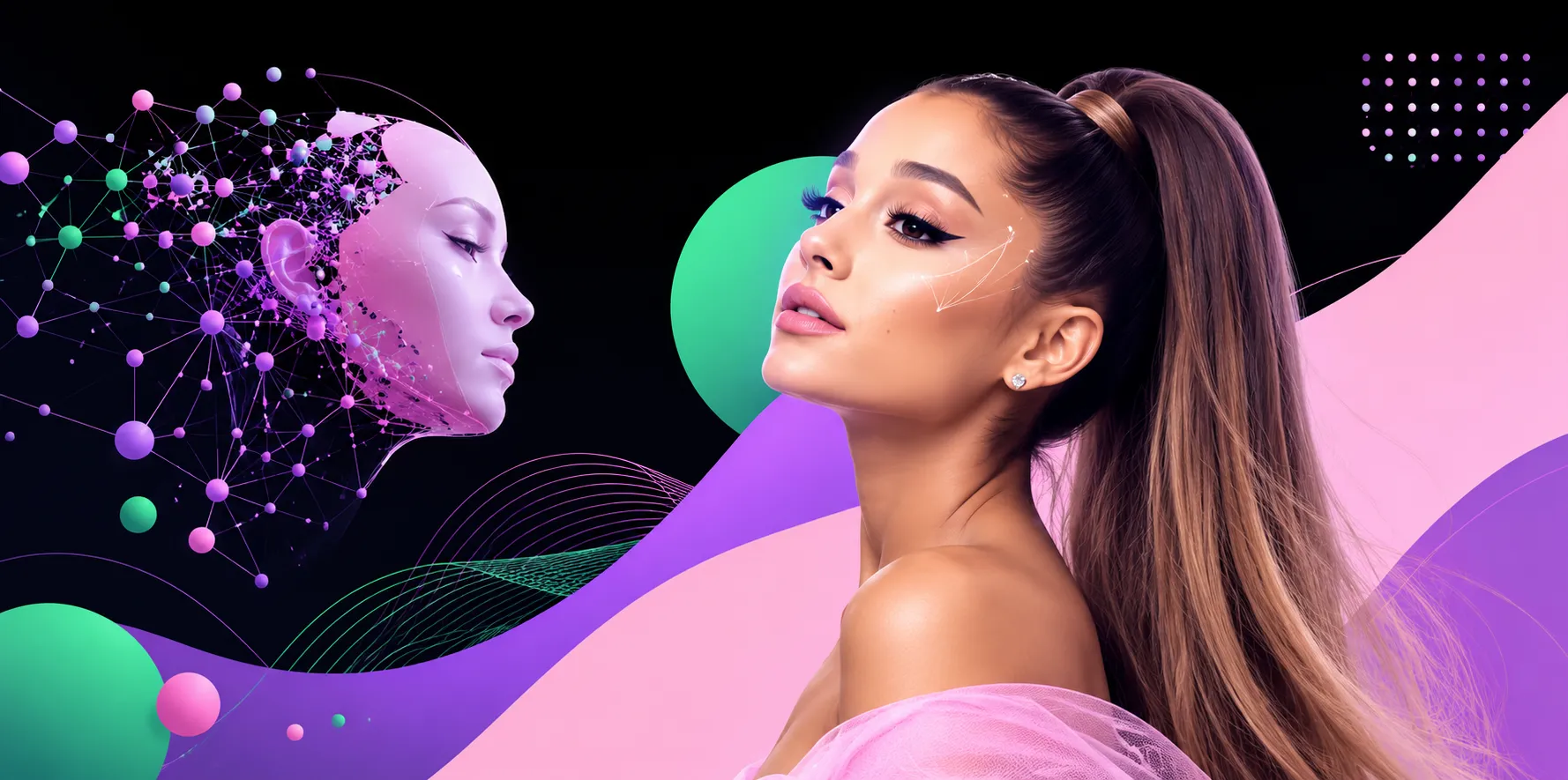
Ariana Grande Artificial Intelligence: How AI Voice Cloning Is Reshaping Her Music and Image
Search Ariana Grande alongside artificial intelligence today and you will not primarily find articles about her albums. You will find AI cover tracks, synthetic duets that never happened, and fan-made clips where her voice sings songs she has never recorded. This is the practical reality of AI voice cloning: a machine-learning process in which a model is trained on recordings of a specific singer until it can convert any new vocal performance into a convincing imitation of that singer's timbre, phrasing, and range. Ariana Grande has become one of the most frequently cloned voices in this ecosystem, which makes her a useful case study for anyone trying to understand where synthetic media law, music production, and brand protection are heading.
Quick Answer: Ariana Grande artificial intelligence refers to AI-generated covers, deepfakes, and voice models that imitate her vocals without her participation. These are created with voice-conversion tools trained on her existing recordings. She has not licensed most of them, and new laws such as Tennessee's ELVIS Act now target this exact practice.
How WebPeak Supports Artists and Labels Facing AI-Generated Content
Managing an artist's identity in an era of synthetic audio is no longer a purely legal task; it is a digital operations task. Fan-made AI covers spread across short-form video before any takedown request is filed, which means the official channels need to rank, load, and convert faster than the clones. Practical work here includes building fast official artist sites, publishing verified release pages that outrank aggregator uploads, and producing consistent visual assets so audiences can tell authentic content from imitation at a glance. Teams such as the specialists at WebPeak approach this through combined AI implementation and consulting, official website design for artist and label properties, and social media and banner design that keeps verified accounts visually distinct from copycat uploads.
Why Ariana Grande's Voice Became a Primary AI Cloning Target
Voice cloning quality depends almost entirely on training data, and Ariana Grande's catalogue is unusually well-suited to it. A voice model is a set of learned parameters that map an input vocal to a target voice's tonal characteristics. To train one well, you need many minutes of clean, isolated singing across a wide pitch range, with consistent recording quality.
Her discography supplies exactly that. She records with a very consistent vocal production style, performs across an exceptionally wide range including whistle register, and has a large volume of acapella stems, live performances, and interview audio circulating publicly. Modern source-separation tools can strip instrumentals from commercial tracks and produce usable isolated vocals in minutes, so the barrier that once protected artists — access to clean stems — has effectively collapsed.
There is also a demand-side factor. Her voice is instantly recognisable, which is precisely what makes a cloned output feel impressive to a casual listener. In practice, the artists most cloned are those whose timbre is distinctive enough that a listener recognises the imitation within two seconds. Generic voices make unremarkable AI demos; signature voices make viral ones.
A second term worth defining is deepfake. In audio contexts, a deepfake is synthetic media that presents a real person as saying or singing something they did not. This includes AI covers, but it also covers more damaging uses: fabricated endorsements, fake interview clips, and scam advertisements using a celebrity voice to sell products.
How AI Voice Cloning of a Singer Actually Works
Understanding the pipeline matters, because each step is a point where rights holders and platforms can intervene. The typical process looks like this:
- Data collection. Someone gathers commercial recordings, live audio, and interview clips of the target artist — usually 10 to 60 minutes of material.
- Source separation. Stem-splitting models remove drums, bass, and instruments, leaving isolated vocals. This step alone is what converted voice cloning from a studio capability into a laptop hobby.
- Dataset cleaning. Reverb, background noise, and overlapping harmonies are removed, and audio is sliced into short segments. Poor cleaning is the single biggest cause of robotic-sounding results.
- Model training. A voice-conversion architecture learns the mapping between generic vocal input and the target's tonal fingerprint. Consumer GPUs can complete this in hours.
- Inference. A human singer records a guide vocal, and the model converts that performance into the target voice. Crucially, the human performance still drives the phrasing, emotion, and timing.
- Post-production. Pitch correction, formant adjustment, doubling, and mixing are applied. This stage is where amateur outputs become convincing enough to fool listeners.
- Distribution. The track is uploaded to video and streaming platforms, often labelled as an AI cover, often not.
The important insight is that step 5 requires a human vocalist. AI covers are not autonomous creations; they are performances laundered through a voice filter. That distinction shapes both the legal argument and the creative one.
Legitimate AI Voice Uses Versus High-Risk Uses
Not all synthetic voice work is equivalent. The table below separates use cases by consent status and practical risk exposure.
| Use Case | Consent Involved | Primary Risk | Typical Outcome |
|---|---|---|---|
| Licensed voice model for a brand campaign | Yes, contracted | Contract scope disputes | Legally distributable with disclosure |
| Artist cloning their own voice for demos or translation | Yes, self-owned | Security of the model file | Standard studio practice |
| Fan-made AI cover uploaded to video platforms | No | Takedown, monetisation loss | Removed on request in many jurisdictions |
| Unlabelled synthetic single on streaming services | No | Publicity rights and fraud claims | Delisting and account penalties |
| Fake endorsement or scam advertisement | No | Consumer deception liability | Highest legal exposure of any category |
What the Law and the Industry Have Actually Established
Several concrete developments define the current landscape, and it is worth separating verified facts from speculation.
In 2023, an AI track titled Heart on My Sleeve, which imitated Drake and The Weeknd, was pulled from major streaming platforms after label complaints — the moment the industry treated voice cloning as an enforcement priority rather than a curiosity. In March 2024, Tennessee enacted the ELVIS Act, which explicitly extends protection to an individual's voice against unauthorised AI simulation. California also passed legislation in 2024 addressing digital replicas in performer contracts, requiring clearer consent terms. At the federal level in the United States, the NO FAKES Act has been introduced to create a national right against unauthorised digital replicas, though introduction is not the same as enactment. In the European Union, the AI Act includes transparency obligations requiring that deepfake content be disclosed as artificially generated.
Platform policy has moved in parallel. YouTube introduced processes allowing individuals to request removal of AI content simulating their voice or likeness, and the Recording Academy clarified that Grammy eligibility requires meaningful human authorship, meaning a fully AI-generated vocal performance does not qualify on its own.
Here is the expert observation that matters more than any headline: enforcement is reactive, and reactive enforcement always loses on speed. A cloned vocal can be produced, uploaded, and reposted thousands of times within a day, while a takedown cycle takes considerably longer. In practice, artists who invest in strong verified channels, rapid official release cadence, and clear audience education suffer materially less reputational confusion than those relying on legal response alone. The defensible position is occupancy of the search and social results, not just the legal high ground.
There is also a legitimate creative side that gets lost in the panic. Voice models trained with consent are already used for vocal doubling, language localisation, and preserving a performer's sound across accessibility formats. Studios exploring this responsibly increasingly pair it with disciplined production workflows, and the same is true in adjacent media — teams handling professional video production now routinely treat synthetic audio disclosure as a standard deliverable rather than an afterthought.
Key Takeaways
- Ariana Grande AI content is overwhelmingly unlicensed fan output produced with voice-conversion models trained on her existing recordings.
- Her vocals are heavily targeted because clean isolated audio is widely available and her timbre is recognisable within seconds.
- AI covers still require a human guide vocal, so they are converted performances rather than autonomous creations.
- Tennessee's ELVIS Act (2024) and the EU AI Act's transparency rules are the clearest legal anchors currently in force.
- Legal takedowns are slower than distribution, so owning verified official channels is the practical defence.
Frequently Asked Questions
Has Ariana Grande approved any AI versions of her voice?
There is no public evidence that she has licensed the fan-made AI covers circulating online. Those models are trained without permission using her commercial recordings. Any officially sanctioned use of a performer's synthetic voice would normally be disclosed contractually and announced, which has not happened here.
Is it illegal to make an AI cover of Ariana Grande?
It depends on jurisdiction and purpose. Publishing an unauthorised voice clone can violate publicity or voice rights in places like Tennessee under the ELVIS Act, and the underlying song still carries copyright. Private experimentation carries far less exposure than public distribution or monetisation.
How can I tell if a song is an AI voice clone?
Listen for unnaturally consistent vibrato, smeared consonants, and breath sounds that do not match the phrasing. Cloned vocals often lose detail in the highest and lowest parts of the range. Checking whether the track exists on the artist's official channels is the fastest reliable test.
Why do AI covers sound so realistic now?
Two advances did it: source-separation tools that produce clean isolated vocals from finished songs, and voice-conversion models that keep a human singer's timing and emotion while replacing only the tonal fingerprint. The human performance underneath is what makes the output feel emotionally believable.
Can artists actually stop AI clones of their voices?
They can force removals through platform likeness policies and new state laws, but they cannot prevent creation. Realistically, the strongest strategy combines rapid takedown requests with dominating official search results and social channels, so audiences reach authentic content first.
Conclusion
The single most important decision facing any artist, label, or brand watching the Ariana Grande AI phenomenon is whether to treat synthetic voice as a legal problem or an operational one. Framed only as a legal problem, you will always be filing complaints after the audience has already heard the fake. Framed operationally, you build the verified channels, release rhythm, and visual consistency that make imitations easy to spot and hard to find. Start by auditing what appears when your name is searched alongside the word AI — that result set, not a courtroom, is where audience trust is currently being decided.
Related articles
 Artificial Intelligence
Why Do We Need AI? The Real Reasons It Matters for Business and Everyday Life
Why do we need AI? Because some problems exceed human scale. Here are the real jobs AI does well, where it reliably fails, and how to adopt it without waste.
 Artificial Intelligence
Artificial Intelligence Dreams: How Machines Generate Dreamlike Worlds
Artificial intelligence dreams are not sleep, they are computation. Learn what AI dreaming really means, how dreamlike imagery is made, and where the limits are.
 Artificial Intelligence
Po Artificial Intelligence: What Poe Is and When Multi-Model AI Platforms Make Sense
Po artificial intelligence usually means Poe by Quora. Here is how multi-model AI platforms work, what they cost you in practice, and when a single provider wins.