
Artificial Intelligence Barbie: How AI Is Rewriting Play, Privacy, and Brand Trust
AI is coming to Barbie through Mattel's OpenAI partnership. Here is what changed since Hello Barbie, what parents should check, and what brands can learn.
Artificial Intelligence Barbie: How AI Is Rewriting Play, Privacy, and Brand Trust
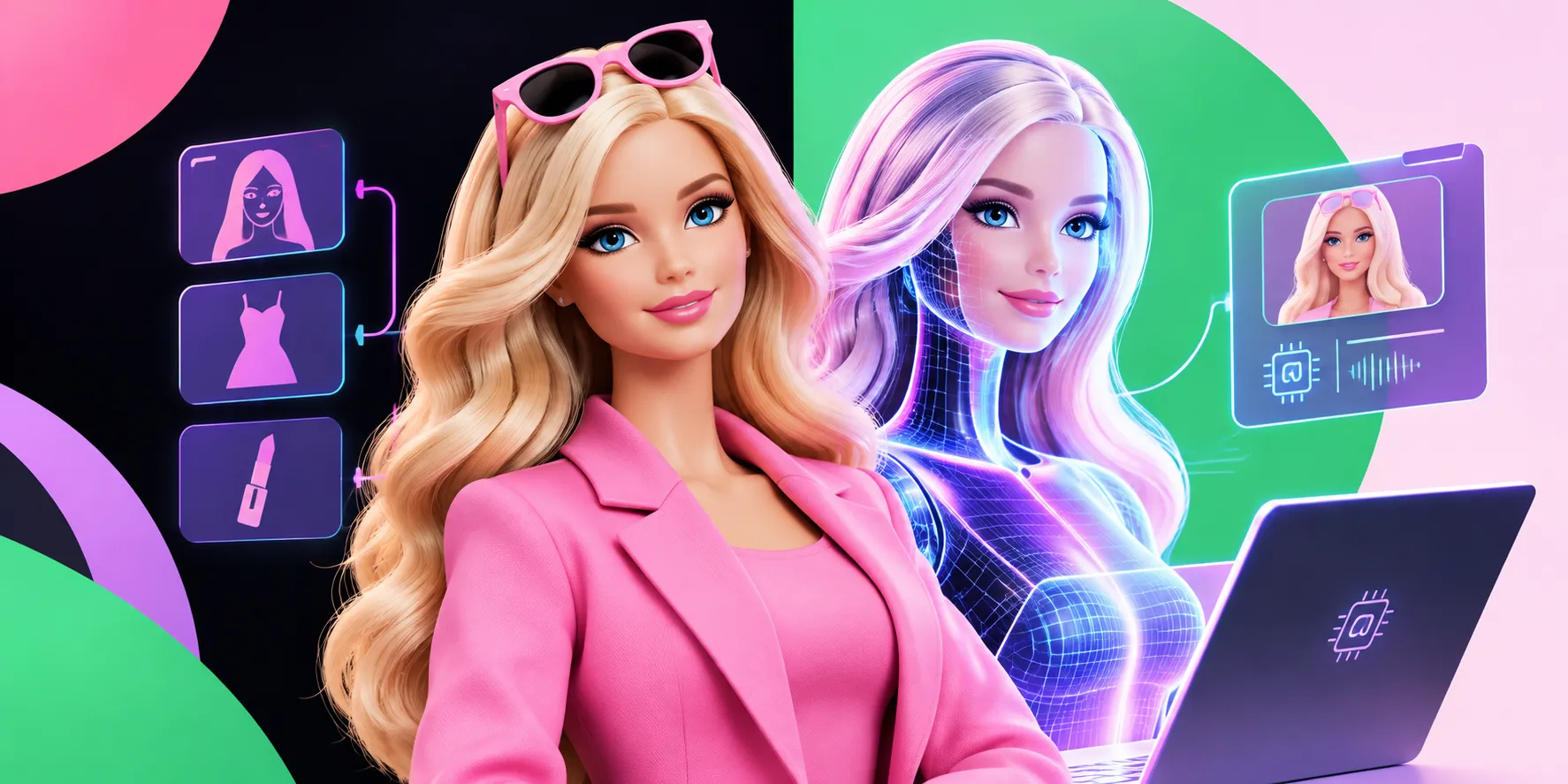
Artificial intelligence Barbie refers to two related but distinct things: connected Barbie products that use conversational AI to talk back to a child, and AI-generated Barbie-style images created by tools like ChatGPT or Midjourney. Both became mainstream conversations in 2025. In June 2025, Mattel announced a collaboration with OpenAI to bring AI to its product and content experiences, describing an approach centred on age-appropriate play and stating that no product would launch immediately. Separately, the AI doll-box trend saw millions of people generate plastic-packaged versions of themselves in a Barbie-like blister pack. Understanding the difference between an AI toy and an AI image matters, because the risks, the regulations, and the brand opportunities are completely different in each case.
Quick Answer: Artificial intelligence Barbie describes AI-powered Barbie products and AI-generated Barbie-style imagery. Mattel confirmed an OpenAI collaboration in June 2025 focused on age-appropriate AI experiences, while the viral AI doll trend produced Barbie-style portraits. Both raise real questions about children's privacy, data retention, likeness rights, and brand safety.
Where WebPeak Fits Into AI-Driven Toy and Character Branding
Brands chasing the AI Barbie moment usually fail on execution rather than idea: the campaign concept is strong, but the landing page loads slowly, the generated visuals are inconsistent across channels, and nobody documented how user-submitted photos are stored. WebPeak's digital team works on exactly that gap, building AI-driven product and campaign experiences that hold up under real traffic and real scrutiny. For a toy or character brand, that typically means three concrete deliverables: an AI implementation plan that defines which model handles image or text generation and what data is retained; a channel-consistent visual system through social post and banner design so the doll-box aesthetic looks identical on Instagram, retail displays, and paid ads; and a conversion-focused website design build that keeps the generator experience fast on mid-range mobile devices, where most children's-brand traffic actually lands.
What Actually Happened With AI and Barbie
The AI Barbie story has a decade-long history, and knowing it prevents repeating old mistakes. In 2015, Mattel launched Hello Barbie, a Wi-Fi-connected doll built with the voice-AI company ToyTalk that recorded a child's speech, sent it to cloud servers, and returned scripted-plus-adaptive replies. It drew immediate opposition from the Campaign for a Commercial-Free Childhood under the Hell No Barbie banner, and security researchers demonstrated weaknesses in the companion app and server configuration. The product was quietly retired, and ToyTalk pivoted away from toys entirely. The lesson was not that children dislike talking toys. Children loved it. The failure was infrastructural: always-on recording, unclear retention periods, and parental consent buried in an app flow.
The 2025 Mattel and OpenAI announcement is a deliberate reset. Public statements from both companies emphasised age-appropriate experiences, privacy and safety as design constraints, and an initial focus on internal product development and employee tooling rather than a rushed consumer launch. Notably, Mattel's messaging positioned the first outputs as products for older audiences and collector-adjacent experiences, not toddler toys. That sequencing is the single most important detail for anyone analysing the deal: the company is testing generative AI where regulatory exposure is lowest first.
The AI doll-box trend is a separate phenomenon with separate legal texture. Users upload a selfie and prompt an image model to render them as a boxed collectible doll. Barbie is a registered trademark and a protected trade dress, which means the packaging shape, the pink palette, and the logo are all owned assets. Individuals posting personal AI dolls are rarely pursued. Businesses using that aesthetic in paid advertising are in a materially riskier position, and several brands quietly pulled campaigns once legal review caught up.
How to Evaluate an AI Toy Before You Buy It
Parents and procurement teams need a repeatable check rather than a gut reaction. Work through these seven questions in order, because the early ones eliminate most problematic products before you reach the harder technical questions.
- Does it record continuously or only on a physical press? Push-to-talk hardware is meaningfully safer than always-listening wake words, because the child controls capture.
- Where is the processing done? On-device speech processing means audio never leaves the toy. Cloud processing means the audio exists on someone else's servers.
- What is the stated retention period? Look for a specific number of days. Vague phrasing about retaining data as long as necessary is a warning sign, not a policy.
- Is parental consent verifiable? Under the US COPPA rule, services aimed at children under 13 must obtain verifiable parental consent before collecting personal information, including voice recordings.
- Can you delete everything in one action? A single delete-all control in the parent dashboard is the practical test of whether the company built for deletion or bolted it on.
- Does the toy keep working offline? A doll that becomes an inert plastic shell when the server retires is a product with a hidden expiry date, which is precisely what happened to earlier connected toys.
- Are firmware updates supported, and for how long? Connected toys without a stated support window become unpatched network devices inside a child's bedroom.
AI Barbie Formats Compared
The term artificial intelligence Barbie collapses several very different products into one phrase. Separating them clarifies where the actual risk sits.
| Format | How AI Is Used | Primary Risk | Who Bears the Risk |
|---|---|---|---|
| Connected talking doll | Cloud speech recognition and dialogue generation | Children's voice data collection and retention | Manufacturer and parent |
| Companion app with AI chat | Text-based conversational model | Unfiltered model responses and account data | Platform operator |
| AI doll-box selfie image | Image generation from a user photo | Trade dress use and biometric photo handling | User, or advertiser if commercialised |
| AI-assisted design and marketing | Concept art, copy variants, packaging mockups | Derivative-output and disclosure questions | Brand and agency |
| AI-driven retail personalisation | Recommendation and search ranking models | Behavioural profiling of family accounts | Retailer |
The Evidence and Expert Read on Where This Goes Next
Three verifiable anchors shape any honest forecast here. First, the regulatory floor is real and specific: COPPA in the United States governs collection of personal data from children under 13, and the UK Age Appropriate Design Code requires services likely to be accessed by children to default to the highest privacy settings. Second, the EU AI Act, which entered into force in 2024 with obligations phasing in through 2026 and 2027, explicitly prohibits AI systems that exploit vulnerabilities of specific groups including children. Third, the precedent of Hello Barbie's withdrawal and the widely reported CloudPets data exposure show that connected-toy failures tend to be data failures, not engineering novelties.
Beyond the documented record, here is the practical pattern observed across consumer AI launches, offered as expert analysis rather than measured statistics. Products that put a visible physical control on data capture — a button, a switch, a light — earn parental trust far faster than products that rely on a policy document to reassure. Trust in this category is granted through hardware affordances, not legal language. Equally, campaigns built on borrowed brand aesthetics like the doll-box trend deliver a short traffic spike and almost no durable brand recall, because the memorable asset belongs to someone else. The teams that convert the AI toy moment into lasting value are the ones building their own recognisable format and treating the AI as the mechanism, not the message. For brands assembling that capability, understanding the wider stack of graphic design and visual production services available is a sensible early step before committing to a generative pipeline.
My read on Mattel's sequencing is that the company learned the correct lesson. Launching AI for collectors and adult fans first, while using generative tools internally for design iteration, lets the organisation build model-governance muscle on low-stakes surfaces before any AI system speaks to a five-year-old. That is the opposite of the 2015 approach, and it is the right order of operations.
Key Takeaways
- Mattel announced an OpenAI collaboration in June 2025 focused on age-appropriate AI experiences, with no immediate consumer product launch.
- Hello Barbie, launched in 2015 with ToyTalk, failed on data governance rather than play value, and its withdrawal remains the defining cautionary case.
- The viral AI doll-box trend is image generation, not a Mattel product, and commercial use of that aesthetic carries trade dress exposure.
- COPPA, the UK Age Appropriate Design Code, and the EU AI Act all constrain how AI toys may collect and process children's data.
- Physical, visible controls over recording build parental trust more effectively than privacy policy wording.
Frequently Asked Questions
Is there an actual AI Barbie doll you can buy right now?
No conversational AI Barbie doll is on general sale. Mattel announced an OpenAI collaboration in June 2025 but stated that no product was launching immediately and that early work would focus on age-appropriate experiences. The earlier Hello Barbie, released in 2015, was discontinued years ago.
What happened to the original Hello Barbie doll?
Hello Barbie launched in 2015 using ToyTalk's voice technology, recording children's speech and processing it in the cloud. Advocacy groups campaigned against it over privacy, and researchers flagged security weaknesses in its app and server setup. It was withdrawn, and ToyTalk exited the toy market.
Is the AI Barbie doll-box image trend legal to use for my business?
Personal social posts are rarely challenged, but commercial use is riskier. Barbie's name, logo, and packaging look are protected trademark and trade dress assets. Using that aesthetic in paid advertising can invite an infringement claim, so build your own distinctive packaging concept instead of borrowing one.
How do I know if an AI toy is safe for my child?
Check whether recording requires a physical button press, whether speech is processed on the device or in the cloud, whether the retention period is stated in days, and whether one control deletes all stored data. Also confirm the toy still functions without an internet connection.
Will AI toys replace traditional dolls?
Unlikely in the near term. Traditional dolls support open-ended imaginative play, where the child supplies the narrative. AI dolls supply the narrative instead, which children often find novel then limiting. The realistic outcome is a small premium AI segment alongside a much larger conventional toy market.
Conclusion
The decision that matters with artificial intelligence Barbie is not whether AI belongs in play, but who holds the recording and for how long. Every other question — model quality, voice realism, conversational range — is downstream of that one governance choice, and it is the question Mattel's 2015 attempt answered badly and its 2025 approach appears to be answering carefully. Your next step depends on your role: if you are a parent, run the seven-question check on any connected toy before it enters the house, starting with whether capture requires a physical press. If you are a brand, stop treating the doll-box trend as a strategy and invest instead in an original generative format you own outright, with documented data handling from day one. In a category built entirely on parental trust, the brands that publish their data practices in plain language will outlast the ones with the most impressive demo.
Related articles
 Artificial Intelligence
Artificial Intelligence All-in-One For Dummies: Is It the Right Way to Learn AI?
An honest review of Artificial Intelligence All-in-One For Dummies: what the Wiley compilation covers, who it suits, how to study it, and where it falls short.
 Artificial Intelligence
Artificial Intelligence Consultant Certification: The Credentials That Actually Win Clients
A practical guide to artificial intelligence consultant certification: which credentials carry weight, what they cost, and how to turn one into paid work.
 Artificial Intelligence
UNESCO Recommendation on the Ethics of Artificial Intelligence: Was It Adopted in 2026? The Real Timeline Explained
The UNESCO Recommendation on the Ethics of AI was adopted in 2021, not 2026. Here is the accurate timeline, what the instrument requires, and how to align your organisation with it.