How AI Automation Is Replacing Manual Work in 2026 — And What It Means for Your Business
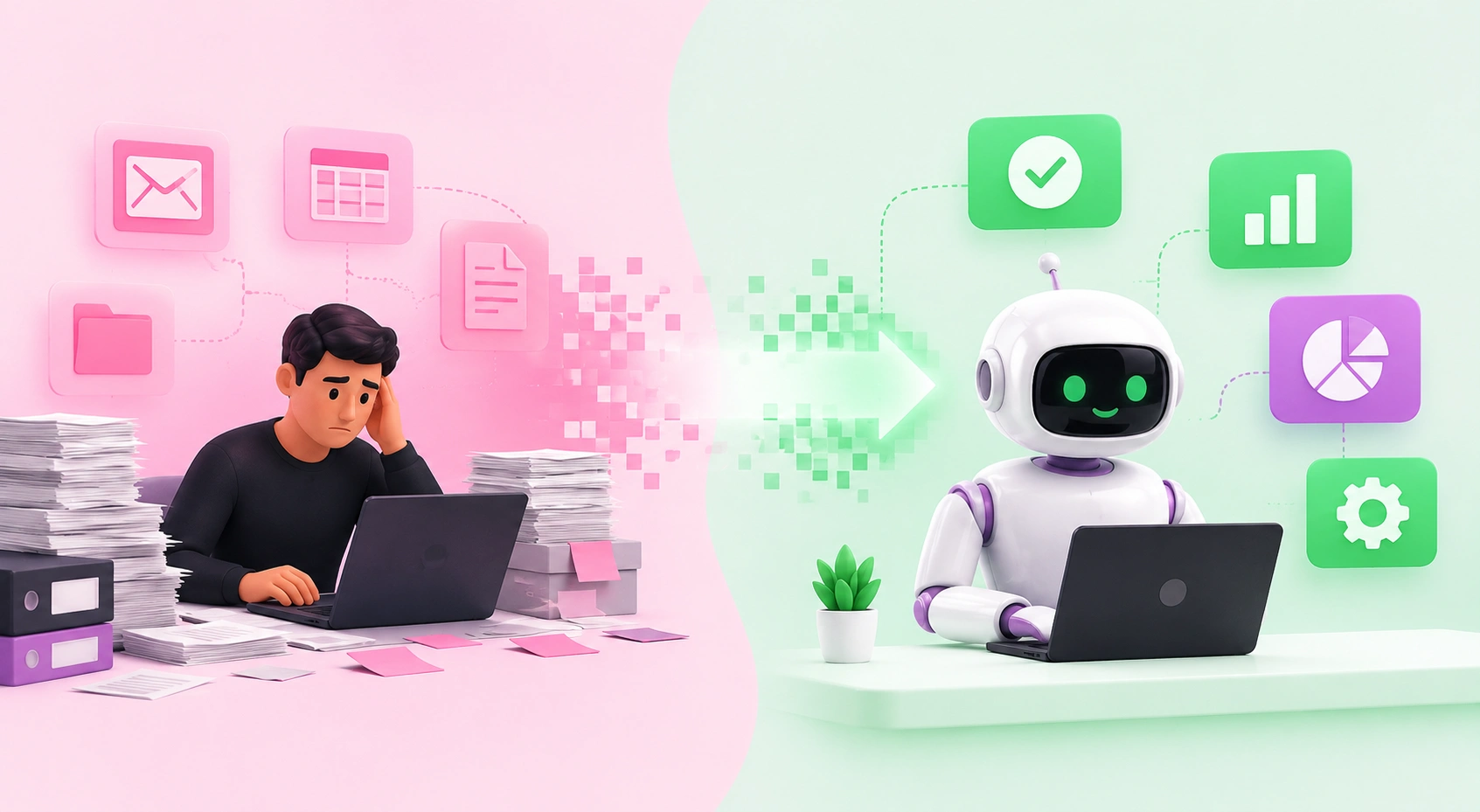
The world of work is changing faster than most businesses expected. In 2026, AI automation is no longer a distant concept debated at technology conferences — it is actively reshaping how companies operate, hire, and grow. From routine data entry to complex customer interactions, intelligent systems are now performing tasks that once required human hands, hours of focused effort, and significant payroll investment.
For business owners, this shift brings both opportunity and uncertainty. The question is no longer whether AI will impact your operations — it already has. The real question is whether your business is positioned to benefit from this transformation or whether you risk being outpaced by competitors who are already moving forward.
This blog post breaks down exactly how AI automation is replacing manual work in 2026, which industries and roles are most affected, and what concrete steps you can take to adapt, compete, and thrive in this rapidly evolving landscape. Whether you run a startup or lead an established enterprise, understanding this shift is no longer optional.
The Rise of AI Automation in 2026
To understand where we are today, it helps to trace how quickly AI technology has matured. Just a few years ago, automation was largely limited to simple, rule-based tasks — think scheduling software, automated email replies, or basic chatbots that could only handle scripted conversations. By 2026, AI systems powered by advanced machine learning, natural language processing, and computer vision are handling work that requires nuanced judgment, contextual awareness, and even creative thinking.
Global investment in AI reached record highs in 2025, and the pace of adoption continues to accelerate across every major economy. Industry research now indicates that more than 40 percent of routine workplace tasks across both white-collar and blue-collar sectors are being performed, at least partially, by automated systems. Businesses that adopted AI early are reporting meaningful reductions in operational costs, faster turnaround times, and significantly improved accuracy across their core workflows.
This is not simply a technology story — it is an economic transformation. AI automation is redrawing the map of competitive advantage, and companies that recognize and respond to this shift are already pulling well ahead of those that have not yet taken meaningful action.
Which Manual Tasks Are Being Replaced?
Understanding the specific categories of work being displaced by AI helps businesses make smarter decisions about where to invest in automation and where to develop human capabilities further. The changes are happening across a far wider range of functions than most business leaders currently realize.
Data Entry and Processing
Manually entering data into spreadsheets, CRM systems, or internal databases has long been one of the most time-consuming and error-prone activities in any organization. AI-powered tools can now extract, classify, and input data from emails, scanned invoices, online forms, and digital documents with near-perfect accuracy — and in a fraction of the time a human employee would require. This capability alone is saving thousands of productive hours per year for mid-to-large businesses operating at scale.
Customer Support and Communication
AI-driven chatbots and virtual assistants in 2026 are vastly more capable than their early counterparts. They handle multi-turn conversations, detect emotional tone, resolve complex customer queries, and escalate to human agents only when genuinely necessary. Many businesses have reduced their customer support workload by 50 to 70 percent through intelligent automation, without any measurable drop in customer satisfaction or resolution quality.
Document Creation and Content Management
From generating first drafts of business reports to organizing, tagging, and archiving digital assets, AI is transforming document workflows at scale. Tools integrated directly into enterprise platforms can auto-generate summaries, translate content into multiple languages, and manage version control — tasks that once required dedicated administrative staff working full-time hours across entire departments.
What AI Automation Means for Your Business
The impact of AI on your specific business depends on your industry, size, and current level of digital readiness. However, several universal realities apply regardless of your starting point, and every business leader needs to understand them clearly.
First, the cost of not automating is rising steadily. Businesses that rely entirely on manual processes are already operating at a cost disadvantage compared to AI-powered competitors. Labor costs are significant, human error is inevitable, and scaling manual operations requires proportional headcount growth — a model that becomes increasingly unsustainable as competitive pressure intensifies.
Second, AI creates new opportunities even as it changes existing roles. The businesses thriving in 2026 are not necessarily those that have cut headcount most aggressively — they are the ones that have redeployed human talent toward higher-value work. Strategic thinking, relationship management, creative problem-solving, and empathetic leadership remain areas where human judgment holds a decisive and lasting advantage.
Third, customer expectations have fundamentally shifted. Consumers now expect faster responses, more personalized experiences, and seamless digital journeys across every touchpoint. AI makes meeting those expectations not just achievable, but scalable and consistent. Businesses that cannot keep pace with those expectations risk losing customers to competitors who can.
If you are exploring how artificial intelligence services can be integrated into your operations, working with an experienced partner who deeply understands your business goals is absolutely essential to getting the outcomes you need.
Industries Being Transformed by AI in 2026
AI automation is not confined to a single sector — it is cutting across virtually every industry and business function simultaneously. Here is a closer look at where the transformation is most pronounced right now.
Healthcare organizations are using AI to automate patient scheduling, medical coding, diagnostic image analysis, and preliminary triage recommendations. This reduces the administrative burden on clinical staff and allows healthcare professionals to focus on direct patient care, where genuine human expertise remains irreplaceable.
Finance and banking institutions have deployed AI systems for real-time fraud detection, loan processing, risk assessment, and regulatory compliance monitoring. Tasks that once required entire teams of analysts working for days are now processed accurately in real time, around the clock, without interruption.
Retail and e-commerce businesses are leveraging AI for dynamic pricing, inventory management, personalized product recommendations, and automated customer service. The result is improved conversion rates, lower overhead costs, and a significantly better shopping experience that keeps customers coming back.
Manufacturing companies are integrating AI-powered robotics and intelligent quality control systems to reduce product defects, minimize equipment downtime, and optimize complex supply chains with a level of speed and precision that was previously unachievable at scale.
Marketing and creative services are also being deeply reshaped. AI tools now assist with content production, campaign personalization, performance analysis, and multivariate testing at speeds and scales no human team could match independently.
How to Adapt Your Business Strategy for an AI-Driven World
Understanding that AI is transforming the landscape is one thing. Taking purposeful, well-structured action is another. Here are the key steps your business should take in 2026 to remain competitive and genuinely future-ready.
Start with a workflow audit. Identify every manual, repetitive process in your organization — payroll processing, report generation, customer follow-ups, data reconciliation, and appointment scheduling among them. These are your primary automation candidates and the areas most likely to deliver immediate, measurable returns on your investment.
Invest in employee upskilling. Resistance to AI often stems from fear of displacement. The most forward-thinking companies are addressing this proactively by training employees to work alongside AI tools rather than in competition with them. Employees who understand how to leverage AI become more productive and significantly more valuable to the organization over time.
Choose the right technology partners. The AI tools market is crowded, and not every solution is built with equal quality or long-term scalability in mind. Look for partners with proven track records, transparent pricing, strong integration capabilities, and genuine commitment to your business outcomes rather than generic platform sales.
Prioritize data quality from the start. AI systems perform only as well as the data they are trained on. Before deploying any automation, ensure your data is clean, well-organized, and governed by clear internal policies. Poor data quality is consistently the most common reason AI implementations underdeliver on their promise.
Measure results and iterate continuously. Implement AI solutions with clearly defined KPIs established from day one. Track time saved, error rate reductions, cost improvements, and customer satisfaction scores. Use these insights to refine your approach and thoughtfully expand automation into additional areas over time.
Partnering with AI Experts to Stay Ahead
Navigating the AI automation landscape independently is a significant challenge for most organizations. The technology evolves rapidly, vendor claims are not always reliable, and the gap between businesses implementing AI strategically and those adopting tools without clear direction is widening with every passing month.
At WebPeak, we help businesses harness the genuine power of AI — not as a marketing talking point, but as a real and sustained driver of efficiency, growth, and long-term competitive strength. Whether you are looking to automate specific workflows, embed intelligent systems into your existing digital infrastructure, or develop a comprehensive AI strategy from the ground up, our team has the expertise and real-world experience to guide you through every stage of the process.
From intelligent chatbots and AI-powered analytics to full process automation and beyond, our approach is built around delivering measurable outcomes for businesses across every size and industry. The future belongs to businesses that move with clarity and intention — and right now, that means moving decisively toward AI.
The Bottom Line
AI automation in 2026 is not a threat to be feared — it is a genuine opportunity to be embraced with the right strategy and the right support in place. The businesses winning in today's market are those that understand what AI can realistically do, make deliberate and well-informed investments in the right tools, and continuously develop the uniquely human capabilities that intelligent systems simply cannot replicate.
Manual work is being replaced, yes — but that replacement is also freeing people to do more meaningful, impactful, and creative work that drives real business value. The challenge for every business leader is to manage that transition thoughtfully and with a clear, long-term vision for where their organization is headed in an AI-first world.
The question is no longer whether your business will be affected by AI automation. It already is. The only question that remains is whether you will proactively shape that impact or simply react to it as it unfolds around you. Start the process today: audit your workflows, explore your options, and get the right expertise firmly in your corner. The competitive advantage you build now will define the trajectory of your business for years to come.