Sheet Metal Manufacturing Yield at Just 85% A Precision Solution Delivers 99.8% Success, Eliminating Assembly Failures.
Introduction
In the realm of industrial automation, engineers employing sheet metal fabrication for custom parts often face a critical dilemma: balancing complex, customized design requirements with stringent targets for cost, timeline, and reliability. The failure of components to fit perfectly on assembly lines or their premature failure in the field are frequently the hidden culprits behind project delays and budget overruns. The root cause typically extends beyond a single processing step, involving disconnects across material properties, design for manufacturability, manufacturing consistency, and supply chain collaboration. The traditional supplier selection model, based on trial-and-error or a narrow focus on price, is ill-equipped to handle the complexity of modern, high-stakes manufacturing.
This article details how a systematic, engineering-driven, and data-informed approach to precision manufacturing solutions can optimize the entire sheet metal fabrication workflow. This methodology delivers extreme accuracy while ensuring project predictability and cost-effectiveness. Mastering the following five strategic pillars is the definitive path to transforming sheet metal fabrication from a potential risk into a core competitive advantage.
Why is Modern Industrial Automation Redefining Standards for Sheet Metal Fabrication?
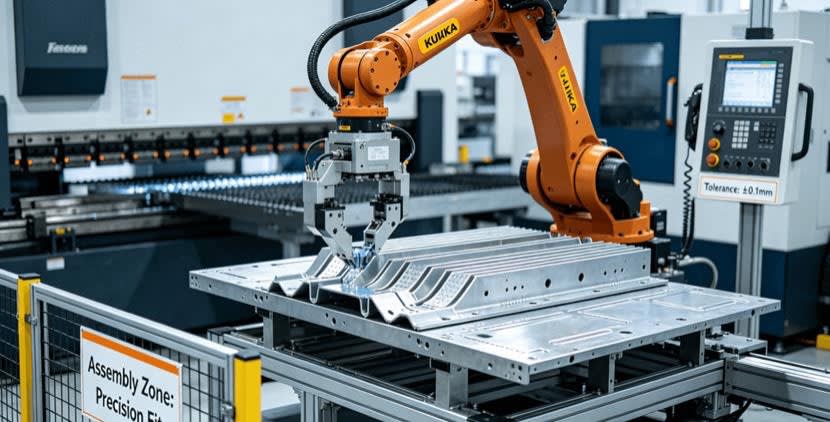
The integration of robotics, precision conveyors, and advanced inspection systems in Industrial Automation Engineering has fundamentally elevated the performance requirements for structural components, moving far beyond the needs of simple enclosures. The reliability of these high-speed, unattended systems depends on part consistency, rigidity, lightweight design, and burr-free assembly interfaces. Consequently, the approach to sheet metal fabrication for custom parts must evolve from a basic forming process into a precision engineering discipline.
Micron-level tolerances (e.g., ±0.1mm), stringent flatness specifications, and predictable batch-to-batch consistency (high Cpk values) are no longer luxuries but necessities. These parameters directly dictate an automation system's cycle time, long-term reliability, and service life. A misaligned bracket can cause robot calibration drift; a panel lacking flatness can disrupt sensor readings; and a part with inconsistent dimensions can halt an entire assembly line. Achieving this level of precision requires a fundamental shift from a conventional "sheet metal shop" mindset to a precision sheet metal fabrication services partnership. Collaboration with a provider that possesses the requisite engineering depth and robust quality systems (such as ISO 9001 and IATF 16949) is critical. In the age of automation, a sheet metal part is a functional component, not merely a cover; its quality is integral to system success.
How Does a Scientific Material Selection Guide Become Your First Cost-Saving Tool?
A common and costly misconception is equating material cost with purchase price. In reality, material selection is one of the most significant levers affecting the total cost of ownership in sheet metal projects. A scientific sheet metal material selection guide evaluates the total lifecycle impact, not just the initial invoice.
Applying this guide involves comparing different sheet metal fabrication materials—such as aluminum 5052-H32 versus stainless steel 304, or various pre-plated steels—across multiple axes: mechanical strength, corrosion resistance, formability, weldability, and post-processing costs. Concrete data, like forming limit diagrams, conductivity ratings, and corrosion resistance classifications, inform the optimal choice. For instance, selecting an overly hard alloy for a deeply drawn housing can lead to cracking, requiring costly rework or design changes, while choosing a material with poor weldability increases labor time and potential distortion.
Poor material choice directly increases manufacturing difficulty, slowing laser cutting speeds, accelerating tool wear, and making welding deformation difficult to control. These issues drive up the hidden costs and delivery risks associated with custom sheet metal fabrication services. Therefore, engaging in a Design for Manufacturability (DFM) analysis at the project's outset with your manufacturing partner is essential to lock in the optimal material-solution pair. For a deep dive into material properties and applications, engineers can consult a detailed resource, such as this blog on precision sheet metal fabrication parts.
What Advanced Forming Technologies Unlock the Potential of Complex Custom Designs?
The trend toward integrated, aerodynamic, and compact product designs pushes the boundaries of what traditional sheet metal forming services can achieve. Challenges like multi-stage flanges, ultra-tight bend radii, and custom embosses demand advanced capabilities. This is where sophisticated custom metal fabrication services differentiate themselves.
Key Enabling Technologies for Complex Geometries
Advanced fabrication relies on synergistic technologies that digitally and physically master complexity. These tools are fundamental for modern custom metal fabrication services.
-
Digital Simulation and Compensation
A core advancement is Finite Element Analysis (FEA)-driven forming simulation. This technology virtually prototypes the forming process, allowing engineers to predict and digitally compensate for issues like material springback before any physical tooling is created, ensuring first-part accuracy. -
Advanced Processing and Machining
Physically, capabilities like 3D laser cutting and multi-axis CNC press brakes execute these optimized designs. 3D cutting handles complex, pre-formed parts, while robotic multi-axis bending achieves intricate, accurate bends in a single setup, enabling stable, high-volume production of sophisticated designs.
From Feasibility to Manufacturing Certainty
The aggregate value of these technologies is a paradigm shift in capability. It transitions the core question from the basic "if a part can be made" to the strategic "how it can be made stably and efficiently in volume." This represents the essential "translation" capability—turning ambitious design intent into reliably producible components through risk-frontloading digital validation.
Beyond the Certificate: How Does a Certified Quality Ecosystem Deliver Real-World Consistency?
A quality certificate on a wall and the daily production of thousands of conforming parts are connected by a comprehensive operational ecosystem. True quality is a process, not an event. For providers of precision sheet metal fabrication services, this ecosystem is the foundational infrastructure that guarantees results.
This system encompasses everything from raw material inspection (using spectrometers for chemical verification) to Statistical Process Control (SPC) for real-time monitoring of critical dimensions during production, and finally to a First Article Inspection Report with comprehensive CMM data. Full traceability—linking a finished part back to the specific coil of steel and production batch—is crucial for root-cause analysis and continuous improvement. Certifications like IATF 16949 or AS9100D are not just market-access badges; they are independent, international validation that this systematic, process-oriented methodology is ingrained in the company's operations. Complementary systems like ISO 14001 for environmental management also indirectly bolster production stability by ensuring controlled and sustainable processes. This holistic, ecosystem approach is the underlying logic that allows a manufacturer to promise and consistently deliver on extreme tolerances. For mission-critical components, the choice must favor manufacturers who have internalized these certification requirements into their daily workflow DNA.
From Vendor to Partner: What Truly Matters When Sourcing Strategic Sheet Metal Fabrication Services?
In an era of persistent supply chain volatility, selecting a source for sheet metal fabrication services must evolve from transactional price shopping to building a value-driven, risk-sharing partnership. The goal is to find a provider of integrated precision manufacturing solutions. Four key dimensions should be evaluated.
The Four Pillars for Strategic Partner Evaluation
Selecting a strategic fabrication partner requires evaluating four key dimensions. This framework moves beyond price comparison to assess long-term value and risk mitigation.
-
Technical Synergy and Integration
True collaboration begins with proactive Design for Manufacturability (DFM) feedback to optimize designs. Partners should also offer comprehensive, vertically integrated capabilities—from cutting and forming to welding and finishing—ensuring single-point accountability and streamlined workflow. -
Operational and Proven Reliability
Operational resilience is critical. Partners must provide supply chain transparency via digital tracking and source materials reliably. Furthermore, documented experience in related high-stakes fields, like Industrial Automation Engineering, demonstrates practical understanding of critical application requirements.
The Partner Paradigm: Beyond Basic Fabrication
A manufacturer like LS Manufacturing, which embodies this synergy of engineering, integrated capabilities, digital transparency, and proven experience, exemplifies a true strategic partner. Such a partner provides end-to-end precision manufacturing solutions, focusing on solving broader business challenges with systematic engineering rather than merely processing orders.
Conclusion
Successfully incorporating sheet metal fabrication into industrial automation projects is no longer a simple machining task. It is a systems engineering challenge spanning scientific material selection, precision forming, systematic quality control, and strategic supply chain management. By adopting the data-driven, engineering-first precision manufacturing solutions outlined above, project teams can effectively navigate complexity. This turns sheet metal from a common source of cost and quality pain points into a solid foundation for product reliability, performance differentiation, and speed to market.
Is your next automation platform or equipment facing challenges with the precision, durability, or cost of structural components? It is time to re-evaluate your manufacturing partnership through a strategic lens. Proactively consult with a specialized provider of precision sheet metal fabrication services to obtain a feasibility analysis and value-engineering proposal tailored to your current design, adding a critical layer of predictability to your project's success.
Author Biography
The author is an industrial consultant specializing in advanced manufacturing and supply chain optimization. With over a decade of experience, the author is dedicated to helping manufacturing clients enhance their competitiveness through technological innovation and process excellence.
FAQs
Q1: For high-strength automation applications, is aluminum or stainless steel a better choice for sheet metal fabrication?
A: The choice depends on the core requirements. Aluminum alloys (like 6061) offer an excellent strength-to-weight ratio and good corrosion resistance, making them ideal for moving components. Stainless steels (like 304 or 316) provide higher absolute strength, rigidity, and superior chemical resistance but are heavier. A comprehensive evaluation based on load, weight constraints, and operating environment is necessary.
Q2: How can post-welding distortion in sheet metal be minimized to ensure assembly accuracy?
A: Professional manufacturers employ multiple strategies: using robust fixtures and jigs, implementing stitch or skip welding techniques to reduce heat input, utilizing pulsed welding processes, and applying post-weld stress relief treatments (like vibration aging). The most effective approach is designing to minimize the need for long, continuous welds from the outset.
Q3: What are the fundamental differences in process and cost structure between low-volume prototyping and mass production for sheet metal parts?
A: Prototyping relies on flexible, tooling-less processes like laser cutting and press brake bending, resulting in low upfront costs but higher per-part labor expense. Mass production can leverage dedicated stamping dies and fixtures, dramatically reducing per-unit cost but requiring a significant initial tooling investment. The two phases demand different strengths from a supplier: agility for prototyping and scalable, consistent throughput for production.
Q4: How important is an IATF 16949 certification when sourcing sheet metal parts for non-automotive industries?
A: Extremely important. This certification represents one of the highest standards for defect prevention, process control, and continuous improvement. It signals that a supplier has a rigorously disciplined quality management system capable of providing a level of quality assurance that far exceeds general industry standards, which is valuable for any high-reliability sector like medical, aerospace, or advanced industrial equipment.
Q5: Besides providing a 3D model, what information helps a sheet metal fabricator provide a more accurate proposal and plan?
A: To receive the most precise proposal, also specify: annual volume forecasts, critical functional dimensions and tolerances, surface finish type and standard (e.g., powder coat thickness, anodize grade), the operational environment (exposure to humidity, chemicals), and any special packaging or labeling requirements. The more comprehensive the information, the more accurate and valuable the proposal will be.